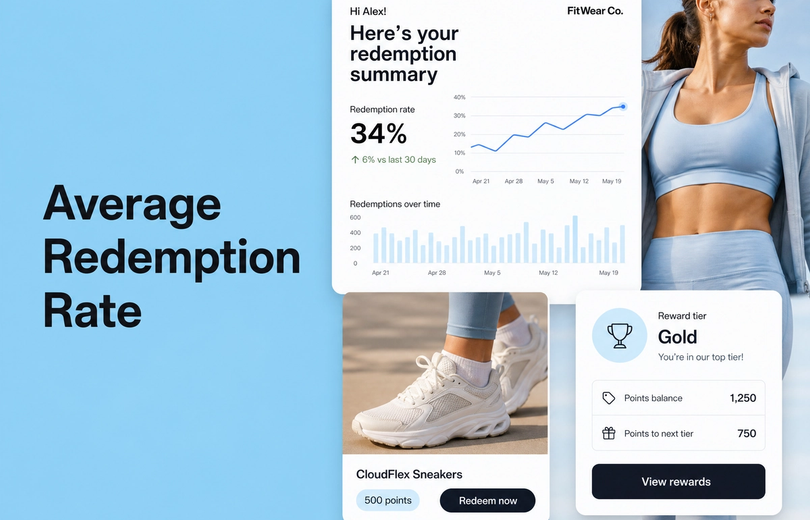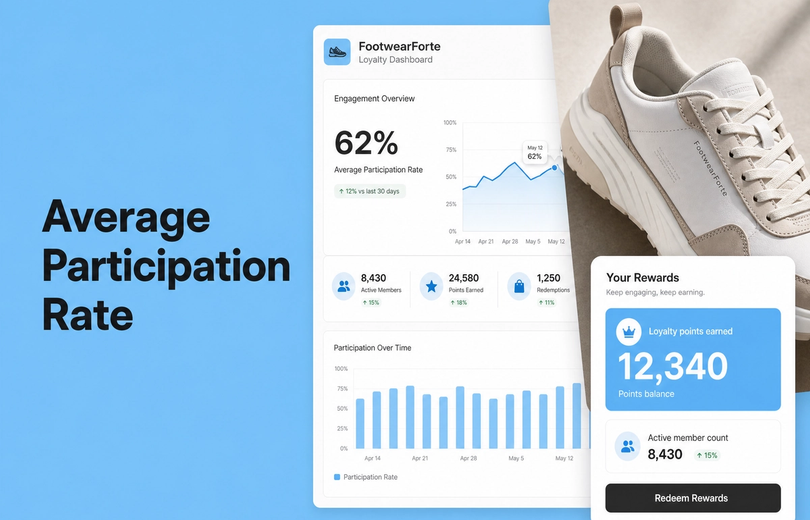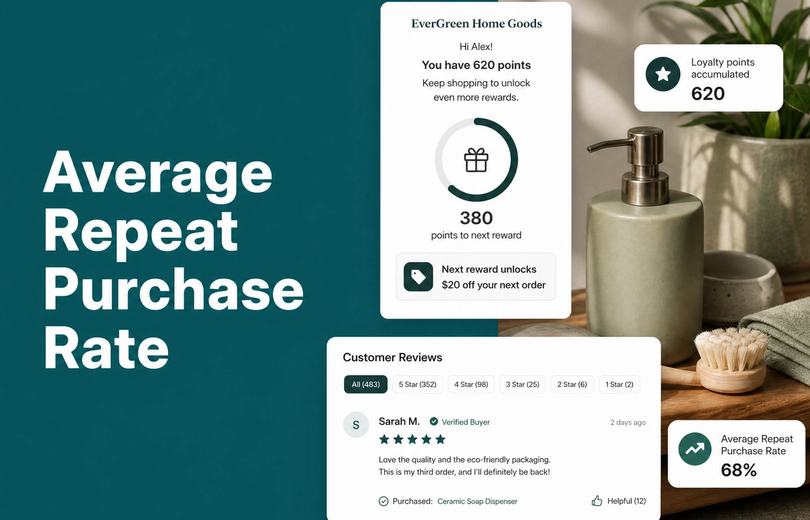
Carlisle Pet Foods achieved a 42% year-to-date repeat customer rate, but that does not supply an average redemption rate for Shopify pet supplies. Repeat purchase rate tracks customers returning. Redemption rate compares points redeemed with points earned during the same selected period.
Short answer: There is no trustworthy universal average redemption rate for Shopify pet-supply stores. Measure points earned versus points redeemed over the same period, then segment results by product type, reorder cycle, subscription status, cohort, and reward type.
Average redemption rate for Shopify pet supplies is not one benchmark
| Metric | What it measures | Do not confuse it with |
|---|---|---|
| Points redemption rate | Points redeemed divided by points earned in one period | Percentage of customers redeeming |
| Redeeming-member rate | Members who redeemed at least once | Points redemption rate |
| Reward usage rate | Claimed rewards used at checkout | Reward claim rate |
| Repeat purchase rate | Customers placing two or more purchases | Loyalty redemption |
Why generic ecommerce averages mislead pet stores
An older ecommerce paper reported a 13% average reward redemption rate. Treat it as dated, broad context, not a target for a Shopify pet store. The paper notes that industry, revenue level, and geography influence results.
Food, litter, treats, and supplements have replenishment cycles. Toys, carriers, and beds may not create a reason to return in the same period. Subscription customers may renew while their points balance barely moves.
A pet loyalty program should reflect those different buying rhythms rather than rely on one storewide benchmark.
Keep redemption and repeat purchase separate
Mage defines Redemption Rate as points redeemed in the selected period divided by points earned in that same period. It is not the percentage of members who redeemed.
Repeat purchase rate is a separate retention measure. What we see across Mage merchants is a typical repeat purchase rate of 20% to 30%, with most brands around 23% to 25% and rare top performers near 40%. Those are repeat purchase observations, not redemption-rate benchmarks.
Calculate redemption rate correctly before changing your program
Use this formula:
Total points redeemed during the selected period ÷ Total points earned during the selected period × 100
The date range must match on both sides. Measuring this month's redemptions against all points ever earned does not show current program behavior.
For example, a hypothetical store earns 100,000 points in April and customers redeem 18,000 points in April. Its April redemption rate is 18%. That may be healthy for a new food-subscription cohort or weak for a mature replenishment cohort. The percentage alone cannot answer the question.
A Shopify loyalty program should be measured by whether redemption supports profitable repeat behavior, not whether it reaches a generic category average.
Outstanding Points Balance is also useful for analysis. It shows approved points sitting in customer accounts. Treat it as a backlog or liability signal to investigate by cohort and category, not as the redemption-rate denominator.
“I looked into so many different integrations for loyalty and referrals for our Shopify Store, but no one impressed me more than Mage on human connection, customer service, and value.”


Read the Reelie case study →
Build a pet-supply baseline by product and purchase cycle
| Segment | Measurement window | Primary comparison metrics |
|---|---|---|
| Food, litter, treats | 30, 60, and 90 days | Redemption, repeat purchase, purchase frequency |
| Supplements | 60, 90, and 180 days | Subscription status, redemption, margin |
| Toys and accessories | 90 and 180 days | Reward usage, AOV, repeat purchase |
| Beds and high-AOV items | 180 days or longer | Contribution margin, referrals, repeat purchase |
| Subscribers | Renewal-based cohort | Renewal retention, milestone activity, redemption |
Consumables and replenishment products
Build cohorts by first-order month and first product category. Compare food, litter, treats, and supplements after 30, 60, 90, and 180 days where the purchase cycle supports it.
Include acquisition source, VIP tier, subscription status, points earned, points redeemed, repeat purchase rate, and contribution margin. A food customer who redeems after a second replenishment order should not be judged against a toy buyer who has no reason to reorder yet.
Accessories and one-time purchases
Toys, apparel, carriers, beds, and accessories often have longer or less predictable purchase cycles. Low redemption may reflect the product rather than a broken program.
For these customers, check reward usage after claim. Free shipping, a fixed amount off, or a free product may fit a basket better than a large percentage discount. Do not let a blended storewide average hide different behavior across consumables and accessories.
Subscriptions and autoship
Report subscribers separately from one-time purchasers. Automatic renewals can produce strong retention even when points redemption stays modest.
Shopify customer accounts can display loyalty information, but Shopify store credit cannot be used for recurring subscription bills. Do not use a store-credit result to judge subscription redemption behavior.
Use renewal cohorts to compare successful payments, milestone rewards, points redeemed against renewals where configured, cancellation behavior, and contribution margin.
Diagnose a low redemption rate in Mage Analytics
| Mage metric or view | Question to ask | Next action |
|---|---|---|
| Total Earned and Total Redeemed | Is earning outpacing redemption? | Segment by category, cohort, and reward type |
| Outstanding Points Balance | Is unused value growing? | Check for dormant balances or delayed purchase cycles |
| Rewards Claimed by Type | Are claimed rewards going unused? | Review checkout friction, thresholds, timing, and reward fit |
| Order Analytics | Do redeemers buy more often? | Compare repeat purchase, frequency, AOV, and margin |
| VIP Tiers analytics | Do tiers show stronger behavior? | Review thresholds and benefits |
| Referrals analytics | Do referral rewards convert? | Analyze the referral funnel separately |
Start with Total Earned, Total Redeemed, and Outstanding Points Balance
Open Mage Analytics and start in the Loyalty tab. The Analytics Explained guide details the available views and definitions.
Review Total Earned and Total Redeemed for the same selected period. Mage calculates Redemption Rate from those values. Then inspect Outstanding Points Balance as a program-wide backlog of approved value that may require cohort analysis.
Find claimed rewards that were never used
Open Rewards Claimed by Type. Mage separates fixed amount, percentage off, free shipping, and free product rewards into Used and Unused.
A large unused share indicates that rewards are being claimed but not redeemed at checkout. Investigate checkout friction, minimum-spend requirements, timing, and reward fit.
Read more on why customers do not redeem their points before lowering thresholds across the board.
Compare redemption with repeat purchase behavior
Use Order Analytics to compare member repeat purchase rate, average purchase frequency, and AOV with redemption activity. A rising redemption rate is only useful if profitable purchase behavior holds or improves.
If you use VIP tiers, check whether higher tiers show stronger revenue, AOV, repeat purchase rate, or purchase frequency. If they do not, review the tier thresholds and benefits before adding discounts.
Keep referrals separate. Referral Analytics measures claim rate, conversion rate, referral revenue, channels, and advocates. Use referral timing to improve the referral funnel, not to explain a points-redemption problem.
Fix the mechanism, not just the percentage
Make the balance visible before the next reorder
Customers need to see their balance and available rewards when they are deciding whether to reorder. Put points balance, reward progress, and redemption options in the account sidebar, loyalty page, Rewards Widget, checkout, and relevant email or SMS messages.
Mage Canvas lets merchants shape these surfaces without custom development. For replenishment customers, show the available value near the next expected purchase cycle, not only in a welcome message.
Lower friction at redemption
Use rewards that fit real baskets: fixed amount off, percentage off, free shipping, free product, or store credit through the configured Mage reward structure.
Flexible redemptions can help when customers want a smaller discount against a replenishment order. Customers choose how many points to exchange instead of waiting until they reach a fixed block.
Mage checkout extensions can show available benefits at checkout, so customers do not need to copy a code.
Match rewards to pet-shopping behavior
Set reward values and minimum purchases around actual food, litter, and supplement baskets. Reward retention actions such as reviews, photo or video reviews, referrals, birthdays, subscription milestones, and receipt submissions where relevant.
Do not lower the redemption threshold first. Test a more visible or relevant reward before increasing discount cost.
Connect loyalty redemption to subscriptions and replenishment
Use milestone rewards for successful renewals
Set a Subscription Milestone earning rule from Loyalty, then Earning Rules, then Add Earning Rule. The subscription milestone setup guide covers the available settings.
Set the customer-facing rule name, award amount, renewal threshold, and approval time. The rule is based on successful payments, and each subscription earns once when it reaches the configured threshold.
This fits food, litter, and supplement programs better than rewarding a customer merely for starting a subscription.
Apply flexible redemption to a subscription renewal
With a supported subscription integration connected, flexible redemption may let signed-in customers exchange points for a custom-value discount on an active subscription renewal. Confirm the supported renewal workflow and settings for the connected integration before enabling it.
Treat this as a discount workflow, not Shopify-native store credit. Shopify’s own documentation says store credit cannot pay recurring subscription bills.
Keep subscription retention separate from points redemption
Subscription retention measures whether customers continue successful payments. Redemption measures whether points are spent. They can move independently.
Compare them together, but do not combine them into one benchmark. The strategic question is whether rewards improve profitable renewal and reorder behavior, as discussed in loyalty programs versus subscription models.
Run a 30-day redemption-rate test for a pet store
| Week | Action | Metrics to record |
|---|---|---|
| Week 1 | Establish a baseline by product group | Redemption, points balance, reward use, repeat purchase, AOV, margin |
| Week 2 | Improve reward visibility | Views, claims, used rewards, redemption |
| Week 3 | Test one catalog adjustment | Reward use, AOV, purchase frequency, margin |
| Week 4 | Compare cohorts and economics | Redemption, repeat purchase, profitable revenue |
Week 1: establish the baseline
Record redemption rate, Outstanding Points Balance, rewards claimed, rewards used, repeat purchase rate, purchase frequency, AOV, and contribution margin by product category. Separate subscribers from one-time purchasers.
Week 2: improve visibility
Expose balances and available rewards in the account sidebar, loyalty page, Rewards Widget, and checkout where appropriate. Keep earning rates and reward values unchanged.
Week 3: test reward fit
Test one change only. Adjust a minimum purchase, feature free shipping for a replenishment cohort, or test flexible redemption where supported. Do not change thresholds, earning rates, reward values, and messaging at once.
Week 4: evaluate economics
Compare the tested cohort with a prior cohort and unaffected product groups. Keep the change only if redemption improves alongside repeat purchase rate, purchase frequency, or profitable revenue.
Frequently asked questions
What is the average redemption rate for Shopify pet supplies?
There is no verified universal benchmark. The older 13% research estimate is broad context only. Build an internal baseline by product group, cohort, and reward type.
How do you calculate loyalty redemption rate?
Divide total points redeemed during a selected period by total points earned during that same period, then multiply by 100. This does not measure the percentage of members who redeemed or rewards used at checkout.
What is a good redemption rate for a pet store?
A good rate supports profitable repeat purchasing for that store's product mix. Review it alongside repeat purchase rate, purchase frequency, AOV, contribution margin, reward usage, and outstanding points.
Should subscription orders count in redemption rate?
Report subscription orders as a separate segment from one-time purchases. Track successful renewals and subscription retention alongside points redemption. Where configured and supported, customers can apply flexible point redemptions to active renewals.
Why is my loyalty redemption rate low?
Common causes include poor reward visibility, thresholds that do not fit basket sizes, unhelpful reward types, long reorder cycles, inactive members, or rewards claimed but left unused. Check Total Earned, Total Redeemed, Outstanding Points Balance, and Rewards Claimed by Type first.
Can a high redemption rate be bad for profit?
Yes. A high rate can hurt profit when rewards are too generous or customers redeem without making another profitable purchase. Review contribution margin, repeat purchase rate, purchase frequency, and AOV alongside redemption.
Ready to see Mage in action? Book a demo.

Graeme is the co-founder at Mage Loyalty. He heads product development, from complex loyalty migrations and large-scale data handling to building the features shaping the future of loyalty on Shopify.