Mage Loyalty, LoyaltyLion and Okendo all help Shopify brands reward repeat customers, but LoyaltyLion vs Okendo is only part of the decision because they take different routes to program ownership and expansion. Mage Loyalty is a Shopify-focused retention layer, LoyaltyLion is a loyalty specialist with an analytics and AI focus, and Okendo combines loyalty with a broader commerce marketing platform. Brands wanting a branded, Shopify-native program that marketing teams can run without giving up developer flexibility will generally find Mage Loyalty the strongest fit.
TL;DR
- Mage Loyalty is a Shopify-focused retention platform, LoyaltyLion is a loyalty-specialist platform, and Okendo places loyalty inside a broader commerce marketing suite.
- Mage Loyalty is built around Shopify-native loyalty, referrals, VIP tiers, account surfaces, wishlists, no-code design and developer tools.
- LoyaltyLion is built around loyalty optimization, analytics, structured programs, Klaviyo workflows and advanced options for larger operations.
- Okendo is built around connecting loyalty with reviews, quizzes, referrals and surveys across one broader customer-marketing platform.
- Mage Loyalty is the stronger fit for most Shopify brands that want branded retention experiences, monthly usage-based pricing and flexible ownership after launch. LoyaltyLion may suit analytics-led, multilingual or multi-location teams, while Okendo may suit brands consolidating several commerce marketing products.
“We are really happy with working with the Mage team and getting this program up and running. They are very responsible and professional. Very seamless and the upsell features seem to already be helping with adoption!”


Read the Tea Drops case study →
Quick snapshot
| Decision factor | Mage Loyalty | LoyaltyLion | Okendo |
|---|---|---|---|
| Positioning | Shopify retention platform | Loyalty specialist | Broader commerce platform |
| Best fit | Shopify-first DTC brands | Analytics-led loyalty teams | Suite consolidation buyers |
| Setup effort | Most programs live quickly | Dedicated onboarding available | Varies by customization |
| Customer-facing surfaces | Canvas, accounts, widgets, wishlist | Branded loyalty page | Multiple loyalty display modules |
| Checkout and POS | Checkout Extensions and Shopify POS | POS and Plus checkout redemption | POS, extensions and Hydrogen |
| Referrals and VIP | Referrals, VIP tiers, engagement tools | Referrals, VIP, dynamic rewards | Referrals, VIP, achievements, memberships |
| Developer access | API, SDK, webhooks, metafields | APIs and integrations | APIs, webhooks, Flow, Hydrogen |
| Analytics | Program and engagement reporting | Predictive loyalty analytics | Loyalty and platform analytics |
| Support model | Founder-led Slack access | Dedicated onboarding support | Onboarding and success support |
| Pricing model | Monthly usage-based plans | Tiered order-volume SaaS | Custom platform pricing |
Updated September 2026.
What is Mage Loyalty?
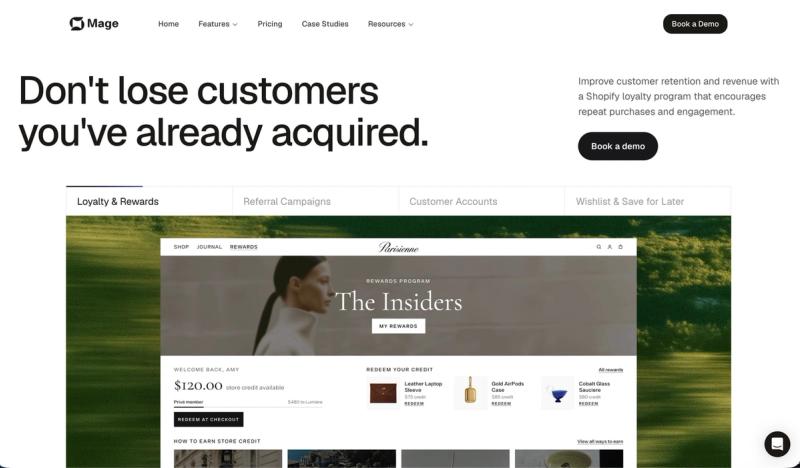
At the time of writing, Mage Loyalty positions itself as a retention and loyalty platform built exclusively for Shopify brands. It covers points, rewards, VIP tiers, referrals, wishlists and customer-facing account experiences, with Shopify Checkout, POS and customer data workflows built into the product direction.
In practice, Mage Loyalty gives a marketing team control over the surfaces customers actually use. Mage Canvas controls the loyalty page, Rewards Widget, referrals, wishlist and account drawer, while developers can use APIs, webhooks, JavaScript tools and metafields when the storefront needs something more bespoke.
Key features and strengths
- Shopify-native foundation: Build a Shopify loyalty program around Shopify Checkout, POS, Flow, app blocks and metafields.
- Mage Canvas: Design loyalty, referral, account and wishlist surfaces without writing code.
- Account experiences: Mage Accounts adds a branded on-site drawer over Shopify customer accounts.
- Flexible rewards: Offer points or store credit, then let customers redeem rewards at checkout.
- Developer tools: REST API, JavaScript SDK and webhooks support custom and headless builds.
- Retention breadth: Add wishlists, Saved for Later, referrals and VIP tiers alongside points.
Best for: Shopify and Shopify Plus DTC brands that want a branded retention system their marketing team can manage, with a developer path available when the program becomes more custom.
What is LoyaltyLion?
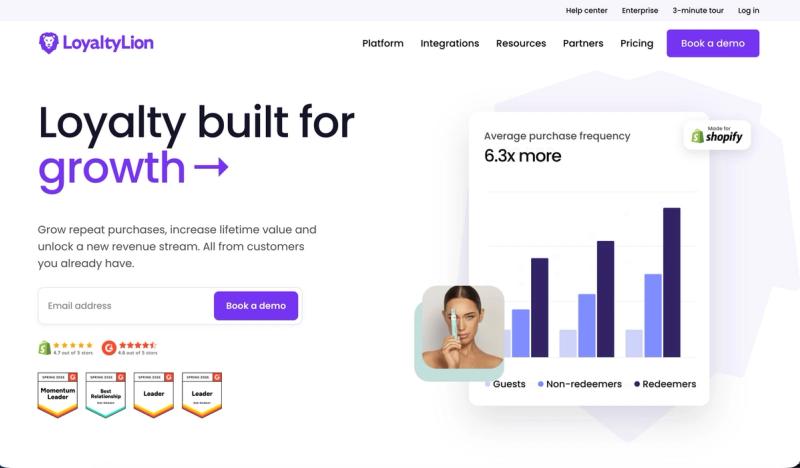
At the time of writing, LoyaltyLion positions itself as a customer loyalty platform for Shopify and other ecommerce platforms focused on repeat purchases, lifetime value and AI-driven loyalty optimization. Its offering centers on structured loyalty programs, reporting and tools designed to improve how brands reward and retain existing customers.
In practice, LoyaltyLion is run as a loyalty-specialist system. Teams configure pre-built earning rules, rewards and tier structures, then use reporting and Klaviyo workflows to improve program performance. Its higher plans add deeper POS, multilingual and AI-led capabilities.
Key features and strengths
- Core loyalty program: Classic includes a branded loyalty page and pre-built earning rules.
- Klaviyo workflows: Ready-to-use email flows connect loyalty activity to customer communications.
- VIP structures: Advanced adds VIP tiers, product-page points and multilingual translations.
- Optimization tools: Plus includes AI-recommended rewards and campaigns, advanced Klaviyo events, automated Flows and quarterly strategic reviews.
- Plan structure: Features and plan placement are organized across Classic, Advanced and Plus.
Best for: brands that prioritize loyalty analytics, AI-led optimization, multilingual support or multi-location Shopify POS workflows.
What is Okendo?
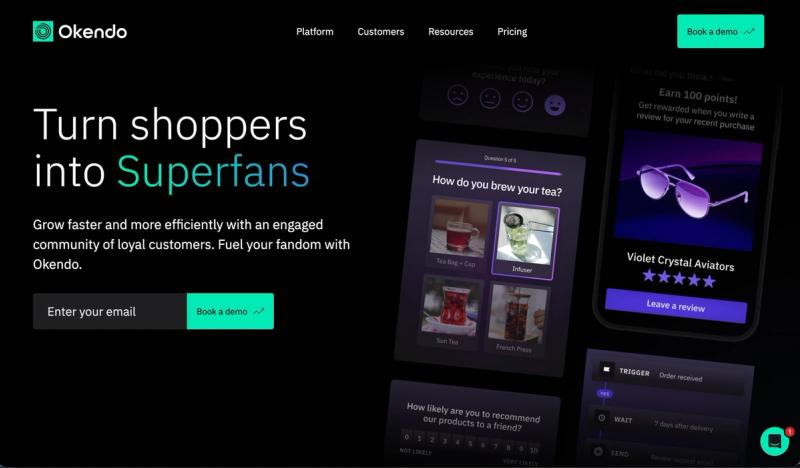
At the time of writing, Okendo positions itself as an enterprise-grade loyalty solution purpose-built for Shopify and one pillar of a unified platform alongside reviews, quizzes, referrals and surveys. Loyalty can be bought as a standalone product or evaluated as part of a broader platform relationship.
In practice, Okendo connects loyalty activity with a wider set of customer inputs and communications. Its loyalty offering includes points, perks, VIP tiers, memberships, achievements, display modules, reporting and integrations, with tools for Shopify POS, Hydrogen and developer-led implementations.
Key features and strengths
- Broader platform model: Loyalty sits alongside reviews, quizzes, referrals and surveys.
- Reward flexibility: Programs can use points, perks and store credit.
- Achievements: Badges and exclusive benefits support gamified engagement.
- Loyalty displays: Okendo provides multiple loyalty display modules.
- Technical flexibility: APIs, webhooks, Shopify Flow, POS and Hydrogen support advanced builds.
- Commercial model: Product and platform options are outlined on Okendo’s pricing page.
Best for: brands that want loyalty connected to reviews, quizzes, referrals and surveys within one broader commerce marketing relationship.
Mage Loyalty vs LoyaltyLion vs Okendo: detailed comparison
Shortlisting decisions are usually made by operating model, ownership after launch, customer-facing surfaces, data flow and cost progression, not a checklist of generic loyalty features. Ask each vendor to demonstrate the same real customer journey, from earning through redemption, reporting and support.
1. Program philosophy and operating model
If you want one team to own loyalty campaigns, referral activity, account surfaces and retention merchandising, ask each vendor to show who configures the program after launch and where those customer experiences live.
Mage Loyalty. Mage is built exclusively for Shopify and positions loyalty as a broader retention layer. Points, referrals, VIP tiers, account surfaces and wishlists can sit within the same customer experience.
LoyaltyLion. LoyaltyLion is a loyalty-specialist platform centered on repeat purchases, customer lifetime value, loyalty reporting and program optimization.
Okendo. Okendo places loyalty inside a broader platform that also includes reviews, quizzes, referrals and surveys. That model can consolidate more customer-marketing activity under one vendor.
Verdict: Mage has the clearest fit for Shopify brands that want loyalty connected to account and wishlist experiences without buying a broader suite. LoyaltyLion suits a narrower loyalty-optimization mandate. Okendo suits a consolidation mandate.
2. Setup and time to launch
If you are replacing an existing program before a seasonal campaign, ask each vendor to demonstrate the setup sequence, data import process, review stages and the work your internal team must complete.
Mage Loyalty. Mage says most merchants have a program live in a day. It also offers concierge-style onboarding, built-in importers for some platforms and CSV import for other migration work.
LoyaltyLion. LoyaltyLion includes dedicated onboarding support on Classic. Confirm how its onboarding changes for a custom program, advanced POS setup or multilingual rollout.
Okendo. Okendo says implementation can be as fast as one day, while more advanced customizations may take roughly two to four weeks. It also offers support for member and points-balance migration.
Verdict: Mage is the strongest option when launch speed depends on a marketing team configuring branded surfaces themselves. For any migration, map balances, tier status, active rules, pending rewards and integrations before selecting a launch date. Use this guide to migrate to a new loyalty app without losing customer points.
3. Customer-facing experience and branding
If you run a fashion brand with seasonal drops, ask each vendor to show a VIP member’s product-page earning view, loyalty landing page, reward redemption flow and logged-in account experience.
Mage Loyalty. Mage Canvas lets marketers build the loyalty page, Rewards Widget, referral campaign, wishlist and account drawer. Mage Accounts can place points, tier progress, saved products and rewards inside an on-site customer drawer.
LoyaltyLion. LoyaltyLion offers a branded loyalty page and product-page points.
Okendo. Okendo provides multiple loyalty display modules for customer-facing loyalty experiences.
Verdict: Mage offers the most clearly connected set of loyalty, account and wishlist surfaces for Shopify brands. Okendo has substantial display breadth. LoyaltyLion remains a focused option for brands prioritizing a branded loyalty page and product-page points.
4. Checkout, POS and omnichannel
If you run three retail stores and staff redeem rewards at the till, ask each vendor to show customer lookup, reward redemption, online balance synchronization and what happens after a refund.
Mage Loyalty. Mage runs inside Shopify POS, where staff can view balances, rewards and history, then redeem for the current transaction. Checkout Extensions can show rewards and points-to-earn in checkout.
LoyaltyLion. LoyaltyLion supports Shopify POS, including multi-location functionality on Advanced. It supports checkout redemption through checkout extensions for Shopify Plus merchants.
Okendo. Okendo supports Shopify POS, checkout extensions and Hydrogen. Confirm the precise checkout and account extension availability for your Shopify plan.
Verdict: All three support meaningful Shopify commerce workflows. Mage is especially strong for brands that want POS, checkout, app blocks and account surfaces from a Shopify-only retention platform. Remember that Shopify extension availability can vary by plan.
5. Referrals, VIP tiers and engagement
If you want to lift repeat purchases without defaulting to broad discounts, ask each vendor to show tier movement, referral attribution, reward timing, campaign reporting and what customers see after qualifying.
Mage Loyalty. Mage supports up to 10 VIP tiers, points multipliers, tier rewards and automated Shopify tagging. Referrals can reward both advocate and friend, while fraud controls can block duplicate accounts, self-referrals and suspicious patterns. Reward strategy also depends on whether you use loyalty points versus store credit.
LoyaltyLion. LoyaltyLion supports VIP tiers and loyalty optimization. Confirm its referral and reward configurations in a demo if those are central to your program.
Okendo. Okendo supports points, perks, store credit, achievements, VIP tiers and memberships. Achievements and badges may matter for brands seeking more gamified customer engagement.
Verdict: Mage gives most Shopify brands a practical balance of VIP, referral and reward flexibility, plus fraud protection and campaign tools. LoyaltyLion is credible for analytics-led loyalty teams, while Okendo offers broader engagement mechanics for brands already investing in its platform.
6. Integrations, data and developer flexibility
If you have a subscription-led wellness business with a custom storefront, ask each vendor to show how loyalty data reaches your email platform, Shopify data model and any custom customer experiences.
Mage Loyalty. Mage supports REST API, JavaScript SDK, webhooks and Shopify metafields. It also connects loyalty data to email, SMS, reviews, subscriptions, support, returns and merchandising tools.
LoyaltyLion. LoyaltyLion supports integrations including Klaviyo, with ready-to-use flows on Classic and advanced Klaviyo events on Plus. Its API capabilities should be reviewed against the custom experience you plan to build.
Okendo. Okendo supports APIs, webhooks, Shopify Flow, email and SMS connections, plus Hydrogen. Its broader platform can be useful when loyalty data must work alongside review, quiz and survey data.
Verdict: Mage is the stronger fit for teams that need both no-code control and a direct route to custom Shopify or headless work. Okendo is compelling where a wider customer-data platform is already central. LoyaltyLion is well suited to programs built around loyalty analytics and Klaviyo activity.
7. Support, onboarding and migration
If you need to change program rules after launch without waiting on a technical backlog, ask each vendor who will help with program design, campaign changes, data migration and escalation when a checkout issue appears.
Mage Loyalty. Mage offers founder-led support with direct Slack access to the engineers building the product. Its onboarding begins with a kickoff call and program design session.
LoyaltyLion. LoyaltyLion offers dedicated onboarding support, while Plus includes quarterly strategic reviews. Confirm the support model that applies at your expected order volume.
Okendo. Okendo offers onboarding, success support and technical support within its platform arrangements. Confirm the migration responsibilities and ongoing strategic support in writing.
Verdict: Mage has a practical advantage for teams that value direct access to the people building the platform. LoyaltyLion and Okendo both provide structured support models, but buyers should compare ownership, response paths and post-launch program guidance rather than judging onboarding alone.
Want to see how Mage handles these workflows on your store? Book a demo.
Pricing compared
See the pricing table below for current plan details. Mage Loyalty uses monthly, usage-based pricing with included orders, published overage on relevant plans and no annual contract. LoyaltyLion uses tiered SaaS pricing based on monthly order volume with Classic, Advanced and Plus plans, while Okendo uses custom order-volume pricing across standalone and broader platform offers. Before signing, budget for a loyalty program by modeling order growth, overage, higher-plan capabilities, paid modules and the cost of changing tools later.
| Plan | Price | Orders included |
|---|---|---|
| Mage Loyalty | ||
| Essential | $15/month | 500 orders included |
| Starter | $49/month | 500 orders included, then $0.20 per order |
| Growth | $499/month | 2,500 orders included, then $0.15 per order |
| Enterprise | Custom, typically from around $999/month | Custom |
| LoyaltyLion | ||
| Classic | $199/month | 500 orders/month included |
| Advanced | Custom | Set by quote |
| Plus | Custom | Set by quote |
| Okendo | ||
| Okendo Platform | From custom pricing | Scales with order volume |
| Okendo Platform Scale | Custom | Unlimited orders |
| Okendo Loyalty (standalone product) | From custom pricing | Scales with order volume |
What each platform costs at 500, 2,500, 5,000, 10,000 orders a month, using the cheapest plan that covers the volume:
| Orders per month | Mage Loyalty | LoyaltyLion | Okendo |
|---|---|---|---|
| 500 | $15 Essential or $49 Starter (list) | $199 Classic (list) | Custom quote |
| 2,500 | $449 Starter or $499 Growth (est.) | Custom quote | Custom quote |
| 5,000 | $874 Growth (est.) | Custom quote | Custom quote |
| 10,000 | $1,624 Growth or Enterprise quote (est.) | Custom quote | Custom quote |
How to read these tables: "list" is the public list price on the vendor's pricing page or Shopify App Store listing, "est." is calculated from the published plan price and overage rate, "Custom quote" means the vendor only prices on request, and "Not published" means no public figure exists at that volume. Prices checked September 2026. Sources: Mage Loyalty pricing; LoyaltyLion pricing, LoyaltyLion on the Shopify App Store; Okendo pricing, Okendo on the Shopify App Store.
- Mage Loyalty at 2,500 orders: Starter is $49 plus $0.20 per order over 500; Growth includes 2,500 orders.
- Mage Loyalty at 5,000 orders: $499 plus $0.15 per order over 2,500.
- Mage Loyalty at 10,000 orders: $499 plus $0.15 per order over 2,500; Enterprise is quoted on volume, typically from around $999.
- LoyaltyLion at 2,500 orders: Advanced and Plus are quote only.
Pros and cons
Mage Loyalty
Pros
- Shopify-native architecture
- Mage Canvas for no-code control
- Branded account and wishlist surfaces
- POS, checkout and Flow support
- API, SDK, webhooks and metafields
- Founder-led support model
Cons
- Built exclusively for Shopify
- Accounts, memberships and cashback have separate packaging considerations
- Reviews and surveys require integrations rather than native products
LoyaltyLion
Pros
- Loyalty-specialist product focus
- Visible Classic entry pricing
- Analytics and AI optimization focus
- Klaviyo and Shopify POS support
- Multilingual support on Advanced
Cons
- Advanced capabilities sit on higher plans
- Some integrations and tools vary by plan
- Multi-platform focus may be unnecessary for Shopify-only teams
Okendo
Pros
- Loyalty connected to reviews, quizzes and surveys
- Points, perks, achievements and memberships
- Broad loyalty display module selection
- POS, Flow, APIs and Hydrogen support
- Platform Scale offers predictable uncapped usage
Cons
- Custom pricing model
- Broader suite may exceed loyalty-only needs
- Some advanced functionality sits within higher platform arrangements
Which should you choose?
Choose Mage Loyalty if
- Your store is fully committed to Shopify and Shopify Plus.
- Marketing needs to launch and update branded loyalty surfaces directly.
- You want loyalty, referrals, VIP tiers, accounts and wishlists to work together.
- Your team needs Shopify POS, checkout and Flow workflows.
- You need no-code tools today and API flexibility later.
LoyaltyLion may suit you if
- Your loyalty team puts predictive analytics and AI-led optimization at the center of its program.
- You operate across locations or markets where multilingual and advanced POS capabilities matter.
Okendo may suit you if
- You want loyalty, reviews, quizzes, referrals and surveys under one broader platform.
- You are evaluating platform-scale commercial arrangements for a high-growth operation.
Final verdict
Mage Loyalty is the recommended choice for most Shopify brands because it combines Shopify-native architecture, branded customer-facing retention surfaces, Mage Canvas and developer flexibility in one focused platform. It gives marketing teams room to manage the program after launch, while still supporting Checkout Extensions, Shopify POS, Shopify Flow, APIs and headless use cases.
LoyaltyLion has a narrower fit for brands that prioritize loyalty-specialist analytics, AI optimization, multilingual support or multi-location POS operations. Okendo has a narrower fit for teams seeking loyalty as part of a larger platform spanning reviews, quizzes, referrals and surveys.
For a Shopify-first team that wants practical program ownership, monthly, usage-based pricing with published overage on relevant plans and direct support, Mage Loyalty is the stronger starting point.
Frequently asked questions
Is Mage Loyalty a good alternative to LoyaltyLion and Okendo?
Mage Loyalty is a good alternative to LoyaltyLion and Okendo for most Shopify brands that want a Shopify-native retention layer with branded loyalty, account, referral and wishlist experiences. LoyaltyLion may fit analytics-led loyalty teams, while Okendo may fit brands consolidating loyalty with reviews, quizzes, referrals and surveys.
Is LoyaltyLion good for Shopify Plus brands?
LoyaltyLion is good for Shopify Plus brands that need loyalty features including checkout redemption through checkout extensions, Shopify POS support and advanced program management. It may be particularly relevant for teams prioritizing loyalty analytics, AI-led recommendations, multilingual support or multi-location retail operations.
Is Okendo better if we already use reviews and surveys?
Okendo may be better if your brand wants loyalty, reviews, quizzes, referrals and surveys managed through one broader platform relationship. Mage Loyalty can connect with review and marketing tools while remaining focused on Shopify retention. The decision depends on whether suite consolidation or a dedicated retention layer is the higher priority.
Which capability should a Shopify brand prioritise first?
A Shopify brand should prioritize the customer behavior it needs to change first, such as repeat purchases, larger orders, referrals, reactivation or in-store retention. Then assess points, VIP tiers, referrals, checkout, POS, account surfaces and integrations against that objective. The team operating the program after launch should be able to run campaigns without constant engineering help.
When does it make sense to switch loyalty platforms?
It makes sense to switch loyalty platforms when your current setup no longer matches your Shopify architecture, customer experience requirements, reporting needs, support expectations or cost model. Review points balances, tier status, referral history, active rules, pending rewards, integrations and the launch calendar before committing to a migration.
What matters more in year two than in year one?
Year two matters more because order-volume economics, campaign iteration, redemption behavior, reporting and ownership become clearer after launch. Review overage, higher-plan features, paid modules, integration depth, data portability and support quality. A program should remain manageable for the people running promotions, not only for the team that launched it.
Ready to see Mage in action? Book a demo.

Kris is the co-founder of Mage Loyalty. I spend most days talking to merchants, and making sure our customers get real results. If you run a Shopify store or Agency we should chat!