Mage Loyalty, Okendo, and Rivo give Shopify brands different ways to run loyalty and retention. All three support repeat-purchase programs, but they differ in how loyalty connects to customer experiences, data, and wider retention work. Mage Loyalty fits brands that want configurable Shopify-native loyalty, Okendo fits broader customer-marketing suite buyers, and Rivo fits teams evaluating a connected retention stack. Mage Loyalty is the strongest fit for most Shopify brands because it combines no-code control, Shopify depth, and developer flexibility.
TL;DR
- Mage Loyalty, Okendo, and Rivo are Shopify-focused retention platforms, but they use different operating models for loyalty, customer data, and customer-facing experiences.
- Mage Loyalty positions itself as a Shopify-only retention platform built around loyalty, referrals, VIP tiers, accounts, wishlist, checkout, and POS.
- Okendo positions loyalty within a broader platform spanning reviews, quizzes, referrals, and surveys.
- Rivo positions itself as a Shopify retention stack built around accounts, loyalty, referrals, memberships, checkout, and POS.
- Mage Loyalty is the stronger fit for most Shopify brands that need configurable loyalty across customer touchpoints. Okendo may suit broader suite buyers, while Rivo may suit teams prioritizing its connected retention stack.
“We are really happy with working with the Mage team and getting this program up and running. They are very responsible and professional. Very seamless and the upsell features seem to already be helping with adoption!”


Read the Tea Drops case study →
Quick snapshot
| Decision factor | Mage Loyalty | Okendo | Rivo |
|---|---|---|---|
| Positioning | Shopify-only retention platform | Broader customer-marketing platform | Shopify retention stack |
| Best fit | Configurable loyalty-led retention | Unified suite buyers | Connected retention products |
| Setup effort | No-code plus technical options | Platform-level configuration | Tier-based configuration |
| Customer-facing surfaces | Loyalty, accounts, wishlist, referrals | Loyalty display modules | Accounts and loyalty experiences |
| Checkout and POS | Checkout extensions and POS | Checkout extensions and POS | Checkout extensions and POS |
| Referrals and VIP | Campaigns, tiers, fraud controls | Tiers, achievements, memberships | Referrals, tiers, memberships |
| Developer access | API, SDK, Metafields, Webhooks | APIs, webhooks, Flow | JS, API, Metafields, Webhooks |
| Analytics | Loyalty, tiers, referrals, wishlist | Loyalty and member analytics | Loyalty and retention analytics |
| Support model | Founder-led Slack access | Confirm commercial scope | Confirm commercial scope |
| Pricing model | Monthly, usage-based | Custom order-volume pricing | Tiered order-volume pricing |
Updated September 2026.
What is Mage Loyalty?
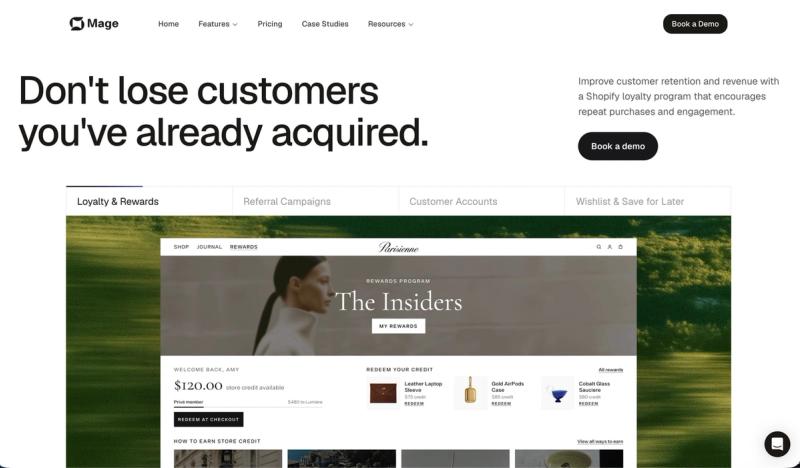
At the time of writing, Mage Loyalty positions itself as a retention and loyalty platform built exclusively for Shopify brands. It is designed for brands that want a Shopify loyalty program to go beyond a points widget into customer accounts, referrals, wishlists, checkout, and in-store purchases.
In practice, Mage gives marketing teams control over customer-facing retention surfaces while giving developers APIs, Metafields, Webhooks, and a JavaScript SDK when a store needs a custom build.
Key features and strengths
- Shopify-only focus: Mage supports Shopify Checkout, POS, Flow, app blocks, and Shopify Plus features.
- Mage Canvas: Marketing teams can build loyalty, account, referral, wishlist, and saved-for-later surfaces without code.
- Points and rewards: Customers can earn through purchases, reviews, birthdays, referrals, and configured actions.
- VIP tiers and referrals: Brands can create tier benefits, two-sided rewards, and fraud-protected referral campaigns.
- Accounts and wishlist: Mage Accounts and wishlist tools place loyalty balances and saved products in one experience.
- Developer toolkit: REST API, JavaScript SDK, Metafields, and Webhooks support headless and custom storefront work.
Best for: Shopify DTC and Shopify Plus brands that want one configurable retention platform, including branded accounts and wishlist experiences. For closer product comparisons, see Mage’s Okendo alternative for Shopify and Rivo alternative for Shopify.
What is Okendo?
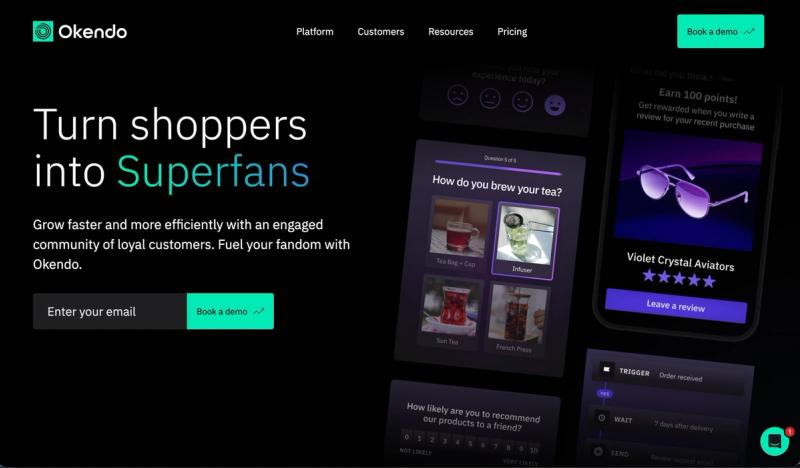
At the time of writing, Okendo positions itself as an enterprise-grade loyalty solution for Shopify and one part of a unified platform that also includes reviews, quizzes, referrals, and surveys. Its loyalty product supports points, perks, store credit, achievements, VIP tiers, paid memberships, and customer-facing display modules.
In practice, Okendo is built for brands that want loyalty data and engagement programs connected to a wider customer-marketing product set, rather than managed as a standalone retention layer.
Key features and strengths
- Broader platform: Okendo connects Loyalty with Reviews, Quizzes, Referrals, and Surveys.
- Loyalty mechanics: Points, perks, store credit, achievements, VIP tiers, and paid memberships are supported.
- Display modules: Okendo provides loyalty display modules for customer-facing loyalty experiences.
- Data and automation: APIs, webhooks, Shopify Flow, POS, Hydrogen, and analytics support advanced loyalty programs.
- Commercial model: Loyalty and broader platform options are listed on Okendo’s pricing page with custom order-volume pricing.
Best for: brands that want loyalty closely connected to a broader customer-marketing suite, especially where reviews, quizzes, referrals, and surveys are part of the same operating model.
What is Rivo?
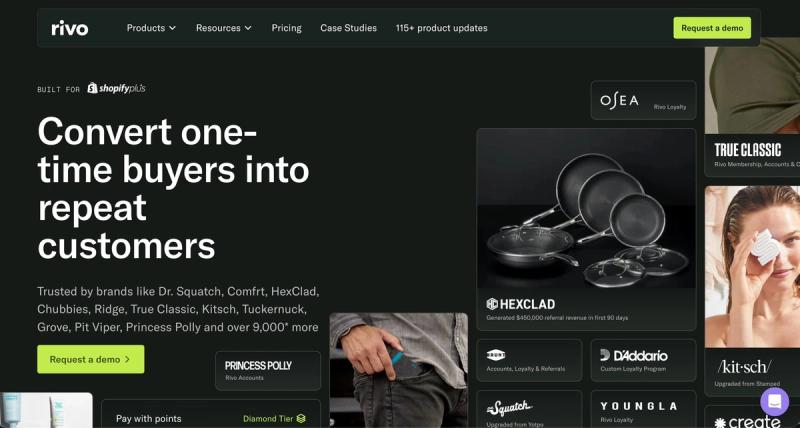
At the time of writing, Rivo positions itself as a Shopify-focused retention platform covering customer accounts, loyalty, referrals, memberships, checkout, and POS. Its offering combines account experiences with loyalty mechanics and developer tools for brands that want a connected retention stack.
In practice, Rivo is suited to teams that want customer account experiences, loyalty, referrals, and membership workflows managed within the same Shopify-focused product family.
Key features and strengths
- Rivo Accounts: Enhanced customer portals support login through Shop, Google, and Apple.
- Loyalty and referrals: Rivo supports points, cashback, VIP tiers, referral pages, and fraud protection.
- Memberships: Rivo includes membership capabilities as part of its retention offering.
- Shopify depth: Checkout extensions, POS integration, and customer account experiences are part of the platform.
- Developer tooling: Rivo JS, REST API, Metafields, and Webhooks support custom implementations.
- Commercial model: Rivo’s tiers are shown through its Shopify App Store listing.
Best for: Shopify brands that want a dedicated retention stack centered on customer accounts, loyalty, referrals, memberships, and developer capabilities.
Mage Loyalty vs Okendo vs Rivo: detailed comparison
Shortlisting gets decided by more than a feature checklist. The useful question is who will run the program after launch, where customers will encounter it, and whether the platform can support new campaigns without repeated rebuilds.
1. Program philosophy and operating model
If you want loyalty to influence checkout, account engagement, referrals, saved products, and retail transactions, ask each vendor to show how these workflows connect in one customer journey.
Mage Loyalty. Mage is a Shopify-only retention and loyalty platform. Its product connects points, store credit, VIP tiers, referrals, customer accounts, wishlist, checkout, POS, and retention campaigns across the same Shopify environment.
Okendo. Okendo places loyalty within a wider commerce marketing platform that includes reviews, quizzes, referrals, and surveys. That model can be useful when one team wants customer feedback, loyalty, and engagement programs closely connected.
Rivo. Rivo presents a dedicated Shopify retention stack spanning accounts, loyalty, referrals, memberships, checkout, and POS. Its model suits brands that want those retention functions connected in one platform.
Verdict: Mage Loyalty is the stronger general-purpose fit for brands that want loyalty to be the operating layer across Shopify customer touchpoints. Okendo has a narrower fit for brands committed to a broader suite model, while Rivo suits teams focused on its connected accounts and retention stack.
2. Setup and time to launch
If you are preparing for a seasonal launch and need a program live without a long technical project, ask each vendor to demonstrate the actual steps for building rules, styling surfaces, testing rewards, and publishing.
Mage Loyalty. Mage says most merchants have a program live in a day. Mage Canvas handles customer-facing design, while the app embed enables storefront features on the live theme.
Okendo. Confirm the loyalty configuration required for your program, including customer-facing modules and any connections to other products in the platform.
Rivo. Request a walkthrough of account setup, loyalty rules, referral configuration, and the checkout or POS implementation required for your store.
Verdict: Mage has the clearest sourced launch claim and offers a no-code builder for merchant-facing work. The practical decision should still rest on a real demo using your earning rules, reward catalog, theme, and customer journey.
3. Customer-facing experience and branding
If your brand has a distinct storefront and customers regularly sign in, save products, or check loyalty progress, ask each vendor to show the account, loyalty, referral, and wishlist experience on mobile.
Mage Loyalty. Mage Canvas lets teams style the loyalty page, Rewards Widget, customer account sidebar, referral campaigns, wishlist, and saved-for-later surfaces. Mage Accounts sits on top of Shopify accounts with an on-site drawer rather than sending customers to an off-site login page.
Okendo. Okendo supports loyalty display modules for customer-facing loyalty experiences. Ask to see how the available modules fit your existing account and storefront design.
Rivo. Rivo Accounts supports customer portal experiences and sign-in through Shop, Google, and Apple. Confirm the available account analytics and branding workflow in a product demo.
Verdict: Mage is particularly strong where marketing owns the layout and needs loyalty, accounts, and wishlist experiences to look and behave as one system. Okendo supports loyalty display modules, while Rivo is relevant for teams evaluating account-led retention experiences.
4. Checkout, POS and omnichannel
If you run three retail stores and staff redeem rewards at the till, ask each vendor to show balance lookup, reward redemption, transaction history, and how online and in-store activity remains connected.
Mage Loyalty. Mage runs inside Shopify POS through a Loyalty tile. Staff can add a customer, view balances and rewards, and redeem against the current transaction. Its Checkout Extensions also support reward visibility and redemption at Shopify checkout.
Okendo. Okendo supports Shopify POS integration, checkout extensions, and Hydrogen. In a demo, ask to see the same customer’s loyalty balance across a storefront order, checkout reward, and POS transaction.
Rivo. Rivo supports Shopify checkout integration, checkout extensions, and POS integration. Ask to see what staff can access when a shopper has an available reward.
Verdict: All three support the Shopify checkout and POS context. Mage is a strong fit when the same team needs points, VIP status, referrals, and account engagement connected to online and retail workflows. Shopify POS supports loyalty app tiles for this purpose, as Shopify explains in its POS loyalty program guidance.
5. Referrals, VIP tiers and engagement
If you sell seasonal collections and want higher-spending customers to receive better access and rewards, ask each vendor to show tier progress, referral attribution, fraud controls, reward timing, and campaign reporting.
Mage Loyalty. Mage supports up to ten VIP tiers, with qualification based on spend, points earned, or orders. Referral rewards can be configured for both advocate and friend, while fraud protection checks self-referrals, duplicate accounts, suspicious devices, and shared IP patterns.
Okendo. Okendo supports points, perks, achievements, VIP tiers, paid memberships, store credit, and custom rewards through APIs and Shopify Flow. Its achievements system is relevant for brands that want badges and gamified progression alongside earning and redemption.
Rivo. Rivo supports loyalty points, cashback, VIP tiers, referral pages, fraud protection, and memberships. Ask to see how referral attribution, reward timing, and membership workflows operate for your program structure.
Verdict: Mage offers a focused loyalty toolkit for brands that need campaign flexibility, referrals, tiering, checkout redemption, and fraud controls without splitting those workflows across products. Okendo has an engagement model that includes perks and achievements, while Rivo is worth examining where memberships are part of the planned program.
6. Integrations, data and developer flexibility
If your retention owner needs to launch campaigns while your developers need custom account or headless experiences, ask each vendor to show the division of work between no-code configuration and technical implementation.
Mage Loyalty. Mage combines Mage Canvas with REST API, JavaScript SDK, Metafields, Webhooks, and Shopify Flow. Loyalty data syncs into Shopify Metafields, and Mage can reward reviews through its Okendo integration without requiring a change to the review workflow.
Okendo. Okendo supports integrations, APIs, webhooks, Shopify Flow, POS, and Hydrogen. Its wider platform can suit teams that want loyalty information linked with review, quiz, referral, and survey activity.
Rivo. Rivo offers Rivo JS, REST API, Metafields, Webhooks, and integrations. Its developer tooling is relevant for brands planning custom loyalty flows or storefront implementations.
Verdict: Mage provides the clearest combination of marketer-controlled surfaces and developer tooling for Shopify-only brands. Okendo is compelling when broader customer-marketing data should be linked, while Rivo offers technical flexibility for teams building within its retention stack.
7. Support, onboarding and migration
If you are replacing an existing program with customer balances, tier status, active referrals, and live campaigns, ask each vendor to show exactly what it imports, who rebuilds rules, and who owns testing before launch.
Mage Loyalty. Mage provides founder-led support with direct Slack access to the engineers building the product. It offers concierge-style onboarding, built-in importers for some platforms, and CSV import for other migration sources.
Okendo. Confirm migration scope, implementation ownership, and the support process for loyalty-specific changes after launch.
Rivo. Confirm the migration process, implementation ownership, and ongoing support model for the selected tier and order volume.
Verdict: Mage’s founder-led support is a practical advantage for brands that want direct access to the product team during setup and optimization. Migration quality depends on the data being moved, so confirm balances, tier status, referral history, program rules, and testing ownership before signing.
Want to see how Mage handles these workflows on your store? Book a demo.
Pricing compared
Mage Loyalty uses monthly plans from $15 with included orders, per-order overage on Starter and Growth, and no annual contracts. Okendo uses custom pricing based on monthly order volume, with loyalty included in a broader platform offering that includes Platform and Platform Scale options. Rivo uses tiered pricing primarily surfaced through the Shopify App Store, based on monthly orders and feature access. See the pricing table below, then budget for a loyalty program by asking what changes as order volume grows, which features sit on higher plans or add-ons, and how overage is calculated.
| Plan | Price | Orders included |
|---|---|---|
| Mage Loyalty | ||
| Essential | $15/month | 500 orders included |
| Starter | $49/month | 500 orders included, then $0.20 per order |
| Growth | $499/month | 2,500 orders included, then $0.15 per order |
| Enterprise | Custom, typically from around $999/month | Custom |
| Okendo | ||
| Okendo Platform | From custom pricing | Scales with order volume |
| Okendo Platform Scale | Custom | Unlimited orders |
| Okendo Loyalty (standalone product) | From custom pricing | Scales with order volume |
| Rivo | ||
| Essential | $15/month | Up to 500 orders/month |
| Scale | From $49/month, scales with orders | Around 500 orders/month, scales by volume |
| Plus | $499/month | Up to 2,500 orders/month |
What each platform costs at 500, 2,500, 5,000, 10,000 orders a month, using the cheapest plan that covers the volume:
| Orders per month | Mage Loyalty | Okendo | Rivo |
|---|---|---|---|
| 500 | $15 Essential or $49 Starter (list) | Custom quote | $15 Essential or $49 Scale (list) |
| 2,500 | $449 Starter or $499 Growth (est.) | Custom quote | $499 Plus (list) |
| 5,000 | $874 Growth (est.) | Custom quote | Custom quote |
| 10,000 | $1,624 Growth or Enterprise quote (est.) | Custom quote | Custom quote |
How to read these tables: "list" is the public list price on the vendor's pricing page or Shopify App Store listing, "est." is calculated from the published plan price and overage rate, "Custom quote" means the vendor only prices on request, and "Not published" means no public figure exists at that volume. Prices checked September 2026. Sources: Mage Loyalty pricing; Okendo pricing, Okendo on the Shopify App Store; Rivo pricing, Rivo on the Shopify App Store.
- Mage Loyalty at 2,500 orders: Starter is $49 plus $0.20 per order over 500; Growth includes 2,500 orders.
- Mage Loyalty at 5,000 orders: $499 plus $0.15 per order over 2,500.
- Mage Loyalty at 10,000 orders: $499 plus $0.15 per order over 2,500; Enterprise is quoted on volume, typically from around $999.
- Rivo at 2,500 orders: Scale brackets above 500 orders are not published.
- Rivo at 5,000 orders: Plus covers up to 2,500 orders.
Pros and cons
Mage Loyalty
Pros
- Shopify-only product architecture
- Mage Canvas for marketer-led customization
- Checkout extensions and Shopify POS support
- Accounts, wishlist, loyalty, and referrals connected
- API, SDK, Metafields, Webhooks, and Flow support
Cons
- Built exclusively for Shopify
- Customer Accounts are packaged as an Enterprise feature or module
- Memberships and cashback are Enterprise features or paid modules
- Advanced programs require thoughtful rule and reward planning
Okendo
Pros
- Loyalty connected to reviews, quizzes, referrals, and surveys
- Points, perks, achievements, VIP tiers, and memberships
- Customer-facing loyalty display modules
- APIs, webhooks, Shopify Flow, POS, and Hydrogen support
Cons
- Custom pricing based on monthly order volume
- Broader suite scope may exceed a loyalty-focused brief
- Platform and Platform Scale commercial options
Rivo
Pros
- Shopify-focused accounts, loyalty, referrals, and memberships
- Checkout and POS integrations
- Cashback, VIP tiers, and fraud protection
- Developer toolkit and integration support
Cons
- Pricing depends on monthly order volume
- Feature access is tied to the selected tier and order volume
- Tier selection requires matching the package to required workflows
Which should you choose?
Choose Mage Loyalty if
- You want one Shopify-native platform for loyalty, referrals, accounts, wishlists, checkout, and POS.
- Your marketing team needs to change customer-facing surfaces without developer tickets.
- You need referral fraud controls alongside VIP tiers and flexible rewards.
- Your retail staff need customer balance and reward access in Shopify POS.
- You need both no-code configuration and APIs, SDKs, Metafields, Webhooks, or Shopify Flow.
Okendo may suit you if
- You want loyalty connected directly to reviews, quizzes, referrals, and surveys.
- Your team prefers a broader unified customer-marketing platform model.
Rivo may suit you if
- You want a Shopify-focused retention stack centered on accounts, loyalty, referrals, and memberships.
- Your roadmap prioritizes Rivo’s account experience and developer toolkit.
Final verdict
Mage Loyalty is the recommendation for most Shopify brands. It is built exclusively for Shopify, supports checkout and POS workflows, and combines Mage Canvas with REST API, JavaScript SDK, Metafields, Webhooks, and Shopify Flow. That mix can reduce operational friction after launch because marketing can run customer-facing campaigns while developers still have tools for custom workflows.
Okendo may suit brands that want loyalty embedded within a broader platform for reviews, quizzes, referrals, and surveys.
Rivo may suit brands that specifically want a connected Shopify retention stack across accounts, loyalty, referrals, memberships, checkout, POS, and developer tooling.
Frequently asked questions
What is the difference between Mage Loyalty, Okendo, and Rivo?
Mage Loyalty, Okendo, and Rivo differ mainly in how they organize retention work for Shopify brands. Mage centers on configurable loyalty across Shopify touchpoints. Okendo connects loyalty with reviews, quizzes, referrals, and surveys. Rivo combines accounts, loyalty, referrals, and memberships in a Shopify-focused retention stack. The best choice depends on operating model, customer experience, and long-term ownership.
Is Okendo good for Shopify Plus brands?
Okendo can be a fit for Shopify Plus brands that want loyalty connected to a broader customer-marketing platform. Its documented loyalty capabilities include checkout extensions, Shopify POS, APIs, webhooks, Shopify Flow, and Hydrogen support. Brands should validate implementation scope, account requirements, and commercial terms against their specific storefront and checkout setup before committing.
When does it make sense to switch loyalty platforms?
It makes sense to switch when the current setup cannot support the customer experience, checkout workflow, POS process, integrations, reporting, fraud controls, or ownership model you need. Before moving, export balances and program rules, confirm migration scope, test rewards and tier logic, and assign a clear owner responsible for the program after launch.
What matters more in year two than in year one?
Year-two loyalty decisions depend on order-volume economics, overage, plan gates, redemption behavior, campaign ownership, reporting quality, and integration reliability. A low entry cost does not answer whether your team can add VIP campaigns, account experiences, POS workflows, or technical integrations without moving to a different package or adding modules.
Who should own the loyalty program after launch?
A loyalty program should have one accountable owner in marketing, ecommerce, or retention. Finance should review reward economics, customer support should understand balances and redemption issues, retail operations should own POS processes, and developers should manage API, Shopify Flow, data, and custom implementation work where needed. Clear ownership prevents campaigns and program rules from becoming neglected.
Is Mage Loyalty a good alternative to Okendo and Rivo?
Mage Loyalty is a good alternative to Okendo and Rivo for Shopify brands that want loyalty, VIP tiers, referrals, checkout, POS, accounts, wishlist, no-code customization, and developer tooling in one retention platform. Okendo may better match broader suite buyers, while Rivo may fit teams prioritizing its accounts, loyalty, referrals, and memberships stack.
Ready to see Mage in action? Book a demo.

Graeme is the co-founder at Mage Loyalty. He heads product development, from complex loyalty migrations and large-scale data handling to building the features shaping the future of loyalty on Shopify.