Mage Loyalty, LoyaltyLion and Stamped help Shopify merchants build repeat-purchase programs, but LoyaltyLion vs Stamped.io represents a different operating-model decision than a simple feature checklist. All three support customer retention through loyalty programs, yet Mage Loyalty is built exclusively for Shopify, LoyaltyLion focuses on loyalty optimization, and Stamped offers Repeat, Loyalty and Reviews products. Mage Loyalty is the strongest fit for most Shopify brands because it connects loyalty mechanics with branded storefront experiences and developer flexibility.
TL;DR
- Mage Loyalty, LoyaltyLion and Stamped support retention, but they differ in how loyalty fits into the wider customer experience.
- Mage Loyalty is a Shopify retention platform built around loyalty, referrals, VIP tiers, accounts, wishlists and checkout experiences.
- LoyaltyLion is loyalty-specialist software built around repeat purchases, program reporting and optimization capabilities.
- Stamped offers connected Repeat, Loyalty and Reviews products for brands evaluating multiple retention functions.
- Mage Loyalty is the stronger fit for most Shopify brands that need branded loyalty experiences, Shopify POS, checkout support and flexible development options. LoyaltyLion may suit teams focused on advanced loyalty optimization, while Stamped may suit teams consolidating loyalty and reviews products.
“We are really happy with working with the Mage team and getting this program up and running. They are very responsible and professional. Very seamless and the upsell features seem to already be helping with adoption!”


Read the Tea Drops case study →
Quick snapshot
| Decision factor | Mage Loyalty | LoyaltyLion | Stamped |
|---|---|---|---|
| Positioning | Shopify retention platform | Loyalty optimization platform | Connected retention products |
| Best fit | Shopify-first retention teams | Loyalty optimization teams | Multi-product retention teams |
| Setup effort | No-code Shopify configuration | Guided loyalty implementation | Product-by-product setup |
| Customer-facing surfaces | Accounts, loyalty, referrals, wishlist | Branded loyalty page | Loyalty widgets and templates |
| Checkout and POS | Checkout extensions and POS | Plus checkout and POS support | Not confirmed |
| Referrals and VIP | Core loyalty program tools | Advanced plan capabilities | Not confirmed |
| Integrations and developer access | API, SDK, Flow, metafields | Klaviyo depth on higher plans | Not confirmed |
| Analytics | Loyalty and retention reporting | Analytics and optimization tools | Basic analytics |
| Support model | Founder-led onboarding | Dedicated onboarding | Not confirmed |
| Pricing model | Usage-based monthly plans | Tiered order-volume plans | Modular subscriptions |
Updated September 2026.
What is Mage Loyalty?
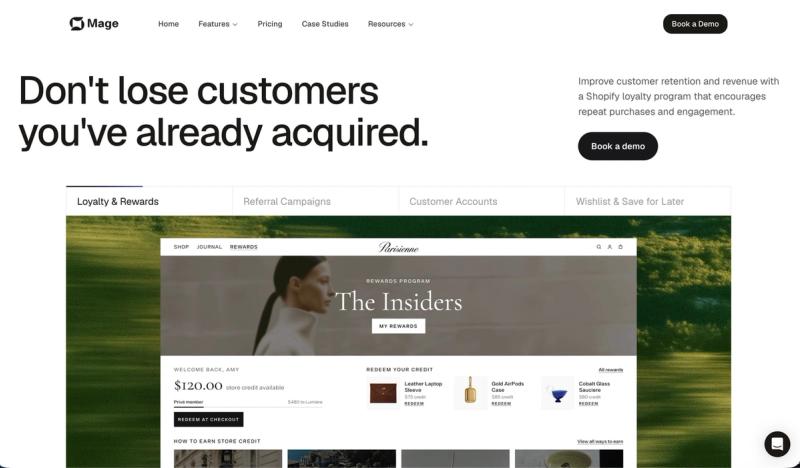
At the time of writing, Mage Loyalty positions itself as a retention and loyalty platform built exclusively for Shopify brands. It gives merchants one place to run points, rewards, referrals, VIP tiers, customer accounts, wishlists and retention campaigns without treating loyalty as an isolated widget.
In practice, Mage Loyalty is designed for ecommerce teams that need to change program rules, customer messaging and on-site layouts without routing routine requests through a developer. Marketing teams can configure customer-facing surfaces, while technical teams can use Shopify-native tools and APIs for custom work.
Key features and strengths
- Shopify focus: Mage supports Shopify 2.0 themes, app blocks, checkout extensions, Shopify Flow, Shopify POS and Multipass SSO.
- Loyalty mechanics: Build a Shopify loyalty program with purchase rules, rewards, points expiry and flexible redemption.
- Mage Canvas: Shape loyalty, account, referral and wishlist surfaces without code.
- VIP tiers: Create up to 10 tiers based on spend, points earned or order count.
- Customer experience: Add a branded account drawer, loyalty page, Rewards Widget, referrals and wishlists around one customer profile.
- Developer tools: REST API, JavaScript SDK, Metafields and Webhooks support custom Shopify builds.
Best for: Shopify brands that want one retention platform for loyalty mechanics and customer-facing experiences, with no-code control for marketers and technical flexibility for custom storefronts.
What is LoyaltyLion?
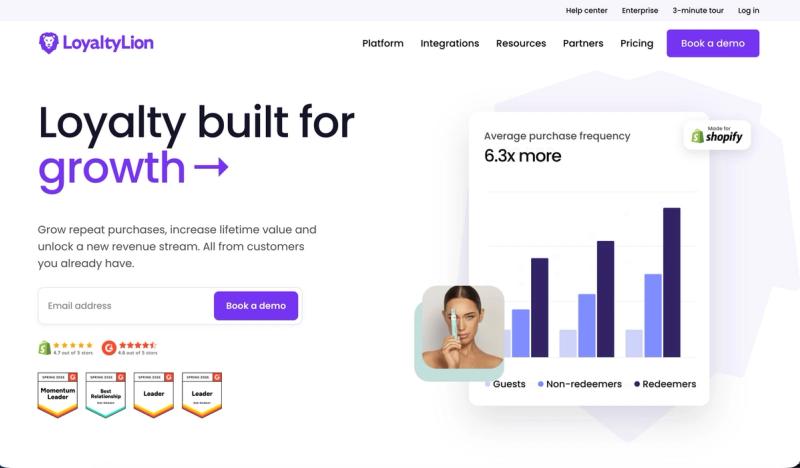
At the time of writing, LoyaltyLion positions itself as a customer loyalty platform focused on repeat purchases, higher lifetime value and loyalty optimization. Its product centers on rewards programs that use earning rules, referrals, tiers and reporting to encourage customers to come back.
In practice, LoyaltyLion is a loyalty-focused operating model with more advanced capabilities available as brands move through its plan structure. Merchants should assess where VIP tiers, enhanced POS, multilingual translations, AI campaigns, advanced Klaviyo events and automated flows sit before committing.
Key features and strengths
- Core loyalty: Classic includes pre-built earning rules for on-site and off-site customer actions.
- Branded program page: Classic includes a loyalty page built for the merchant.
- Klaviyo integration: Classic includes Klaviyo integration and onboarding, as listed on the LoyaltyLion pricing page.
- VIP structure: Advanced plans include VIP tiers and additional loyalty capabilities.
- Optimization tools: Plus adds AI campaigns, AI-recommended rewards, advanced Klaviyo events and automated flows.
- Omnichannel support: Advanced plans include multi-location POS support and translations.
Best for: Brands with a loyalty program team that prioritizes established loyalty analytics, optimization workflows, international requirements or higher-tier omnichannel capabilities.
What is Stamped?
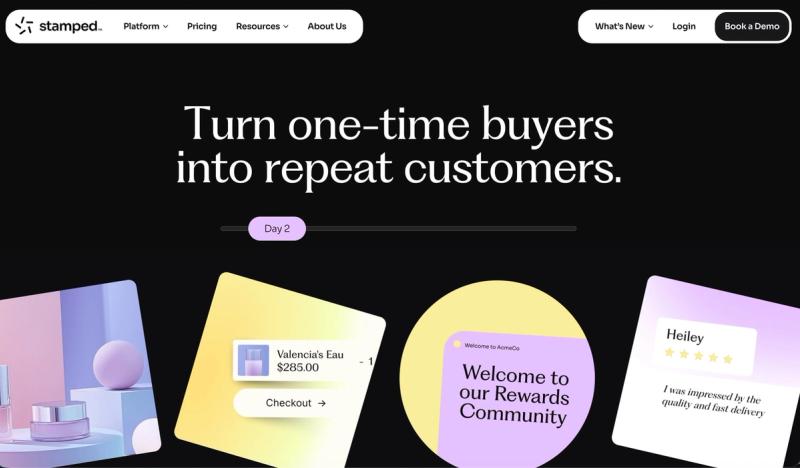
At the time of writing, Stamped positions itself as a connected retention platform for Shopify brands with Repeat, Loyalty and Reviews products. Rather than selling loyalty as the entire system, it offers loyalty alongside other retention products.
In practice, Stamped can reduce vendor sprawl for a team that wants loyalty and reviews under one commercial relationship. Loyalty is one part of a broader product setup, so merchants should assess which products they need now and which they are likely to add as their retention program matures.
Key features and strengths
- Connected products: Stamped offers Repeat, Loyalty and Reviews products in a broader retention suite.
- Loyalty programs: Loyalty includes customizable earning rules, points and rewards.
- On-site experience: Flexible widgets and templates support customer-facing loyalty participation.
- Program customization: Merchants can configure loyalty rules and rewards around their program design.
- Analytics: Stamped provides basic analytics for its loyalty product.
- Modular buying: Merchants can buy individual products or bundles, listed on the Stamped pricing page.
Best for: Shopify brands that want loyalty and reviews from one retention vendor and are comfortable evaluating each product module as part of the buying decision.
Mage Loyalty vs LoyaltyLion vs Stamped: detailed comparison
Shortlisting decisions rarely come down to whether a platform can issue points. They come down to what your team can operate after launch, where the program appears to customers, and how the platform fits the rest of your Shopify stack.
1. Program philosophy and operating model
If you want retention to live inside Shopify rather than beside it, ask each vendor to show how loyalty, customer data and on-site experiences work together during a normal customer journey.
Mage Loyalty. Mage is built exclusively for Shopify and combines loyalty, referrals, VIP tiers, customer accounts and wishlist experiences in one platform. Its model centers on shaping the customer journey across Shopify storefront surfaces.
LoyaltyLion. LoyaltyLion is a loyalty specialist focused on repeat purchases, lifetime value, reporting and optimization. Its higher plans add AI-recommended rewards and campaigns.
Stamped. Stamped offers Repeat, Loyalty and Reviews products. Its model may appeal to teams assessing several retention functions under one vendor.
Verdict: Mage has the clearest Shopify-first operating model for brands that want loyalty connected to accounts, checkout, POS and on-site engagement. LoyaltyLion provides a more specialized loyalty optimization approach. Stamped may fit teams looking to buy across loyalty and reviews categories.
2. Setup and time to launch
If you have a small ecommerce team and need to launch without a lengthy implementation project, ask each vendor to demonstrate how staff create rules, edit rewards and publish customer-facing changes.
Mage Loyalty. Mage Canvas lets marketing teams configure loyalty, referral, account and wishlist surfaces without code. Most merchants have a program live in a day, though migrations take longer when balances and historical records need mapping.
LoyaltyLion. Classic includes dedicated onboarding support and a branded loyalty page. Confirm the practical setup path for Advanced or Plus requirements during a demo.
Stamped. Stamped’s supported loyalty capabilities include configurable earning rules, rewards, widgets and templates. Ask how its Loyalty product is configured alongside any other Stamped products you are considering.
Verdict: Mage is the practical choice when speed depends on marketers owning program presentation and routine changes. LoyaltyLion has structured onboarding, while Stamped buyers should assess the implementation scope of the specific products they plan to adopt.
3. Customer-facing experience and branding
If you want loyalty participation to feel like part of the storefront instead of a separate destination, ask each vendor to show the account area, loyalty page, widget, referral flow and mobile experience.
Mage Loyalty. Mage Canvas controls the dedicated loyalty page, Rewards Widget, customer account sidebar, referral campaigns, wishlist and saved-for-later surfaces. Mage Accounts replace Shopify’s off-site login experience with a branded on-site drawer that sits on top of Shopify accounts.
LoyaltyLion. LoyaltyLion Classic includes a branded loyalty page. Confirm how its other loyalty surfaces and design controls fit your theme and customer account setup.
Stamped. Stamped Loyalty includes customer-facing widgets and templates. Confirm the exact loyalty journey and account-area workflow you intend to publish.
Verdict: Mage has the strongest documented range of branded customer-facing surfaces for teams that want loyalty, saved products and account activity in one place. LoyaltyLion and Stamped should be assessed against the precise journey you want customers to use.
4. Checkout, POS and omnichannel
If you run retail stores and staff need to identify customers and redeem rewards at the till, ask each vendor to show points lookup, reward redemption and online-to-store balance behavior inside Shopify POS.
Mage Loyalty. Mage runs in Shopify POS, where staff can view a customer’s balance, rewards and history, then apply a reward to the transaction. Mage also provides Shopify Checkout Extensions, including redemption experiences for logged-in customers.
LoyaltyLion. LoyaltyLion supports checkout redemption for Shopify Plus merchants through checkout extensions. Its Advanced plans include multi-location Shopify POS support, as listed on its pricing page.
Stamped. Stamped supports Shopify, but its official pricing information does not confirm a POS or checkout-redemption workflow. Request a live demonstration of those requirements.
Verdict: Mage has clear Shopify POS and checkout support for brands running online and in-store loyalty from the same customer balance. LoyaltyLion has documented higher-tier POS and Shopify Plus checkout capabilities. Stamped requires direct confirmation for this workflow.
5. Referrals, VIP tiers and engagement
If you need referrals that protect against abuse and tiers that reflect real customer value, ask each vendor to show the full reward lifecycle, including qualification, fraud checks, tier movement and reward timing.
Mage Loyalty. Mage supports Basic Referrals on Starter and above, with Referral Campaigns on Growth and above. It can block self-referrals, duplicate accounts and suspicious patterns before rewards are issued. Its VIP tiers support spend, points or order thresholds, with up to 10 tiers.
LoyaltyLion. LoyaltyLion supports referrals, earning rules and VIP tiers. Its pricing structure places VIP capabilities above Classic, so assess the applicable plan and tier configuration before committing.
Stamped. Stamped supports customizable earning rules, rewards, widgets and templates. Referral and tier functionality should be confirmed in a demonstration for your intended program.
Verdict: Mage is well suited to brands that need referral fraud controls, flexible tier criteria and a program their marketing team can adjust. LoyaltyLion supports mature tier programs at higher plan levels. Stamped requires validation for more complex referral and tier requirements. Learn how to prevent loyalty program fraud before setting referral rewards.
6. Integrations, data and developer flexibility
If your retention data needs to reach your marketing stack and a custom storefront, ask each vendor to show profile properties, event flows, API access and the exact implementation model.
Mage Loyalty. Mage syncs points, tiers and referrals into connected tools. Its Klaviyo loyalty integration supports profile properties and events, while REST API, JavaScript SDK, Metafields, Webhooks and Shopify Flow support custom work.
LoyaltyLion. LoyaltyLion includes Klaviyo integration on Classic, while Plus adds advanced Klaviyo events and automated flows. Confirm developer access and additional integrations against your required plan.
Stamped. Stamped’s official pricing information supports a modular product model. Confirm the data-sharing and developer requirements for the Stamped products you plan to use.
Verdict: Mage offers the most clearly documented toolkit for brands that need both marketer-friendly configuration and custom Shopify development. LoyaltyLion has documented Klaviyo depth at higher plans. Stamped should be assessed according to the connected products in scope.
7. Support, onboarding and migration
If you are replacing a live program, ask each vendor to show who owns migration, how they map balances and tiers, and how they preserve customer communications during launch.
Mage Loyalty. Mage provides founder-led support, concierge-style onboarding and white-glove migration. It supports built-in importers for some platforms plus CSV import, with migration planning covering balances, tier status, referral history, rules and pending rewards.
LoyaltyLion. LoyaltyLion Classic includes dedicated onboarding support, while Plus includes quarterly reviews. Confirm migration scope and ownership for your program.
Stamped. Confirm onboarding and migration ownership for the Stamped Loyalty product and any additional products in your implementation.
Verdict: Mage’s founder-led model is a meaningful advantage for teams that want direct access to the people building the product during setup. LoyaltyLion offers structured onboarding and higher-tier strategic support. Stamped buyers should clarify support ownership across the product combination they purchase.
Want to see how Mage handles these workflows on your store? Book a demo.
Pricing compared
See the pricing table below, then model what happens after launch. Mage Loyalty uses monthly plans with included orders, per-order overage on Starter and Growth, and no annual contract. LoyaltyLion uses tiered SaaS pricing based on monthly order volume with Classic, Advanced and Plus plans, while Stamped uses modular pricing for Repeat, Loyalty and Reviews, with per-product subscriptions and bundles based on monthly order volume.
The year-two questions matter more than the entry point: what changes as order volume grows, which capabilities sit on higher plans or add-ons, and how overage works. Use this framework to budget for a loyalty program.
| Plan | Price | Orders included |
|---|---|---|
| Mage Loyalty | ||
| Essential | $15/month | 500 orders included |
| Starter | $49/month | 500 orders included, then $0.20 per order |
| Growth | $499/month | 2,500 orders included, then $0.15 per order |
| Enterprise | Custom, typically from around $999/month | Custom |
| LoyaltyLion | ||
| Classic | $199/month | 500 orders/month included |
| Advanced | Custom | Set by quote |
| Plus | Custom | Set by quote |
| Stamped | ||
| Loyalty (standalone) | From $299/month | Scales with order volume |
| Reviews (standalone) | From $199/month | Scales with order volume |
| Lifecycle (standalone) | From $499/month | Scales with order volume |
| Bundles / Multi-product | From $798/month | Scales with order volume |
What each platform costs at 500, 2,500, 5,000, 10,000 orders a month, using the cheapest plan that covers the volume:
| Orders per month | Mage Loyalty | LoyaltyLion | Stamped |
|---|---|---|---|
| 500 | $15 Essential or $49 Starter (list) | $199 Classic (list) | From $299 Loyalty (list) |
| 2,500 | $449 Starter or $499 Growth (est.) | Custom quote | Not published |
| 5,000 | $874 Growth (est.) | Custom quote | Not published |
| 10,000 | $1,624 Growth or Enterprise quote (est.) | Custom quote | Not published |
How to read these tables: "list" is the public list price on the vendor's pricing page or Shopify App Store listing, "est." is calculated from the published plan price and overage rate, "Custom quote" means the vendor only prices on request, and "Not published" means no public figure exists at that volume. Prices checked September 2026. Sources: Mage Loyalty pricing; LoyaltyLion pricing, LoyaltyLion on the Shopify App Store; Stamped pricing.
- Mage Loyalty at 2,500 orders: Starter is $49 plus $0.20 per order over 500; Growth includes 2,500 orders.
- Mage Loyalty at 5,000 orders: $499 plus $0.15 per order over 2,500.
- Mage Loyalty at 10,000 orders: $499 plus $0.15 per order over 2,500; Enterprise is quoted on volume, typically from around $999.
- LoyaltyLion at 2,500 orders: Advanced and Plus are quote only.
- Stamped at 500 orders: Slider price; exact figure per volume not shown.
Pros and cons
Mage Loyalty
Pros
- Shopify-exclusive product focus
- Branded accounts, loyalty and wishlist surfaces
- POS and checkout extension support
- No-code Mage Canvas controls
- API, SDK, Metafields and Webhooks
Cons
- Built only for Shopify
- Customer Accounts are Enterprise packaged
- Memberships are Enterprise or paid modules
- Cashback is an Enterprise feature or module
LoyaltyLion
Pros
- Loyalty-specialist product focus
- Branded loyalty page
- Klaviyo integration on Classic
- AI campaigns and automated flows on Plus
- Multi-location POS support on Advanced
Cons
- Plan capabilities vary by tier
- Advanced and Plus use custom pricing
- Key capabilities sit above Classic
Stamped
Pros
- Repeat, Loyalty and Reviews products
- Configurable loyalty earning rules
- Flexible loyalty widgets and templates
- Modular product purchasing
Cons
- Multiple products can add operating complexity
- Bundle costs can rise with product scope
- Loyalty is one product within a broader suite
Which should you choose?
Choose Mage Loyalty if
- You want loyalty built around Shopify storefront, checkout and POS workflows.
- Your marketing team needs to update customer-facing surfaces without developers.
- You want loyalty, referrals, VIP tiers, accounts and wishlists connected.
- You need referral controls and configurable reward timing.
- Your developers need APIs, webhooks, Shopify Flow and metafields.
LoyaltyLion may suit you if
- Your program team prioritizes loyalty reporting, optimization and AI capabilities.
- You need multilingual support or multi-location POS capabilities on higher plans.
Stamped may suit you if
- You want loyalty and reviews from one connected vendor.
- You prefer modular access to retention products as needs change.
Final verdict
Mage Loyalty is the recommended option for most Shopify brands because it is built exclusively for Shopify and connects loyalty to the storefront experiences customers actually use. Mage Canvas gives marketing teams control over branded loyalty, referral, account and wishlist surfaces, while Shopify Checkout Extensions, Shopify POS and developer tools provide operational depth.
LoyaltyLion may suit brands that place loyalty optimization, AI capabilities, multilingual support or higher-tier omnichannel requirements at the center of their evaluation.
Stamped may suit teams that want Repeat, Loyalty and Reviews products operating under one connected retention vendor.
Frequently asked questions
Is Mage Loyalty a good alternative to LoyaltyLion and Stamped?
Mage Loyalty is a good alternative to LoyaltyLion and Stamped for Shopify brands that want Shopify-native loyalty, branded account and loyalty surfaces, referrals, VIP tiers and developer flexibility. The right choice depends on your operating model, customer experience requirements and retention scope. Compare the platforms alongside the LoyaltyLion alternative before making a migration decision.
Is LoyaltyLion good for Shopify Plus brands?
LoyaltyLion can suit Shopify Plus brands that need checkout redemption through checkout extensions and higher-tier loyalty capabilities. Its Advanced plans include multi-location Shopify POS support, while checkout redemption is available for Shopify Plus merchants. Confirm the required plan, implementation scope and operational workflow before signing, especially if POS is central to your retention strategy.
What capability should a Shopify brand prioritize first?
A Shopify brand should prioritize the customer behavior it needs to change first, such as repeat purchasing, referrals, higher order value or subscription retention. Then assess earning rules, reward economics, checkout redemption, reporting and integrations. A polished widget is less useful if the underlying behavior, reward cost and customer journey remain unclear.
When does it make sense to switch loyalty platforms?
It makes sense to switch loyalty platforms when your current program limits customer experience, creates integration friction, lacks referral or VIP controls, or no longer fits your retention strategy. Audit points balances, tier status, referral records, earning rules, pending rewards and customer communications before migration. That audit helps protect customer trust during launch.
What matters more in year two than in year one?
Year-two loyalty decisions should focus on total cost as orders grow, feature gates, overage, reporting quality, redemption behavior and internal operating time. Launch speed matters in year one, but ongoing economics determine whether the program remains sustainable. Review who can run campaigns, update surfaces and diagnose performance without outside implementation work.
Who should own the loyalty program after launch?
A loyalty program should have a named owner in marketing, ecommerce or CRM, with finance involved in reward economics and support involved in account and redemption workflows. The owner needs authority to change campaigns and messaging. Choose software that allows routine program management without making every adjustment dependent on developers.
Ready to see Mage in action? Book a demo.

Graeme is the co-founder at Mage Loyalty. He heads product development, from complex loyalty migrations and large-scale data handling to building the features shaping the future of loyalty on Shopify.