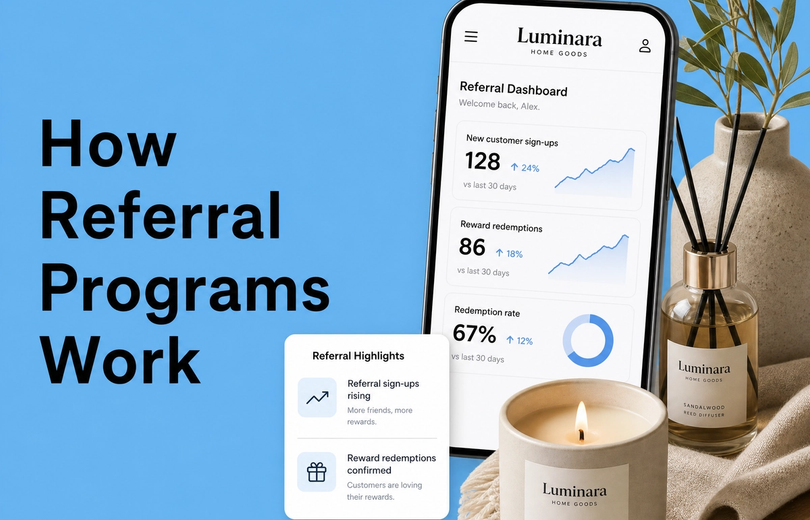
Most ecommerce founders believe referral programs are a "set it and forget it" growth tactic. They're wrong. The stores crushing it with referrals treat them like living, breathing systems that demand constant attention and evolution.
Here's what separates thriving referral programs from the ones that fizzle: the best ones don't just reward transactions. They create moments where customers feel genuinely seen, understood, and excited to spread the word. And yes, that takes more work than slapping a "Give $10, Get $10" banner on your homepage.
If you're running a Shopify store and haven't implemented a referral program yet, you're essentially leaving money on the table. Referred customers spend 25% more on their first order than regular newcomers, maintain a 37% higher retention rate, and convert at rates that make paid ads look expensive by comparison. The best part? You only pay when the referral actually converts.
This guide walks you through everything: what referral programs actually are, why they work better than you probably think, how to set one up using the right apps, and most importantly, how to keep them performing month after month.
Unlocking Growth: What Is a Shopify Referral Program and Why Your Store Needs One
Let's start with a distinction that matters more than most merchants realize. A referral program and an affiliate program sound similar, but they operate in completely different ways.
A referral program rewards your existing customers for sharing your products with friends and family. The person doing the referring isn't a business partner or influencer—they're a real customer who already loves what you sell. They earn rewards (discounts, store credit, points, or exclusive perks) when someone they refer makes a purchase. The referred friend typically gets a discount or incentive too, making it a two-sided arrangement.
An affiliate program, by contrast, recruits external promoters—bloggers, content creators, publishers—who earn commission for driving sales. Affiliates aren't necessarily customers. They're marketers promoting your store because the commission structure makes it worth their time.
Here's why the distinction matters: referred customers come with built-in trust. When your cousin tells you a skincare brand is worth trying, you listen differently than when an influencer you don't know sponsors a product. That trust translates to higher conversion rates, stronger retention, and customers who spend more over their lifetime.
The numbers validate this. 88% of consumers trust personal recommendations from people they know, while only a fraction of that percentage trust traditional advertising. Referred customers convert at rates 25-40% higher than cold traffic, spend an average of 25% more on their first order, and stay loyal three times longer than paid acquisition channels.
Think of it like this: paid ads are renting attention. Referrals are building community.
The financial impact extends beyond the first purchase. Referred customers have a 37% higher retention rate than customers acquired through other channels. They make repeat purchases more frequently, they spend more per transaction, and they're more likely to recommend you to others—creating a compounding growth effect that accelerates over time.
Beyond retention and revenue, referral programs generate authentic social proof. When a customer shares your product on their Instagram story or recommends it to a friend, that's endorsement marketing at its most genuine. No amount of paid promotion can replicate that authenticity.
The cost structure is another game-changer. Traditional customer acquisition requires upfront ad spend whether the customer converts or not. Referral programs flip this model on its head. You reward referrals only when they succeed. This means your cost per acquisition drops dramatically, your marketing spend becomes performance-based, and you're incentivizing your most loyal customers to become active marketing channels.
For Shopify merchants specifically, this is critical. If you're competing against larger brands with bigger ad budgets, a referral program levels the playing field by turning your existing customers into a distributed sales force that costs nothing until they deliver a result.
Your Step-by-Step Guide to Setting Up a Shopify Referral Program
Why You Need a Third-Party App (Not Shopify's Native Solution)
Here's the straightforward truth: Shopify doesn't offer a native referral program feature. You'll need a third-party app to make this work.
This isn't a limitation—it's actually an advantage. The apps built specifically for Shopify referral programs have evolved to be far more sophisticated than any native solution Shopify could build. They handle the technical complexity, automate reward distribution, provide analytics dashboards, and integrate seamlessly with your email and SMS platforms.
Without an app, you'd be managing referral links manually, tracking conversions in a spreadsheet, and calculating who owes what reward. That's chaos at scale.
Choosing the Best Shopify Referral App
When evaluating referral apps, look for these core features:
Two-sided rewards architecture: Both the referrer and the referred customer should benefit. This dramatically increases participation rates. One-sided programs where only the referrer benefits typically see 30-50% lower engagement.
Customizable reward types and values: Your app should support percentage discounts, fixed-dollar discounts, store credit, free products, loyalty points, cashback, and exclusive perks. Different customer segments respond to different incentives. Some want instant discounts. Others prefer exclusive early access or free products.
Custom landing pages: A dedicated referral page that reflects your brand and clearly explains how the program works increases conversions. Generic, templated pages underperform.
Social sharing options: Make it dead simple for customers to share unique referral links via email, WhatsApp, Facebook, Instagram, and text message. One-click sharing drives participation rates up significantly.
Real-time analytics dashboard: You need visibility into how many referrals are generated, conversion rates, reward costs, and revenue attribution. Without this, you're flying blind.
Automated reward distribution: Manual reward processing creates customer service headaches and delays that kill enthusiasm. The app should automatically credit rewards when qualifying conditions are met.
Fraud prevention mechanisms: The app should identify and flag suspicious patterns like self-referrals, repeated referrals from the same device, or unusually high referral velocity from a single customer.
Integration capabilities: Your referral app should connect with Klaviyo, Omnisend, Postscript, Gorgias, and other tools in your marketing stack. This enables automated email sequences, customer service workflows, and data consolidation.
Popular options in the Shopify ecosystem include Rivo (strong on design and social sharing), ReferralCandy (well-established with robust analytics), BON Loyalty (integrates points with referrals), Smile.io loyalty alternative (focused on simplicity), and platforms such as Mage Loyalty, Growave, and UpPromote. Each has strengths depending on your specific needs and business model.
Setting up your referral program begins with matching your choice of app to your store's growth stage and technical integration needs. Smaller stores might prioritize ease of setup and transparent pricing. Scaling brands usually need advanced segmentation, multi-currency support, and custom integration capabilities.
The Shopify loyalty program growing brands trust
See how Mage helps Shopify brands lift repeat purchase rate with loyalty, referrals and store credit.
Book a demoCrafting Irresistible Referral Incentives
Here's where most merchants go wrong: they treat referral incentive design like a one-time decision, then wonder why participation plateaus after three months.
The conventional wisdom says "Give $10, Get $10" and call it done. But this approach misses a critical insight: the incentive structure that attracts participation in month one might bore customers into silence by month six. Sustained referral engagement requires evolving incentives that match where customers are in their relationship with your brand.
The two-sided reward principle is non-negotiable. When only the referrer benefits, you're essentially asking existing customers to do free marketing. They're naturally hesitant. When the referred friend also gets a benefit, you've solved for objection. The referrer isn't asking a friend to do them a favor—they're offering their friend a genuine discount or perk.
Start with these reward structures and then layer in sophistication:
Percentage discounts (most common): "Give 15%, Get 15%" appeals to price-conscious customers and scales automatically with your AOV. If you raise prices, the discount rises proportionally. This maintains consistent margin impact.
Fixed-value discounts: "$10 off" is easier to understand and communicate than percentages, but doesn't account for order size variation. A $10 discount on a $100 order feels generous. On a $30 order, it feels awkward.
Store credit vs. discount codes: Store credit requires the customer to make another purchase to use the reward. Discount codes can be applied immediately. Store credit extends customer lifetime value but feels less immediate. Discount codes drive faster re-engagement.
Free products or gifts: Offering a free item at a certain referral threshold creates aspirational targets. "Refer 5 friends, get this exclusive tote bag free" generates excitement that a $20 discount doesn't.
Loyalty points: If you're already running a loyalty program, awarding points for referrals integrates the two systems seamlessly. Customers accumulate points toward tiered benefits rather than receiving a one-time discount.
Exclusive access or experiences: Early access to new product launches, exclusive community events, or private customer appreciation calls create emotional value beyond transactional savings. For luxury or community-focused brands, this outperforms discounts substantially.
Here's what separates average referral programs from exceptional ones: against conventional wisdom, a static "set it and forget it" incentive structure is a recipe for stagnation. While initial monetary discounts attract attention and drive early participation, sustained engagement requires dynamic iteration. True advocacy stems from deeper brand connection, not just transactional benefits.
This means regularly testing different offer structures with different customer segments. Maybe your highest-AOV customers respond better to percentage discounts that preserve margin, while newer customers need fixed-dollar incentives to feel the impact. VIP customers might prize exclusive early access over any discount. Newsletter subscribers might engage more with points-based rewards that extend the relationship.
The merchants seeing 2-3x higher referral revenue than benchmarks are treating incentive design as an ongoing experiment, not a setup task. They adjust quarterly based on participation data, test new offer structures with segments, and sometimes surprise top referrers with unexpected bonuses that deepen loyalty beyond what any standard incentive could achieve.
Practically speaking: cap your referral rewards at 10-20% of your average order value. Going higher eats margins without proportionally increasing participation. Test one new incentive structure every quarter. Segment your audience and offer different incentives to different groups. Track which structures drive the highest-quality referrals (customers with high lifetime value, not bargain hunters).
Designing a Seamless On-Site Experience
Your referral program only works if customers can find it and understand it in under 30 seconds.
Start with dedicated real estate. Create a referral landing page that explains the program clearly: "Here's what you earn. Here's what your friend earns. Here's how to participate." Include a prominent call-to-action button that opens a share modal or generates a unique referral link. Make the sharing process visible—show customers a QR code they can text to friends, a link to copy and paste, and one-click sharing buttons for social media.
Place referral links where customers are already thinking about your brand: in their account dashboard (where loyalty-engaged customers spend time), on post-purchase confirmation pages (when gratitude and excitement are highest), and in the footer of your store (for passive discovery). Some brands see strong participation by adding referral prompts directly to product pages—"Love this? Share with a friend and both get a discount."
Avoid referral pop-ups that interrupt the shopping experience. Instead, use persistent banners or subtle links that customers notice when they're ready. Context matters more than frequency.
The on-site experience should also clarify the referral mechanics. How does the referred friend access the discount? Do they need a unique code, or does the system recognize them automatically? How long does it take for the referrer to receive their reward? Can they track their referrals in real time? Vagueness kills participation. Clarity compounds it.
Automating Program Communications and Rewards
The apps handle distribution, but you need to set up the communication sequences that keep your program top-of-mind.
Welcome email sequence: When a customer joins your referral program, send them two emails within the first week. The first explains the program and shows them how to generate their unique referral link. The second shares social proof: "X customers have earned rewards this month" or "People just like you earned $50 in store credit last week."
Referral reminder emails: Send monthly emails to program members reminding them of available rewards and highlighting success stories. Segment these so high-value referrers get recognized publicly while others receive private encouragement.
Successful referral notifications: The moment a referred friend makes a purchase, both the referrer and the new customer should receive an email. For the referrer, it's confirmation and excitement. For the new customer, it's their welcome sequence.
Reward issuance emails: When rewards are credited, make it a moment of celebration. "Your $15 store credit is ready to use—here are our most-popular items you could try."
Shopify Flow automation can handle much of this. Set up workflows that automatically tag customers who refer friends, trigger emails when referral thresholds are hit, and manage refund scenarios (if a referred order gets refunded, the reward should be reversed).
compare Shopify loyalty apps to understand how different platforms handle automation complexity.
“Cannot say enough good things about the team at Mage Loyalty, one of the absolute best organizations we have ever worked with, full stop! So glad we connected with them, completely redid our loyalty program, new concepts, use of loyalty, increasing user engagement, showing us where we were not valuing our best customers, just WOW, amazing team!”


Read the West Coast Goalkeeping case study →
Supercharge Your Referrals: Promotion Strategies That Work
Here's what kills most referral programs: merchants launch them and assume customers will magically discover and share them. Participation requires active promotion across multiple channels.
On-Site Visibility: Making Your Program Discoverable
Your referral program needs to be impossible to miss, but not annoying.
Navigation integration: Add a "Refer & Earn" link in your main navigation menu. Place it in the header so it's visible on every page, or in the footer if you want it less prominent. Some brands integrate it directly into the account menu—customers click their profile, and "My Referrals" is right there.
Post-purchase pages: The moment a customer completes an order, they're in a grateful, engaged mindset. This is prime real estate for a referral prompt: "Just bought something you love? Share the love and earn a $10 reward."
Email signature: If you have a small team responding to customer emails, add a subtle referral program mention to your email signature. "Share our store with friends—both of you get $10 off."
Product page integration: For high-volume products or bestsellers, add a "Share this product" section below the add-to-cart button. Include buttons for referral links, social sharing, and email.
Checkout page: Some brands add a final touchpoint at checkout, reminding customers they can earn rewards by referring. "Earn $10 for every friend you refer—add it to your account after completing this purchase."
Off-Site Amplification: Spreading the Word
On-site visibility gets people into the program. Off-site amplification gets them actively promoting.
Email marketing campaigns: Your most engaged customers are on your email list. Send them a dedicated campaign introducing the referral program. Explain benefits clearly, show examples of what rewards look like, and include a prominent call-to-action. Follow this with monthly reminder campaigns highlighting success stories ("Sarah earned $100 last month—here's how") or seasonal boosts ("Refer a friend in December and earn double rewards").
Segment these emails. VIP customers might see higher reward offers. First-time buyers might see simpler program explanations. Lapsed customers might see special bonus offers to re-engage them through referrals.
SMS marketing: For customers who've opted in, text messages drive urgency and engagement. "Your friend just signed up with your referral link—reward is on the way" creates real-time gratification. SMS also works for time-limited bonus campaigns: "Triple rewards this weekend—refer now."
Social media integration: Make sharing your store ridiculously easy. Generate unique referral links for each customer. Let them share these links directly from your referral page to Instagram Stories, Facebook, TikTok, or Twitter. Pre-write share messages they can use: "I've been obsessed with [Brand]. Use my link for 15% off your first order." One-click sharing multiplies participation.
Influencer and brand ambassador programs: Identify your top referrers and give them special status. Feature them in your email campaigns, offer them higher reward rates, or include them in exclusive events. Turn them into official brand ambassadors with unique discount codes.
Package inserts: Include a referral card in every shipped order. Make it beautiful and specific: "You just made a great purchase. Share this code with a friend and you both get $15 off." QR codes work well here—customers scan from their phone immediately.
Simplifying the Sharing Process
Friction kills referral sharing. Every additional step reduces participation.
Unique referral links: Each customer should have their own permanent link (e.g., mybrand.com/ref/sarah-smith). This is far more trackable than generic codes.
QR codes: Generate unique QR codes for each customer. They're easy to share, especially on visual platforms like Instagram and TikTok.
Pre-written messages: Let customers choose from templated share messages rather than asking them to write their own. "Check out [Brand]—I've been using their products for 6 months and love them" is more likely than customers crafting something from scratch.
One-click social sharing: Buttons that automatically share to Instagram, Facebook, WhatsApp, and email with the referral link included. The fewer steps between "I want to share this" and "my friend sees it," the higher your participation.
Email sharing: A "Share via email" button that opens the customer's email client with a pre-populated message and link reduces friction significantly.
Track, Measure, and Optimize: Ensuring Referral Program ROI
A referral program that isn't measured is just a discount you're giving away.
Setting Clear Goals and Key Performance Indicators
Before you launch, decide what success looks like. Generic goals like "more referrals" aren't actionable. Specific goals are.
Revenue-focused goals: "Increase referral-attributed revenue from $5,000/month to $15,000/month within 6 months" or "Achieve 0.5% of total revenue from referrals by end of year."
Acquisition-focused goals: "Reduce customer acquisition cost from $45 to $30 through referral-attributed channels" or "Generate 200 new customers monthly from referrals."
Retention-focused goals: "Increase repeat purchase rate for referred customers from 35% to 50%" or "Improve customer lifetime value for referral-sourced cohorts by 40%."
Engagement-focused goals: "Get 30% of active customers participating in the referral program" or "Generate 500 referral shares monthly by month three."
Once you've set goals, track these KPIs:
Referral conversion rate: Percentage of referred visitors who become paying customers. Benchmark is 2-5%, depending on your industry and offer strength.
Average referral value: Total revenue generated by referrals divided by number of referrals. Higher values mean better quality referrers.
Cost per acquisition via referral: Total reward cost divided by number of customers acquired. Compare this to your paid acquisition channels.
Program ROI: (Revenue from referred customers - Total reward costs) / Total reward costs. The benchmark referral revenue for a loyalty program that has been live for 12 months is 0.20% of total store revenue, but top performers hit 0.5-1%.
Participation rate: Percentage of your customer base enrolled in the referral program. Higher is generally better, but focus more on quality than volume.
Leveraging Analytics and Reporting
Your chosen referral app provides a dashboard showing real-time referral activity. Study it weekly.
Look for patterns: Which customer segments generate the most referrals? What's the geographic distribution of referred customers? Which incentive offers drive the highest conversion rates? Are referred customers from certain products stickier than others?
Export this data into a spreadsheet alongside your broader Shopify analytics. Map referral revenue against total revenue, customer acquisition costs, repeat purchase rates, and customer lifetime value. This unified view shows you the true impact of your program.
Create a monthly report that tracks these metrics month-over-month. Improvement indicates your program is working. Stagnation signals it's time to adjust.
The Power of A/B Testing and Iteration
Every element of your referral program is testable: incentive amounts, reward types, email copy, referral page design, CTA button text, sharing message templates.
Run these tests sequentially (not simultaneously, which can create confounding variables):
Test 1: Change your referral reward from "Give 15%, Get 15%" to "Give $20, Get $20" for one month. Track participation and conversion rates. Which drives more referrals? Which generates higher-quality referred customers?
Test 2: Change your email subject line from "Earn $20 for every friend you refer" to "Turn your friends into your personal discount." Track open rates and click-through rates.
Test 3: Test two different referral landing page layouts—one emphasizing the simplicity of sharing, the other emphasizing reward value. Which has higher conversion to referral link generation?
Document every test result. Build a database of what works. Double down on winning variations and sunset the losers.
Most merchants only test once, then leave their program static. The ones seeing 2-3x better results than benchmarks are constantly experimenting. They understand that referral program optimization is an ongoing discipline, not a one-time setup task.
Advanced Strategies for Shopify Referral Program Mastery
Identifying and Nurturing Your "Super-Referrers"
Most referral programs treat all customers equally. The sophisticated ones identify their top referrers and give them disproportionate attention.
Pull your customer data and create a segment of people who have referred 5+ customers. These are your super-referrers. They're already advocates—you just need to fuel them.
Offer them higher reward rates: Instead of the standard "Give 15%, Get 15%," give super-referrers "Give 20%, Get 20%" or exclusive products. Make them feel special.
Feature them publicly: Include a "Top Referrers This Month" section in your email newsletter. Feature testimonials from super-referrers explaining why they love referring friends. Public recognition drives continued participation.
Invite them to exclusive experiences: Host a virtual Q&A with your founder, offer exclusive product previews, or invite them to an in-person event. These experiences create deeper loyalty than any discount.
Give them ambassador status: Formalize their role. Send them early access to new products with a request for feedback. Ask for permission to feature them in marketing. Provide them with higher-tier rewards or exclusive perks they can't get elsewhere.
Provide insights and recognition: Let them see their impact. "Your referrals have generated $3,500 in revenue for our store—thank you." Quantified impact drives continued engagement.
Deep Integrations within the Shopify Ecosystem
A referral app that doesn't integrate with your marketing stack creates silos and limits automation.
Email platform integration (Klaviyo marketing integration): When a customer generates a referral, you should automatically trigger a Klaviyo workflow. Tag them as "referrer," add them to a high-value segment, and start a nurture sequence designed to encourage more referrals. When a referral converts, trigger a separate workflow thanking them and showing their reward status.
SMS platform integration: Postscript or Omnisend should receive real-time data about referral activity, letting you send immediate congratulations messages or time-sensitive bonus offers.
Customer service integration: Gorgias should show you referral metrics for each customer. If someone reaches out with a support question and they're a super-referrer, your support team sees that context and can thank them for their advocacy.
Analytics consolidation: Pull referral data into tools like Shopify's native analytics or a data warehouse so you can see how referrals contribute to overall metrics like repeat purchase rate and customer lifetime value.
These integrations transform referral programs from isolated systems into core growth engines that inform all your marketing decisions.
Long-Term Program Evolution and Engagement
Referral programs need attention to avoid becoming stale.
Quarterly reward refreshes: Every 3 months, introduce a new reward option or test a higher incentive. This creates a sense of novelty that re-engages lapsed referrers.
Seasonal campaigns: Winter holidays, back-to-school, summer vacations—these seasonal moments drive gifting behavior. Launch limited-time bonus referral campaigns around them ("Triple rewards through December 24th").
Community building: Use your referral data to identify groups of customers who've referred each other (social clusters). Feature these clusters in your marketing. "These 12 friends all shop with us—they started because one of them had a great experience and told the rest."
Feedback loops: Periodically ask referrers what would make them more likely to share. "Would you refer more often if we offered early access to new launches?" or "What would your ideal reward be?" Use this feedback to evolve your program.
Lapsed referrer reactivation: Identify customers who referred friends in the past but haven't in months. Send them a special re-engagement offer: "Miss you! Come back—we're offering double rewards for the next 30 days if you refer again."
Safeguarding Your Success: Fraud Prevention and Legal Compliance
Referral fraud is real, and it erodes your margins if you're not vigilant. So is legal exposure if you're not transparent about how you're using customer data.
Proactive Fraud Detection and Mitigation
Apps provide fraud detection, but don't rely on them entirely.
Monitor for self-referrals: If a customer refers themselves from a different email address or device, that's fraud. Flag any accounts that refer from the same IP address or device. Most quality apps catch this automatically, but periodically audit manually.
Watch for referral velocity spikes: If one customer generates 20 referrals in a week, investigate. This often indicates bot activity or a scheme to rack up rewards before getting caught.
Verify purchase behavior: Do referred customers actually engage with your store, or do they buy once with a discount and vanish? Referred customers with high repeat purchase rates are legitimate. Those with one-time purchases might be test accounts.
Manual review of top referrers: Spot-check your top 5-10 referrers. Look at the quality of their referral links. Are they sharing on genuine social media accounts with real followers? Or are these new accounts created just to rack up referrals?
Terms and conditions clarity: Your referral program terms should explicitly prohibit self-referrals, fraudulent accounts, bulk sharing, and purchasing multiple accounts to game the system. Make these terms visible and enforceable.
Navigating Data Privacy and FTC Disclosure Requirements
This is less glamorous than optimization but equally critical.
GDPR compliance: If any of your customers are in the EU, you need explicit consent to store their referral data and send them referral-related communications. Your privacy policy should clearly state how you're using customer data in your referral program. Provide easy opt-out options.
CCPA compliance: California residents have the right to know what personal data you've collected and how it's used. Your referral program should have a data privacy statement. You must honor requests to delete or export customer referral data.
FTC endorsement disclosure: This is critical and often overlooked. When customers share your products or post about referrals on social media, they're endorsing you. The FTC requires endorsers to disclose their relationship with the brand. If a customer earns a reward for promoting your product, that's a material connection. They should use hashtags like #ad or #sponsored or include text like "I earn rewards from this brand."
Many merchants ignore this, but the FTC has increasingly enforced these requirements. You're not legally responsible for customer social media posts, but you can include language in your referral program terms asking customers to disclose their connection to your brand.
Transparency in communication: Be clear about how customer data flows through your referral program. If you're integrating with Klaviyo or other platforms, state that in your privacy policy. If you're using referral data for analytics or marketing segmentation, disclose it.
Real-World Inspiration: Shopify Referral Program Examples
OSEA: The sustainable skincare brand runs a straightforward referral program: "Give $10, Get $10." Both the referrer and the referred customer receive discounts. They promote it consistently via email and on their product pages. The program drives measurable repeat purchases from referred customers, who tend to be more engaged with the brand's sustainability values.
Thrive Causemetics: The cruelty-free cosmetics brand takes a different approach, offering 15% cash rewards for referrers and 15% discounts for referred customers. They promote heavily on their Instagram, where they tag referral success stories. Their program emphasizes community and shared values, not just discounts. This attracts referrals from customers who genuinely align with their mission.
Galen Leather Co.: The leather goods maker generated over $350,000 in sales and acquired 2,000+ new customers through their referral program, according to published case studies on ecommerce referral strategies. They succeeded by treating referrers as partners, regularly featuring them in their newsletter, and offering escalating rewards—the more you refer, the better the incentive.
Key Takeaways for Launching a Thriving Shopify Referral Program
- Differentiate referrals from affiliates: Referral programs reward existing customers sharing with friends. Affiliates are external partners earning commission. Referred customers are inherently more trusted and valuable.
- Choose an app with the right feature set: Prioritize two-sided rewards, customizable incentives, real-time analytics, social sharing integration, fraud prevention, and compatibility with your email and SMS platforms.
- Design incentives for sustained engagement: Static "set and forget" offers underperform. Test different reward structures, segment your audience, and iterate quarterly to maintain participation and excitement.
- Make your program easy to find and share: Place referral links in navigation, post-purchase pages, customer dashboards, and footer. Use QR codes, email sharing buttons, and pre-written messages to reduce friction.
- Promote actively: A great referral program that customers don't know about isn't great. Use email, SMS, social media, and package inserts to keep the program top-of-mind.
- Measure relentlessly: Track referral conversion rate, average referral value, customer acquisition cost, and program ROI. Use this data to identify what's working and what needs adjustment.
- Identify and nurture super-referrers: Your top referrers drive disproportionate revenue. Feature them, offer higher rewards, invite them to exclusive experiences, and make them feel like partners.
- Integrate deeply with your marketing stack: Connect your referral app to Klaviyo, SMS platforms, customer service tools, and analytics dashboards. This creates automation and unified insights.
- Evolve continuously: Referral programs stagnate if left unchanged. Refresh incentives quarterly, test new approaches, re-engage lapsed referrers, and respond to customer feedback.
- Stay compliant: Clearly disclose data practices in your privacy policy. Follow FTC endorsement requirements. Include fraud prevention terms in your program rules. Transparency builds trust with your customers.
Frequently Asked Questions
What's the difference between a referral program and a loyalty program?
Referral programs specifically reward customers for bringing new people into your store. Loyalty programs reward customers for their own continued purchases and engagement. Many merchants run both: a loyalty program that builds long-term retention, and a referral program that drives new customer acquisition. Some all-in-one platforms combine both features—look for solutions that offer flexible reward structures supporting both programs simultaneously.
How long does it take to see results from a referral program?
Most merchants see initial activity (referral link shares) within the first 2-4 weeks of launching. However, meaningful revenue impact usually takes 2-3 months as referred customers make purchases and you accumulate enough data to identify patterns. Super-referrers typically emerge after 60+ days. Plan to invest at least 90 days in testing, optimization, and promotion before evaluating overall program effectiveness.
What's the average ROI of a referral program for Shopify stores?
This varies by industry and effort level. The benchmark is 0.20% of total store revenue from referrals after 12 months. Stores that actively promote and optimize their programs typically achieve 0.4-1% of revenue from referrals. If your store does $100,000/year in revenue, a well-run referral program might contribute $400-$1,000 annually. Top performers (stores treating referral programs as core growth channels rather than side projects) sometimes see 2-3% of revenue from referrals.
Which Shopify referral app should I choose?
This depends on your specific needs. Simple, design-focused stores often choose apps like Smile.io or Rivo. Stores wanting a unified loyalty and referral solution prefer platforms such as Mage Loyalty, BON Loyalty, or Growave. Larger stores needing advanced analytics and customization choose ReferralCandy or LoyaltyLion. Start with a free trial on 2-3 options, test them with a small initial cohort, and pick the one that integrates best with your existing tools and feels most natural for your team to manage.
TLDR
Referral programs turn existing customers into your most cost-effective acquisition channel, with referred customers spending 25% more initially and maintaining 37% higher retention rates. Success requires choosing an app with robust analytics and social sharing integration, designing two-sided incentives that evolve beyond static discounts, promoting actively across email and social channels, tracking performance metrics religiously, identifying and rewarding super-referrers, and continuously testing new approaches to prevent engagement decay. While the benchmark is 0.20% of annual revenue from referrals, stores that treat referral programs as living systems worthy of

Graeme is the co-founder at Mage Loyalty. He heads product development, from complex loyalty migrations and large-scale data handling to building the features shaping the future of loyalty on Shopify.