Mage Loyalty, Okendo and Yotpo all run loyalty and referral programs, but they organize the work differently. In an Okendo vs Yotpo comparison, each platform can connect rewards to Shopify customers, purchases and retention activity. Mage Loyalty fits Shopify-first brands running loyalty as an owned retention system, Okendo fits teams consolidating commerce marketing tools, and Yotpo fits broader retention and UGC requirements. Mage Loyalty is the strongest fit for most Shopify brands because it keeps loyalty close to checkout, POS, customer accounts and the Shopify stack.
TL;DR
- Mage Loyalty, Okendo and Yotpo support loyalty, but Mage is Shopify-exclusive, Okendo is a unified commerce marketing toolkit, and Yotpo is a broader retention and UGC suite.
- Mage Loyalty centers on points, VIP tiers, referrals, branded customer surfaces, Shopify POS and checkout redemption.
- Okendo combines loyalty with reviews, quizzes, referrals and surveys in one broader platform.
- Yotpo combines loyalty and referrals with reviews, UGC and AI visibility tools.
- Mage Loyalty is the stronger fit for most Shopify brands that need deep Shopify workflows and monthly pricing. Okendo may suit a unified commerce-marketing strategy, while Yotpo may suit a broader UGC and connector-heavy stack.
“Cannot say enough good things about the team at Mage Loyalty, one of the absolute best organizations we have ever worked with, full stop! So glad we connected with them, completely redid our loyalty program, new concepts, use of loyalty, increasing user engagement, showing us where we were not valuing our best customers, just WOW, amazing team!”


Read the West Coast Goalkeeping case study →
Quick snapshot
| Decision factor | Mage Loyalty | Okendo | Yotpo |
|---|---|---|---|
| Positioning | Shopify-exclusive loyalty platform | Unified commerce marketing toolkit | Retention and UGC suite |
| Best fit | Shopify-first DTC retention teams | Consolidated marketing platform buyers | Broad martech and UGC teams |
| Setup effort | Most programs live in a day | One day to advanced implementation | Confirm implementation scope |
| Customer-facing surfaces | Canvas-built loyalty, accounts, wishlist | Loyalty display modules | On-site engagement modules |
| Checkout and POS | Shopify Checkout, Extensions and POS | Shopify POS, checkout not confirmed | Shopify POS support |
| Referrals and VIP | Fraud controls, up to ten tiers | VIP tiers and memberships | Advanced capabilities on Premium |
| Developer access | API, SDK, metafields, webhooks | APIs and webhooks | Webhooks and custom workflows |
| Analytics | Loyalty, engagement and ROI dashboards | Revenue and tier analytics | Loyalty and review outcomes |
| Support model | Founder-led Slack access | Confirm commercial support terms | Confirm support model |
| Pricing model | Monthly, usage-based | Custom order-volume pricing | Public Pro, custom Premium |
Updated September 2026.
What is Mage Loyalty?
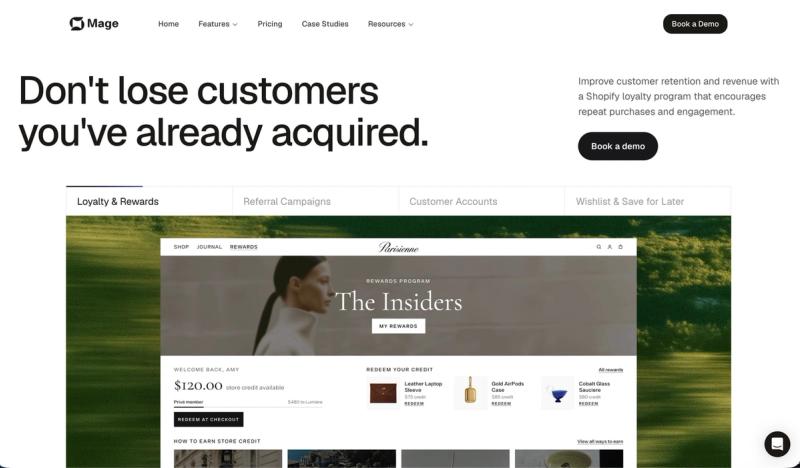
At the time of writing, Mage Loyalty positions itself as a retention and loyalty platform built exclusively for Shopify brands. It is designed for merchants that need more than a floating points widget, including branded loyalty pages, referrals, VIP tiers, customer accounts and wishlist activity within the same retention setup.
In practice, the program runs through purchase earning rules, rewards, referrals and tier progress, with customer activity visible across Shopify storefront and retail workflows. Customers can earn and redeem through Shopify POS, and rewards apply at checkout without copying a discount code. A Shopify loyalty program can therefore sit in the purchase journey rather than beside it.
Key features and strengths
- Shopify workflows: Supports Shopify Checkout, POS, Flow, Checkout Extensions, app blocks and metafields.
- Branded surfaces: Mage Canvas builds loyalty, referral, account and wishlist experiences without code.
- Referral controls: Detects self-referrals, duplicate accounts, shared IP patterns and rapid referral bursts.
- Developer toolkit: REST API, JavaScript SDK, metafields and webhooks support custom Shopify experiences.
- Migration support: Founder-led support includes direct Slack access and white-glove migration.
Best for: Shopify and Shopify Plus DTC brands that have outgrown a basic rewards widget, operate online and in person, or need a branded retention system that marketing can manage while developers can extend. See the full Okendo alternative comparison for a closer product view.
What is Okendo?
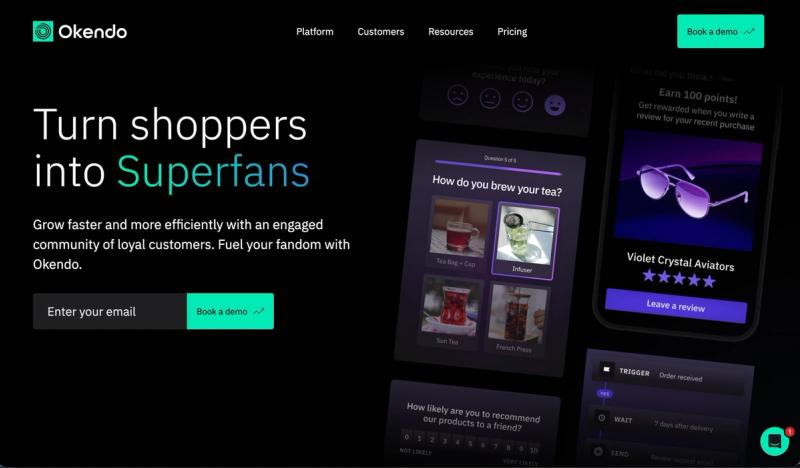
At the time of writing, Okendo positions itself as a unified commerce marketing toolkit combining Reviews, Loyalty, Quizzes, Referrals and Surveys. Loyalty is one pillar in a broader product model intended to connect customer feedback, engagement and rewards data.
In practice, Okendo Loyalty gives teams points, rewards, VIP tiers, memberships, loyalty display modules, analytics, Shopify POS and developer functionality within the wider Okendo platform. This can make sense when the same team wants reviews, quizzes and loyalty to share a common operating model and customer data.
Key features and strengths
- Unified toolkit: Brings Reviews, Loyalty, Quizzes, Referrals and Surveys together.
- Loyalty mechanics: Supports points and rewards as part of its loyalty offering.
- VIP and memberships: Includes VIP tiers and memberships.
- Display modules: Provides loyalty display modules for customer-facing experiences.
- Developer options: Supports APIs, webhooks and Shopify POS.
- Pricing structure: Platform and loyalty options are listed on Okendo's pricing page.
Best for: brands that want loyalty closely connected to reviews, quizzes, referrals and surveys, especially where a broader unified platform matters more than selecting a loyalty-first system.
What is Yotpo?
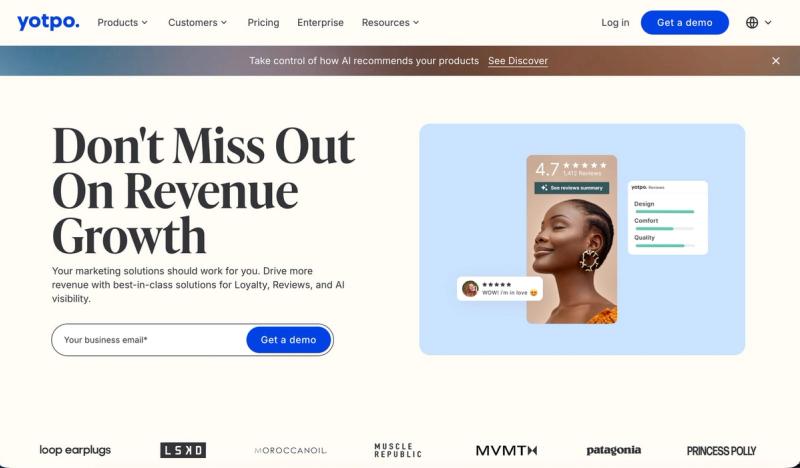
At the time of writing, Yotpo positions itself as a multi-product retention and UGC platform combining Loyalty and Referrals, Reviews and UGC, and AI visibility. Its loyalty product sits inside a wider marketing suite that also emphasizes product discovery and review content.
In practice, Yotpo gives merchants points and referrals alongside review collection, UGC syndication, AI-powered review summaries and a large connector ecosystem. The trade-off is a broader platform footprint, which may be worthwhile when loyalty is one part of a wider retention and UGC operation.
Key features and strengths
- Loyalty and referrals: Offers points, referral programs and standard earning rules.
- Advanced loyalty: VIP tiers, scheduled earning rules, custom actions and free-product rewards are higher-plan capabilities.
- Reviews and UGC: Includes review collection, syndication and AI-powered summaries.
- AI visibility: Tracks how products appear in AI engines.
- Commerce workflows: Supports Shopify POS, Recharge, Klaviyo and webhooks.
Best for: brands that need a broader multi-platform retention and UGC suite, extensive martech connectivity or AI visibility alongside their loyalty program.
Mage Loyalty vs Okendo vs Yotpo: detailed comparison
Shortlisting decisions are made in the workflows your team will run each week, not a feature checklist alone. Ask who builds campaigns, where customers redeem, how data moves, and what the program costs after order volume grows.
1. Program philosophy and operating model
If you want loyalty to be owned by a retention team, ask each vendor to show how points, tiers, referrals, customer data and campaigns are managed after launch.
Mage Loyalty. Mage is built exclusively for Shopify and treats loyalty as the central product. Its surrounding account, wishlist and referral surfaces support the same customer retention system.
Okendo. Okendo treats loyalty as part of a unified commerce marketing toolkit alongside reviews, quizzes, referrals and surveys.
Yotpo. Yotpo places loyalty and referrals within a broader retention and UGC suite that also includes reviews and AI visibility.
Verdict: Mage gives Shopify retention teams the clearest loyalty-first operating model. Okendo is a narrower fit when one unified commerce-marketing platform is the main requirement. Yotpo may fit teams already prioritizing UGC operations and broad retention tooling.
2. Setup and time to launch
If you need a program live before a campaign, ask each vendor to demonstrate the exact setup path, required theme work, migration process and ownership after launch.
Mage Loyalty. Mage states that most merchants have a program live in a day. Mage Canvas gives marketing teams a no-code way to publish customer-facing surfaces.
Okendo. Okendo says implementation can range from one day to around two to four weeks for advanced customizations.
Yotpo. Confirm the implementation scope, onboarding process and customization requirements for your intended loyalty configuration.
Verdict: Mage has the clearest fast-launch claim for a Shopify loyalty program. Okendo provides a stated range that accounts for advanced customization. For Yotpo, get a written implementation plan tied to your program design and data migration.
3. Customer-facing experience and branding
If your marketing team needs to change a loyalty page, referral offer or account experience without engineering help, ask each vendor to build that workflow during the demo.
Mage Loyalty. Mage Canvas controls loyalty pages, Rewards Widget, customer accounts, referral campaigns, wishlist and saved-for-later surfaces. Mage Accounts provides a branded on-site drawer that sits on top of Shopify accounts.
Okendo. Okendo includes loyalty display modules. Confirm the available display and developer functionality in the demo.
Yotpo. Yotpo offers loyalty and referral workflows within its broader on-site engagement toolkit. Review which display and account surfaces are included in the proposed plan.
Verdict: Mage is stronger for teams that want one no-code builder across loyalty, accounts, referrals and wishlist. Okendo offers loyalty display modules within its wider platform. Yotpo should demonstrate the specific customer-facing experience your team plans to own.
4. Checkout, POS and omnichannel
If you run retail stores and an online storefront, ask each vendor to demonstrate customer lookup, earning, reward redemption, refunds and balance visibility in Shopify POS and checkout.
Mage Loyalty. Mage supports Shopify POS and Shopify Checkout. Checkout Extensions can show a rewards wallet and points-to-earn information, while Flexible Redemption lets eligible logged-in customers redeem at checkout.
Okendo. Okendo supports Shopify POS. Confirm the reward, customer-identification and checkout workflow used by your store staff.
Yotpo. Yotpo supports Shopify POS. Review checkout redemption behavior, POS reward handling and how loyalty data appears across channels.
Verdict: Mage provides a concrete Shopify-first workflow spanning POS, checkout extensions and on-site customer surfaces. Okendo and Yotpo both support POS, so the practical buying test is whether their redemption and refund flow matches your retail operation.
5. Referrals, VIP tiers and engagement
If you use referral incentives or tier benefits to drive repeat purchase, ask each vendor to show fraud controls, tier qualification, reward timing and what customers see as they progress.
Mage Loyalty. Mage supports up to 10 VIP tiers, fraud protection, double-sided referral rewards and engagement mechanics including bonus points campaigns, punch cards and custom actions.
Okendo. Okendo supports VIP tiers, memberships and loyalty rewards. Review the available earning and redemption options in the proposed configuration.
Yotpo. Yotpo offers points and referrals, while VIP tiers, scheduled earning rules, custom actions and free-product redemption sit on Premium, as shown in Yotpo's loyalty pricing.
Verdict: Mage is particularly strong where configurable tier design and fraud-protected referrals are daily operating concerns. Okendo offers VIP tiers and memberships within a broader toolkit. Yotpo can support advanced loyalty programs, but plan placement needs to be modeled before buying.
6. Integrations, data and developer flexibility
If you need loyalty data in lifecycle marketing, subscriptions or a custom storefront, ask each vendor to show the actual data fields, events, API access and implementation documentation.
Mage Loyalty. Mage supports a REST API, JavaScript SDK, Shopify metafields, Shopify Flow and webhooks. Its Mage integrations include both Okendo Reviews and Yotpo Reviews, so reviews and loyalty can remain separate buying decisions.
Okendo. Okendo supports APIs and webhooks. Confirm the available display and developer functionality in the demo.
Yotpo. Yotpo supports webhooks and a broad connector ecosystem. It also supports Shopify POS, Recharge and Klaviyo.
Verdict: Mage gives Shopify brands both no-code control and developer tools built around Shopify data. Okendo and Yotpo have wider surrounding platform ecosystems. Choose based on the systems your team already operates, rather than assuming one suite must own reviews and loyalty.
7. Support, onboarding and migration
If you are moving an existing program, ask each vendor to map points balances, points history, VIP tiers, birthdays, enrollment dates, referral records and pending rewards before signing.
Mage Loyalty. Mage provides founder-led support with direct Slack access and white-glove migration. Its built-in importers and CSV import support moving member data, and its Yotpo migration flow covers balances, history, VIP tiers, birthdays and enrollment dates where available. Tea Drops moved 200,000+ members in under two weeks.
Okendo. Okendo's loyalty offer sits within a broader commerce marketing platform. Confirm onboarding, support terms, migration fields and ownership model in the commercial proposal.
Yotpo. Yotpo should demonstrate its migration plan against your historical loyalty data and active program rules.
Verdict: Mage has the most specific migration scope in this comparison and a founder-led support model. That matters when balances, tier status and referral records are business-critical. Ask all vendors to document responsibility for data mapping, testing and launch approval.
Want to see how Mage handles these workflows on your store? Book a demo.
Pricing compared
See the pricing table below, then model the cost at your current volume and at the volume you expect next year. Mage Loyalty uses monthly, usage-based plans with included orders and per-order overage on Starter and Growth. Okendo uses custom pricing based on monthly order volume, while Yotpo has a public Pro list price that scales with volume and a custom-quote Premium plan. Use this guide to budget for a loyalty program and review overage, add-ons, annual terms and higher-plan features before committing.
| Plan | Price | Orders included |
|---|---|---|
| Mage Loyalty | ||
| Essential | $15/month | 500 orders included |
| Starter | $49/month | 500 orders included, then $0.20 per order |
| Growth | $499/month | 2,500 orders included, then $0.15 per order |
| Enterprise | Custom, typically from around $999/month | Custom |
| Okendo | ||
| Okendo Platform | From custom pricing | Scales with order volume |
| Okendo Platform Scale | Custom | Unlimited orders |
| Okendo Loyalty (standalone product) | From custom pricing | Scales with order volume |
| Yotpo | ||
| Free | $0/month | Not published |
| Pro | From $199/month | Scales with order volume |
| Premium | Custom | Set by quote |
What each platform costs at 500, 2,500, 5,000, 10,000 orders a month, using the cheapest plan that covers the volume:
| Orders per month | Mage Loyalty | Okendo | Yotpo |
|---|---|---|---|
| 500 | $15 Essential or $49 Starter (list) | Custom quote | $199 Pro (list) |
| 2,500 | $449 Starter or $499 Growth (est.) | Custom quote | $299 to $524 Pro (est.) |
| 5,000 | $874 Growth (est.) | Custom quote | Not published |
| 10,000 | $1,624 Growth or Enterprise quote (est.) | Custom quote | Not published |
How to read these tables: "list" is the public list price on the vendor's pricing page or Shopify App Store listing, "est." is calculated from the published plan price and overage rate, "Custom quote" means the vendor only prices on request, and "Not published" means no public figure exists at that volume. Prices checked September 2026. Sources: Mage Loyalty pricing; Okendo pricing, Okendo on the Shopify App Store; Yotpo pricing, Yotpo on the Shopify App Store.
- Mage Loyalty at 2,500 orders: Starter is $49 plus $0.20 per order over 500; Growth includes 2,500 orders.
- Mage Loyalty at 5,000 orders: $499 plus $0.15 per order over 2,500.
- Mage Loyalty at 10,000 orders: $499 plus $0.15 per order over 2,500; Enterprise is quoted on volume, typically from around $999.
- Yotpo at 500 orders: Entry point of the Pro slider; Premium features are quote only.
- Yotpo at 2,500 orders: Slider shows $299 at 1,000 and $524 at 3,500 orders.
- Yotpo at 5,000 orders: Slider figures above 3,500 orders are not shown publicly.
- Yotpo at 10,000 orders: Slider figures above 3,500 orders are not shown publicly.
Pros and cons
Mage Loyalty
Pros
- Shopify-exclusive architecture
- POS and checkout redemption
- Mage Canvas no-code control
- API, SDK, metafields and webhooks
- Founder-led migration support
Cons
- Shopify-only platform
- Customer accounts are Enterprise features or paid modules
- Memberships are Enterprise features or paid modules
- Wallet Pass availability is limited on some plans
Okendo
Pros
- Unified Reviews, Loyalty, Quizzes and Surveys
- Loyalty display modules
- VIP tiers and memberships
- Shopify POS and developer functionality
Cons
- Custom order-volume pricing
- Broader platform can add operating complexity
- Platform Scale uses annual fixed pricing
- Loyalty purchasing sits within wider platform decisions
Yotpo
Pros
- Loyalty alongside reviews and UGC
- Broad connector ecosystem
- Public Pro pricing model
- AI visibility tooling
Cons
- Broader platform footprint
- Premium requires a custom quote
- VIP tiers and custom actions are Premium capabilities
- Advanced loyalty planning requires higher-tier evaluation
Which should you choose?
Choose Mage Loyalty if
- You run a Shopify-first DTC business and retention is a core operating function.
- You need customers to earn and redeem in Shopify POS and checkout.
- Your marketing team needs branded loyalty, referral, account and wishlist surfaces without code.
- You want monthly pricing without annual contracts.
- You need both marketer control and developer extensibility.
Okendo may suit you if
- You want Reviews, Loyalty, Quizzes, Referrals and Surveys under one platform.
- You prefer a platform-scale commercial model for high-volume operations.
Yotpo may suit you if
- You need broad retention and UGC tooling in one suite.
- Your team values extensive martech connectivity and AI visibility alongside loyalty.
Final verdict
Mage Loyalty is the recommended choice for most Shopify brands. It is built exclusively for Shopify, supports POS and checkout redemption, gives marketing teams Mage Canvas for branded customer experiences, and provides API, SDK, metafields and webhooks for custom work. Its monthly pricing model and founder-led migration support are practical advantages when retention needs to remain manageable after launch.
Okendo may suit brands that place equal weight on reviews, quizzes, surveys and loyalty in one commerce marketing platform. Yotpo may suit brands that need loyalty alongside a broader UGC, AI visibility and connector-heavy retention suite. For deeper product context, review the Yotpo alternative page.
Frequently asked questions
Is Mage Loyalty a good alternative to Okendo and Yotpo?
Mage Loyalty is a good alternative to Okendo and Yotpo for Shopify brands that want loyalty-first workflows, branded surfaces, POS support and checkout redemption. It also integrates with Okendo Reviews and Yotpo Reviews, so a merchant can keep its preferred review platform while running points, tiers and referrals through Mage.
Is Okendo good for Shopify Plus brands?
Okendo is suitable for Shopify Plus brands that want loyalty within a unified Reviews, Loyalty, Quizzes, Referrals and Surveys platform. Shopify Plus evaluators should assess checkout workflows, POS requirements, customer-account experience, data access, implementation ownership and commercial terms instead of selecting a product based on brand recognition alone.
What should a Shopify brand prioritize first: loyalty, reviews or referrals?
A Shopify brand should prioritize the capability that addresses its largest retention bottleneck. Choose loyalty when repeat purchase and lifetime value need attention, referrals when advocacy and acquisition matter most, and reviews when proof and UGC are the constraint. Mage can connect loyalty to review activity and referrals without forcing one vendor decision.
When does it make sense to switch loyalty platforms?
It makes sense to switch loyalty platforms when branding control, checkout workflows, POS support, reporting, fraud controls, data access or pricing no longer support the next stage of the program. Before moving, map balances, points history, VIP tiers, birthdays, enrollment data, referral records and any pending rewards that must survive migration.
What matters more in year two than in year one of a loyalty program?
Year two should focus on program economics and customer behavior, including order-volume pricing, redemption rate, repeat purchase rate, customer lifetime value, tier progression, fraud and campaign performance. Track the loyalty program metrics that show whether rewards are changing profitable behavior, not just generating member signups.
Who should own the loyalty program after launch?
A loyalty program should have a clear owner in lifecycle marketing, ecommerce or retention. That owner manages earning rules, rewards, campaigns, reporting and testing, while merchandising, customer support, retail and developers contribute customer insight, operational feedback and technical support when needed.
Ready to see Mage in action? Book a demo.

Graeme is the co-founder at Mage Loyalty. He heads product development, from complex loyalty migrations and large-scale data handling to building the features shaping the future of loyalty on Shopify.