Mage Loyalty, Smile.io and Rivo all serve Shopify brands building loyalty and retention programs, but they differ in how merchants run the program after launch. For brands comparing Smile.io vs Rivo, the decision comes down to program ownership, customer experience and technical flexibility. Smile.io centers on a structured loyalty product, while Rivo covers a broader retention suite. Mage Loyalty combines loyalty, referrals, VIP tiers, POS, branded customer experiences and developer tools in one Shopify-focused platform, making it the strongest fit for most Shopify brands.
TL;DR
- All three are Shopify-focused platforms, but they differ in program ownership, customer experience and technical flexibility.
- Mage Loyalty is built around connected loyalty, referrals, VIP tiers, customer-facing surfaces, Shopify POS and developer workflows.
- Smile.io is built around a structured loyalty program with points, referrals, VIP tiers, loyalty pages and reporting.
- Rivo is built around a broader Shopify retention suite spanning accounts, loyalty, referrals, memberships and developer tooling.
- Mage Loyalty is the stronger fit for most Shopify brands that need loyalty to connect across storefront, checkout, POS and customer accounts. Smile.io may suit brands prioritising defined loyalty tiers and reporting, while Rivo may suit brands seeking a broad retention suite.
“We are really happy with working with the Mage team and getting this program up and running. They are very responsible and professional. Very seamless and the upsell features seem to already be helping with adoption!”


Read the Tea Drops case study →
Quick snapshot
| Decision factor | Mage Loyalty | Smile.io | Rivo |
|---|---|---|---|
| Positioning | Shopify retention and loyalty platform | Structured loyalty and rewards platform | Broad Shopify retention platform |
| Best fit | Connected retention workflows | Loyalty-first programs | Broad retention requirements |
| Setup effort | No-code configuration available | Structured loyalty setup | Broad platform configuration |
| Customer-facing surfaces | Loyalty page, widget, accounts, wishlist | Loyalty page and product embeds | Accounts, loyalty and referral surfaces |
| Checkout and POS | Checkout Extensions and Shopify POS | Checkout redemption on higher plans | Checkout and POS support |
| Referrals and VIP | Referrals, fraud controls, up to ten tiers | Referrals and VIP program | Referrals, VIP and memberships |
| Developer access | API, SDK, Metafields, Webhooks | API on higher tiers | Developer toolkit on higher tiers |
| Analytics | Loyalty and engagement reporting | Structured specialist reporting | Retention analytics |
| Support model | Founder-led Slack access | Higher-tier priority support | Human-support positioning |
| Pricing model | Usage-based monthly plans | Tiered monthly order volume | Orders and feature access |
Updated September 2026.
What is Mage Loyalty?
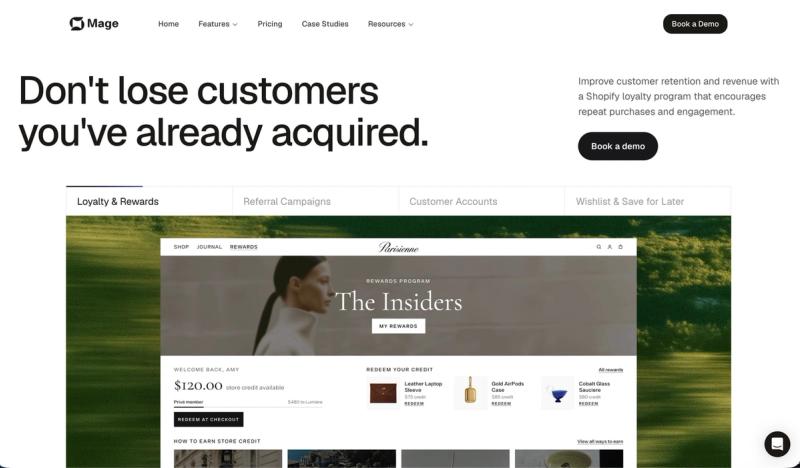
At the time of writing, Mage Loyalty positions itself as a Retention & Loyalty platform built for Shopify brands. It is designed for merchants that want a program extending beyond points and discounts, including referrals, VIP tiers, branded account experiences, wishlists and retention campaigns.
In practice, merchants configure the core program from one Shopify-focused platform, then decide where customers encounter it: a loyalty page, Rewards Widget, account drawer, checkout or Shopify POS. A Shopify loyalty program can earn and redeem across those surfaces rather than relying on a single floating widget.
Key features and strengths
- Mage Canvas: Build loyalty, account, referral and wishlist surfaces without code.
- Checkout and POS: Customers can redeem rewards at Shopify Checkout and Shopify POS.
- Mage Accounts: A branded on-site account drawer sits on top of Shopify customer accounts.
- VIP and referrals: Configure up to ten VIP tiers, two-sided rewards and referral fraud controls.
- Developer toolkit: REST API, JavaScript SDK, Metafields and Webhooks support custom builds.
- Migration options: Built-in importers for some platforms and CSV import support data moves.
Best for: Shopify brands that need marketers to own the day-to-day program while developers retain room to build custom storefront or data workflows.
What is Smile.io?
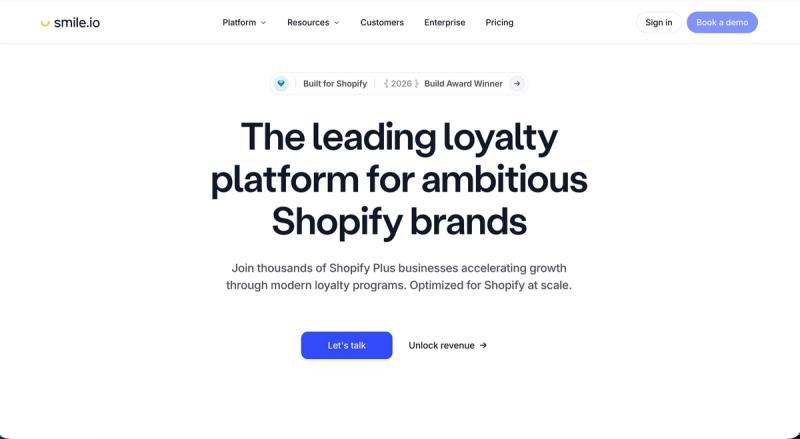
At the time of writing, Smile.io positions itself as a Shopify-native loyalty and rewards platform with points, referrals, VIP tiers and dedicated loyalty experiences. Its offering is organized around loyalty mechanics, defined plan tiers and reporting depth as a brand grows.
In practice, merchants configure points earning and redemption rules, referral offers and VIP benefits, then surface those elements through a dedicated loyalty page and product-page embeds. Its paid tiers add more program depth over time, including checkout redemption, a VIP program and API access.
Key features and strengths
- Points and referrals: Configurable earn and burn rules plus referral rewards across paid plans.
- Loyalty surfaces: Dedicated loyalty pages and product-page embeds are listed on Smile.io pricing.
- VIP program: VIP benefits and Loyalty Hub are available on Growth and above.
- Checkout redemption: Redeem-at-checkout functionality begins on Growth.
- Enterprise support: Plus adds migration support, priority support and API access.
Best for: Merchants that value a structured loyalty program, established reporting and clearly defined order-volume tiers. Brands looking for a more connected retention stack can also assess Mage as a Smile.io alternative.
What is Rivo?
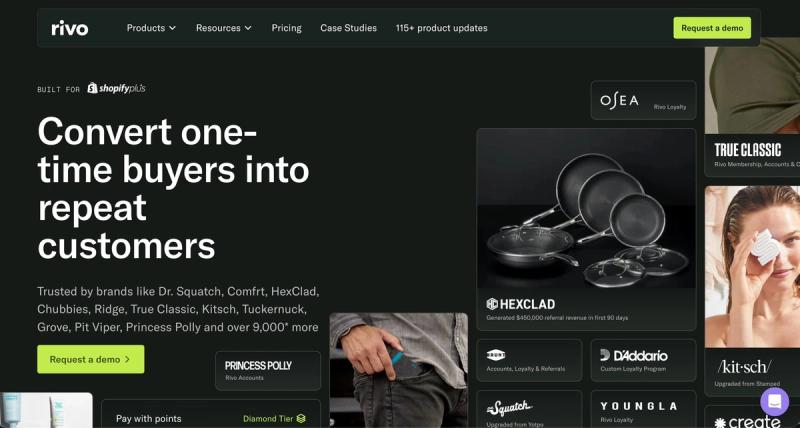
At the time of writing, Rivo positions itself as a Shopify-focused retention platform covering customer accounts, loyalty, referrals and memberships. Its product scope reaches beyond a standard points program into account experiences, checkout workflows and membership-led retention.
In practice, merchants combine loyalty rules with accounts, referral campaigns, memberships, POS activity and developer tooling. The platform is aimed at brands that want a broad Shopify retention stack rather than a narrower loyalty deployment.
Key features and strengths
- Retention suite: Accounts, loyalty, referrals and memberships are part of its core positioning.
- Customer accounts: Rivo Accounts provides an enhanced customer portal with multiple sign-in options.
- Shopify workflows: Its published pricing details cover Shopify POS and checkout extensions.
- Memberships: Paid memberships are part of Rivo’s broader retention-platform positioning.
- Scale and customization: Rivo’s pricing structure describes Scale, Plus and Custom options with broader feature access.
- Ecosystem breadth: Rivo publishes a broad feature and integration catalogue.
Best for: Shopify-focused brands seeking a broad retention suite where customer accounts, memberships and a large integration footprint are central requirements.
Mage Loyalty vs Smile.io vs Rivo: detailed comparison
Shortlisting decisions are usually made after the feature checklist. The practical questions are who owns the program, where customers interact with it, how it works in checkout and POS, and what happens when order volume and technical requirements increase.
1. Program philosophy and operating model
If you want your ecommerce team to run rewards, referrals, VIP status and customer-facing retention experiences from one place, ask each vendor to show a marketer changing an earning rule, launching a campaign and updating the storefront presentation.
Mage Loyalty. Mage combines points, store credit, VIP tiers, referrals, wishlists, account experiences and Shopify POS workflows. Mage Canvas gives marketing teams control of customer-facing surfaces, while technical teams can work through the API, SDK, Metafields and Webhooks.
Smile.io. Smile.io centers on a structured loyalty model with points, referrals, VIP programs and a dedicated loyalty experience. Its plan structure is particularly clear for brands that want their loyalty operation organized around established tiers and reporting.
Rivo. Rivo takes a broad retention-platform approach, spanning loyalty alongside customer accounts, referrals and memberships. That scope can suit brands making accounts and membership programs central to their retention plan.
Verdict: For a team balancing marketing ownership with custom development, Mage provides the most connected operating model in this comparison. Smile.io keeps the focus on structured loyalty operations, while Rivo is relevant when a wider retention stack is the central requirement.
2. Setup and time to launch
If you are replacing an existing program before a campaign or seasonal launch, ask each vendor to show its data-import process, tier mapping, rule recreation, testing process and customer communication plan.
Mage Loyalty. Mage says most merchants have a program live in a day, although migration preparation can add time. Its migration workflow supports built-in importers for some platforms and CSV import for other sources.
Smile.io. Smile.io offers migration and launch support on Plus. That can matter for merchants who prefer a plan-based onboarding package and structured launch assistance.
Rivo. Rivo’s onboarding and migration scope should be confirmed before committing, including which customer data, rules and program settings are included in the move.
Verdict: Mage is practical for teams that want to configure the program themselves while retaining migration flexibility. Before moving data, migrate from Smile.io without losing customer points by exporting balances and mapping tier names before import.
3. Customer-facing experience and branding
If your loyalty program needs to look like part of your storefront rather than a separate utility, ask each vendor to demonstrate loyalty pages, widgets, account experiences, product-page placements and styling controls without developer involvement.
Mage Loyalty. Mage Canvas covers the dedicated loyalty page, Rewards Widget, account sidebar, referral campaigns, wishlist and saved-for-later surfaces. Mage Accounts provides a branded drawer on the storefront instead of sending customers away to a separate login page.
Smile.io. Smile.io supports a dedicated loyalty page and product-page embeds. Its loyalty experience is built around surfacing points, rewards and status through those customer-facing placements.
Rivo. Rivo includes customer accounts as part of its broader retention platform. Confirm the styling controls and customer-facing placement options required for your storefront in a demo.
Verdict: Mage offers the broadest documented set of connected, no-code customer-facing surfaces here. Smile.io is well suited to loyalty-page-led programs, while Rivo deserves consideration when the account experience is part of a wider retention requirement.
4. Checkout, POS and omnichannel
If you run multiple retail stores and staff redeem rewards at the till, ask each vendor to show customer lookup, balance visibility, reward redemption and refund handling inside Shopify POS, then show the same customer at online checkout.
Mage Loyalty. Mage supports Shopify Checkout, Checkout Extensions and a Shopify POS tile. Staff can look up a customer, view balances and redeem available rewards against the same balance used online.
Smile.io. Smile.io offers redeem at checkout from Growth onward. Its pricing materials position this as part of the more advanced loyalty program tier.
Rivo. Rivo lists Shopify POS integration on Essential and checkout extensions on Plus. Its Shopify focus makes POS and checkout relevant areas to assess in its demo.
Shopify itself supports app extensions across the Online Store, checkout, customer accounts and POS through its app extension framework. Shopify POS customer profiles can also retain customer history, preferences and loyalty-related data.
Verdict: Brands that need one connected balance for online and POS earning and redemption have a clear reason to prioritize Mage. Smile.io and Rivo both support relevant Shopify workflows, but the required checkout and POS experience should be confirmed against the selected plan.
5. Referrals, VIP tiers and engagement
If your goal is to increase repeat purchase frequency while acquiring customers through referrals, ask each vendor to show referral attribution, reward timing, VIP qualification, fraud controls and the process for launching a time-limited points campaign.
Mage Loyalty. Mage supports points, store credit, VIP tiers, basic referrals and more configurable referral campaigns. Its referral controls can block self-referrals, duplicate accounts, email aliases, shared IP patterns and other suspicious activity before a reward is issued.
Smile.io. Smile.io includes points, referrals and VIP programs. It also lists points-weekend functionality for merchants planning simple engagement campaigns.
Rivo. Rivo supports loyalty points, cashback, VIP tiers, referrals, memberships and fraud protection as part of its broader retention offering.
Verdict: Each platform covers core loyalty mechanics, but Mage is the more operationally flexible option for teams that need referral fraud controls, configurable VIP rules and campaign tools connected to the wider customer experience.
6. Integrations, data and developer flexibility
If you use an email platform, subscriptions app and custom storefront workflows, ask each vendor to show which data syncs out, what events are available, how API access works and how a developer would build a custom experience.
Mage Loyalty. Mage supports Klaviyo, Recharge, Shopify Flow and other tools across email, SMS, reviews, subscriptions, support and returns. The Mage integrations directory covers the supported ecosystem, while its API, JavaScript SDK, Metafields and Webhooks support custom work.
Smile.io. Smile.io provides API access on Plus and Enterprise. Its reporting and loyalty structure can suit teams whose primary integration requirement is connecting a mature loyalty program to their existing stack.
Rivo. Rivo publishes broad integration coverage and an open API platform, while its Developer Toolkit and custom integrations are positioned on Plus. This is relevant for agencies and technical teams building beyond standard loyalty flows.
Verdict: Mage gives marketers a no-code operating path and developers dedicated tools for custom work. Rivo is also relevant for teams assessing a broad Shopify ecosystem, while Smile.io’s API access becomes more relevant at its higher tiers.
7. Support, onboarding and migration
If your team has limited time to configure the program or needs technical input during launch, ask each vendor who owns onboarding, how quickly support reaches product specialists and what migration work is included.
Mage Loyalty. Mage offers founder-led support with direct Slack access to the engineers building the platform. Its migration approach includes supported importers, CSV options and tier-matching guidance before customer data is imported.
Smile.io. Smile.io adds migration and launch support, quarterly program monitoring and priority support on Plus. That creates a defined support model for brands operating at that level.
Rivo. Rivo publishes human-support and broader onboarding options. Confirm the support scope and migration responsibilities for the required plan.
Verdict: Mage stands apart for teams that value direct access to the people building the product during setup and beyond. Smile.io provides a structured higher-tier support path, while Rivo’s support and migration responsibilities should be assessed against the plan under consideration.
Want to see how Mage handles these workflows on your store? Book a demo.
Pricing compared
See the pricing table below for plan details. Mage Loyalty uses monthly plans with included orders, per-order overage on Starter and Growth, and no annual contract. Smile.io uses tiered SaaS pricing by monthly order volume across Standard, Growth, Plus and Enterprise tiers, while Rivo uses pricing based on monthly orders and feature access. Before signing, use this guide to budget for a loyalty program and model order growth, feature gates, modules, overage and developer needs.
| Plan | Price | Orders included |
|---|---|---|
| Mage Loyalty | ||
| Essential | $15/month | 500 orders included |
| Starter | $49/month | 500 orders included, then $0.20 per order |
| Growth | $499/month | 2,500 orders included, then $0.15 per order |
| Enterprise | Custom, typically from around $999/month | Custom |
| Smile.io | ||
| Standard | $79/month | 1,000 orders/month included |
| Growth | $199/month | 2,500 orders/month included |
| Plus | $999/month | 7,500 orders/month included |
| Enterprise | Custom | Unlimited orders |
| Rivo | ||
| Essential | $15/month | Up to 500 orders/month |
| Scale | From $49/month, scales with orders | Around 500 orders/month, scales by volume |
| Plus | $499/month | Up to 2,500 orders/month |
What each platform costs at 500, 2,500, 5,000, 10,000 orders a month, using the cheapest plan that covers the volume:
| Orders per month | Mage Loyalty | Smile.io | Rivo |
|---|---|---|---|
| 500 | $15 Essential or $49 Starter (list) | $79 Standard (list) | $15 Essential or $49 Scale (list) |
| 2,500 | $449 Starter or $499 Growth (est.) | $199 Growth (list) | $499 Plus (list) |
| 5,000 | $874 Growth (est.) | $999 Plus (list) | Custom quote |
| 10,000 | $1,624 Growth or Enterprise quote (est.) | Custom quote | Custom quote |
How to read these tables: "list" is the public list price on the vendor's pricing page or Shopify App Store listing, "est." is calculated from the published plan price and overage rate, "Custom quote" means the vendor only prices on request, and "Not published" means no public figure exists at that volume. Prices checked September 2026. Sources: Mage Loyalty pricing; Smile.io pricing, Smile.io on the Shopify App Store; Rivo pricing, Rivo on the Shopify App Store.
- Mage Loyalty at 2,500 orders: Starter is $49 plus $0.20 per order over 500; Growth includes 2,500 orders.
- Mage Loyalty at 5,000 orders: $499 plus $0.15 per order over 2,500.
- Mage Loyalty at 10,000 orders: $499 plus $0.15 per order over 2,500; Enterprise is quoted on volume, typically from around $999.
- Smile.io at 500 orders: Includes 1,000 orders.
- Smile.io at 2,500 orders: Includes 2,500 orders.
- Smile.io at 5,000 orders: Includes 7,500 orders.
- Smile.io at 10,000 orders: Enterprise above 7,500 orders.
- Rivo at 2,500 orders: Scale brackets above 500 orders are not published.
- Rivo at 5,000 orders: Plus covers up to 2,500 orders.
Pros and cons
Mage Loyalty
Pros
- Shopify-focused retention platform
- Mage Canvas no-code control
- Connected checkout and POS workflows
- Branded account and loyalty surfaces
- API, SDK, Metafields and Webhooks
Cons
- Built exclusively for Shopify
- Accounts are higher-plan features or paid modules
- Memberships are higher-plan features or paid modules
- Cashback is a higher-plan feature or paid module
Smile.io
Pros
- Clearly defined monthly order tiers
- Dedicated loyalty page and embeds
- Structured points and referral model
- Specialist reporting by plan
- Higher-tier migration and API access
Cons
- Order caps vary by tier
- VIP and checkout redemption begin on Growth
- API access begins on Plus
- Advanced tiers carry higher subscription costs
Rivo
Pros
- Broad Shopify retention scope
- Customer accounts and memberships
- Shopify POS support
- Checkout extension capability
- Broad feature and integration catalogue
Cons
- Feature access varies by plan
- Broader scope may exceed loyalty-only needs
- Developer access is positioned on higher plans
- Custom integrations are positioned on higher plans
Which should you choose?
Choose Mage Loyalty if
- Your program needs to work across storefront, checkout and Shopify POS.
- Marketing needs to update campaigns and customer-facing surfaces without code.
- Developers need API, SDK, Metafields or Webhooks for custom workflows.
- You want loyalty, referrals, VIP tiers, accounts and wishlists connected.
- You are moving platforms and need points balances and tier status prepared for import.
Smile.io may suit you if
- You want a structured loyalty model with clearly defined plan tiers.
- Reporting depth and a loyalty-page-led experience are your main priorities.
Rivo may suit you if
- Customer accounts and memberships are central to a broader retention plan.
- Your team values a broad published integration and feature footprint.
Final verdict
Mage Loyalty is the recommended choice for most Shopify brands because it connects loyalty operations to the customer experience customers actually use. It supports Shopify Checkout, Shopify POS and customer account workflows, while Mage Canvas lets marketers shape loyalty, referral, account and wishlist surfaces without handing every change to developers.
It also gives technical teams room to build through a REST API, JavaScript SDK, Metafields and Webhooks. That combination matters once a brand has outgrown a basic points widget and needs loyalty, referrals, VIP tiers, account experiences and retention data to work together.
Smile.io may suit merchants that prefer a structured loyalty product with established reporting and clearly defined order-volume tiers. Rivo may suit brands that want a broad Shopify retention suite where accounts, memberships and an extensive integration footprint are the main buying criteria.
Frequently asked questions
Is Mage Loyalty a good alternative to Smile.io and Rivo?
Mage Loyalty is a good alternative to Smile.io and Rivo for most Shopify brands that want loyalty, referrals, VIP tiers, POS, branded customer experiences and developer flexibility in one platform. Smile.io may fit a more structured loyalty-first model, while Rivo may fit brands prioritising a wider retention suite with accounts and memberships.
Is Smile.io good for Shopify Plus brands?
Smile.io is a structured loyalty platform that can suit larger Shopify brands when its order-volume tiers, reporting needs and higher-tier support model match the program. Merchants should assess whether its available migration support, program monitoring, priority support and API access match their operating requirements.
What should Shopify brands prioritise in a loyalty platform?
Shopify brands should prioritise the customer behavior they need to change first, such as repeat purchase, larger baskets, referrals or in-store retention. Then assess earning rules, checkout redemption, POS workflows, customer-facing experience, reporting and integration ownership. A long feature list matters less than whether customers and staff will actually use the program.
When should a business switch loyalty platforms?
A business should switch loyalty platforms when its current program limits the customer experience, creates disconnected workflows or becomes difficult to operate as the brand grows. Prepare the move by exporting balances, mapping VIP tiers, testing earning and redemption rules, confirming integrations and explaining the change clearly to members before launch.
What matters more in year two than in year one?
Year-two loyalty decisions depend more on order growth, overage, higher-plan feature access, reporting quality and integration maintenance than initial setup. Merchants should also consider whether marketing can run campaigns independently, whether operations can support POS and checkout workflows, and whether developers can maintain the required custom connections.
Who should own a loyalty program after launch?
A loyalty program should be owned jointly by marketing, ecommerce operations and technical teams. Marketing should manage rewards, campaigns and customer messaging, while operations owns checkout and POS workflows. Developers or agencies should manage API, headless and custom integration work, while Mage Canvas can keep routine customer-facing changes with marketing.
Ready to see Mage in action? Book a demo.

Graeme is the co-founder at Mage Loyalty. He heads product development, from complex loyalty migrations and large-scale data handling to building the features shaping the future of loyalty on Shopify.