In this Rivo vs Yotpo comparison, Mage Loyalty, Rivo and Yotpo all run loyalty and referral programs for Shopify merchants, but they are built around different operating models. Mage Loyalty is a dedicated Shopify retention platform, Rivo combines Shopify accounts, loyalty and memberships, while Yotpo combines loyalty with reviews, UGC and AI visibility tools. Each can fit a particular stack, but Mage Loyalty is the strongest fit for most Shopify brands that want focused retention tooling with control over the customer experience.
TL;DR
- Mage Loyalty, Rivo and Yotpo all support loyalty and referrals, but Mage focuses on dedicated Shopify retention, Rivo on Shopify-centric retention workflows, and Yotpo on a broader UGC and marketing suite.
- Mage Loyalty is built exclusively for Shopify, combining loyalty, branded accounts, wishlists, referrals, Shopify Checkout, POS and developer tools.
- Rivo is built around Shopify customer accounts, loyalty, referrals, memberships, checkout and POS.
- Yotpo combines loyalty and referrals with reviews, UGC syndication and AI visibility tooling.
- Mage Loyalty is the stronger fit for most Shopify brands that want branded retention experiences, no-code control, developer flexibility and monthly pricing. Rivo may suit account and membership-led teams, while Yotpo may suit brands consolidating loyalty with reviews and UGC.
“We are really happy with working with the Mage team and getting this program up and running. They are very responsible and professional. Very seamless and the upsell features seem to already be helping with adoption!”


Read the Tea Drops case study →
Quick snapshot
| Decision factor | Mage Loyalty | Rivo | Yotpo |
|---|---|---|---|
| Positioning | Dedicated Shopify retention platform | Shopify-focused retention platform | Loyalty and UGC suite |
| Best fit | Retention-focused Shopify brands | Accounts and memberships focus | Broader martech consolidation |
| Setup effort | No-code or custom build | Shopify-native configuration | Multi-product implementation |
| Customer-facing surfaces | Accounts, widget, loyalty page, wishlist | Accounts and loyalty surfaces | Loyalty experience and reviews |
| Checkout and POS | Checkout Extensions and POS | Checkout and POS integrations | Confirm scope in demo |
| Referrals and VIP | Campaigns, tiers, fraud controls | Referrals, tiers, fraud protection | Premium loyalty capabilities |
| Integrations and developer access | API, SDK, Metafields, Webhooks | API and developer toolkit | Broad martech connectivity |
| Analytics | Loyalty, referral and retention reporting | Loyalty and account analytics | Loyalty and review analytics |
| Support model | Founder-led Slack access | Human support | Confirm support package |
| Pricing model | Monthly usage-based plans | Tiered order-based access | Free, volume-priced Pro, custom Premium |
Updated September 2026.
What is Mage Loyalty?
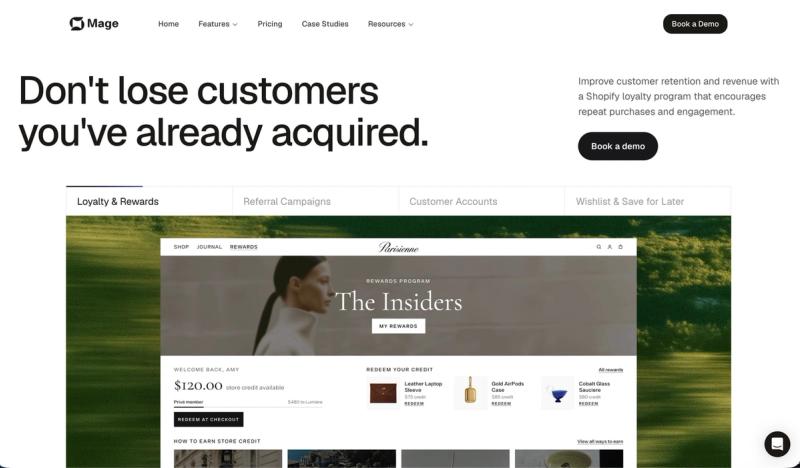
At the time of writing, Mage Loyalty positions itself as a retention and loyalty platform built exclusively for Shopify brands. It is designed for brands that want points, rewards, referrals, VIP tiers and customer-facing retention surfaces without stitching together separate loyalty tools.
In practice, marketing teams can build and update customer-facing experiences in Mage Canvas, while developers can extend the program through a REST API, JavaScript SDK, Shopify Metafields and Webhooks. The platform covers the loyalty journey from a branded account drawer to checkout redemption and Shopify POS.
Key features and strengths
- Shopify loyalty engine: Build a Shopify loyalty program with points, rewards, store credit, referrals and VIP tiers.
- Checkout and POS: Customers can redeem rewards at Shopify Checkout, while staff can view balances and apply rewards in Shopify POS.
- Customer experience: Mage Accounts, the Rewards Widget, loyalty pages, wishlists and referrals can share one branded experience.
- VIP tiers: Create up to 10 VIP tiers using spend, points or order thresholds.
- Developer flexibility: REST API, JavaScript SDK, Metafields and Webhooks support custom storefronts and workflows.
- Support and migration: Founder-led support includes direct Slack access to the engineers building Mage.
Best for: Shopify and Shopify Plus DTC brands that want one retention and loyalty system across online storefronts, checkout, POS, customer accounts and lifecycle marketing.
What is Rivo?
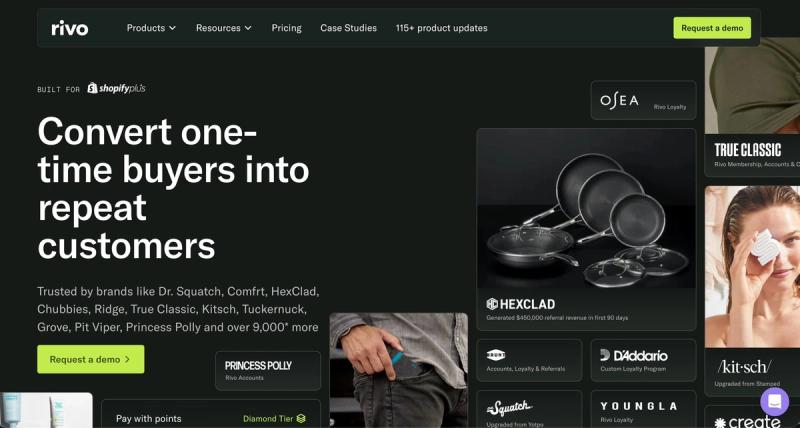
At the time of writing, Rivo positions itself as a Shopify-focused retention platform covering customer accounts, loyalty, referrals and memberships. Its product model is built around giving Shopify merchants account experiences and retention tools in one platform.
In practice, Rivo combines customer accounts with loyalty mechanics, cashback, memberships, referral programs and Shopify integrations. Its higher-tier offering includes checkout extensions, custom integrations, advanced analytics and a developer toolkit, as described on Rivo’s pricing page.
Key features and strengths
- Customer accounts: Rivo offers customer accounts alongside its retention tools.
- Loyalty mechanics: The platform supports points, cashback, VIP tiers, analytics and Shopify checkout integration.
- Referrals: Rivo supports referral programs and fraud protection.
- Memberships: Rivo includes memberships within its Shopify-focused retention platform.
- Shopify depth: Rivo supports Shopify POS, checkout integrations and customer account experiences.
- Developer tools: Its Shopify App Store listing describes open API and developer tooling access.
Best for: Shopify brands that want a retention platform centered on customer accounts, loyalty, referrals and memberships within an established Shopify-centric operating model.
What is Yotpo?
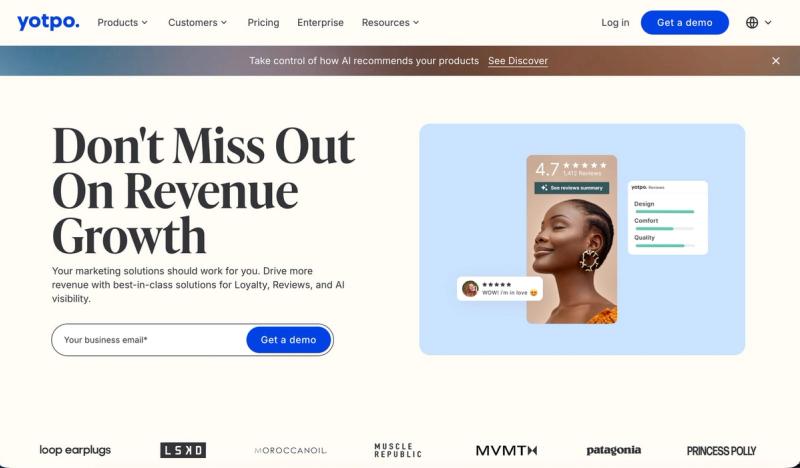
At the time of writing, Yotpo positions itself as a multi-product retention and UGC platform combining Loyalty and Referrals, Reviews and AI-based visibility tooling. Loyalty is one product area within a broader suite designed around customer feedback, product discovery and retention.
In practice, Yotpo can suit teams that want loyalty programs alongside review collection, UGC syndication, AI-based visibility tooling and broad martech connectivity. Its loyalty plans range from an entry-level option to public volume-priced Pro access and Premium custom pricing, according to Yotpo’s pricing page.
Key features and strengths
- Loyalty and referrals: Points and referral programs are available within Yotpo’s loyalty product.
- Reviews and UGC: Reviews and UGC syndication sit alongside loyalty.
- AI visibility: Yotpo provides AI-based visibility tooling.
- Integrations: The platform supports 180+ integrations across email, SMS, CRM and martech tools.
- Premium loyalty tools: VIP tiers, product-specific earning rules, custom actions and free product redemption sit on Premium.
Best for: Larger brands that value a broader retention and UGC suite alongside loyalty, particularly where reviews, syndication and extensive martech connectivity are part of the same operating plan.
Mage Loyalty vs Rivo vs Yotpo: detailed comparison
Shortlisting decisions are usually made after the feature checklist. The bigger questions are who owns the program, how it appears to customers, how it connects to Shopify, and what the platform costs to operate as volume and complexity increase.
1. Program philosophy and operating model
If you want one team to own repeat purchase, referrals, customer accounts and rewards, ask each vendor to show where a marketer builds campaigns, where developers extend the program and where customers see their balance.
Mage Loyalty. Mage is a dedicated Shopify retention platform. Its product is centered on loyalty, referrals, VIP tiers, accounts, wishlist activity, checkout and retention data rather than a broader reviews or UGC suite.
Rivo. Rivo combines Shopify customer accounts, loyalty, referrals and memberships. Its model can appeal to teams that want account experiences and membership mechanics closely connected to loyalty.
Yotpo. Yotpo positions loyalty alongside reviews, UGC and AI visibility. That broader scope can reduce vendor sprawl for brands that already want those functions managed through the same suite.
Verdict: Mage Loyalty is the clearer fit when retention is the primary operating discipline and you want focused ownership. Rivo is worth evaluating when accounts and memberships lead the brief. Yotpo has a narrower fit when loyalty must sit beside reviews and UGC.
2. Setup and time to launch
If your team needs a program live before a seasonal campaign, ask each vendor to demonstrate the path from program design to a published loyalty page, referral experience and reward redemption flow.
Mage Loyalty. Mage Canvas gives marketing teams a no-code builder for loyalty, account, referral and wishlist surfaces. Most merchants have a program live in a day, while migrations require data mapping and validation.
Rivo. Rivo offers Shopify-focused setup with loyalty, accounts and memberships in one platform. Your demo should clarify which configuration work, migration timing and ownership apply to your program structure.
Yotpo. Yotpo can involve a broader implementation when loyalty is being evaluated alongside reviews, UGC and other products. Ask to see the loyalty setup separately from the wider suite rollout.
Verdict: Mage Loyalty is well suited to teams that want marketers to configure and publish customer-facing retention surfaces themselves. Ask all three vendors to build your actual earning rules, referral offer and customer journey during the demo.
3. Customer-facing experience and branding
If your brand team cares about how loyalty looks on product pages, inside customer accounts and at checkout, ask each vendor to show the editable surfaces without using a developer.
Mage Loyalty. Mage Canvas controls the loyalty page, Rewards Widget, account sidebar, referral campaigns, wishlist and saved-for-later experiences. Mage Accounts places points, VIP progress, rewards and saved products in an on-site customer drawer.
Rivo. Rivo offers customer accounts, and its platform includes custom CSS on relevant plans.
Yotpo. Yotpo supports a customer-facing loyalty experience, but the provided sources do not establish the same account-drawer, wishlist or no-code surface model. Ask to see the exact storefront components available on your plan.
Verdict: Mage Loyalty has the clearest documented combination of connected account, loyalty, wishlist and referral surfaces in the supplied sources. That matters when loyalty, saved products and account activity should feel like one storefront experience.
4. Checkout, POS and omnichannel
If you run retail locations and staff redeem rewards at the till, ask each vendor to demonstrate the complete Shopify POS flow, then show the same customer using points online. Shopify apps can extend the Online Store, Checkout, customer accounts and POS.
Mage Loyalty. Mage supports Shopify Checkout, Checkout Extensions and Shopify POS. Staff can look up a customer, see their balance and apply a reward from the POS checkout screen.
Rivo. Rivo supports checkout and POS integrations as part of its Shopify-focused platform. Its higher-tier offering includes checkout extensions.
Yotpo. The supplied sources confirm loyalty and referrals but do not establish equivalent POS or checkout extension scope. Ask Yotpo to demonstrate the exact checkout and in-store workflow for your Shopify plan.
Verdict: Mage Loyalty and Rivo have documented Shopify checkout and POS depth. Mage is especially practical for merchants that need the same points and rewards balance to work across online checkout and POS.
5. Referrals, VIP tiers and engagement
If referral fraud is a concern or your program needs more than purchase points, ask each vendor to show a referral conversion, a blocked suspicious referral, VIP progression and a new campaign built by your marketing team.
Mage Loyalty. Mage supports points, store credit, VIP tiers and referral campaigns. It can create up to 10 tiers, and its fraud controls cover self-referrals, aliases, duplicate accounts, shared IPs, repeat devices and rapid referral bursts.
Rivo. Rivo supports loyalty, cashback, VIP tiers, referrals, memberships and fraud protection. Confirm the campaign and referral workflow details in a demo.
Yotpo. Yotpo supports points and referrals. VIP tiers, product or collection earning rules, scheduled earning rules, custom actions and free product rewards are listed as Premium capabilities.
Verdict: Mage Loyalty is the stronger fit for brands that want flexible loyalty and referral mechanics with clear fraud controls and a marketer-managed campaign layer. Rivo is relevant for membership-led programs. Yotpo can fit brands prepared to package advanced loyalty requirements into Premium.
6. Integrations, data and developer flexibility
If lifecycle marketing depends on points balances, tier changes and referral activity, ask each vendor to show the data objects, event flow, API access and how a developer would build a custom account or headless experience.
Mage Loyalty. Mage provides a REST API, JavaScript SDK, Metafields and Webhooks. Loyalty data syncs into Shopify Metafields, and the Klaviyo loyalty integration can sync points, VIP data and loyalty events into customer profiles.
Rivo. Rivo provides an open API and developer tooling. Its Plus tier includes custom integrations and checkout extensions, so technical teams should confirm access requirements before committing.
Yotpo. Yotpo’s pricing materials present the platform as part of a broad martech ecosystem. Its 180+ integrations can matter when loyalty data must connect with a large existing stack.
Verdict: Mage Loyalty gives both marketing and engineering teams a clear operating lane, with Mage Canvas for storefront control and developer tooling for custom work. Yotpo’s wider integration footprint may matter more for complex multi-product martech programs.
7. Support, onboarding and migration
If you are replacing an existing program, ask each vendor to show a migration worksheet covering points balances, point history, VIP tiers, birthdays, enrollment dates, pending rewards and customer communication before launch.
Mage Loyalty. Mage offers founder-led support with direct Slack access to its engineers. Its migration tooling can bring across points balances, point history, VIP tier status, birthdays and enrollment dates where available. Tier names must match exactly apart from letter case, as explained in its migration guide.
Rivo. Confirm the migration plan covering data validation, launch ownership and the post-launch support model.
Yotpo. Yotpo’s migration process should be evaluated alongside the loyalty product and any broader reviews or UGC implementation. Confirm which historical loyalty records, active referral links and reward states will transfer.
Verdict: Mage Loyalty has the clearest documented migration fields and a direct support model for brands that want technical access during setup. Whatever platform you choose, tier mapping and historical point validation need testing before customers are moved.
Want to see how Mage handles these workflows on your store? Book a demo.
Pricing compared
As of September 2026, Mage Loyalty uses monthly plans with included orders, per-order overage on Starter and Growth, and no annual contract. Rivo uses tiered pricing primarily surfaced through the Shopify App Store, based on monthly orders and feature access, while Yotpo uses public Pro pricing that scales with monthly order volume and Premium custom quotes. See the pricing table below, then budget for a loyalty program around order growth, overage, paid modules and higher-plan access.
| Plan | Price | Orders included |
|---|---|---|
| Mage Loyalty | ||
| Essential | $15/month | 500 orders included |
| Starter | $49/month | 500 orders included, then $0.20 per order |
| Growth | $499/month | 2,500 orders included, then $0.15 per order |
| Enterprise | Custom, typically from around $999/month | Custom |
| Rivo | ||
| Essential | $15/month | Up to 500 orders/month |
| Scale | From $49/month, scales with orders | Around 500 orders/month, scales by volume |
| Plus | $499/month | Up to 2,500 orders/month |
| Yotpo | ||
| Free | $0/month | Not published |
| Pro | From $199/month | Scales with order volume |
| Premium | Custom | Set by quote |
What each platform costs at 500, 2,500, 5,000, 10,000 orders a month, using the cheapest plan that covers the volume:
| Orders per month | Mage Loyalty | Rivo | Yotpo |
|---|---|---|---|
| 500 | $15 Essential or $49 Starter (list) | $15 Essential or $49 Scale (list) | $199 Pro (list) |
| 2,500 | $449 Starter or $499 Growth (est.) | $499 Plus (list) | $299 to $524 Pro (est.) |
| 5,000 | $874 Growth (est.) | Custom quote | Not published |
| 10,000 | $1,624 Growth or Enterprise quote (est.) | Custom quote | Not published |
How to read these tables: "list" is the public list price on the vendor's pricing page or Shopify App Store listing, "est." is calculated from the published plan price and overage rate, "Custom quote" means the vendor only prices on request, and "Not published" means no public figure exists at that volume. Prices checked September 2026. Sources: Mage Loyalty pricing; Rivo pricing, Rivo on the Shopify App Store; Yotpo pricing, Yotpo on the Shopify App Store.
- Mage Loyalty at 2,500 orders: Starter is $49 plus $0.20 per order over 500; Growth includes 2,500 orders.
- Mage Loyalty at 5,000 orders: $499 plus $0.15 per order over 2,500.
- Mage Loyalty at 10,000 orders: $499 plus $0.15 per order over 2,500; Enterprise is quoted on volume, typically from around $999.
- Rivo at 2,500 orders: Scale brackets above 500 orders are not published.
- Rivo at 5,000 orders: Plus covers up to 2,500 orders.
- Yotpo at 500 orders: Entry point of the Pro slider; Premium features are quote only.
- Yotpo at 2,500 orders: Slider shows $299 at 1,000 and $524 at 3,500 orders.
- Yotpo at 5,000 orders: Slider figures above 3,500 orders are not shown publicly.
- Yotpo at 10,000 orders: Slider figures above 3,500 orders are not shown publicly.
Pros and cons
Mage Loyalty
Pros
- Shopify-native checkout and POS support
- Mage Canvas for no-code control
- API, SDK, Metafields and Webhooks
- Branded accounts, loyalty and wishlist surfaces
- Founder-led support and direct Slack access
Cons
- Available only for Shopify brands
- Some capabilities sit on higher plans or paid modules
- Requires program strategy and configuration from your team
Rivo
Pros
- Shopify-focused customer accounts and loyalty
- Memberships and cashback support
- Checkout and POS integrations
- Open API and developer tooling
- Strong Shopify-centric product scope
Cons
- Feature access varies by tier
- Checkout extensions sit on higher-tier access
- Custom integrations and advanced analytics require higher-tier access
Yotpo
Pros
- Free entry-level loyalty tier
- Public Pro volume pricing
- Reviews and UGC alongside loyalty
- AI visibility tooling
- Broad martech integration coverage
Cons
- VIP tiers, earning rules, custom actions and free products sit on Premium
- Premium pricing requires a custom quote
- Broader suite scope may exceed a loyalty-focused brief
Which should you choose?
Choose Mage Loyalty if
- You want a Shopify-native loyalty platform rather than a broader suite.
- Marketing needs control over loyalty, account, referral and wishlist surfaces.
- Your program needs Shopify Checkout and Shopify POS support.
- Developers need APIs, Metafields, Webhooks or headless flexibility.
- You want monthly usage-based pricing and founder-led support.
Rivo may suit you if
- Your retention plan is strongly centered on customer accounts, memberships and loyalty.
- Your team prefers Rivo’s existing Shopify-focused operating model and feature packaging.
Yotpo may suit you if
- You want loyalty alongside reviews, UGC syndication and AI visibility tooling.
- Your team needs a broad martech suite with extensive integration coverage.
Final verdict
Mage Loyalty is the recommended choice for most Shopify brands because it combines Shopify Checkout, POS, branded customer-facing surfaces and a practical split between no-code control and developer flexibility. Mage Canvas gives marketing teams ownership of the storefront experience, while APIs, Metafields and Webhooks support custom retention workflows as the program grows.
Rivo may suit brands whose retention plan centers heavily on customer accounts and memberships. Yotpo may suit larger teams that want loyalty managed alongside reviews, UGC and AI visibility tooling.
For a focused Shopify retention system with points, referrals, VIP tiers, checkout, POS and direct support, Mage Loyalty is the more practical default.
Frequently asked questions
Is Mage Loyalty a good alternative to Rivo and Yotpo?
Mage Loyalty is a good alternative to Rivo and Yotpo for most Shopify brands that want a dedicated retention platform with loyalty, referrals, VIP tiers, customer-facing account surfaces, checkout and POS support. Rivo may fit account and membership-led programs, while Yotpo may fit brands that need loyalty alongside reviews, UGC and AI visibility.
Is Rivo good for Shopify Plus brands?
Rivo is a Shopify-focused retention platform with customer accounts, loyalty, referrals, memberships, checkout integrations, POS support and developer tooling. Shopify Plus brands should verify the exact checkout extension scope, account behavior, support package and pricing at their projected monthly order volume before selecting a plan.
What loyalty capability should a Shopify brand prioritise first?
A Shopify brand should prioritise the loyalty capability that supports its main retention objective, such as repeat purchases, larger orders, referrals or subscription retention. Then assess earning rules, rewards, checkout redemption, customer-facing surfaces, lifecycle data sync and reporting against that objective rather than selecting software by feature count.
When should a Shopify brand switch loyalty platforms?
A Shopify brand should switch loyalty platforms when its current setup limits customer experience, Shopify integration, referral controls, reporting, support or long-term economics. Plan the move around balances, point history, VIP tiers, birthdays, enrollment dates, active rules, pending rewards, customer communication and testing before launch.
What matters more in year two than in year one?
Year two matters more for order-volume pricing, overage, higher-plan features, paid modules, reporting depth, integration maintenance and internal ownership. Launch speed matters early, but a mature program also needs a platform that supports new requirements across POS, checkout, customer accounts, referrals and membership workflows.
Who should own a loyalty program after launch?
A loyalty program should have one accountable owner in ecommerce, retention or CRM, supported by marketing and technology teams. Marketing can manage campaigns and customer-facing content, while technology maintains integrations and data quality. Mage Canvas supports marketing control, while Mage developer tools support custom workflows.
Ready to see Mage in action? Book a demo.

Graeme is the co-founder at Mage Loyalty. He heads product development, from complex loyalty migrations and large-scale data handling to building the features shaping the future of loyalty on Shopify.