This guide covers customer referral programs — how brands turn existing customers into a new-customer acquisition channel. If you're researching employee or employment referrals, that's a different topic.
A referral program is a structured system where existing customers recruit new ones in exchange for a reward — and usually the new customer gets a reward too. When that loop runs well, it's one of the most cost-efficient acquisition channels available to a Shopify brand.
Key Insights
- Referred customers cost 5–7× less to acquire than paid-channel customers.
- Two-sided referral programs — advocate and friend both rewarded — convert 40–100% better than one-sided.
- Referred customers have 16–25% higher lifetime value than non-referred customers (Wharton, multiple Nielsen studies).
- Healthy participation is 5–15% of an active customer base sending at least one referral per year. Below 3% means the program is invisible.
- SMS is the dominant share channel (~45% of referral shares). Optimize the share UX for text first.
- Most Shopify brands benchmark at $10/$10 or $15/$15 store credit for both sides — symmetry and simplicity outperform complexity.
What is a referral program?
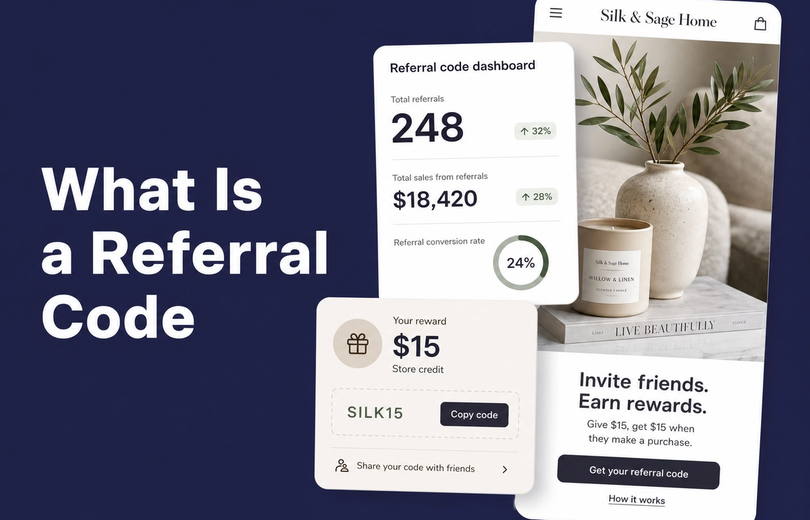
A referral program is a formal customer-acquisition mechanism that rewards existing customers — the advocates — for bringing in new customers — the friends. The brand sets the reward structure, provides the sharing tools, tracks conversions, and issues incentives automatically when a referred friend makes a qualifying purchase.
It's distinct from word-of-mouth marketing, which is organic and unmeasured. A referral program is structured: links are tracked, rewards are predefined, and results are attributable.
A referral program is a specific tactic inside the broader practice of loyalty marketing — where existing customers actively recruit new customers in exchange for a reward.
The core value proposition is economics. Referred customers cost 5–7× less to acquire than customers from paid channels because a trusted peer is doing the persuasion work. No CPM, no CPC, no ad creative — just a reward paid post-conversion, when you already have revenue to offset it.
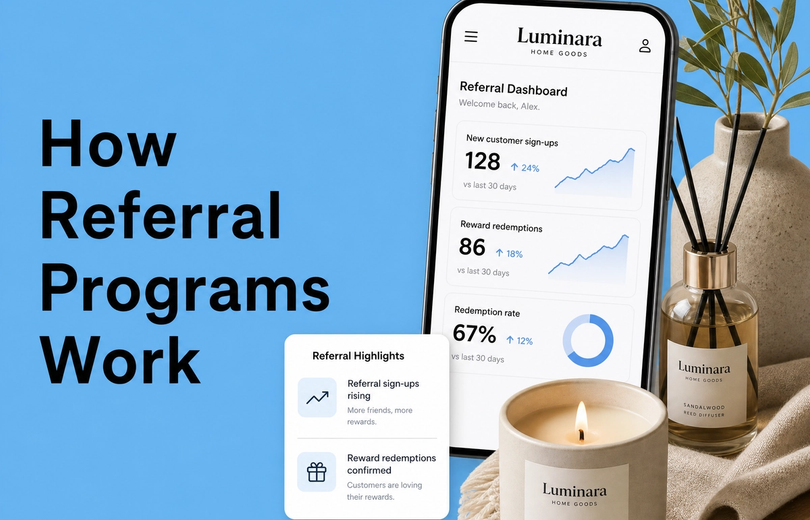
How a referral program works
- Advocate gets a unique referral link — tied to their customer account, shareable via SMS, email, or social.
- Friend clicks the link and lands on the site, often with a discount pre-applied to their cart.
- Friend completes a qualifying purchase — usually within a 30–90 day attribution window from click.
- Both sides receive their rewards — advocate gets store credit or points, friend gets their welcome discount.
- Cycle repeats — advocates keep sharing as long as the reward is worth their effort.
A two-sided referral program — one where both the advocate and the friend get rewarded — typically converts 40–100% better than a one-sided program, and the math is straightforward. The friend has a reason to act on the referral instead of ignoring it, and the advocate has a reason to share more than once. Most Shopify brands settle on $10 store credit for both sides on first purchase, or 10% off for the friend and a $5 reward for the advocate. The ratio matters less than the symmetry.
Some brands tier the rewards — base members get $10 store credit per referral, while VIP tiers earn $25. That compounds the program's LTV impact because the customers most likely to refer are also your highest-value segment.
Attribution window matters. Thirty days is standard for fast-moving consumer goods. Ninety days is more appropriate for considered purchases — apparel, electronics, home goods — where the friend needs time to think before converting.
The key types of referral program
Referral programs cluster into a few reward shapes. The right one depends on your margin structure and what your customers actually value.
Store credit is the most effective reward for repeat-purchase brands. Discount codes are simpler to implement, but store credit tends to lift repeat purchase rate by ~10–15% over a flat discount because it carries forward to a future order — the advocate has to come back to redeem it.
Points-based referrals are common in programs that already run a points economy. The advocate earns a points bonus; the friend gets a welcome points grant. This works well when your points have clear, desirable redemption options.
Cash or gift card rewards are typical in fintech and SaaS, where LTV justifies higher payouts ($25–$50+ both sides). For most Shopify brands selling physical goods, this is more cost than the margin can support.
Product rewards — a free item, a bundle add-on, a sample kit — work well for brands where product trial is itself a retention mechanism. They also sidestep the discount-conditioning problem.
Tiered rewards let you escalate payouts for high-volume advocates. Refer five friends and get a $50 bonus instead of the standard $10. Effective for category-specific brands with genuinely passionate customers.
Referral programs are one of several program shapes — see types of loyalty programs for the full breakdown of points, tiers, memberships, and referrals as distinct structures.
The most successful referral program examples
The best-known referral programs all share a common pattern: a two-sided reward structure, symmetry, and a product that customers already liked enough to tell people about.
Dropbox gave 500MB of free storage to both advocate and friend. Simple, tied directly to the product's value, zero cash outlay. At peak (2008–2010), 60% of Dropbox sign-ups came through referrals. The lesson: make the reward feel like more of the thing they already want.
Tesla ran a referral program in 2017 that drove over $1B in vehicle sales — supercharging credits, Powerwall unlocks, and Model Y access for top referrers. High-LTV product, high-LTV reward. The program proved that referral economics scale to almost any price point.
Bombas offers $20 store credit for both sides. Consistent, simple, well-matched to their AOV. It's been a reliable new-customer acquisition driver for years without structural changes.
Casper ran a $75/$75 credit program — one of the highest cash values in DTC at the time, justified by a $1,000+ mattress AOV. If your margin structure allows it, a premium reward signals a premium brand.
Allbirds uses $15/$15 credit — lower than Casper, appropriate for a $120–$160 shoe AOV. Consistent with their brand positioning: unpretentious, sustainability-first.
Outdoor Voices leaned on referrals as a primary acquisition channel during their 2018–2020 growth phase. That concentration in a single channel carries risk, but it validated that referrals can drive significant volume when a brand has genuine community affinity.
The pattern across all of these: reward symmetry, straightforward mechanics, and a product people genuinely wanted to share.
How to set up a referral program on Shopify
Operationally, setting up a referral program on Shopify has four phases:
1. Define your reward structure. Start with the benchmark: $10/$10 or $15/$15 store credit for both sides. Adjust based on AOV — a $200 AOV brand can absorb $20/$20; a $40 AOV brand might cap at $5/$5. Choose store credit over discount codes if you want the program to pull double duty as a retention lever.
2. Set your attribution window. Thirty days for high-frequency purchases, 90 days for considered purchases. Set this before launch — changing it retroactively creates attribution disputes.
3. Configure sharing channels. SMS should be the default share option — it drives ~45% of referral shares. Email gets ~25%. Social DM and messenger get ~15%. Copy-link covers the rest. Surface the referral share UI prominently in post-purchase confirmation and in the customer account portal, not just buried in a transactional email.
4. Install and integrate. On Shopify, the cleanest path is a native loyalty app that includes referrals as a built-in module — Mage's Shopify referral program is purpose-built for this. Native integration means the referral link is tied directly to the Shopify customer account, share events are logged, and rewards are issued automatically on conversion — no webhook duct-tape required.
The best referral programs are bolted onto a brand customers already like. Without that foundation — see what causes customer loyalty for the full breakdown — referrals don't compound. A mediocre product with a referral program just makes unhappy customers refer other people they don't like.
How to measure referral program success
Four metrics matter most.
Participation rate. The percentage of your active customer base that sends at least one referral per year. Healthy is 5–15%. Below 3% means the program is invisible — either no one knows it exists or the reward isn't worth the effort. Above 20% is rare and usually category-specific (creator economy, financial products, beauty).
Referral conversion rate. Of all referral links clicked, what percentage convert to a purchase? Typically 10–20% for a well-structured two-sided program. If this is low, the issue is usually either the friend landing experience or the welcome reward value.
Referred customer LTV. Track referred-customer customer lifetime value alongside acquisition cost — referred customers typically have 16–25% higher LTV than non-referred. If referred customers look exactly like everyone else on LTV, you may be attracting one-time buyers referred by advocates gaming the reward.
Advocate repeat rate. The fraction of participating advocates who refer more than once. If most advocates send exactly one referral and stop, the reward isn't compelling enough to sustain behavior — or you're not reminding them the program exists.
A healthy referral program also lifts customer retention indirectly — advocates are more loyal because they've publicly endorsed the brand. That social commitment effect is real and measurable in cohort data.
“Cannot say enough good things about the team at Mage Loyalty, one of the absolute best organizations we have ever worked with, full stop! So glad we connected with them, completely redid our loyalty program, new concepts, use of loyalty, increasing user engagement, showing us where we were not valuing our best customers, just WOW, amazing team!”


Read the West Coast Goalkeeping case study →
Frequently Asked Questions
What is a referral program?
A referral program is a structured customer-acquisition system where existing customers — advocates — earn rewards for bringing in new customers. The brand defines the reward, tracks referral links, and issues incentives automatically when a referred friend completes a qualifying purchase.
What's the difference between a one-sided and two-sided referral program?
A one-sided program rewards only the advocate. A two-sided program rewards both the advocate and the referred friend. Two-sided programs convert 40–100% better because the friend has a tangible reason to act on the referral instead of ignoring it.
What are the best referral rewards for Shopify brands?
Store credit is the most effective reward for repeat-purchase brands — it drives a return visit to redeem, lifting retention in the process. Most ecommerce brands benchmark at $10/$10 or $15/$15 for both sides. High-AOV brands can justify larger payouts (Casper ran $75/$75 against a $1,000+ mattress AOV).
How do I know if my referral program is working?
Track four metrics: participation rate (5–15% is healthy), referral conversion rate (10–20% is normal for two-sided programs), referred-customer LTV (should be 16–25% above non-referred), and advocate repeat rate — the share of advocates who refer more than once.
What's the right attribution window for a referral program?
Thirty days from referral click is standard for fast-moving consumer goods. For considered purchases — apparel, electronics, home goods — 90 days is more appropriate. Set the window before launch and don't change it retroactively.
Do referral programs work for Shopify brands with smaller audiences?
Yes, but the absolute numbers will be small early on. Referral programs compound over time as your customer base grows. Even 5% of 500 active customers sending one referral each generates 25 new-customer opportunities per year at 5–7× lower CAC than paid channels.
The best Shopify referral program for retention-driven brands
Mage Loyalty for Shopify bundles two-sided referrals with native Shopify customer-account tracking alongside points, VIP tiers, store credit, paid memberships, wishlists, AI receipt scanning, and a no-code editor — all from a single app, with native Shopify POS, customer-account, and checkout integration. Pricing starts at $49/month with no enterprise minimums.

Kris is the co-founder of Mage Loyalty. I spend most days talking to merchants, shipping features, and making sure our customers get real results. If you run a Shopify store or Agency we should chat!