Beauty brands operate in one of the most competitive industries on earth. Customer acquisition costs average $127, yet the real fortune lies in retention. Here's what most beauty merchants don't realize: your biggest revenue opportunity isn't finding new customers—it's turning the ones you already have into repeat buyers who spend 10 times more than first-time shoppers.
The beauty industry has a specific problem. Discovery is high. Loyalty is fleeting. A customer might buy a single foundation from you, then bounce to a competitor for their next purchase. Without intervention, your store becomes a one-time transaction rather than a relationship.
That's where loyalty programs enter. The best ones don't just offer discounts. They create emotional connections. They reward customers for actions beyond spending. They build community. And they fundamentally change customer behavior.
This guide breaks down 8 exemplary beauty loyalty programs, from Sephora's iconic tiered system to the community-driven approach of newer brands like OSEA Malibu. More importantly, you'll see exactly how to build your own standout program, step by step, regardless of your brand size or current resources.
Why Loyalty Is the Ultimate Growth Lever for Beauty Brands
Beauty customers are promiscuous. They experiment. They switch brands constantly. A skincare enthusiast might buy from five different brands in a single month, testing serums and moisturizers obsessively.
This creates a brutal math problem for brand owners. You spend $127 to acquire a customer, they buy once, and then vanish into the competitive wilderness. Most never return. The ones who do shop at competing brands simultaneously.
Retention flips this equation entirely.
Customer acquisition costs 5-7 times more than retention. A 5% increase in customer retention boosts profits by 25-95%. And customers in well-designed loyalty programs spend 3x more than non-members—with top-tier VIPs spending 10 times more.
The numbers from leading brands prove this works. Sephora's Beauty Insider program drives 80% of North American sales from just the members. Ulta's Ultamate Rewards account for over 95% of total sales, with 44.6 million active members. These aren't small percentages. This is dominance.
But the advantage goes beyond immediate revenue. Loyal customers become advocates. They leave reviews, refer friends, and post about your products on social media. They generate user-generated content that converts strangers at a 6x higher rate than traditional advertising. They become your unpaid marketing team.
In a market where acquisition costs keep climbing and attention spans keep shrinking, retention isn't just important. It's existential.
The Core Elements of a World-Class Beauty Loyalty Program
The best beauty loyalty programs share common DNA. Not because they copy each other, but because they've independently discovered what actually works.
Tiered systems create aspiration. Simple programs work fine for beginners. But tiered structures—where customers progress from Bronze to Silver to Gold—unlock something psychological. Each tier isn't just a reward level. It's a status symbol. Customers spend more to reach the next tier. They feel ownership of their achievement. Sephora's Insider, VIB, and Rouge tiers don't just segment customers. They create a ladder customers want to climb.
Diverse earning opportunities move beyond the transaction. Sephora members earn points for purchases, but also for leaving reviews, completing beauty quizzes, watching tutorials, and attending events. Charlotte Tilbury lets customers unlock rewards through quizzes and social shares. Lancôme rewards video testimonials. When earning becomes a habit across multiple touchpoints, loyalty deepens. Customers engage with your brand constantly, not just at checkout.
Experiences matter more than discounts. Here's what separates good programs from exceptional ones: exclusive experiences. Birthday gifts. Access to masterclasses. Early product launches. VIP shopping events. Personalized skin consultations. These create memories. A 20% discount fades from memory by next week. A private masterclass with a makeup artist becomes a story customers retell. Emotional connections drive lifetime value far more than percentage-off codes.
Personalization makes customers feel seen. Generic rewards feel... generic. "Here's a 10% coupon." A personalized reward feels different. "We noticed you love our rose hydration line. Early access to our new rose essence—launching tomorrow." Or birthday gifts tailored to past purchases. Or product recommendations based on browsing history. Personalization signals that you see customers as individuals, not transactions.
Omnichannel consistency prevents friction. If your online loyalty program doesn't sync with your retail store, you've created a frustrating experience. A customer earning points online should seamlessly use them in-store. Points earned in-store should reflect online. Inventory should be visible everywhere. This seamless experience matters intensely. Any friction gives customers a reason to shop competitors instead.
These elements work together. Tiered systems without diverse earning feel hollow. Personalization without omnichannel consistency feels incomplete. The best programs weave all of these together into a unified system.
The Shopify loyalty program growing brands trust
See how Mage helps Shopify brands lift repeat purchase rate with loyalty, referrals and store credit.
Book a demoOpinion Against Standard Advice: Why Points-Based Loyalty Isn't Always the Future for Gen Z Beauty Brands
Here's the contrarian take that most loyalty consultants won't say: pure points-based "earn and burn" systems are becoming less effective with Gen Z consumers.
Points systems work. They're simple, measurable, and proven. Accumulate 100 points, get a $10 discount. Clear math. Easy to understand. Most brands default to this model because it's familiar and low-risk.
But Gen Z consumers—now the fastest-growing customer segment in beauty—operate differently. They've grown up in a landscape of infinite loyalty programs. Every brand offers points. Every brand has a discount code. Points no longer feel special. They feel expected.
What actually moves Gen Z? Alignment with personal values. Community. Authenticity. Experiences that feel exclusive or aspirational. Brands that stand for something beyond selling products.
Look at OSEA Malibu. Their Sea Rewards program rewards eco-friendly actions—not just purchases. Earn points by choosing plastic-free packaging, supporting ocean conservation, or sharing sustainability tips. This isn't about discounts. It's about values. Customers feel like they're part of something meaningful. That emotional connection outlasts any percentage-off promotion.
Similarly, Ouai Obsessed doesn't primarily focus on transactional rewards. Instead, the program rewards community participation. Exclusive access to content. Early event invitations. Insider status. You're buying into membership in a tribe, not accumulating currency for discounts.
The data supports this shift. Research on Gen Z consumer behavior shows that 78% of Gen Z consumers are more likely to engage with brands aligned with their values. 71% expect personalized experiences. Community engagement drives higher lifetime value than discounts alone.
This doesn't mean abandon points entirely. Points have their place. But relying solely on "spend $100, get $10 off" is increasingly tone-deaf to younger customers. The most forward-thinking beauty brands are layering points with values-alignment, community-building, and experiential rewards. That's where the future lies.
“Cannot say enough good things about the team at Mage Loyalty, one of the absolute best organizations we have ever worked with, full stop! So glad we connected with them, completely redid our loyalty program, new concepts, use of loyalty, increasing user engagement, showing us where we were not valuing our best customers, just WOW, amazing team!”


Read the West Coast Goalkeeping case study →
8 Beauty Loyalty Programs Setting the Standard
These eight programs represent different approaches, price points, and brand philosophies. Each has something worth copying.
| Brand | Program Name | Tier Structure | Key Earning Methods | Standout Element |
|---|---|---|---|---|
| Sephora | Beauty Insider | Insider, VIB, Rouge | Purchases, reviews, events | Robust tiering driving 80% of sales |
| Ulta Beauty | Ultamate Rewards | Member, Platinum, Diamond | Purchases, referrals, social | 95% of sales from members |
| MAC | MAC Lover | Standard, Select, VIP | Purchases, social engagement | Product exclusivity and artistry focus |
| The Body Shop | Love Your Body | Points-based | Purchases, in-store visits | Alignment with ethical values |
| Lancôme | My Lancôme Rewards | Standard, Elite | Purchases, reviews, video testimonials | Hyper-personalization and high-touch |
| Charlotte Tilbury | Beauty Universe | Tiered with coins | Purchases, quizzes, social, reviews | Gamification and mystery rewards |
| OSEA Malibu | Sea Rewards | Tiered | Purchases, eco-friendly actions | Values-alignment and sustainability |
| Ouai | Ouai Obsessed | Membership-based | Community engagement, purchases | Exclusive content and insider access |
Sephora Beauty Insider: The Gold Standard of Tiered Loyalty
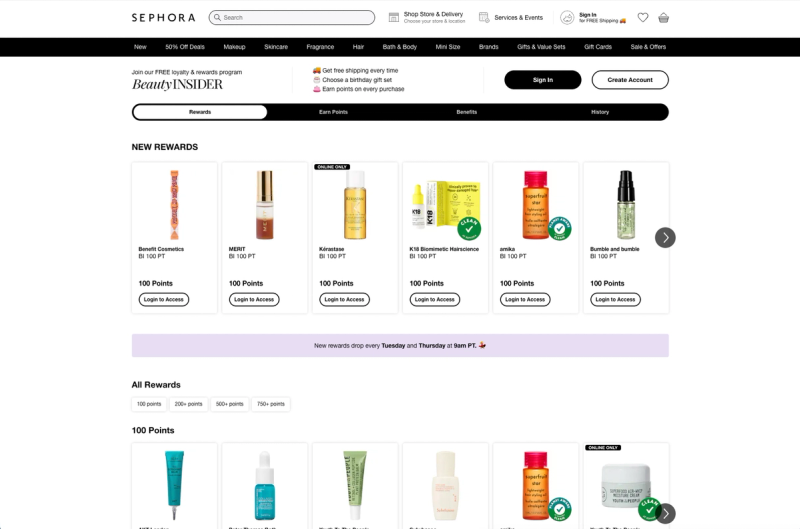
Sephora's Beauty Insider program is the industry benchmark. Three tiers—Insider (free), VIB (annual spend requirement), Rouge (higher annual spend)—create clear progression pathways.
Benefits escalate meaningfully. Insiders get birthday gifts and free samples. VIB members get access to exclusive events, priority customer service, and bonus point days. Rouge members receive free full-size products, VIP event invitations, and personalized shopping services.
The genius is that Sephora rewards engagement across channels. Shop in-store, get points. Write a review, get points. Attend a masterclass, get points. Complete a beauty quiz, get points. This diversified earning keeps customers engaged constantly.
The program drives obsessive results. Beauty Insider members account for 80% of Sephora's North American sales. Customers don't just shop more—they shop significantly more. Top-tier VIB and Rouge members spend 10x more than regular customers annually.
Takeaway for your brand: Don't be afraid to implement meaningful tier requirements. The gap between free and paid tiers creates psychological motivation. Customers will spend extra to reach the next level. Also, reward non-purchase engagement. Reviews and social interaction are free for your customers but incredibly valuable for your business.
You can read our guide on how to create a Loyalty Program Like Sephora's Beauty Insider on Shopify.
Ulta Beauty Ultamate Rewards: Accessibility Meets Scale
Ulta runs the largest loyalty program in beauty. 44.6 million active members. Their Ultamate Rewards program has three tiers (Member, Platinum, Diamond) with the lowest barrier to entry in the industry.
Even basic members earn points on every purchase. As members accumulate spending, they unlock Platinum (at $450 annual spend) and Diamond (at $1,200 annual spend) status. Each tier offers escalating benefits: free shipping, bonus points multipliers, exclusive sales, and birthday rewards.
The program's power lies in accessibility. Ulta democratized loyalty. You don't need to spend thousands to see benefits. Everyone gets points. Everyone gets birthday gifts. The tiers just amplify those benefits for heavier spenders.
The result? 95% of Ulta's total sales come from Ultamate Rewards members. Nearly all customers join. The program isn't exclusive—it's universal—which creates massive scale and data advantages.
Takeaway for your brand: Lower barriers to entry mean higher enrollment. Consider making your base tier free and unskippable. Tiering should feel aspirational, not gatekeeping. Small benefits for all members (points, birthday rewards) create baseline engagement that premium tiers then amplify.
MAC Lover: Building Community Around Artistry
MAC's loyalty program rewards a specific identity: the makeup artist and beauty enthusiast. The program tiers members based on spending, but the community focus is paramount.
MAC rewards customers for creating and sharing makeup looks using MAC products. The program celebrates artistry, not just consumption. Members unlock exclusive artist collaborations, limited edition products, and invitations to makeup masterclasses taught by professional artists.
This positions MAC Lover as membership in a tribe of creators, not just a point-accumulation system. The community aspect means members feel ownership. They're not just customers—they're artists. The emotional connection runs deeper than any discount.
Takeaway for your brand: If your customers have a strong identity or passion, build your program around that identity. MAC didn't create "Loyalty Program." They created "Lover"—membership in a community of passionate creators. This reframing changes how customers relate to the program.
The Body Shop Love Your Body Club: Values-First Loyalty
The Body Shop's loyalty program is straightforward on mechanics: points for purchases, redeemable for discounts. Tier 1 and Tier 2 members unlock increasing benefits.
The power comes from values alignment. The Body Shop is obsessively committed to ethical sourcing, cruelty-free practices, and community activism. Their loyalty program reinforces these values constantly. Earn bonus points for choosing sustainable packaging. Get rewarded for participating in community initiatives.
Members feel like they're part of a brand on a mission, not just accumulating discounts. That emotional alignment drives retention far beyond what generic points would achieve.
Takeaway for your brand: If your brand has a cause or values-driven mission, weave it into every loyalty communication. Members who align with your values become advocates who recruit others. This creates a virtuous cycle of growth driven by shared values.
Lancôme My Lancôme Rewards: Personalization at Scale
Lancôme's program rewards non-purchase engagement intensely. Write a product review, earn points. Submit a video testimonial, earn bonus points. Complete a skin assessment quiz, earn points.
The program uses this engagement data to power hyper-personalization. Members receive product recommendations based on skin type, past purchases, and stated preferences. They get personalized promotional offers and early access to products aligned with their needs.
Lancôme also offers high-touch experiences: exclusive masterclasses with skincare experts, personalized skin consultations, and invitations to member-only events. These experiences create genuine relationships between brand and customer.
Takeaway for your brand: Reward data collection. Every review, quiz, and video submission teaches you more about your customers. Use that data to deliver genuinely personalized experiences. Personalization isn't just product recommendations—it's showing customers you understand them as individuals.
Charlotte Tilbury Beauty Universe: Gamification as Engagement Engine
Charlotte Tilbury's Beauty Universe uses gamification extensively. Customers earn "Loyalty Coins" for purchases, but also for quizzes, social shares, reviews, and referrals. These coins unlock tier progression and access to exclusive rewards.
The "Magic Vault" feature adds mystery and surprise. Members don't always know exactly what reward they'll unlock. This unpredictability keeps engagement high. There's a slot-machine element—the anticipation of what you'll get drives participation.
Quizzes become a primary engagement tool. Members complete beauty-related quizzes to earn coins and get personalized recommendations simultaneously. The program gamifies discovery.
Takeaway for your brand: Gamification increases engagement beyond transactional loyalty. Quizzes, challenges, milestone celebrations, and surprise rewards keep the program feeling fresh. Members don't just accumulate rewards passively—they actively participate in games and activities.
OSEA Malibu Sea Rewards: Loyalty Aligned With Values
OSEA Malibu—a clean, sustainable beauty brand—built their Sea Rewards program around environmental values. Members earn points for purchases, but also for eco-friendly actions: choosing plastic-free shipping, supporting ocean conservation initiatives, or sharing sustainability content.
The program signals that OSEA values environmental commitment as much as spending. Customers who purchase plastic-free packaging earn the same points as customers who buy full-price products. This rebalancing rewards the behaviors OSEA actually cares about.
Members unlock experiential rewards: exclusive access to sustainability workshops, donations made to ocean conservation on their behalf, and featured placement in OSEA's sustainable community storytelling.
Takeaway for your brand: If sustainability or social impact matters to your brand identity, reward those actions in your loyalty program. Don't just talk about values—bake them into how customers earn and redeem rewards. This authenticity builds fierce loyalty with aligned customers.
Ouai Ouai Obsessed: Community as the Core Product
Ouai's loyalty program centers on exclusive community access. Members unlock insider content (behind-the-scenes videos, formula development stories), early event invitations, and exclusive product previews.
The program doesn't emphasize discounts. Instead, it emphasizes belonging. Members feel like insiders with special access. The positioning is aspirational—you're not just buying products, you're joining the Ouai obsessed community.
Engagement comes from wanting insider status, not from points accumulation. The program builds FOMO (fear of missing out) around exclusive member benefits.
Takeaway for your brand: Community membership can be more valuable than discounts. If your brand has compelling behind-the-scenes content, exclusive knowledge, or insider access to offer, position loyalty as membership in a special community. The aspiration to belong drives engagement beyond transactional benefits.
Step-by-Step: Crafting Your Own Standout Beauty Loyalty Program
You don't need Sephora's budget to build an effective loyalty program. You need clarity and the right system.
Step 1: Define Your Goals and Understand Your Audience
Before selecting a platform or designing rewards, get crystal clear on what you want to achieve. Are you trying to increase customer lifetime value? Reduce churn? Build community? Generate reviews and user-generated content? Grow your email list?
Different goals require different program designs. A brand focused on review generation emphasizes reward mechanics for submissions. A brand focused on retention emphasizes emotional connection and values alignment.
Equally important: understand your audience deeply. Age, values, spending habits, product preferences, shopping frequency. Gen Z customers respond to different incentives than millennial or Gen X customers. Sustainability-focused customers require different reward options than bargain hunters.
Research your current customers. Survey them. Ask what they'd want from a loyalty program. This audience insight prevents building a program nobody wants.
Step 2: Choose Your Loyalty Program Model
You have several options:
Points-based: Customers earn points for purchases (and other actions) and redeem for discounts or free products. Simple, proven, familiar. Good for beginners.
Tiered: Multiple membership levels with escalating benefits based on annual spend or engagement. More complex but creates psychological motivation. Ideal for brands with broad customer bases.
Values-based: Rewards align with brand mission and customer values. Customers earn points for eco-friendly actions, ethical purchases, or community engagement. Excellent for values-driven brands.
Paid membership: Annual subscription fee unlocking exclusive benefits. Higher barrier to entry but creates stronger commitment. Works well for brands with passionate fans.
Hybrid: Combine elements. Free base tier plus paid premium tier. Points-based earning plus values-aligned bonuses. Most sophisticated approach.
Your choice depends on brand positioning and customer base. New brands often start with simple points systems. Scaling brands can add tiering. Values-driven brands lean into values-based approaches. Established brands with devoted followers can introduce paid membership.
Step 3: Design Engaging Earning and Redemption Pathways
This is where program mechanics become real. Map out exactly how customers earn and what they can redeem for.
Earning opportunities should extend beyond purchases:
- Points for purchases ($1 spent = 1 point, or whatever ratio works)
- Bonus points for social shares or referrals
- Points for reviews and testimonials
- Points for quiz completion or email sign-ups
- Bonus points for birthday purchases
- Points for user-generated content
Redemption options should include:
- Discounts (100 points = $10 off, etc.)
- Free products or samples
- Free shipping
- Exclusive access (early launches, private sales)
- Experiential rewards (exclusive events, consultations)
- Donations to charity (values-aligned)
The key principle: redemption should feel rewarding, not grudging. If 100 points feels like work to earn but buys practically nothing, engagement dies. Test your math. Make sure the value exchange feels fair.
Step 4: Implement Personalization at Every Touchpoint
Use customer data to tailor experiences. Different customers have different needs and preferences.
Product recommendations should be based on purchase history and stated preferences. Promotional offers should target relevant products. Email communications should reflect individual engagement patterns. If a customer primarily buys skincare, don't spam them about makeup.
Birthday rewards should align with previous purchases. Milestone celebrations should feel personal.
Personalization requires data. You need to track purchase history, product categories, engagement patterns, and stated preferences. Most loyalty platforms collect this automatically. Use it. Generic mass communications underperform personalized messages by massive margins.
Step 5: Ensure Seamless Omnichannel Integration
Your loyalty program should work identically online and offline (if you have both channels). Points earned online should be usable in-store. In-store purchases should count toward online progress.
Inventory visibility matters. If a customer sees an exclusive reward online but can't find it in their local store, frustration results.
Customer service training matters. Staff need to understand how loyalty works so they can educate and support members in-store.
Integration with your POS system is critical. It should be invisible to the customer—they swipe a card or scan a code, loyalty benefits automatically apply.
Step 6: Select the Right Technology Platform
You have multiple options.
For Shopify stores specifically, prioritize:
- Native Shopify integration (no complicated third-party connectors)
- Ease of setup and customization
- Integration with your email marketing tool (Klaviyo, Omnisend, etc.)
- Real-time analytics and dashboards
- Customer support quality
Test the platform's mobile experience. Most customers manage loyalty programs through mobile, so the app experience matters intensely.
Pricing should be transparent. Avoid platforms with unclear cost structures or surprise fees.
Step 7: Launch, Promote, and Educate
A loyalty program hidden in your navigation drives zero signups. Launch requires intentional promotion.
Create a dedicated landing page explaining program benefits clearly. Add prominent banners and pop-ups to your website. Promote in your email list. Train staff to mention the program at checkout.
Make signup effortless. Single-click enrollment vastly outperforms multi-step registration. Don't ask for more data than necessary—collect information over time as customers engage.
Celebrate early members. Send welcome emails with bonus points to kickstart engagement. Make them feel special for joining early.
Step 8: Monitor, Analyze, and Optimize for Continuous Growth
Track key metrics obsessively:
- Enrollment rate: What percentage of customers join?
- Engagement rate: What percentage complete earning actions?
- Redemption rate: What percentage actually redeem rewards?
- Customer lifetime value: Are members spending more than non-members?
- Repeat purchase rate: Is loyalty improving retention?
- Tier progression: Are customers advancing through tiers?
Analyze which rewards drive the most engagement. Which earning opportunities have highest participation. Which customer segments are most engaged.
Use this data to optimize. Adjust reward values that seem off-target. Promote earning opportunities that resonate. Double down on what works.
Loyalty programs aren't set-and-forget. They're living systems. Continuous optimization—informed by real data about customer behavior—is what separates mediocre programs from exceptional ones.
Advanced Strategies to Future-Proof Your Loyalty Program
Once your program is operating smoothly, consider these advanced approaches:
Leverage AI for personalization: Machine learning can analyze vast datasets to predict what individual customers want before they know themselves. Recommendation engines, predictive offers, and dynamic pricing adjusted per customer create genuinely personalized experiences at scale.
Integrate sustainability: Reward customers for eco-friendly choices. Offer points for choosing plastic-free packaging, supporting environmental initiatives, or completing sustainability education. This appeals to conscious consumers while advancing brand values.
Combat program fatigue: As customers progress through tiers, some disengage because benefits feel stale. Combat this with seasonal surprises, limited-time challenges, surprise-and-delight moments, and new reward options. Keep the program feeling fresh.
Measure ROI beyond direct sales: Track how loyalty programs impact brand equity, customer advocacy, user-generated content creation, and community engagement. These indirect benefits often exceed direct revenue impact.
Building Legacies, Not Just Transactions
The best beauty loyalty programs do something simple: they recognize that customers are people, not transactions.
Sephora's Beauty Insider doesn't just offer points. It offers status, community, and beauty education. Ulta's Ultamate Rewards don't just give discounts. They make shopping accessible and rewarding for everyone. OSEA's Sea Rewards don't just sell products. They build community around environmental values.
The common thread: these programs see customers as human beings with values, preferences, and desires. They reward accordingly.
Your loyalty program is an opportunity to do the same. Start with the mechanical framework—the tiers, the points, the redemptions. But then breathe life into it. Make it feel authentic to your brand. Align it with your values. Build community around it. Celebrate your customers, not just their spending.
That's how you transform a discount program into a loyalty engine.
Frequently Asked Questions
What makes a loyalty program truly successful for a beauty brand?
Success combines mechanics with emotion. Mechanically, successful programs have clear earning and redemption pathways, meaningful tier benefits, and seamless technology integration. Emotionally, they create belonging and values alignment. The best programs measure success not just by revenue increases but by customer lifetime value growth, repeat purchase rate improvements, and member engagement across multiple touchpoints. Research on customer retention strategies shows that programs combining transactional and emotional rewards outperform those focusing on either element alone.
How can a small beauty brand compete with loyalty programs from giants like Sephora and Ulta?
Scale isn't the only advantage. Small brands win by being more authentic, more nimble, and more aligned with customer values. A niche skincare brand can build a tiered program offering exclusive access to the founder, personalized consultations, or community forums around specific skin concerns. Personalization and community matter more than points accumulation. Competitors like OSEA Malibu and Ouai prove that values-driven community engagement beats generic discounting, regardless of brand size. Focus on what only your brand can offer—authenticity, specialization, and genuine relationship-building.
What are the best types of rewards to offer in a beauty loyalty program?
Different rewards drive different behaviors. Points-for-discounts drive repeat purchases. Exclusive product access and early launches create FOMO. Birthday gifts and milestone rewards increase emotional connection. Experiential rewards (consultations, masterclasses, events) build deepest loyalty. Community features (user-generated content showcase, community forums) create belonging. The strongest programs layer multiple reward types. Points for purchases, exclusive access for top tiers, experiences for community building, birthday surprises for emotional connection. Match reward types to your audience. Gen Z responds to community and experiences more than pure discounts.
Can small beauty brands afford quality loyalty program software, or should they use a manual approach?
Many offer free or very affordable entry-level plans. The investment quickly pays for itself through increased repeat purchases and customer lifetime value. A manual spreadsheet-based approach doesn't scale. Customers won't engage without seamless technology integration. The cost of quality software ($50-500 monthly depending on scale) is cheaper than the revenue lost from poor customer retention. As a rule: invest in software early. It's less expensive than it appears and multiplies program effectiveness.
TLDR
Beauty brands lose customers constantly because acquisition costs are high but loyalty is low. The industry's best loyalty programs—from Sephora's tiered Beauty Insider to OSEA Malibu's values-aligned Sea Rewards—solve this through tiered progression, diverse earning opportunities, experiential rewards, hyper-personalization, and omnichannel integration. While points-based systems remain foundational, Gen Z customers increasingly respond to values alignment and community over discounts alone. Build your program by clearly defining goals, selecting a model that matches your brand, designing engaging earning and redemption pathways, implementing personalization at scale, ensuring omnichannel consistency, choosing the right platform, launching with intentional promotion, and continuously optimizing based on member data. The strongest programs recognize that customers are people, not transactions—and reward accordingly.

Kris is the co-founder of Mage Loyalty. I spend most days talking to merchants, shipping features, and making sure our customers get real results. If you run a Shopify store or Agency we should chat!