← Back to Blog
Guides & Tips

The Best Loyalty Program for Beauty Brands: A Complete Guide

GraemeGraeme
Posted: April 27, 2025
The Best Loyalty Program for Beauty Brands: A Complete Guide

Beauty brands face a painful truth: acquiring a new customer costs $127 on average, while losing one feels like watching money walk out the door. Yet most brands keep chasing new shoppers instead of nurturing the ones they already have. The difference between thriving and struggling often comes down to a single strategic decision: investing in loyalty.

A well-designed loyalty program isn't just another marketing tactic. It's the difference between customers who buy once and customers who become lifelong advocates. In an industry where 74% of shoppers switched brands last year, and where repeat customers spend 3x more than new ones, loyalty programs have become essential infrastructure for sustainable growth.

This guide walks you through everything required to build a loyalty program that actually works for beauty brands—from understanding why your current approach might be leaving money on the table, to implementing a system that turns casual buyers into passionate advocates. You'll discover exactly what Sephora's Beauty Insider and Ulta's Ultamate Rewards program got right, and more importantly, how to adapt those principles for your specific brand, whether you're running a 7-figure DTC startup or a multi-location retailer.

Why Loyalty is the Ultimate Beauty Secret for Your Brand

The economics of beauty retail tell a story that most brand owners refuse to acknowledge. It costs 6-7 times more to acquire a new customer than to retain an existing one. That $127 customer acquisition cost in beauty? It becomes almost irrelevant when a loyal repeat customer generates 3x higher spend.

But the financial advantage is just the obvious part.

Consider this: a modest 7% increase in customer loyalty can lift lifetime value by 85%. That's not incremental improvement. That's fundamental business transformation. Yet most beauty brands allocate 70% of their marketing budget to acquisition and 30% to retention—precisely backwards from where the ROI actually sits.

The beauty industry faces unique pressures that make loyalty programs non-negotiable. Competition is ferocious. Product quality has commoditized. Every established brand offers similar formulations and similar marketing narratives. What hasn't commoditized is the emotional connection. That sense of belonging to a community. The feeling that a brand truly understands your specific beauty needs and cares enough to reward your loyalty.

When Ulta Beauty reports that their Ultamate Rewards program generates over 95% of total sales from 44 million members, they're not talking about a nice-to-have feature. They're describing the core business model. Similarly, Sephora's Beauty Insider drives 80% of North American sales. These aren't loyalty programs that sit alongside the business—they are the business.

The second layer of value lives in advocacy. Loyal customers generate authentic reviews, create user-generated content, and make personal recommendations that convert at far higher rates than any paid advertising. An 83% of consumers say loyalty programs influence their repeat purchases, according to recent research. But more importantly, 79% of consumers say user-generated content highly impacts their purchasing decisions. Loyalty programs create the conditions for both to flourish simultaneously.

Then there's the data advantage. Every interaction within a loyalty program teaches you something about your customer: which products they actually love, which categories they'll try if incentivized, which experiences they value enough to earn points toward. That information compounds into increasingly accurate personalization, which drives higher conversion rates, lower returns, and stronger customer satisfaction.

ultimate customer retention guide

The brands that win in beauty over the next three years won't be the ones with the biggest advertising budgets. They'll be the ones who turned 15% of their customers into advocates who each convert 2-3 additional buyers. That leverage comes from loyalty.

Understanding the Core Components of a Beauty Loyalty Program

A beauty loyalty program is a structured system designed to reward and incentivize customer engagement beyond simple transactions. The definition sounds straightforward, but execution separates the programs that move the needle from those that merely occupy space in your tech stack.

At its core, an effective beauty loyalty program accomplishes three things simultaneously. First, it creates reasons for customers to return. Second, it captures data that enables personalization. Third, it builds emotional connection by making customers feel recognized and valued.

For beauty brands specifically, the strategic objectives are slightly different from other verticals. You're not just driving repeat purchases (though that matters). You're trying to:

Increase purchase frequency. Beauty products have natural replenishment cycles. A skincare routine depletes faster than a lipstick collection. A well-structured program reminds customers when they should be reordering and incentivizes them to restock with your brand rather than testing competitors.

Boost average order value (AOV). Beauty customers often buy single items. Loyalty programs can encourage basket expansion through tiered earning thresholds (spend $75, earn double points) or bonus point offers tied to specific product combinations.

Drive product discovery. Most customers never try the majority of your catalog. Loyalty programs create safe opportunities for experimentation through bonus points on new product categories, personalized product recommendations based on purchase history, or exclusive access to new launches before general availability.

Build community. This is the layer most brands miss. Beauty is inherently social. Creating spaces where customers can share their routines, ask experts questions, and connect with others who share their values creates switching costs that have nothing to do with points balances.

Step-by-Step: Crafting Your Standout Beauty Loyalty Program

Step 1: Define Your Goals and Identify Your Ideal Loyal Customer

Before installing any software or designing any reward structure, you need clarity on what success looks like. Vague objectives like "increase loyalty" fail because they can't be measured and don't guide decision-making.

Instead, establish specific, measurable goals. These might include: increase repeat purchase rate from 22% to 30% within 12 months, boost average customer lifetime value from $180 to $280, drive 25% of new sales from referrals, or achieve 40% loyalty program enrollment within six months of launch.

The more specific your goals, the better you can design a program that actually delivers them. A program designed to maximize AOV will have a completely different reward structure than one designed to maximize repeat purchase frequency.

Next, segment your existing customer base. Pull data on your most valuable customers. What do they buy? How frequently? Which product categories do they concentrate in? How long have they been customers? What's their average order value?

You'll likely discover that your top 20% of customers generate 80% of revenue. These are your reference point for what "loyal customer behavior" actually looks like in your business. If your most loyal customers repurchase every 45 days with an average order value of $92, your loyalty program should be designed to move the broader customer base toward that pattern.

Additionally, map out what motivates your target audience specifically. Beauty consumers span enormous range: sustainability-focused minimalists, luxury-obsessed maximalists, Gen Z trend-chasers, millennial professionals, budget-conscious bargain hunters. Each segment values different rewards. Understanding your audience prevents you from designing a program that appeals to everyone and excites no one.

Step 2: Choose Your Loyalty Program Structure

Three primary loyalty structures dominate the beauty space, and each serves different brand strategies.

Points-based systems remain the industry default. Customers earn points per dollar spent (typically 1-2 points per $1), accumulate them in an account, and redeem when they hit certain thresholds. This model works well for straightforward value exchange and easy consumer understanding. The mathematics feel fair and transparent.

However, points-based systems face a growing perception problem: they feel transactional and uninspired. In an industry where emotional connection drives loyalty, purely points-based approaches miss the opportunity to create deeper engagement. More on this shortly.

Tiered loyalty programs create aspirational progression. Customers advance through levels (Bronze, Silver, Gold, Platinum) based on annual spending or engagement metrics. Each tier unlocks escalating benefits. Bronze members might get 5% discounts. Silver gets 10% plus free shipping. Gold gets 15%, free expedited shipping, and early access to launches. Platinum gets all that plus quarterly surprise gifts and invitation-only shopping events.

Tiered programs work because they leverage psychological principles. Customers see a higher tier within reach and increase spending to attain it. Once they reach a tier, they're motivated to maintain their status—and to push toward the next level. This creates sustained engagement in a way that simple point accumulation rarely achieves.

Sephora's Beauty Insider (Insider, VIB, Rouge) and Ulta's Ultamate Rewards (Member, Platinum, Diamond) both use tiered models because they understand that aspirational progression drives higher lifetime value and stronger retention than transactional point-chasing.

Hybrid and experiential models combine tiered progression with non-monetary rewards. A customer might earn points toward discounts (transactional), progress through tiers (aspirational), and unlock exclusive experiences (emotional). These experiences might include early product access, invitation-only beauty consultations, private shopping events, exclusive online communities, or even metaverse experiences for forward-thinking brands.

The hybrid model reflects a crucial insight: modern beauty consumers, especially Gen Z, increasingly value experiences over discounts. The ability to try a new product before it launches to the general public often holds higher perceived value than a percentage discount on future purchases. Early access creates scarcity and prestige. Discounts feel cheap.

Your choice of structure should align with your brand positioning and customer base. Premium brands typically benefit from tiered or experiential models. Mass-market accessible brands often start with points-based systems and layer on tier benefits as they scale. DTC beauty brands frequently use hybrid models to differentiate from legacy retailers.

Step 3: Design Irresistible Rewards and Diverse Earning Opportunities

This section separates programs that move the needle from programs that disappoint.

The single most common mistake beauty brands make: focusing exclusively on discount rewards. Yes, customers like discounts. But if your loyalty program reward is "10% off," you've created a system that trains customers to expect cheaper prices and reduces margin on your most loyal buyers. You've also created no switching cost. Every competitor can match 10% off.

Instead, design a reward structure that includes:

Exclusive product access. Early release of new products. Limited edition items only available to loyalty members. Exclusive product bundles. Personalized sample collections curated based on their beauty profile. These rewards create scarcity and prestige that pure discounts cannot match.

Experiential rewards. Virtual beauty consultations with your in-house experts. Invitations to private shopping events. VIP access to brand founders or celebrity makeup artists. Exclusive beauty workshops or masterclasses. Web3-forward brands are experimenting with metaverse experiences. These create memories and connections that discount codes never will.

Community and recognition. Public recognition of top contributors (featured in email, social, or website galleries). Invitations to exclusive online communities where members connect with each other and brand experts. Birthday gifts. Milestone celebrations (their 10th purchase, their 1-year loyalty anniversary). Psychological research shows that people value recognition by their peer community even more than monetary rewards.

Sustainability rewards. For brands aligned with eco-conscious positioning, loyalty points for recycling empties, using sustainable packaging, or completing sustainability challenges. This demonstrates authentic values alignment rather than rewards that feel disconnected from brand purpose.

Now, diversify the earning mechanisms beyond purchases alone. This is critical.

Customers earn points for product reviews and testimonials. A 25-50 point reward for a written review, 75-100 for a photo review, 150-200 for a video testimonial. This drives user-generated content that converts new customers at dramatically higher rates than brand-created content.

Social media engagement earns points. Share us on Instagram, tag us in posts, use our branded hashtag, follow our account. This expands reach, builds social proof, and taps into earned media that paid advertising cannot replicate.

implementing referral programs creates compound growth. Customers earn points for successful referrals (typically 100-200 points per new customer acquired). The referred customer often gets a welcome discount or bonus points. This turns your customer base into a distributed sales force.

Engagement with quizzes, polls, and beauty challenges. "What's your skin type?" quizzes earn bonus points and provide data for personalization. Seasonal challenges ("Share your 30-day skincare routine using our products") incentivize deeper engagement and content creation.

Community participation. Contributing to community forums, answering beauty questions from other members, or sharing beauty advice earns points. This builds network effects where participation becomes self-sustaining.

The result is a program where points accumulation feels organic and frequent rather than a single transaction every few months. Every meaningful customer interaction becomes an opportunity to reinforce loyalty and capture engagement data.

Ready to increase customer lifetime value?

Join 100+ Shopify stores using Mage to turn one-time buyers into loyal repeat customers.

Step 4: Implement Personalization and Community Building

Generic rewards fail. The 15% discount code sent to every loyalty member gets ignored by those who've already budgeted to purchase at full price, excites those seeking a reason to buy more, and creates resentment among those who feel the offer doesn't match their interests.

Personalization transforms this. A customer who purchases exclusively skincare gets skincare-specific offers, skincare expert recommendations, and exclusive skincare product access. A customer who consistently buys color cosmetics gets invited to makeup tutorials and color-coordinated product suggestions. A customer whose purchase history suggests interest in sustainable beauty gets rewards tied to eco-conscious actions.

This level of personalization requires capturing and analyzing customer data. Loyalty programs are fundamentally data collection infrastructure. Every purchase, review, referral, and social mention teaches you something about that customer.

Use that data to deliver tailored product recommendations. Send targeted emails highlighting new launches that match their profile. Offer bonus points specifically on product categories they rarely purchase to encourage experimentation. Create personalized sample collections that feel like gifts rather than promotions.

Advanced personalization uses AI-driven prediction to identify which specific recommendations will resonate with each customer. Rather than manual segmentation, algorithms analyze thousands of customer attributes and purchase patterns to predict what each person will actually buy. This level of sophistication is increasingly available in modern loyalty platforms.

Build community deliberately. Create exclusive online spaces where loyalty members can connect, share their beauty routines, ask experts questions, and feel part of something larger than a transaction. This might be a private Facebook group, a branded Discord server, or a dedicated community portal within your loyalty program interface.

Host expert Q&A sessions where dermatologists, makeup artists, or brand founders answer member questions. This positions your brand as an authority while building relationships that extend far beyond product purchases.

Run member-exclusive events, whether virtual or in-person. Private shopping events where members get first access to inventory. Exclusive masterclasses from celebrity makeup artists. Pop-up experiences in key markets. These create shareable moments that members post about on social media, amplifying reach.

The critical piece: ensure this community experience feels exclusive. Locked behind loyalty status. Membership-only events. Early access to new products before general release. VIP treatment that makes members feel privileged rather than like they're being sold to.

Finally, ensure your program works seamlessly across omnichannel touchpoints. A customer who earned points through an online purchase should be able to redeem them for an exclusive product at a physical retail location. A customer who engaged with your community on mobile should experience that same personalization when visiting your website. This seamless integration prevents friction and frustration.

Step 5: Integrate with Your E-commerce Platform (A Deep Dive for Shopify Brands)

For beauty brands building or scaling on Shopify, the loyalty program serves as a critical differentiator. Shopify's flexibility and extensive app ecosystem make it an ideal platform for brands who want sophisticated loyalty capabilities without the overhead of enterprise CMS systems.

When evaluating Shopify loyalty solutions, prioritize certain core features. Tiered rewards functionality so you can create aspirational progression. Referral program capabilities for viral growth. Gamification elements like leaderboards or challenges. Real-time analytics so you understand what's working. Integration with your email and SMS platforms so loyalty drives directly into your broader marketing automation. Omnichannel support if you operate physical retail alongside e-commerce.

Check out best Shopify loyalty apps to understand your options in depth. Platforms such as Mage Loyalty, Rivo, LoyaltyLion, Smile.io, and Growave each offer distinct approaches. Mage Loyalty specializes in Shopify-native deep integration with emphasis on real-time dashboards and advanced customization. Rivo emphasizes user-friendliness and beautiful default designs. LoyaltyLion focuses on advanced analytics for optimization. Smile.io prioritizes ease of setup for smaller brands. Growave combines loyalty with reviews and referrals in one platform.

Installation and basic setup typically requires minimal technical knowledge. Install the app from the Shopify App Store, authorize Shopify API access, and you can begin configuration. Most apps walk you through initial setup with onboarding flows that take 15-30 minutes.

Configure your baseline reward structure: how many points customers earn per dollar spent (typically 1-2 points per $1), and what point thresholds unlock rewards (100 points = $10 discount, 200 points = $20 discount, and so on). These decisions flow directly from your goals—higher point-to-value ratios encourage frequent small redemptions, while lower ratios train customers to accumulate toward larger rewards.

Customize tiers and earning rules within the app interface. Define your tier structure (Bronze, Silver, Gold, Platinum) and specify the spending threshold for advancement. $500 annual spend = Silver, $1,500 = Gold, $3,000 = Platinum. Then assign escalating benefits to each tier. Platinum members might earn 1.5x points per dollar while Bronze members earn 1x.

Create specific earning rules for different actions. One rule for purchase points. Another for product review submissions. Another for social media shares. Another for referral conversions. The app's rule editor typically allows drag-and-drop or form-based configuration without code.

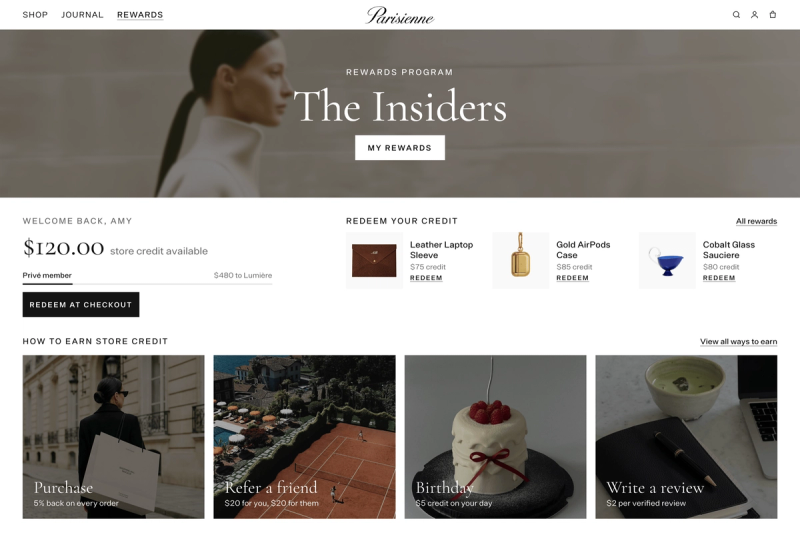
Design a branded loyalty page within your Shopify store. This page serves as the hub where customers learn about the program, check their points balance, view available rewards, and access their referral link. The page should clearly explain how points work, showcase tier benefits with compelling imagery, and make the emotional value of membership obvious.

Include customer testimonials about how much they value the program. Showcase the most redeemed rewards. Highlight exclusive benefits. Use beautiful imagery. This page is marketing real estate—treat it accordingly.

Integrate with your marketing automation. Connect your loyalty platform to Klaviyo, Omnisend, or your SMS platform of choice. This creates automated workflows that drive engagement and redemption. A customer earning 100 points receives an automated email celebrating the milestone and showcasing rewards available at that threshold. A customer close to a tier upgrade receives a reminder of what spending will push them over the edge. A customer whose points are about to expire receives a gentle nudge to use them.

These automated communications drive significantly higher redemption rates and engagement compared to static, non-personalized communication.

Mage Loyalty's Shopify solutions offer particular depth on this integration front, with native Shopify POS support for unified omnichannel operations and pre-built Klaviyo templates that eliminate manual workflow building.

Step 6: Launch, Promote, and Continuously Optimize Your Program

The loyalty program launch is not a "build and hope" moment. It's the beginning of an ongoing optimization cycle.

Before launch, build anticipation. Email your customer list 2-3 weeks before announcing the program. Explain what's coming, why you're building it (customer retention, exclusive benefits, community), and how it will create value. This soft launch builds excitement and ensures strong initial adoption.

Across all your customer-facing channels, promote the program at launch. Website banners above the fold. Email campaigns highlighting benefits. Social media content introducing the program and explaining tiers. In-store signage for physical retail locations. SMS messages to your text list announcing that the program is live. SMS typically drives the highest immediate conversion to enrollment.

Make enrollment effortless. One-click signup through existing customer login. Guest signup option that doesn't require creating a new account. Mobile-optimized signup flow. Instant welcome bonus (50-100 points) for joining, creating immediate sense of progress.

Ongoing promotion keeps the program top-of-mind. Share member spotlights in your email newsletter. Celebrate tier advancements via personalized SMS. Announce limited-time bonus point events (double points this weekend, 1.5x points on new product categories). Showcase member reviews and UGC that reinforce community aspects.

Critically, gather feedback continuously. Monthly surveys asking what rewards members want to see. Quarterly cohort analysis examining which program features drive the strongest engagement and retention. A/B testing different reward structures, point values, and tier thresholds to identify what resonates with your specific audience.

Beauty brands run the most effective loyalty programs when they treat the program as a core business system that receives ongoing investment and optimization, not as a marketing tactic that's deployed once and left to run on autopilot.

The Unpopular Opinion: Why Points-Based Loyalty Alone is Falling Short for Modern Beauty Brands

Here's a contrarian take backed by behavioral data: the traditional points-based loyalty model is becoming obsolete for brands targeting digitally native consumers and younger demographics.

The reasoning sounds controversial, but examine the evidence. Points systems have become commoditized. If every major beauty brand offers 1-2 points per dollar spent with 100 points = $10 discount, then points-based earning and redemption create zero differentiation. They're table stakes, not competitive advantages. A customer with 50 unspent points in your program will switch brands if a competitor offers 15% off today without any point accumulation friction.

Psychologically, pure points systems trigger transactional thinking rather than emotional loyalty. The customer approaches the relationship as "spend money to earn rewards to get discounts." This is fundamentally different from emotional loyalty, where the customer approaches the relationship as "I'm part of a community that values me and aligns with my values." The first creates price sensitivity. The second creates switching costs that have nothing to do with mathematical comparison.

Modern consumers, especially Gen Z (33% of US luxury beauty spending), explicitly state they value experiences and values alignment over price discounts. Exclusive early access to new products lands differently emotionally than a 10% discount code. A personalized skincare consultation from an expert carries different weight than a discount coupon. Membership in an exclusive community with other enthusiasts creates switching costs that simple point-chasing does not.

The data supports this shift. Experiential rewards consistently show higher redemption rates and stronger emotional engagement than discount-based rewards. Community-driven loyalty programs show stronger retention metrics than transaction-driven programs. Brands emphasizing values alignment (sustainability, inclusivity, craftsmanship) with their loyalty programs show stronger engagement among younger cohorts than brands emphasizing price.

Consider Sephora and Ulta's evolution. Both started with straightforward point systems. Both have layered in experiential rewards, community elements, and values-aligned benefits. Sephora added personalized beauty services and invitation-only events. Ulta integrated expert consultations and community features. They maintain the points foundation but recognize that points alone no longer create the emotional connection required for competitive advantage.

The solution isn't to abandon points entirely—they remain useful for simple value quantification—but to move beyond points-only programs. Integrate tiered aspirational progression. Emphasize experiential rewards. Build authentic community. Align rewards with brand values. This shift separates programs that generate incremental sales lift from programs that create genuine brand advocacy and switching costs.

Measuring Success: Key Metrics for Your Beauty Loyalty Program

Data discipline separates programs that thrive from programs that underwhelm. Track these essential KPIs:

Enrollment rate. What percentage of your customer base has joined the loyalty program? After six months, target 40-50% enrollment among existing customers. New customers should be offered enrollment at checkout, targeting 60-70% new customer enrollment rate.

Repeat purchase rate. What percentage of loyalty members make a second purchase within 90 days? Compare this against non-members. Loyalty members should have materially higher repeat purchase rates (typically 2-3x higher). If your data shows similar repeat rates between members and non-members, the program isn't creating behavioral change.

Customer lifetime value (CLTV). Calculate average total revenue per customer, comparing loyalty members vs. non-members over a 12-month window. Loyalty members should generate 2-3x higher CLTV. If not, your program isn't creating incrementality.

Average order value (AOV). Loyalty members should have higher average order values than non-members, especially once they achieve higher tiers with escalating benefits. Track AOV by tier to understand which tier benefits drive the highest spending.

Redemption rate. What percentage of earned points actually get redeemed? Healthy programs see 60-75% redemption rates. Very low redemption (under 40%) suggests your rewards aren't appealing or customers don't understand how redemption works. Very high redemption (over 85%) suggests your point-to-value ratio may be too generous.

Tier advancement rate. In tiered programs, track what percentage of members advance to higher tiers. Healthy progression should see 20-30% of Bronze members advance to Silver annually, and similar rates at higher tiers. Stalled advancement suggests tier thresholds may be unrealistic.

Referral program metrics. If your program includes referrals, track referral rate (what percentage of members actually make a referral) and referred customer quality (do referred customers have higher lifetime value than non-referred). High-quality referral programs generate 15-25% of new customers.

Community engagement metrics. For programs with community elements, track daily active users in community spaces, average posts per member, response rates to expert Q&As, and event attendance. These indicate whether community features are creating genuine value.

Return on investment (ROI). This is where many brands go vague. Calculate it explicitly: total incremental revenue generated by loyalty members (compare cohort spend before and after loyalty program launch) minus program costs (app fees, staff time, reward costs). For most brands, healthy loyalty programs deliver 3:1 to 5:1 ROI within 12 months.

The discipline of measurement drives continuous optimization. Run monthly performance reviews examining which program features are driving engagement and which are underperforming. Use this data to adjust reward structures, communicate about underutilized features, and evolve the program based on what your specific customer base values.

Inspiring Examples: Top Beauty Loyalty Programs to Emulate

Understanding how category leaders execute loyalty provides concrete templates for your own program.

Sephora Beauty Insider dominates the prestige beauty space through elegant simplicity. Three tiers (Insider, VIB, Rouge) with ascending benefits create clear progression. Members earn 1-2 points per dollar spent. Rewards are primarily product-focused: free deluxe samples, exclusive products, birthday gifts. The program drives 80% of North American sales, making it essentially the business model.

The key insight: Sephora recognized early that points-to-discount conversion feels cheap in prestige beauty. Instead, they emphasized exclusive product access, expert consultations, and early release of new launches. The emotional proposition is "you're part of an exclusive beauty community," not "you get discounts."

Ulta Beauty Ultamate Rewards operates at massive scale (44 million members generating 95%+ of sales) while maintaining program sophistication. Three tiers with escalating benefits from free shipping at the base level to quarterly preview events at the top. Earn 1 point per dollar on most products, with accelerated points on branded purchases. Redemption is straightforward: 100 points = free product, with escalating thresholds.

The key insight: Ulta recognized that their customer base spans massive demographic range (Gen Z to Baby Boomers, budget to luxury). The program had to be simple enough for first-time users while sophisticated enough for power users. They achieved this by making base-level membership straightforward while layering in experiential benefits at higher tiers.

Charlotte Tilbury Loyalty Program illustrates effective execution at smaller scale. Members earn points per pound spent, redeem for product discounts and gifts, and unlock tier benefits like free shipping and exclusive product access. The program feels integrated with brand identity rather than bolted on—it reinforces the "luxury, accessibly priced" positioning.

The key insight: The program reflects brand values. It's elegant, achievable, and feels like you're part of an exclusive community without gatekeeping at the financial level.

OSEA Malibu Sea Rewards showcases how clean beauty niches can build powerful loyalty. The program emphasizes values alignment (sustainability, clean ingredients, ethical sourcing) alongside transactional rewards. Members earn points, progress through tiers, but also unlock rewards tied to sustainable actions (recycling empties earns bonus points). Limited-edition founder-curated product bundles available only to members.

The key insight: Modern beauty customers seek brands that align with their values. A loyalty program that rewards sustainable behavior and emphasizes values alignment creates emotional resonance that transactional points never achieve.

Glow Recipe Club Glow (now part of a larger loyalty ecosystem) demonstrates community-focused approach. Beyond earning points for purchases, members engage in exclusive challenges, share beauty routines, receive personalized skincare recommendations based on community feedback, and participate in expert-led sessions. The program builds community that extends beyond transactions.

The key insight: For DTC brands without physical retail infrastructure, community becomes a primary differentiator. Creating spaces where customers connect with each other and with your brand team builds switching costs that competitors can't easily replicate.

The landscape continues to evolve. Several emerging trends will shape next-generation loyalty programs.

AI-driven personalization is moving beyond manual segmentation toward predictive recommendation engines that dynamically adjust based on individual behavior. Rather than assigning customers to static segments, algorithms will predict which specific rewards, product recommendations, and communications will resonate with each customer in real time.

Sustainability integration will become baseline expectation rather than differentiator. Loyalty programs that reward recycling, sustainable purchases, or carbon-neutral shipping options will be standard. Brands that haven't integrated sustainability into their loyalty model will appear out of touch.

Web3 and NFT integration remains speculative but worth monitoring. Some forward-thinking brands are experimenting with blockchain-based loyalty points (which can be traded or held as investments), NFT membership tokens that unlock exclusive digital and physical experiences, and metaverse shopping experiences exclusive to loyalty members. Whether these become mainstream or remain niche experiments remains uncertain.

Immersive experiences like AR/VR try-on features, virtual beauty consultations, and metaverse shopping events are emerging as loyalty rewards for tech-forward brands. The perceived value of exclusive access to immersive experiences may exceed the perceived value of discounts or physical products.

Hyper-localization will enable programs to offer location-specific rewards and community experiences. A loyalty member in Los Angeles gets invitations to exclusive LA-based events, while a member in London gets access to London-specific pop-ups and community gatherings.

Beauty brands building loyalty programs today should build with flexibility in mind, ensuring their platform can evolve as these trends mature.

Conclusion: Your Path to Lasting Beauty Brand Loyalty

The evidence is overwhelming: well-designed loyalty programs transform customer economics and competitive positioning for beauty brands. The brands generating the strongest sustainable growth aren't the ones with the largest marketing budgets—they're the ones who've turned 10-15% of their customer base into genuine advocates who each drive 2-3 new customer acquisitions through authentic recommendations and user-generated content.

A strategic loyalty program isn't a nice-to-have feature or a quarterly marketing initiative. It's core infrastructure that touches every customer interaction and drives material improvement in retention, lifetime value, and profitability. The financial case alone justifies investment. The community-building and brand-advocacy benefits compound that advantage.

Your next steps are concrete:

Identify your specific loyalty program goals (increase repeat purchase rate by X%, boost CLTV by Y%, achieve Z% referral contribution).

Segment your existing customer base to understand which behaviors you're trying to encourage.

Choose a loyalty program structure that aligns with your brand positioning and customer base.

Design a reward and earning system that extends far beyond simple point-for-discount exchanges.

Select a Shopify loyalty platform that offers the features and integration depth you need for your brand scale.

Launch with clear communication and strong promotion to drive enrollment.

Commit to ongoing measurement, optimization, and evolution based on customer feedback and performance data.

The brands that execute this well don't just retain customers—they build communities. They create switching costs that have nothing to do with discounts. They turn one-time buyers into advocates. They achieve growth that feels sustainable rather than constantly chasing new customers at escalating acquisition costs.

Your beauty brand's competitive advantage isn't determined by product quality alone (most competitors offer equivalent formulations) or by marketing reach (advertising is commoditized). It's determined by how effectively you convert customers into advocates. Loyalty programs are the infrastructure that makes that conversion possible.

Ready to increase
customer lifetime value?

Join 100+ Shopify stores using Mage to turn one-time buyers into loyal repeat customers.

|Cancel anytime|5-min setup|Rated 5/5 by Shopify stores

Great app! User friendly and straightforward. The customer service team has been great and so helpful with some minor tweaks I wanted to make and customize.

skynbio

Related articles