Most Shopify founders believe loyalty programs are exclusively for massive brands with enormous budgets, or worse, that they're just discounting tools that destroy profit margins. This misconception costs growing stores hundreds of thousands in unrealized revenue every year. The reality? Strategic loyalty programs are powerful growth engines that work at virtually any scale, turning struggling retention into a competitive advantage. They're about building relationships and maximizing customer lifetime value, not slashing prices.
The average ecommerce store loses three out of four customers after their first purchase. That's not a retention problem. That's leaving money on the table with a "For Sale" sign on it.
A well-designed loyalty program doesn't just recover some of those lost customers. It fundamentally reshapes your business economics by making your existing customer base significantly more profitable. But timing matters. Launch too early and you're adding complexity to an unstable operation. Launch at the right moment, and you create a flywheel that compounds your growth month after month.
This guide reveals exactly when your Shopify store is ready for a loyalty program, what signs indicate you should launch now, and how to structure one for maximum impact. More importantly, it addresses what most content misses: the specific thresholds and indicators that actually matter for deciding whether today is your day.
The Biggest Loyalty Program Myth (And Why It's Costing You Growth)
Here's what I've seen repeatedly working with ecommerce brands over the past several years: founders hear "loyalty program" and immediately picture Starbucks or Amazon Prime. Massive budgets. Millions of members. Sophisticated technology. The gap between their store and those giants feels unbridgeable, so they assume loyalty programs aren't for them yet.
This assumption is precisely backwards.
The truth is that loyalty programs work at every scale because they solve a fundamental problem all growing ecommerce businesses face: customers are expensive to acquire but cheap to keep. A recent study found that acquiring a new customer costs 5 to 7 times more than retaining an existing one. When customer acquisition costs are rising and profit margins are tightening, the math becomes obvious. You don't need to be Amazon to benefit from loyalty.
The second misconception is that loyalty programs are just elaborate discounting schemes. Founders worry they'll train customers to only buy when they're offering rewards, compressing margins further. This misses what modern loyalty programs actually do. They're not primarily discount tools. They're data collection engines and engagement platforms that foster emotional connections, encourage repeat behavior, and provide the customer insights needed to drive personalization and smarter marketing.
Here's what I mean: one of our clients, a beauty brand doing roughly $40,000 in monthly revenue, launched a points-based program alongside a simple tiered VIP structure. Within four months, their repeat purchase rate climbed from 22 percent to 31 percent. Their top 8 percent of customers, who had previously accounted for 28 percent of revenue, suddenly represented 39 percent. That shift wasn't from deeper discounts. It was from customers feeling recognized, rewarded for their loyalty, and incentivized to reach the next VIP tier.
A loyalty program is a customer relationship flywheel. The more customers engage, the more value they extract. The more value they receive, the faster they spin the wheel back toward repeat purchases, higher order values, and social advocacy. The math compounds.
What Exactly Is a Shopify Loyalty Program?
A customer loyalty program is a structured marketing system designed to reward customers for their continued engagement and purchases with your brand. That's the functional definition. But understanding what it actually is requires stepping beyond the basics.
At its core, a modern loyalty program has three layers:
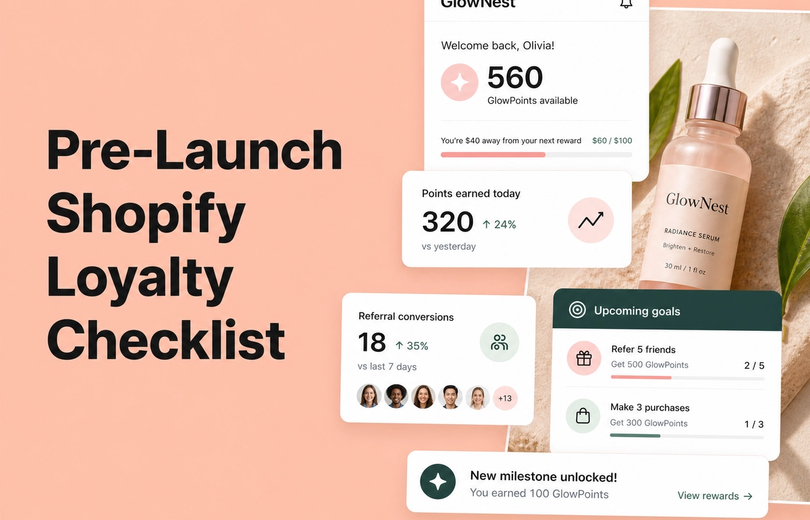
The first is behavioral tracking. Every customer action gets recorded and valued: purchases, account sign-ups, product reviews, social shares, referrals, even birthdays. This tracking layer is what enables the second layer.
The second is reward mechanics. Customers earn points, progress through tiers, or unlock exclusive benefits based on their accumulated actions and engagement. A customer might earn 1 point for every dollar spent, with 100 points redeemable for a $10 discount. Or they might progress from Bronze to Silver status by making five purchases within six months, unlocking free shipping as they ascend.
The third is emotional connection. When customers earn rewards, they feel recognized. When they progress to a higher tier, they feel exclusive. When they see personalized offers based on their purchase history, they feel understood. This emotional layer is what turns a transactional relationship into an emotional one, and that's where the real retention magic happens.
Think of a loyalty program as a customer relationship engine. Every touchpoint is fuel. Every reward is acceleration. The system runs continuously, compounding the value for both your business and your customers.
Common structures include points-based systems (the most flexible), tiered VIP programs (where customers unlock escalating benefits), referral programs (rewarding word-of-mouth), and paid membership models (like Costco or Amazon Prime). Each serves different business goals. For most growing Shopify stores, a hybrid approach works best: points for purchases with a tiered layer on top that rewards your most valuable customers with exclusive benefits.
Why Customer Loyalty Is Non-Negotiable for Shopify Growth
The economics are brutal right now. Customer acquisition costs across ecommerce have been rising steadily for three years. Paid advertising channels are saturated. Customer attention is fragmented. You're competing for the same eyeballs as thousands of other brands.
Meanwhile, your existing customers already know who you are. They've already proven they'll buy from you. They're comparatively cheap to reach through email, SMS, and on-site messaging. Yet most Shopify stores treat this massive asset like an afterthought, pouring 80 percent of their marketing budget into acquiring new customers they might never see again.
This is where loyalty programs become non-negotiable.
Retention beats acquisition on almost every economic measure. Loyalty program members spend roughly 67 percent more than guest visitors. They show three times higher repeat purchase rates. Brands that offer loyalty programs see customers who are 84 percent more likely to remain loyal. When you increase customer retention by just 5 percent, you can boost profits by 25 to 95 percent depending on your industry.
Here's the thing: your top 5 percent of customers generate 35 percent of your revenue. That's not an outlier. That's consistent across virtually every ecommerce vertical. Your small group of repeat customers is bankrolling your entire operation. A loyalty program's job is to expand that small group, move more customers into it, and maximize the lifetime value of every single one.
Increasing customer lifetime value happens through three mechanisms that loyalty programs directly enable: increasing purchase frequency, boosting average order value, and reducing churn. A member might start as a once-a-year buyer. A well-designed loyalty program encourages them to buy four times a year. A member might typically spend $75 per order. Tiered rewards and exclusive perks nudge them to $95. Members who feel recognized and valued churn at dramatically lower rates than anonymous customers.
The compound effect is remarkable. A customer worth $300 annually becomes a customer worth $900. Multiply that across your entire customer base, and you're looking at a fundamental reshaping of your business profitability.
Signs You're Leaving Money on the Table
Before you ask "when should I launch," ask "am I currently leaving revenue on the table by not having a loyalty program?" These signs suggest the answer is yes.
Your customer acquisition cost is high, but customers aren't returning. You're spending $50 to acquire a customer who buys once for $75 and never returns. That's a brutal equation. The money spent on acquisition doesn't recover. A loyalty program won't fix a poor product, but if your product is solid and customers simply don't know why they should return, rewards and recognition can change that math dramatically.
Your repeat purchase rate is significantly below 28 percent. The ecommerce benchmark hovers around 28 percent, meaning roughly one in four customers who make a first purchase will return. If your rate is 15 percent, 20 percent, or below, a loyalty program is a powerful lever to pull. You have a "leaky bucket" problem, and loyalty programs are designed specifically to patch those leaks.
You have no organized way to identify your best customers. If you can't tell your founder who your top 20 customers are, how much they've spent, what they buy repeatedly, or what they actually want, you're flying blind. A loyalty program creates structured data that reveals these patterns. That data becomes the foundation for all smarter marketing decisions.
Competitors are already running loyalty programs, or you're seeing industry trends shift toward them. If your competitive set is engaging customers with loyalty, you're likely at a disadvantage. Conversely, this is an opportunity to differentiate and build community before the space becomes saturated in your niche.
Customers are asking (directly or indirectly) for rewards or recognition. Pay attention to support emails, survey responses, and social media comments. If customers are asking why they don't get points, or if they're mentioning that a competitor's rewards program kept them loyal, that's a signal worth heeding.
Your product-market fit is solid. This is non-negotiable. You have a product customers love, are willing to buy again, and genuinely believe in. Without this foundation, a loyalty program amplifies a weak offering. With it, loyalty programs accelerate growth.
The Anatomy of a Successful Loyalty Program
Before discussing when to launch, understanding how loyalty programs actually work helps clarify whether you're ready.
Earning rules define how customers accumulate value. Typically, customers earn points for purchases (often at a rate of 3-10 percent, so 3-10 points per dollar spent). But earning mechanisms can expand to include sign-ups, reviews, social shares, referrals, and behavioral actions like birthdays or anniversaries. The key is making earning transparent and easy to understand.
Redemption options give points tangible value. A customer with 100 points needs to know exactly what they can get: a $10 discount, a free product, exclusive access, or something else. Redemption should feel rewarding. If a customer accumulates 100 points and the only option is a $5 discount, they'll feel cheated. The best programs offer tiered rewards at different point levels, creating options and aspiration.
Tiered or VIP structures segment customers by value and engagement level. I worked with a skincare brand that introduced a simple three-tier system: Bronze (first tier, automatic), Silver (at $500 lifetime spend), and Gold (at $1,500 lifetime spend). As customers moved up, benefits escalated: free samples, birthday gifts, early access to launches, exclusive discounts. This created internal competition and motivation. Customers who felt close to Silver status increased purchase frequency specifically to reach it. Revenue per customer in the Gold tier was four times higher than Bronze customers.
Referral mechanics reward advocacy. When customers bring in friends, both the referrer and referred typically receive points or bonuses. This turns your customer base into a volunteer sales force, dramatically reducing acquisition costs for new customers who are already pre-qualified by existing members.
The implementation layer matters too. The best Shopify loyalty apps handle the technical complexity, integrating with your Shopify store, email platforms, and customer data systems. You shouldn't have to manually track points or manage redemptions. The app does that. Your job is strategy: defining what earns points, what rewards matter, and how to communicate the program.
The Right Time Is Now (Or Soon): Key Thresholds for Shopify Founders
Okay. The real question: when is your store actually ready?
Revenue Thresholds
There's no rigid minimum. I've seen effective loyalty programs at stores doing $3,000 monthly revenue, and I've seen poorly implemented programs at stores doing $100,000 monthly. But there's a sweet spot where the math works best and the operational lift feels manageable.
Stores consistently generating $5,000 to $10,000 in monthly revenue are generally well-positioned. At this level, you have enough transaction volume for points to feel meaningful (customers see their points accumulate visibly), enough customers that program management doesn't consume excessive time, and a revenue base that can absorb the small cost of the program while capturing the returns. Below this threshold, loyalty programs can still work, but the returns may feel harder to quantify. Above this, you probably wonder why you haven't launched yet.
Why this threshold? It's about having sufficient operational capacity and transaction volume to make the program feel real to customers while providing enough data and volume to show tangible results. A store doing $2,000 monthly revenue might struggle to demonstrate clear ROI in the first 90 days. A store doing $15,000 monthly revenue sees impact faster, making it easier to justify continued investment.
Customer Base Size
Aim for at least a few hundred active, unique purchasers. Specifically, 500 or more unique customers who have made at least one purchase within the last 12 months is a healthy baseline. Why? Because loyalty programs thrive on network effects and sufficient data. With 500 engaged customers, you have enough people earning and redeeming points to create community feeling, generate meaningful reward redemptions, and collect data that reveals patterns about what actually drives repeat purchases in your specific customer base.
Below 500 active customers, the program can still work, but participation might feel sparse. Customers won't see their peers redeeming rewards. The program feels empty. Network effects don't kick in.
Repeat Purchase Rate Data
The ecommerce average repeat purchase rate sits at roughly 28 percent. If your current rate is below that, a loyalty program is a strategic priority. Improving your repeat purchase rate through loyalty is one of the highest-leverage moves you can make.
To assess your rate, divide the number of customers who've made more than one purchase by your total number of customers, multiply by 100. If you're at 15 percent, 20 percent, or 22 percent, you're seeing that three out of four customers vanish after purchase. That's the leaky bucket. Loyalty programs can't seal every leak, but they seal many. A realistic first year target is moving from 22 percent to 28 percent or beyond.
Operational Readiness and Product Consistency
Your product line needs to be stable. You can't launch a loyalty program if you're overhauling your catalog every month, discontinuing items customers love, or constantly iterating wildly on product direction. Loyal customers need something consistent to be loyal to.
Your core operations (shipping, customer service, product quality, returns) should be solid. A loyalty program amplifies the existing customer experience. If that experience is mediocre, loyalty actually highlights the problems. You'll have customers earning points, feeling invested in your brand, then becoming frustrated because shipping is slow or customer service is unresponsive. Better to fix those foundations first.
Finally, acknowledge that you'll need to dedicate some time to the program. Even with an excellent app handling the technical work, someone needs to promote the program across channels, monitor engagement, adjust mechanics based on performance, and respond to customer questions. This isn't a set-it-and-forget-it tool. It's an asset that compounds with attention.
Setting Clear Goals for Your Loyalty Program
Before launching, clarify your "why." Are you trying to increase repeat purchase frequency? Boost average order value? Reduce churn? Gather customer data for personalization? Build community?
Define SMART objectives: Specific, Measurable, Achievable, Relevant, Time-bound. "Increase engagement" is too vague. "Increase repeat purchase rate from 24 percent to 31 percent within six months" is actionable. "Boost average order value by 12 percent for loyalty members within 12 months" is measurable. "Collect 50 customer reviews per month through loyalty rewards" is concrete.
These goals drive all downstream decisions: which actions you reward, what redemption options you offer, how aggressively you promote the program, and whether certain mechanics are working or need adjustment.
How to Strategically Launch Your Loyalty Program on Shopify
Once you've confirmed you're ready, execution becomes straightforward.
Choose your app. Research Shopify-native loyalty platforms that align with your budget and feature needs. Popular options range from simple and affordable to sophisticated and expensive. The best choice depends on your specific goals and complexity tolerance.
Design your reward structure. Decide what earns points (purchases, reviews, shares), at what rate (3-10 percent back is standard), and what points redeem for (discounts, free products, exclusive access). Keep it simple at launch. You can add complexity later.
Create a dedicated loyalty page. Make it easy for customers to understand the program, see their current status, and understand redemption options. This page lives in your Shopify store and becomes a hub for loyalty engagement.
Promote aggressively across all channels. An amazing loyalty program that nobody knows about is worthless. Announce it in your email list, add banners to your website, feature it at checkout, mention it in post-purchase follow-ups, and integrate it into social media strategy. Promoting your program across multiple touchpoints creates awareness and participation.
Monitor and optimize continuously. Track key metrics: enrollment rate, participation rate, redemption rate, repeat purchase rate trends, and customer lifetime value changes. Use this data to refine your program. If a certain reward isn't getting redeemed, adjust it. If participation is low, boost the points for a specific action. Loyalty is an iterative system.
When Not to Launch a Loyalty Program
These situations warrant waiting:
Before you've achieved strong product-market fit. If you're still iterating heavily on product, positioning, or pricing, a loyalty program adds complexity without solving the core problem. Get the product right first. Loyalty programs work best when customers already know what they want and why they love your offering.
If your customer experience is inconsistent. Poor shipping, unresponsive support, quality issues. A loyalty program amplifies existing problems. Fix the foundation. Loyalty programs make good experiences better. They make bad experiences worse.
If you lack the resources to actually manage it. Don't launch if nobody has time to promote, monitor, and optimize the program. A neglected program that sits dormant creates negative perception. Better to wait six months until you have capacity than to launch prematurely and let it atrophy.
Frequently Asked Questions
How much does a Shopify loyalty program cost?
Most modern loyalty apps range from free (with basic features) to $300+ monthly for advanced functionality. Many offer free trials or freemium models. The cost is typically negligible compared to the ROI. A program that increases customer lifetime value by 15-20 percent quickly pays for itself.
What's the best Shopify loyalty app for small businesses?
That depends on your goals and budget. For simplicity and affordability, many small stores start with points-based or tiered systems offered by affordable apps. For comprehensive functionality and data integration, premium apps offer more. Research demos, read reviews, and choose based on your specific needs rather than price alone.
How long does it take to see results from a loyalty program?
Realistic timeframe is 60-90 days to see meaningful impact on repeat purchase rates and engagement. Some metrics (like points redemption rate) show up faster. Others (like customer lifetime value trends) take 6-12 months to fully materialize. Don't expect overnight transformation, but expect to see measurable improvement within 90 days if you've launched with reasonable timing.
Can a loyalty program really increase my average order value?
Yes, consistently. Loyalty program members who receive tiered benefits tied to higher spending amounts are motivated to push their orders over thresholds. A customer earning 50 bonus points for orders over $100 will often bump their $95 order to $102. Across hundreds of customers monthly, these incremental increases compound significantly.
TLDR
Loyalty programs aren't exclusive to giant brands; they're strategic growth engines for Shopify stores at virtually every scale. Launch when you have a solid product, a customer base of at least a few hundred active purchasers, consistent monthly revenue around $5,000+, and a repeat purchase rate below the ecommerce benchmark of 28 percent. Watch for signs that you're leaving money on the table: high customer acquisition costs with poor retention, single-purchase customers dominating your base, and lack of insights into customer preferences. Focus on building community and increasing customer lifetime value rather than simply discounting. The right time to launch is usually when your operations are stable, you have capacity to promote and manage the program, and your founding team is ready to treat loyalty as a strategic priority rather than an afterthought.

Kris is the co-founder of Mage Loyalty. I spend most days talking to merchants, shipping features, and making sure our customers get real results. If you run a Shopify store or Agency we should chat!