Most beauty brands are spending 5-7 times more to acquire new customers than to retain existing ones. Yet they're still chasing fresh traffic like it's the only path to growth.
Here's what's counterintuitive: the brands tripling their customer lifetime value aren't finding more customers. They're making their current customers worth dramatically more. Sephora generates 80% of North American sales from loyalty members. Ulta's loyalty program drives 95% of total sales. These aren't anomalies—they're the result of deliberate, strategic systems designed to deepen relationships and increase what each customer spends over their lifetime.
This guide reveals exactly how top beauty brands are achieving a 3x increase in customer lifetime value. You'll discover the frameworks, specific tactics, and tools that transform casual shoppers into lifelong advocates who spend more, buy more frequently, and refer others to your brand.
The Unwavering Power of Customer Lifetime Value in Beauty
Customer Lifetime Value (CLV) represents the total revenue a customer will generate for your business over the entire duration of your relationship with them. For beauty brands, this metric is non-negotiable.
In an industry where beauty consumers are bombarded with options—from indie DTC brands to massive conglomerates—CLV tells you which customers actually matter to your bottom line. A customer acquired through a $50 ad spend who makes one $60 purchase and never returns generates minimal value. But that same acquisition spend on a customer who makes ten $60 purchases over three years, plus refers friends and leaves reviews, completely changes the economics of your business.
Here's why CLV dominates the strategy of every smart beauty brand right now:
Reduced dependence on paid acquisition. When your current customers are worth 2-3x more, you don't need to constantly feed dollars into ad platforms. You can afford to be more selective, bidding on higher-intent traffic and investing in organic channels.
Predictable, sustainable growth. Retention-focused businesses are more resilient than acquisition-focused ones. Market downturns, iOS tracking changes, and algorithm shifts affect paid channels. Loyal customers aren't affected by any of that.
Competitive moat. A brand with high CLV and strong retention has time and resources to innovate, experiment, and differentiate. Acquisition-obsessed competitors are stuck on the hamster wheel.
The numbers validate this priority. Loyalty program participants in the beauty industry show CLV that's 15-40% higher than non-members. That's not incremental. That's transformative. Companies that foster emotional connections with customers outperform competitors by 85% in sales growth.
Why CLV Beats CAC in Beauty
The cost to acquire a new customer in beauty averages 5-7 times higher than retaining an existing one. Focus on CLV, and you reverse this equation. A 3x increase in CLV means your existing customer base becomes your most profitable channel.
Cultivating the "3x CLV" Mindset: Beyond Incremental Gains
Increasing CLV by 50% is achievable through basic retention tactics—better email sends, a simple points program, faster customer service. A 3x increase requires different thinking entirely. You need to shift from transactional interactions to transformational relationships.
Most beauty brands operate in transaction mode. Customer buys product. Brand sends thank-you email. Silence for three weeks. Customer sees a discount offer. Maybe they buy again, maybe they don't. This generates a CLV of maybe $200-300 per customer over a lifetime.
Brands tripling CLV operate in relationship mode. Every interaction has purpose. Data informs every decision. Customers feel understood, valued, and part of something bigger than a transaction.
The pillars of exponential CLV growth are:
Hyper-personalization at scale. Not "Hi Sarah" in an email subject line. Actual personalization based on skin type, purchase history, engagement patterns, and predicted preferences.
Deep engagement across multiple touchpoints. Loyalty programs, community spaces, content, customer service, and even in-store experiences all reinforce each other.
Seamless omnichannel experiences. Whether customers shop online, on mobile, through social, or in-store, the experience feels cohesive and rewarding.
Values alignment. Transparent communication about ethics, sustainability, and social impact resonates with beauty consumers, especially younger demographics.
To benchmark your current CLV and set targets: Calculate your average customer lifetime value by multiplying average order value (AOV) × average purchase frequency × average customer lifespan. If your CLV is $300 today, a 3x goal means reaching $900. That's ambitious but achievable when you implement the strategies in this guide systematically.
Step 1: Unlocking Deeper Understanding Through Data and AI
You cannot personalize at scale without data. You cannot predict which customers will churn without analytics. You cannot optimize journeys without understanding what works.
The first pillar of 3x CLV growth is a data infrastructure that gives you a 360-degree view of each customer.
Harnessing Zero- and First-Party Data
Zero-party data is information customers explicitly share with you. First-party data is what you collect from their behavior. Together, they form the foundation of personalization.
Collect strategically with quizzes and preference centers. Implement a skin assessment quiz at onboarding or on your homepage. Ask about skin type, concerns, preferences, and goals. Beauty brands like DRMTLGY use this approach to understand routine needs and recommend tailored products. Offer a reward—points, a discount code, product access—for completing it. Customers benefit from better recommendations. You benefit from richer data.
Create preference centers where customers control their communication. This isn't just privacy-compliant; it's strategic. A customer who opts in to weekly skincare tips and product launches will engage at a higher rate than someone forced into a generic email program.
Consolidate across all touchpoints. Most beauty brands have data scattered across their Shopify store, email platform, SMS provider, loyalty app, social media, and customer service tools. Unified customer profiles pull this fragmented data together.
A unified profile shows you: complete purchase history, browsing behavior, email engagement, loyalty program activity, customer service interactions, social mentions, and predicted preferences. With this view, you move from guessing to knowing.
Tools like Klaviyo offer first-party data integration with Shopify, but many beauty brands benefit from a dedicated CDP (Customer Data Platform) that consolidates everything. The investment pays for itself through better targeting.
Advanced Customer Segmentation for Precision
Demographic segmentation is table stakes. You segment by age and location, then send offers. That's not what top beauty brands do.
They segment by behavioral patterns and predicted value. Examples:
High-intent beauty researchers. Customers who view multiple product pages, read reviews extensively, and watch tutorials before purchasing. These customers respond to educational content and detailed product information.
Replenishment-focused customers. Customers with clear routines who reorder the same products regularly. These customers respond to reminders and subscription offers.
Explorers. Customers who browse across categories, try new products, and engage with recommendations. These customers respond to variety and new launches.
At-risk customers. Customers whose purchase frequency is declining or engagement is dropping. These customers respond to win-back campaigns and exclusive reconnection offers.
Within each segment, you create micro-segments based on CLV tier (high, medium, low), product category preference, and engagement channel preference (email vs. SMS vs. social).
This precision enables messaging that feels custom-built, not generic. The result? Higher open rates, click-through rates, and most importantly, repeat purchase rates.
Leveraging AI for Predictive CLV and Proactive Engagement
This is where beauty brands creating real separation. AI isn't just hype for loyalty programs—it's the difference between reactive and proactive strategies.
Forecasting future value. Machine learning models can predict which customers will spend the most over the next 12 months based on their current behavior, product affinity, engagement patterns, and cohort benchmarks. Identify your top 20% of predicted high-value customers and allocate premium support, exclusive offers, and VIP experiences to them.
Similarly, predictive models flag customers showing early signs of churn—declining purchase frequency, dropping email engagement, or moving away from your brand in social listening data. Intervene with personalized win-back offers, exclusive content, or a direct outreach from customer service before they're gone.
Automated personalized journeys with a seamless Klaviyo integration. AI can trigger the right message at the right time based on predicted needs. A customer who typically purchases sunscreen in March? Email a reminder in February with a limited-time offer. A customer whose last purchase was a moisturizer two months ago, with a typical repurchase window of 8-10 weeks? Send a personalized product recommendation in week 9.
These automations feel like thoughtful service, not marketing bombardment. They increase the likelihood that customers reach for your brand when they need it, rather than a competitor's.
Step 2: Designing Irresistible Loyalty and Experiential Programs
Points-based loyalty programs have been the default for a decade. Earn 1 point per $1, redeem 100 points for a $10 discount. Simple. Effective. Also increasingly commoditized.
Top beauty brands are moving beyond points toward experiential loyalty that delivers genuine value and emotional connection.
Moving Beyond Basic Points: Crafting Experiential Loyalty
Tiered programs with escalating value. Structure loyalty tiers—Bronze, Silver, Gold, Platinum—where each level unlocks increasingly exclusive benefits.
At Bronze, customers earn points for purchases and get access to a loyalty page and mobile app. At Silver, they unlock free shipping, birthday rewards, and early sale access. At Gold, they access exclusive products, priority customer service, and invites to virtual beauty classes. At Platinum, they get curated product boxes, direct access to founders or product teams, and naming rights on limited editions.
Sephora's Beauty Insider program exemplifies this. Members start with basic benefits (birthdate bonus, free shipping threshold). Rouge members (the highest tier) access private shopping events, personalized beauty consultations, and exclusive product lines. The progression motivates customers to spend more, not for the discount, but to unlock the tier itself.
Exclusive community access. Create a branded community space—whether private Discord, Facebook Group, or dedicated forum—where loyalty members connect, share routines, and access exclusive content. Beauty brands like Glossier have built communities where customers feel like insiders.
Offer exclusive webinars with dermatologists, makeup artists, or founders. Host virtual try-on sessions. Create member-only content libraries with skincare guides, ingredient deep dives, and routine-building resources.
This transforms loyalty from "spend more to get discount" to "join our community and feel part of something bigger." The emotional value often exceeds the monetary value.
A Contrarian Take: Why Points-Only Systems Are Losing Traction With Gen Z
Here's an uncomfortable truth for many beauty brands: traditional points-for-discount loyalty programs are becoming less effective for Gen Z and younger Millennial shoppers.
Gen Z values authenticity, experiences, and alignment with their values more than transaction savings. Research shows that 88% of skincare and cosmetics shoppers expect tailored experiences. Most don't want points. They want to feel understood.
A Gen Z customer sees a "earn 1 point per $1" offer and thinks: "Okay, I'll save $10 eventually if I spend enough." A Gen Z customer sees "join our inner circle and get early access to limited drops, exclusive content, and a voice in product development" and thinks: "This brand actually wants my input."
Data from beauty communities and engagement platforms shows declining redemption rates for points-only systems among younger demographics, while experiential and community-focused programs see higher engagement and repeat purchase rates.
The implication? If your loyalty program is purely points-based, you're likely leaving money on the table with younger customers. Hybrid programs—combining points with community, exclusivity, and values alignment—perform significantly better.
Gamification and Interactive Rewards
Engagement spikes when loyalty feels like play rather than math.
Implement profile completion challenges: earn 50 bonus points for filling out a skin type quiz, another 25 for linking social media, 15 for writing a review. This accumulation makes customers feel progress toward rewards.
Create limited-time challenges: "Share your skincare routine this week for 100 bonus points." "Refer three friends this month and unlock a $50 exclusive product." Challenges create urgency and social reinforcement.
Offer surprise-and-delight mechanics: random bonus point drops in customer accounts, mystery rewards for high-tier members, or unexpected free products at checkout. These moments of delighted surprise disproportionately impact emotional connection and sharing.
Badges and visual progress bars make achievement visible. Members see they're 30% of the way to Gold status or that they've earned "Skincare Expert" and "Community Champion" badges. This gamification taps into intrinsic motivation beyond discounts.
The Shopify loyalty program growing brands trust
See how Mage helps Shopify brands lift repeat purchase rate with loyalty, referrals and store credit.
Book a demoStep 3: Architecting Seamless and Cohesive Customer Journeys
Fragmentation kills CLV. When a customer has one experience online, a different one in-store, and yet another on mobile, they feel the friction. They take their business elsewhere.
Top beauty brands ensure consistency across every touchpoint.
The Unified Omnichannel Experience
Consistency across online, offline, and social. A customer who sees a personalized product recommendation in email should see the same recommendation on your website and in-store (via POS integration) without re-identifying themselves.
A customer who earns points for an online purchase should have those points automatically available if they shop in-store the next day. A customer who receives a birthday offer via email should see that same offer available in the app.
This requires that your loyalty platform, ecommerce platform, POS system, and email platform share customer data in real-time. It sounds complex, but platforms like Shopify, combined with a robust Shopify loyalty program, handle this seamlessly.
In-store pickup for online orders, personalized in-store recommendations. Use purchase history and loyalty data to train in-store associates. When a customer picks up an online order, associates see their profile: favorite product categories, previous purchases, skin type, and communication preferences. They can offer relevant recommendations or inform customers about new launches in their favorite category.
This turns in-store pickup from a transactional errand into a personalized experience that drives incremental purchases.
Proactive Replenishment and Flexible Subscriptions
Most beauty brands wait for customers to reorder. Smart brands anticipate it.
Automated replenishment reminders. Track product usage patterns. A customer who buys a 50ml moisturizer typically uses it in eight weeks. Send a reminder in week seven with a discount code. This prevents churn caused by customers simply forgetting or switching to a competitor out of convenience.
For brands with recurring products (cleansers, serums, sunscreen), these reminders are CLV multipliers. They increase purchase frequency with minimal friction.
Flexible subscription services. Offer customizable subscription boxes—build-your-own beauty boxes, curated routine subscriptions, or monthly discovery boxes. Allow customers to skip months, change frequency, swap products, or pause anytime.
Subscriptions create predictable revenue and increase CLV by locking in regular purchases. A customer spending $60 every three months through a subscription generates $240 annual CLV. Without subscriptions, they might forget to reorder for five months, then switch brands.
Make subscriptions transparent and easy to manage. The brands losing subscription revenue typically have confusing cancellation processes or unclear terms. The brands winning treat subscriptions as a service, not a trap.
Exceptional Customer Service as a CLV Multiplier
Customer service at scale means different things for different customers.
High-value customers (top 10% by spend or predicted CLV) deserve premium support: direct channels, shorter response times, proactive outreach, and personalized problem-solving.
A high-value customer receives a damaged product? They get proactive replacement before they even mention it, plus a bonus reward. They have a question about ingredients? They get a personalized consultation call with a beauty expert, not a canned FAQ.
This VIP treatment doesn't need to be expensive. It's about recognizing that not all customers are equal economically, and treating them accordingly.
Proactive problem-solving using data creates magic. If you notice a customer has purchased the same product three times in six months but engagement has declined, reach out with a direct message: "Hey, we noticed you love [product], but your engagement has dropped. Everything okay? We'd love to help if there's an issue."
This simple outreach often uncovers problems—package arrived damaged, customer tried another brand and didn't love it, customer needs a different formulation—that you can fix. It prevents churn before it happens.
“Cannot say enough good things about the team at Mage Loyalty, one of the absolute best organizations we have ever worked with, full stop! So glad we connected with them, completely redid our loyalty program, new concepts, use of loyalty, increasing user engagement, showing us where we were not valuing our best customers, just WOW, amazing team!”


Read the West Coast Goalkeeping case study →
Step 4: Amplifying Value Through Influential Marketing and Brand Values
Loyalty and engagement happen in a vacuum. They're amplified when external voices validate your brand and when your values resonate.
Strategic Influencer Marketing for Direct CLV Impact
Most influencer marketing focuses on awareness: get someone with a big following to post your product, hope some of their audience converts.
CLV-focused influencer marketing is different. You partner with micro and nano-influencers (10k-100k followers) whose audiences are aligned with your brand values and actively engaged in beauty discourse. You structure long-term relationships, not one-off posts. You track actual repeat purchases from influenced audiences, not just first-purchase conversions.
A brand might partner with five nano-influencers who collectively reach 150k highly engaged beauty enthusiasts. Over six months, they integrate products into genuine routines, share honest reviews, build community trust. You track unique discount codes or tracking links for each influencer and measure not just first-purchase conversion but repeat purchase behavior and CLV within those segments.
Often, you'll find that one influencer's audience has 2x the repeat purchase rate or CLV of another's. Double down on those relationships. Pay them more. Give them exclusive product access and earlier launches.
This approach treats influencer marketing as a CLV channel, not just an awareness channel. The ROI is measurable and sustainable.
Sustainability and Ethical Practices as Loyalty Magnets
Beauty consumers increasingly care about where products come from and how they're made.
Integrate sustainability into your customer retention strategy by rewarding conscious behavior within your loyalty program. Points for returning empty bottles for recycling. Bonus points for choosing eco-friendly shipping. Donate a portion of loyalty point redemptions to environmental organizations.
Communicate transparently about ethical sourcing, cruelty-free certification, and sustainable packaging. Transparency builds trust. Trust builds loyalty.
For younger demographics especially, this values alignment is a significant CLV driver. A brand that shows genuine commitment to sustainability isn't just selling products; it's offering participation in something meaningful.
Creating Engaging Content and Thriving Communities
Content is the connective tissue of CLV. Educational content keeps customers thinking about your brand. Inspirational content keeps them engaged. Community content keeps them feeling part of something.
Develop rich educational content: multi-part skincare routine guides, ingredient deep dives, seasonal routine shifts, tutorials on using specific products. This content doesn't directly sell; it builds authority and keeps your brand top-of-mind.
Specialized beauty loyalty programs can integrate content recommendations directly into customer journeys. A customer with oily skin sees skincare articles focused on oil control. A customer with sensitive skin sees content on building a gentle routine.
Encourage and amplify user-generated content. Customers sharing their routines, before-and-afters, and product reviews on social or your community platforms create authentic social proof that's more persuasive than any brand content.
Feature customer stories. A customer who's been with you for five years, tried your entire routine, and built a loyal habit—their story is more compelling than any marketing copy. Ask them to share their journey. Reward them with points, exclusive products, or featured placement.
Measuring Your Success: Tracking CLV Growth and ROI
Data without measurement is just noise. Track what matters.
Key Metrics for Monitoring CLV
Average Order Value (AOV). Track both overall AOV and segment-specific AOV. If your loyalty program targets high-value customers, has their AOV increased? If you've launched a tiered program, do higher tiers show higher AOVs?
Purchase Frequency. How often does the average customer purchase? How has this changed since implementing CLV initiatives? Frequency increases often signal that customers are becoming more routine-oriented and loyal.
Retention Rate. What percentage of customers from one period make at least one purchase in the next period? Beauty benchmarks typically range 20-30%, but top brands reach 40-50%. Retention rate improvement directly translates to CLV improvement.
Churn Rate. The inverse of retention. Which segments churn fastest? Focus retention efforts there.
Customer Lifetime Value itself. Calculate it regularly. Basic formula: (Average Order Value × Purchase Frequency × Average Customer Lifespan) - Customer Acquisition Cost = CLV. As CLV grows, your unit economics improve.
Calculating the ROI of Your CLV Strategies
Not every dollar you invest in CLV initiatives generates equal returns. Measure.
Attribute revenue to specific programs. If you launch a loyalty program, track how much additional revenue comes from loyalty members versus non-members over the same period. The difference is attributable to the program.
Clarins achieved a 30x ROI in 12 weeks using personalized customer experience strategies. That's not luck. That's tracking incremental revenue from personalization efforts against the cost of implementation.
Conduct cost-benefit analysis. A loyalty platform costs $200/month. If it drives $500 in additional monthly revenue from increased repeat purchases and higher AOV, that's 2.5x ROI. If it drives $5,000, that's 25x ROI.
Segment analysis is important here. A loyalty program might generate 15x ROI for your top 20% of customers but only 2x ROI for your bottom 50%. This isn't a reason to deprioritize the program; it's a reason to allocate different benefits to different segments.
A complete loyalty programs guide with detailed ROI frameworks helps brands think through these calculations systematically.
Continuous Optimization Through Testing
Once you have baseline metrics, iterate.
A/B test loyalty point structures. Is 1 point per $1 spent optimal, or do 1.5 points per $1 drive higher engagement with acceptable redemption costs? Test and measure.
Test different reward tiers and benefits. Do exclusive early access to launches drive more spending than point multipliers? Test both. Measure repeat purchase behavior and CLV for each segment.
Test email frequency and timing for loyalty communications. Does a weekly newsletter engagement with loyalty members drive higher redemption than monthly? What time of day sees highest open and click rates?
Set up quarterly review cycles. Analyze what worked, what didn't, and adjust. Beauty brands that treat CLV optimization as an ongoing discipline—not a set-and-forget initiative—see continuous improvement and compounding CLV growth.
Overcoming Implementation Hurdles: A Shopify Ecosystem Focus
Theory is great. Implementation is where most brands stumble.
Choosing Compatible Tools and Managing Integrations
Your Shopify store likely touches multiple platforms: email (Klaviyo, Omnisend), SMS (Postscript, Klaviyo), loyalty program, analytics, customer service. Each integration adds complexity.
The most critical rule: ensure your loyalty platform integrates seamlessly with Shopify and with your email and SMS platforms. You want real-time data flow, not nightly batch imports or manual exports.
Choose one that fits your needs: budget, customization requirements, omnichannel capability, and support quality.
Best practices for Shopify merchants:
Audit your current tech stack. List every tool you use. Identify which ones have direct Shopify integrations and which require workarounds.
Prioritize connections. Loyalty → Email integration is critical for automating rewards notifications and engagement. Loyalty → SMS is important for time-sensitive offers. Loyalty → Analytics is important for tracking performance.
Plan data flow. When a customer makes a purchase, loyalty points should update in seconds. When they redeem points, that action should reflect in email segmentation immediately. Design this flow before implementation.
Test everything in a sandbox environment. Import a small cohort of test customers and verify data flows correctly across platforms before full rollout.
Best Practices for Data Management and Sync
Data inconsistency kills personalization. If one platform thinks a customer made a purchase and another doesn't, your personalization breaks.
Establish a single source of truth. For most Shopify brands, that's Shopify itself. Ensure loyalty and other platforms sync with Shopify as the authoritative store of purchase data.
Set up automated reconciliation. Weekly checks that loyalty point balances match expected purchase volumes, that segment membership updates correctly, that email lists stay in sync.
Have a data governance document. Who can access customer data? What's the security protocol? How are GDPR/CCPA requests handled? This protects your brand and customers.
Top Beauty Brands Increasing CLV: Inspiring Examples
Theory becomes tangible through examples.
Sephora's Beauty Insider Program
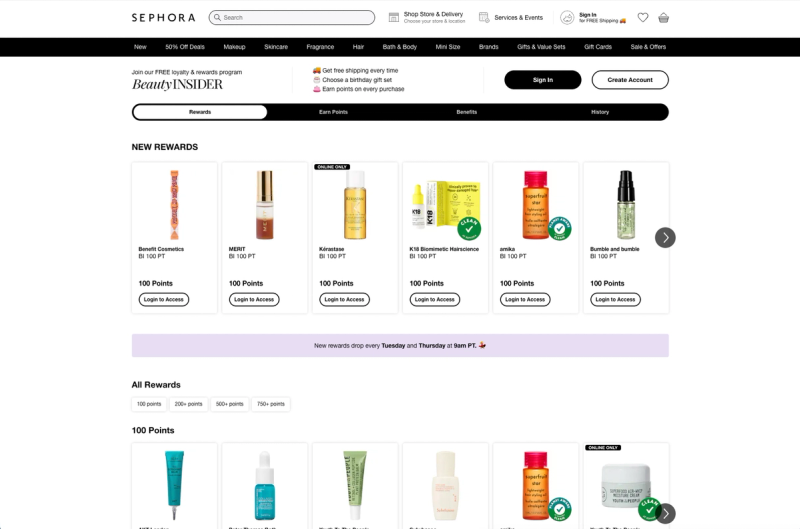
Sephora's three-tier program (Insider, VIB, Rouge) generates 80% of North American sales from members. The structure is simple: higher tiers unlock increasingly exclusive benefits. But the execution is flawless.
Rouge members (top spenders) receive free expedited shipping, exclusive products, and invites to private shopping events and beauty classes. The experience feels premium, validating the spending required to reach that tier.
Sephora also uses data brilliantly. Personalized recommendations, targeted offers, and relevant product showcases create the sense that Sephora understands each customer's preferences.
Result: Members spend significantly more and return more frequently than non-members.
Ulta Beauty's Ultamate Rewards
Ulta's program drives 95% of total sales from loyalty members. The massive percentage indicates that nearly every Ulta customer is enrolled.
The program works through simplicity: points for purchases, birthday gifts, and milestone rewards. But Ulta amplifies it through partnership with Target and omnichannel consistency. Customers earn at Ulta's physical stores, on Ulta.com, and through Target beauty. Points sync across all channels.
This omnichannel approach increases convenience and purchase frequency. A customer can earn toward rewards anywhere Ulta sells products.
Kitsch's Community-Driven Growth
Kitsch generated $5.8M in loyalty-attributed revenue and achieved an 8.7x higher repeat purchase rate for top-tier VIPs.
The distinction: Kitsch built community, not just a points program. They created a space where customers felt like insiders, access to product development, and alignment with brand values. The loyalty program became the membership to that community.
OSEA's Repeat Purchase Success
OSEA achieved a 77% repeat purchase rate among members who redeemed rewards and showed 40% higher AOV among loyalty members.
The lesson: rewards that are actually valuable and easy to redeem drive behavior change. OSEA's rewards aligned with customer desires (exclusive products, discounts on bestsellers) and redemption was frictionless.
Conclusion: Your Path to a 3x CLV Boost
A 3x increase in customer lifetime value isn't a miracle. It's the result of systematic investment in understanding customers, rewarding loyalty, and creating seamless experiences.
The brands achieving this growth combined hyper-personalization powered by data and AI, experiential loyalty programs that build community, seamless omnichannel journeys, and authentic values alignment. They measure relentlessly and optimize continuously.
Start with one pillar. If your data infrastructure is weak, begin there. Implement zero- and first-party data collection. Unify customer profiles. Then layer in loyalty and personalization.
The long-term benefit is resilience. Brands with strong CLV and high retention are profitable even during downturns. They can invest in innovation because they're not trapped on the customer acquisition hamster wheel.
Your current customers are your growth engine. Triple their value, and you triple your business.
Frequently Asked Questions About Beauty Brand CLV
What makes a loyalty program truly successful for a beauty brand?
A successful loyalty program aligns with customer values, delivers genuine value (experiential or monetary), and integrates seamlessly into the broader customer journey. Generic points-for-discounts programs are increasingly ineffective, especially with younger demographics. Top programs combine points with community access, exclusive experiences, values alignment, and genuine personalization.
How can beauty brands effectively use personalization to boost CLV?
Collect zero- and first-party data through quizzes and preference centers. Consolidate data across touchpoints into unified customer profiles. Use segmentation to tailor product recommendations, content, and offers. Implement AI to predict future purchases and proactively engage customers before they churn. Personalization feels like service when it's done well and cheap enough to scale.
What is the average customer retention rate in the beauty industry, and how can I improve mine?
The industry average is 20-30%, but top brands reach 40-50%. Improve yours by implementing a loyalty program, launching a subscription service, creating community or exclusive content, offering exceptional customer service to high-value customers, and using predictive analytics to identify and win back at-risk customers. Retention compounds: every point of improvement adds directly to CLV.
Are paid memberships a viable strategy for luxury beauty brands to increase CLV?
Yes, with caveats. Paid memberships create higher commitment and perceived value, especially for luxury brands. But implementation matters. The membership benefit (exclusive products, early access, VIP service) must genuinely justify the cost. Luxury brands using memberships typically pair them with tangible perks—private events, personalized consultations, limited-edition access—rather than pure discounts.
TLDR
Triple your beauty brand's customer lifetime value by combining hyper-personalization powered by AI and zero-party data, experiential loyalty programs that build community over transactional discounts, seamless omnichannel experiences, and authentic values alignment with your customer base. Top brands like Sephora (80% of sales from loyalty members) and Ulta (95% from members) prove that CLV-focused strategies generate dramatically higher revenue per customer than acquisition-focused approaches.

Graeme is the co-founder at Mage Loyalty. He heads product development, from complex loyalty migrations and large-scale data handling to building the features shaping the future of loyalty on Shopify.