Most loyalty programs underperform because they're built around one mechanic — usually points-for-purchases — and stop there. The brands with the highest repeat-purchase rates and longest customer lifecycles stack three or four ideas in parallel: an earning mechanic, a redemption mechanic, a status mechanic, and an engagement mechanic. This guide covers 12 loyalty program ideas worth stealing, organised by what each one is for, with notes on which kind of Shopify brand each one suits.
Key Insights
- The best loyalty programs combine ideas across four layers: how customers earn, how they redeem, how they're recognised (tiers/status), and how they're engaged between purchases.
- Points-for-purchase is the floor, not the program. Brands that stop there see participation cap at single digits.
- The single highest-leverage idea on this list is rewarding non-purchase actions (reviews, referrals, content). It raises participation rates by 2–4× over purchase-only programs.
- Status (VIP tiers) outperforms cash value as a retention mechanism above $100 AOV. Below that, store credit and discounts work harder.
- The cheapest idea to implement is surprise-and-delight rewards. The most expensive is a paid subscription program. Both can work — pick based on your margin structure and existing engagement.
- Don't run more than 4–5 ideas at launch. Stack additional mechanics over time so the program feels expansive rather than overwhelming.
What makes a great loyalty program idea?
Three properties separate ideas that compound from ideas that fizzle.
It maps to behaviour the customer already does or wants to do. A points-for-reviews idea works because the customer was going to consider leaving a review anyway. A members-only product drop works because customers like exclusivity. An idea that requires customers to learn a new behaviour they don't already exhibit will underperform.
It has a clear, repeatable trigger. Birthday rewards trigger annually. Tier upgrades trigger when spend crosses a threshold. Points-expiry rewards trigger 30 days before expiration. Ideas without a built-in trigger become manual marketing campaigns that decay over time.
It can be measured in isolation. If you can't tell whether the idea is working (incremental orders, participation rate, redemption rate), you can't iterate. The 12 ideas below all have measurable behavioural signals.
12 loyalty program ideas worth stealing
1. Points for non-purchase actions. Award points for reviews (with photo > without photo), social follows, account creation, profile completion, birthday submissions, and content shares. This raises program participation rates 2–4× over purchase-only programs because it gives customers a way to engage before their next purchase. Pair with Mage's points program for automated earning rules.
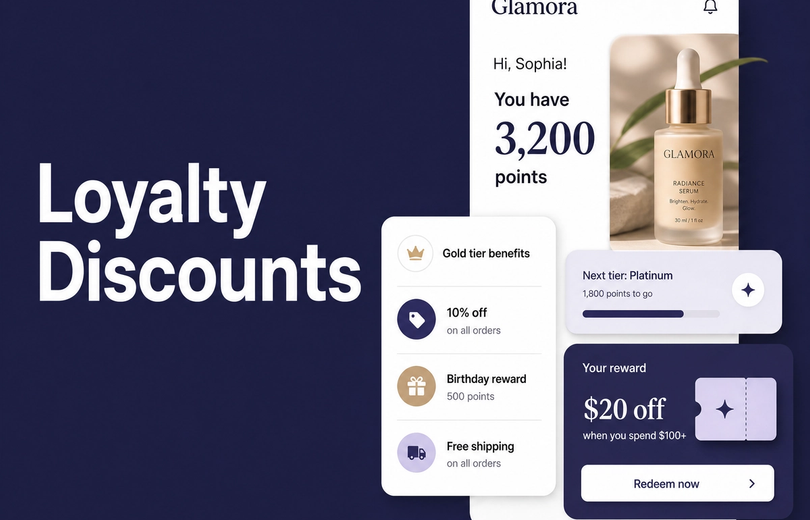
2. Tiered VIP perks with status. Three or four VIP tiers (Silver / Gold / Platinum / Black) with escalating benefits — point multipliers, early access, free shipping thresholds, dedicated support. Status is a stronger retention mechanism than cash above ~$100 AOV. Members who hit the top tier often refer 2–3× more than base-tier members.
3. Birthday and anniversary rewards. A 100-point bonus or $5 store credit on the customer's birthday plus a similar reward on their signup anniversary. Cheap to deliver, surprisingly effective. Birthday emails see 2–3× higher open rates than generic campaigns.
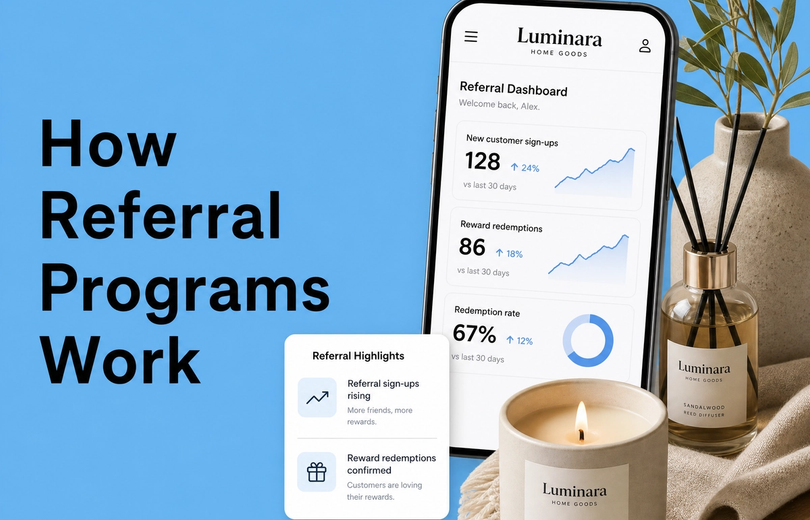
4. Two-sided referral program. Both the advocate and the friend get a reward. Two-sided programs convert 40–100% better than one-sided. Mage's Shopify referral program supports symmetric rewards (e.g., $10/$10 store credit) with native attribution.
5. Paid membership / subscription loyalty. Customers pay a recurring fee (monthly or annual) for bundled benefits — free shipping, member pricing, early access. See subscription loyalty programs for the full mechanics. Premium for high-frequency categories.
6. Pay-with-points at checkout. Let customers redeem points directly against an order at checkout, with a clear $-equivalent shown (e.g., "200 points = $10 off"). Increases redemption rates because the value is immediate and tangible. Native Shopify Checkout integration is required for this to work without friction.
7. Members-only product drops. Drop a limited-edition product or colourway with access restricted to tier-2+ members. Creates a status-driven reason to climb tiers. Works especially well in apparel, beauty, and lifestyle categories.
8. Charity-aligned redemption option. Let customers donate their points to a partner charity instead of (or alongside) redeeming for personal rewards. Doesn't beat cash redemptions on participation, but it strengthens emotional connection and drives organic word-of-mouth.
9. Bonus-point campaigns (themed events). Double-points weekends, 3× points on a specific category, holiday-themed earning multipliers. Creates short bursts of program engagement and works as a non-discount promotion mechanic.
10. Surprise and delight. Random bonus points or store credit dropped to a member's account with no advance notice ("We just added 250 points to your balance — thanks for being a Gold member"). Disproportionately effective because customers don't expect it.
11. Gamified streaks and challenges. Award a tier-bonus or store credit for hitting a streak — three orders in three months, four reviews in 90 days, monthly engagement targets. Works in high-frequency categories (food, consumables, beauty). Not appropriate for considered-purchase categories.
12. Customer-generated content rewards. Higher points for reviews with photos, UGC posted to social with a brand tag, video testimonials. Doubles as social proof creation. Award asymmetrically — a photo review should be worth 5–10× a text-only review to incentivise the right behaviour.
“I looked into so many different integrations for loyalty and referrals for our Shopify Store, but no one impressed me more than Mage on human connection, customer service, and value.”


Read the Reelie case study →
How to pick the right ideas for your brand
Don't run all 12 at launch. Pick 3–4 that match your customer behaviour, AOV, and category.
- First idea: points for non-purchase actions. Universal. Cheap to set up. Raises participation rates immediately.
- Second idea: pick by AOV. Above $100 AOV, lead with VIP tiers for status. Below $100 AOV, lead with store credit and pay-with-points for immediate value.
- Third idea: pick by purchase frequency. High frequency (food, beauty, consumables) → streaks and bonus campaigns. Low frequency (apparel, electronics, home) → tiered VIP perks and members-only drops.
- Fourth idea: pick by community strength. Strong brand community → referrals and UGC rewards. Newer brand → birthday and surprise-and-delight to build affinity.
This is a tactical layer on top of the broader loyalty program management function — what works for your brand depends on the rest of your retention stack.
Common mistakes when ideating loyalty program concepts
Stacking too many ideas at launch. Five or more mechanics at launch overwhelms customers and complicates the program UI. Start with 3–4 and add over time.
Copying competitor programs without adapting to your AOV. Sephora's Beauty Insider works at Sephora's AOV and frequency. Copying it directly for a $40 AOV brand kills program economics. Calibrate the earn-rate and reward thresholds to your category.
Treating loyalty program ideas as discounts in disguise. A "10% off after 5 purchases" idea is just a discount with extra steps. Real loyalty mechanics use status, exclusivity, store credit, and engagement — not just percentage discounts.
Skipping the engagement layer. Programs that only have earn-and-redeem (no surprise rewards, no streaks, no campaigns) lose customer interest between purchases. The engagement ideas (#9–11) keep the program active in customers' minds during the gap.
A 30–60–90 day rollout plan for new ideas
Stacking all 12 ideas at launch overwhelms customers. A phased rollout lets each idea prove itself before the next is added.
Days 1–30 — launch the foundation. Ship points-for-purchase + points-for-reviews + birthday rewards. These three are universal, measurable, and don't require complex UI. Measure participation rate at day 30 (target: 15%+ of active customers earning at least once).
Days 31–60 — add tier mechanics + referrals. Introduce VIP tiers (3-tier structure: Silver/Gold/Platinum) and a two-sided referral program with symmetric reward (e.g., $10/$10 store credit). At day 60, measure tier distribution and referral activation rate. Healthy: 5–10% of active members reach Tier 2; 5–15% send at least one referral.
Days 61–90 — add the engagement layer. Layer in bonus-point campaigns (monthly themed events), surprise-and-delight drops to top-tier members, and a charity-aligned redemption option. These engagement mechanics keep the program active in customers' minds between purchases. At day 90, measure participation breadth (percentage of active customers who engaged with at least one program mechanic) and depth (average actions per active member).
Beyond day 90. Layer in paid membership (if economics support it), members-only product drops, gamified streaks (for high-frequency categories), and UGC rewards. Each additional mechanic should be A/B tested against a holdout cohort before full rollout.
The pattern: launch 3 ideas, prove they work, add 3 more, prove again, expand. Programs that stay static for 12+ months see renewal and engagement decay; programs that compound mechanics over time see retention rates rise.
Frequently Asked Questions
What are the best loyalty program ideas for ecommerce?
Points for non-purchase actions, tiered VIP perks, two-sided referrals, paid membership, pay-with-points checkout, members-only drops, and surprise-and-delight rewards. Most successful programs combine 3–4 of these rather than running a single mechanic.
How many loyalty program ideas should I run at once?
3–4 at launch, expanding to 6–8 over the first 12 months. Stacking 10+ mechanics at once overwhelms customers and creates UI complexity that obscures the program's value.
Which loyalty program ideas work best for low-AOV brands?
Points for non-purchase actions (cheap, raises participation), birthday and anniversary rewards (low cost, durable), pay-with-points checkout (immediate value perception), and bonus-point campaigns (creates promotion mechanic without discounting). Status-driven ideas like VIP tiers work less well below ~$100 AOV.
Which loyalty program ideas work best for high-AOV brands?
VIP tiers with status, members-only product drops, paid membership, and early-access perks. Customers who spend $200+ per order respond more to recognition and exclusivity than to cash-value rewards.
Do I need different loyalty program ideas for B2C vs B2B?
The core ideas translate but the activation differs. B2B customers respond more to volume-based tiering and account-level rewards (rather than individual-level), while consumer brands lean harder on emotional rewards (birthday, surprise, community). The structural ideas (points, tiers, referrals) work in both.
The best Shopify loyalty program for retention-driven brands
Mage Loyalty for Shopify bundles every loyalty program idea on this list — points, VIP tiers, referrals, store credit, paid memberships, wishlists, AI receipt scanning, and a no-code editor — into a single app, with native Shopify POS, customer-account, and checkout integration. Mix and match the mechanics that match your brand. Pricing starts at $49/month with no enterprise minimums.

Kris is the co-founder of Mage Loyalty. I spend most days talking to merchants, and making sure our customers get real results. If you run a Shopify store or Agency we should chat!