Should Smile.io pricing fit your store’s normal order volume and its busiest month? Smile.io pricing uses subscription tiers with monthly order allowances, so the headline fee alone cannot tell you what you will pay across a full year.
Short answer: Model your normal volume, growth volume, and peak-season volume before choosing a tier. Then add the features you need, likely reward costs, implementation work, and migration effort before comparing that total with a Shopify-native alternative.
Smile.io pricing in 2026: the short version
| Plan | Price | Orders included |
|---|---|---|
| Mage Loyalty | ||
| Essential | $15/month | 500 orders included |
| Starter | $49/month | 500 orders included, then $0.20 per order |
| Growth | $499/month | 2,500 orders included, then $0.15 per order |
| Enterprise | Custom, typically from around $999/month | Custom |
| Smile.io | ||
| Standard | $79/month | 1,000 orders/month included |
| Growth | $199/month | 2,500 orders/month included |
| Plus | $999/month | 7,500 orders/month included |
| Enterprise | Custom | Unlimited orders |
What each platform costs at 500, 2,500, 5,000, 10,000 orders a month, using the cheapest plan that covers the volume:
| Orders per month | Mage Loyalty | Smile.io |
|---|---|---|
| 500 | $15 Essential or $49 Starter (list) | $79 Standard (list) |
| 2,500 | $449 Starter or $499 Growth (est.) | $199 Growth (list) |
| 5,000 | $874 Growth (est.) | $999 Plus (list) |
| 10,000 | $1,624 Growth or Enterprise quote (est.) | Custom quote |
How to read these tables: "list" is the public list price on the vendor's pricing page or Shopify App Store listing, "est." is calculated from the published plan price and overage rate, "Custom quote" means the vendor only prices on request, and "Not published" means no public figure exists at that volume. Prices checked September 2026. Sources: Mage Loyalty pricing; Smile.io pricing, Smile.io on the Shopify App Store.
- Mage Loyalty at 2,500 orders: Starter is $49 plus $0.20 per order over 500; Growth includes 2,500 orders.
- Mage Loyalty at 5,000 orders: $499 plus $0.15 per order over 2,500.
- Mage Loyalty at 10,000 orders: $499 plus $0.15 per order over 2,500; Enterprise is quoted on volume, typically from around $999.
- Smile.io at 500 orders: Includes 1,000 orders.
- Smile.io at 2,500 orders: Includes 2,500 orders.
- Smile.io at 5,000 orders: Includes 7,500 orders.
- Smile.io at 10,000 orders: Enterprise above 7,500 orders.
Why the headline monthly fee is not the full cost
Smile.io’s pricing model combines plan tiers, monthly order allowances, and feature access. A plan that fits a quiet month may become restrictive when a product launch, holiday promotion, or BFCM spike pushes volume higher.
Feature access matters too. Check whether the tier you are considering includes the earning, redemption, referral, branding, reporting, integration, and support capabilities your program needs.
The four numbers to check before choosing a tier
Check four inputs: your average monthly orders, highest monthly orders, required features, and the cost treatment once usage rises. Also confirm billing cadence, how monthly usage is measured, and whether additional orders are charged automatically.
The official Smile.io pricing page should be your source of truth before purchase because public pricing and usage rules can change.
“I looked into so many different integrations for loyalty and referrals for our Shopify Store, but no one impressed me more than Mage on human connection, customer service, and value.”


Read the Reelie case study →
How Smile.io pricing can change your monthly bill
Compare both platforms at your actual order volumes, rather than comparing only the entry subscription. Model a normal month, a growth month, and your busiest seasonal month to see where a plan change or usage charge could affect the total.
Mage uses usage-based pricing, while Smile.io also structures plans around order volume and feature access. See the pricing table below for the current modeled costs for Mage and Smile.io from 500 to 10,000 monthly orders, along with official sources.
Normal-month volume versus peak-season volume
Use three scenarios. Your normal month shows the baseline. Your growth month shows the cost if acquisition or repeat purchases improve. Your peak month tests what happens when seasonal demand moves beyond the included order allowance.
Do not select a plan solely because it covers the average month. One high-volume month can change the annual math.
How to calculate your effective cost per order
Use this formula:
Effective monthly software cost per order = (base subscription + documented usage charges) ÷ monthly orders.
Run it at the volumes in the pricing table. The output is not a measure of program profitability, but it can show whether costs rise sharply at a particular volume band.
What to confirm about order counting and overages
Ask the vendor how it counts Shopify orders, when usage is measured, whether usage resets on a billing date, and how additional-order charges appear on your invoice. Confirm the current mechanics directly before committing.
What you are actually paying for at each Smile.io tier
Entry-level loyalty functionality
Assess whether the tier supports the program customers will actually use. Check whether it includes the earning, redemption, referral, branding, and on-site loyalty capabilities you need.
Start with the customer behavior you want to influence: second purchase, higher basket value, product reviews, referrals, or reactivation after a quiet period.
Dedicated loyalty pages, integrations, and reporting
A branded loyalty page may matter if customers need a clear place to see their balance and rewards. Integrations matter when points, tier changes, or referral activity need to reach your email, SMS, reviews, subscription, or support tools.
Reporting is equally practical. Your team needs to see whether members return, redeem, advance through tiers, and generate revenue that justifies reward cost.
VIP programs, API access, and support
Feature requirements can determine the right tier before order volume does. Use the pricing table and official plan details to verify where VIP functionality, API access, reporting limits, and priority support are available.
Match the tier to your program requirements and team capacity. A simple points program has different needs from a program with tier progression, custom customer experiences, and several connected systems.
What Shopify includes before you add a loyalty app
Customer accounts and order history
Shopify customer accounts let customers manage orders, edit profile information, reorder, and access supported self-serve returns, according to Shopify’s customer accounts documentation. That is valuable account infrastructure.
Mage sits on top of Shopify customer accounts rather than replacing them. Its on-site account drawer can bring loyalty balance, tier progress, saved products, and rewards into the customer experience.
Shopify POS customer profiles
Shopify POS customer profiles can hold contact details, purchase history, preferences, and customer metafields, as outlined in Shopify’s POS customer management documentation. This gives staff context when serving a customer in store.
What still requires a loyalty app
Points balances, reward catalogs, VIP tiers, referral attribution, redemption rules, and loyalty analytics require a loyalty layer. A Shopify loyalty program adds those mechanics around Shopify’s accounts, checkout, and POS infrastructure.
The distinction is simple: Shopify provides the customer and order foundation. A loyalty app defines what customers earn, how they redeem, and how your team measures the program.
How to compare Smile.io with a Shopify alternative
Compare total cost, not just subscription cost
Compare five categories: software fee, order-volume exposure, feature access, reward liability, and implementation or migration effort. The lowest subscription can still create a higher operating cost if it requires manual work, lacks a needed capability, or forces an upgrade at the wrong time.
Measure that cost against retained-customer economics, not only acquisition spend. This guide to cost per retained customer explains why that metric belongs next to CAC.
Check the retention surfaces customers actually use
Mage is a Retention & Loyalty platform built for Shopify brands. Its evaluation criteria include a dedicated loyalty page, Rewards Widget, VIP tiers, referrals, Shopify POS, Checkout Extensions, and Mage Canvas for shaping customer-facing loyalty surfaces.
Mage rewards apply at Shopify checkout, so customers do not need to copy a discount code for standard reward redemption. Customer accounts, memberships, and cashback have separate plan or module considerations, so use the current pricing table when comparing scope.
For a focused comparison of platform approach and migration options, review this Smile.io alternative.
Confirm migration ownership and validation
Switching cost includes more than data export. Your team needs to preserve member balances, tier status, customer details, active reward logic, and the customer experience at launch.
Mage describes its support as founder-led, with direct Slack access to the engineers building Mage. Confirm who will validate the migration, what data will be rebuilt, and what your team needs to test before launch.
What carries over when you migrate from Smile.io
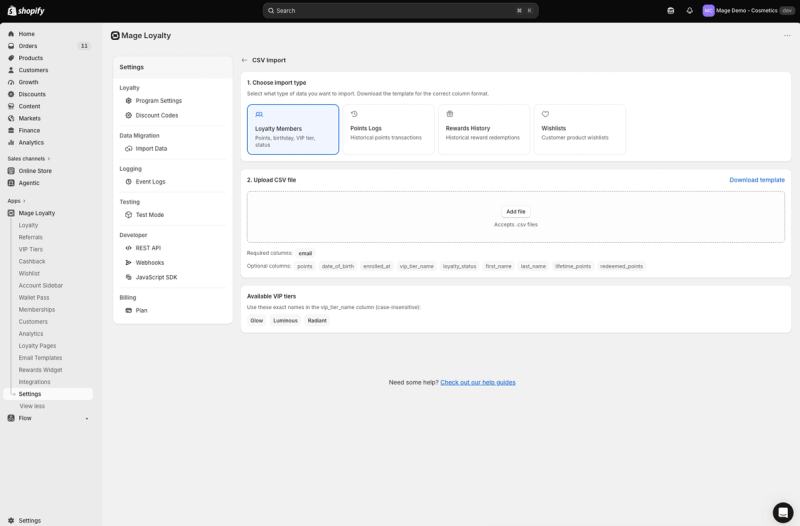
| Migration item | Confirm before export | Post-import check |
|---|---|---|
| Points balance | Customer export contains current balance | Test balances for a sample of customers |
| VIP tier | Tier names and customer tier values are present | Confirm customers retained the intended tier |
| Birthday | Date field is included where used | Check dates on selected customer records |
| First and last name | Name fields are populated consistently | Confirm names display correctly |
| Points history | Determine whether historical transactions are needed | Review imported points logs if included |
| Rewards history | Identify redemption history needed for records | Confirm history is available if imported |
| Wishlists | Export wishlist data if applicable | Verify saved products after launch |
Data Mage documents as importable
Follow Mage’s documented procedure for migrating from Smile.io. Export the customer CSV from Smile.io, then go to Settings > Data Migration > Import Data in Mage and use Manual CSV Import.
Mage supports CSV import types for Loyalty Members, Points Logs, Rewards History, and Wishlists. The Loyalty Members import requires an email column and can include points, birthday, VIP tier, loyalty status, names, and historical point totals.
VIP tier matching before the import
Create matching VIP tiers in Mage before importing customer data. Tier names in the source CSV need to match the Mage tier names for customers to retain their tier. Customers with unmatched tier names import without a tier.
Mage supports up to 10 VIP tiers, with progression based on amount spent, points earned, or number of orders. Match names first, then decide whether the future tier structure needs changes after the migration is stable.
A practical pre-launch checklist
Before launch, test a small customer sample. Check balances, names, birthdays, tier assignment, earning rules, rewards, referral settings, storefront placement, and checkout redemption.
Keep the old program available until your team confirms the new customer experience is working as intended.
The loyalty program costs Smile.io pricing does not show
Reward liability and margin
Software is only one budget line. Include discounts, free shipping, free products, store credit, referral rewards, and campaign incentives. Reward cost should be assessed against incremental repeat purchases, not the full value of every reward redeemed.
A deeper budget for a loyalty program includes those costs alongside software and setup.
Implementation and maintenance
Budget for program design, visual work, integration setup, customer communication, testing, and ongoing campaign management. A program with unclear earning rules or weak redemption options can create support work without delivering a useful reason to return.
The metrics that decide whether the spend pays back
Track repeat purchase rate, retention rate, average order value, customer lifetime value, redemption rate, referral revenue, and cost per retained customer. Shopify recommends these loyalty metrics in its loyalty analytics guidance.
Shopify reports that repeat customers account for 21% of customers but generate 44% of total revenue and 46% of orders. Use your own store data to decide whether the program is earning its budget.
Frequently asked questions
What is Smile.io pricing in 2026?
Smile.io pricing in 2026 uses subscription tiers tied to monthly order volume and feature access. Review the pricing table, then verify the official pricing page before purchase because plan details and usage rules can change.
Does Smile.io charge for extra orders?
Smile.io lists additional-order rates for some higher-volume tiers. Model normal and peak months, then confirm how monthly orders are counted, when usage is measured, and how additional usage is billed.
Is Smile.io worth it for a Shopify store?
Smile.io can be worth it when its features, order-volume exposure, and operating cost fit the program you plan to run. Compare software cost with reward liability, reporting needs, implementation work, and expected incremental repeat revenue.
Does Shopify have a loyalty program built in?
Shopify includes customer accounts, order history, customer profiles, and POS infrastructure, but it does not provide a complete loyalty program by itself. Points, rewards, VIP tiers, referrals, redemption rules, and loyalty analytics generally require a loyalty app layered onto Shopify.
Can you migrate Smile.io points and VIP tiers?
You can migrate Smile.io points and VIP tiers by exporting a customer CSV, creating matching VIP tiers in Mage, uploading the file through Settings > Data Migration > Import Data, and validating imported records. See Mage’s Smile.io migration procedure for the documented steps.
What is a cheaper alternative to Smile.io?
A cheaper alternative to Smile.io depends on order volume, required functionality, reward cost, and migration effort. Compare the pricing table with the customer surfaces and operational support you need, then assess whether Mage fits your Shopify program requirements.
Ready to see Mage in action? Book a demo.

Graeme is the co-founder at Mage Loyalty. He heads product development, from complex loyalty migrations and large-scale data handling to building the features shaping the future of loyalty on Shopify.