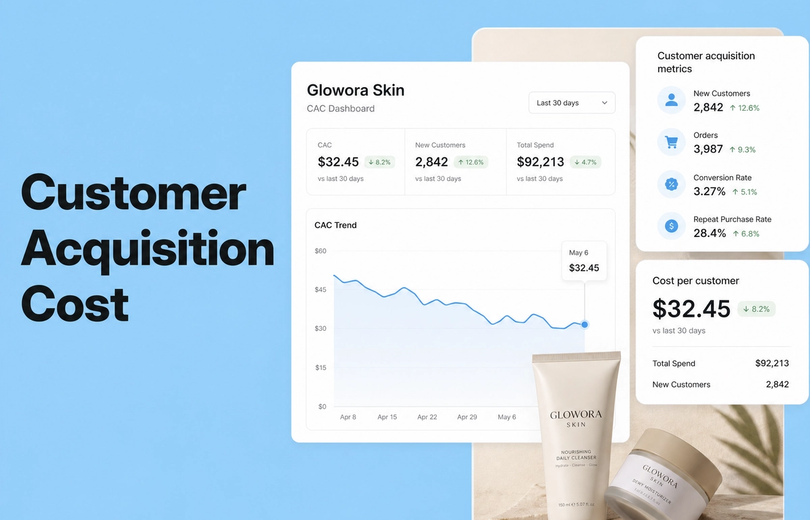
Monday’s Shopify report shows a $60 customer acquisition cost, while the loyalty dashboard shows more repeat orders from members. Those are useful numbers, but they answer different questions. Customer acquisition cost measures what it took to acquire a new paying customer in a period, not whether that customer returned afterward.
Short answer: A loyalty program can lower CAC when it creates a measurable acquisition channel, usually through qualified customer referrals. Retention and review rewards usually do not lower the CAC formula directly, but they can make a given CAC more profitable through repeat revenue, payback, or better paid conversion. Track referral CAC separately from loyalty-attributed revenue and member LTV.
Can a loyalty program lower CAC? Only referrals lower it directly
CAC is acquisition cost divided by new paying customers over the same period. Shopify’s guidance is clear on the accounting boundary: retention-focused spending such as loyalty programs, winback campaigns, and post-purchase email should generally stay out of CAC.
A Shopify loyalty program usually belongs in the retention bucket. Points for purchases, VIP perks, and birthday rewards may increase repeat buying, but they do not create a lower acquisition cost line item simply because existing customers buy again.
Use a three-bucket test before claiming loyalty lowered CAC:
- Direct acquisition: Referral incentives, referral-only creative, and referral operations can sit in CAC because they produce identifiable first-time customers.
- Indirect economics: Retention changes repeat revenue, contribution-margin LTV, and payback. It can justify a higher bid, but it does not reduce the recorded cost of the first acquisition.
- Conversion assistance: Reviews and customer content may improve an ad or landing page’s conversion rate. That can lower paid CAC if a test proves the improvement.
Referrals are the direct mechanism because an advocate shares a unique link, a friend converts, and the merchant can count that friend as a distinct new customer. The opposite answer is right when referral CAC does not beat the paid channel it replaces, or when margin, repeat purchase, or customer advocacy are too weak to support a qualified double-sided reward.
Calculate the blended CAC effect before you call referrals cheaper
| Scenario | Acquisition cost | New customers | CAC | Calculation note |
|---|---|---|---|---|
| Paid acquisition only | $12,000 | 200 | $60.00 | Paid spend divided by first-time customers |
| Referral pilot only | $1,200 | 30 | $40.00 | Redeemed referral incentives divided by referred first-time customers |
| Paid plus referral pilot | $13,200 | 230 | $57.39 | Total acquisition cost divided by all new customers |
Referral CAC needs its own formula: realized friend incentive cost, plus realized advocate incentive cost, plus referral-specific creative or operating cost, divided by distinct first-time referred purchasers. Do not use the face value of every code issued. A discount that expires unused is not a realized reward cost.
The table uses illustrative inputs, not benchmarks. Paid spend of $12,000 acquires 200 customers, so paid CAC is $60. A referral pilot acquires 30 new customers at $1,200 in redeemed incentives, so referral CAC is $40.
Combined, the store spends $13,200 to acquire 230 customers. $13,200 divided by 230 equals $57.39 blended CAC, a 4.3% decrease from the $60 paid-only baseline.
Volume determines whether that lower referral CAC matters. A $40 referral CAC barely moves blended CAC if it produces three net-new customers. It matters when referred customers represent enough incremental acquisition volume to replace a meaningful share of paid acquisition.
Use a qualified offer to protect the math. Primally Pure gives a friend $10 off a first order of $50 or more, while the advocate gets $10 as a coupon code. The minimum order matters because the merchant must absorb the realized cost of both sides without giving away margin on an order that was too small to support it.
Use redeemed reward cost after returns and cancellations. If your return rate is material, delay the advocate reward until the qualifying order clears the return window, then calculate CAC from the rewards that remain valid.
Retention changes the bid ceiling, not the CAC line item
CAC must be judged against order value, expected repeat revenue, and margin. The chart below shows how sharply first-order acquisition pressure differs by category, using median CAC divided by median AOV rather than a target for any individual store. Mage’s ecommerce customer acquisition cost benchmarks use Polar Analytics’ August 2026 snapshot of more than 4,000 Shopify brands, and the ratios are ratios of industry medians, not each brand’s own ratio.
| Group | Value |
|---|---|
| Health and wellness | 110% ($72.66 CAC on a $66 order) |
| Pets | 69% ($44.79 on $64.90) |
| Beauty and personal care | 67% ($44.29 on $66) |
| Food and beverage | 65% ($49.39 on $76.43) |
| Automotive | 51% ($61.81 on $122.10) |
| Home and garden | 45% ($54.08 on $121) |
| Gifts and occasions | 45% ($37.47 on $84.04) |
| Apparel and accessories | 41% ($34.03 on $82.50) |
| Toys and hobbies | 39% ($38.28 on $98.72) |
| Consumer electronics | 32% ($43.38 on $135.60) |
| Retail | 28% ($22.74 on $82.04) |
| Business and industrial | 25% ($84.22 on $340.21) |
| Arts and entertainment | 23% ($22 on $93.80) |
| Sports and outdoor | 20% ($27.66 on $138.48) |
Median CAC divided by median AOV for each industry, both from Polar's August 2026 snapshot of 4,000+ Shopify brands. A ratio of medians, not the median of each brand's ratio.
Source: Mage Loyalty calculation from Polar Analytics industry medians
A retention program can make a $60 CAC acceptable if the customer returns quickly and contributes enough margin over subsequent orders. That changes the bid ceiling and payback period. It does not turn the original $60 media cost into a lower CAC figure.
Across most consumer categories, Polar Analytics’ data summarized in Mage’s ecommerce customer acquisition cost benchmarks puts median CAC between $34 and $54. Use that only as context. Your acceptable CAC depends on your own AOV, gross margin, repeat behavior, discounting, and return rate.
Referred customers may also be worth more than customers from another channel, but test that as a cohort question. A Journal of Marketing study tracking approximately 10,000 customers at a German bank found referred customers had at least 16% higher value than comparable non-referred customers. That is useful evidence for testing referred-customer quality, not a Shopify forecast.
Compare referred and paid cohorts at 90 and 180 days. Measure repeat revenue or contribution margin after the first order, and keep member-versus-non-member comparisons out of causal claims unless you have a proper control group.
“Cannot say enough good things about the team at Mage Loyalty, one of the absolute best organizations we have ever worked with, full stop! So glad we connected with them, completely redid our loyalty program, new concepts, use of loyalty, increasing user engagement, showing us where we were not valuing our best customers, just WOW, amazing team!”


Read the West Coast Goalkeeping case study →
Reviews and UGC improve acquisition only when they help a prospect convert
A review reward creates more customer evidence. It lowers acquisition cost only when that evidence improves the conversion rate of a paid ad, product page, or landing page enough to reduce the cost per first purchase.
Classify a reward for an honest review as review-collection or retention spend by default. If you use customer content in an ad, track the attributable creative-production cost separately, then test that creative against a control. The question is whether the prospect converts more efficiently, not whether the reviewer received points.
The compliance line is simple. Never make an incentive conditional on a positive rating or positive sentiment, disclose incentives where required, and follow the review platform’s own rules. Read how to reward reviews without breaking FTC rules before putting an offer in a review request.
Mage can reward review activity through a connected review app while keeping that reward separate from ad attribution. With the Judge.me loyalty integration, a merchant can set a review earning rule after connecting the app, award once per product reviewed, and avoid rewarding reviews submitted before the rule was enabled.
Test the acquisition effect directly. Run one paid landing page with verified customer content and one without it, hold targeting and spend constant, then compare first-purchase conversion and CAC. Keep the review reward in the review-collection budget unless the test ties its cost to measurable acquisition performance.
Measure referral CAC, payback, and incrementality separately
| Metric | Formula or comparison | What it answers | Recommended window | Do not include or infer |
|---|---|---|---|---|
| Referral CAC | Realized referral costs divided by first-time referred purchasers | Whether referrals beat paid acquisition | Weekly and 90 days | Existing customers or unused code face value |
| Blended CAC | All acquisition spend divided by all new customers | Whether referrals change total acquisition efficiency | Monthly and 90 days | General retention rewards |
| Referred cohort quality | Referred versus paid repeat revenue or margin | Whether referred customers return differently | 90 and 180 days | Causality from one cohort comparison |
| Incremental referrals | Offer-exposed group versus holdout group | Whether the offer created net-new customers | 90 days | Reported referral revenue alone |
Referral CAC answers whether the referral offer beats paid acquisition
Set one fixed reporting period and calculate referral CAC from referral-specific realized costs divided by distinct first-time referred purchasers. Include redeemed friend discounts, redeemed advocate rewards, and any referral-only creative or operations costs.
Mage’s referral program analytics exposes referral traffic, claimed referrals, completed referrals, blocked referrals, new customers acquired, friend discounts issued, advocate rewards issued, referral channels, and referred-friend revenue. Use new customers acquired as the denominator. Referral revenue is useful for cohort monitoring, but it is not referral CAC.
Blended CAC answers whether referrals materially change total acquisition efficiency
Calculate blended CAC by dividing all acquisition spend, including referral acquisition expense, by all first-time customers acquired in the period. Keep broad loyalty rewards out unless they were genuinely required to acquire the referred customer.
Report paid-only CAC, referral CAC, and blended CAC side by side. This prevents a common reporting error: crediting referral revenue or loyalty-attributed revenue as if it were acquisition savings.
Mage reports every order placed by referred friends in the selected period, including later purchases. That supports cohort analysis, but it does not prove the referral program lowered CAC without the realized cost and first-time-customer calculation.
Cohorts and holdouts answer whether customer quality or program exposure caused the result
Track 90-day and 180-day repeat revenue or contribution margin by acquisition source. A referred cohort with stronger repeat behavior may support a higher allowable referral CAC, but only after you account for the first-order reward, returns, and early-order margin.
Where practical, hold out a random group of eligible customers from the referral prompt or offer. Compare incremental referred customers between exposed and holdout groups. Fraud controls also matter: Tea Drops uses device and IP referral-fraud prevention, a useful reminder that weak controls can make referral CAC look artificially low.
Run a 90-day pilot with a qualified referral offer
Pull the prior 90 days of paid acquisition spend and first-time customers first. That gives you the paid CAC baseline your pilot must beat. Keep the program only if realized referral CAC stays below that benchmark and the new-customer volume is meaningful.
Use a double-sided offer with a minimum first purchase. Hyperice gives a friend $25 off a first order of $200 or more, then gives the advocate $25 in points. The $200 threshold protects the offer from being spent on low-value orders.
Mage’s basic referral guidance identifies $15 to $20 as a useful test range for a meaningful two-sided reward, rather than a universal setting. Set the friend reward and purchase minimum so the first order can carry the realized cost of both rewards.
Send friends to a dedicated referral landing page that explains the offer. Turn on email-alias and self-referral blocking from launch, and delay advocate rewards until qualifying orders clear the return window when returns are material.
At day 90, scale only if referral CAC beats paid CAC, fraud remains controlled, and referred cohorts show acceptable early repeat behavior. Revise the reward if conversion is weak. Stop the offer if it fails the cost threshold.
Frequently Asked Questions
Does a loyalty program reduce CAC or improve LTV?
A loyalty program can reduce CAC through qualified referrals, while its retention mechanics usually improve LTV, payback, and the maximum profitable acquisition bid. Points, tiers, and post-purchase rewards should normally be measured as retention investment unless they directly fund acquisition of a distinct first-time customer.
How do I calculate referral CAC?
Referral CAC is calculated by dividing realized referral-specific costs by distinct first-time referred purchasers. Include redeemed friend incentives, redeemed advocate rewards, and referral-only creative or operations costs. Exclude unused codes, existing customers, and general loyalty costs that were not required to acquire the referred customer.
Should loyalty rewards be included in CAC?
Loyalty rewards should usually be excluded from CAC because they are retention spend rather than acquisition spend. Include only rewards genuinely required to acquire a referred customer, then apply the same documented allocation policy each reporting period so referral CAC remains comparable with paid-channel CAC.
Can incentivized reviews lower paid advertising costs?
Incentivized reviews can lower paid advertising costs only if the resulting customer content improves paid-ad or landing-page conversion in a controlled test. The incentive cannot depend on positive sentiment, and merchants should disclose material incentives where required while following their review platform’s policies.
What is a good referral CAC?
A good referral CAC is lower than the comparable paid-channel CAC and remains economically viable after incentives, discounts, returns, and expected early-order margin. There is no universal dollar target because AOV, margin, repeat behavior, and the qualification threshold determine whether a referral offer pays back.
Pull your paid CAC baseline, run a qualified 90-day referral pilot, and calculate realized referral CAC from redeemed costs and distinct first-time customers. Keep retention, review collection, and referral acquisition in separate buckets. Scale only when referrals beat the paid baseline without relying on weak attribution or inflated customer counts.

I'm Kris, co-founder of Mage Loyalty. I spend most days talking to merchants and making sure our customers get real results. We work with Shopify brands, retailers and restaurants, so if that's you (or you're an agency working with them), we should chat!