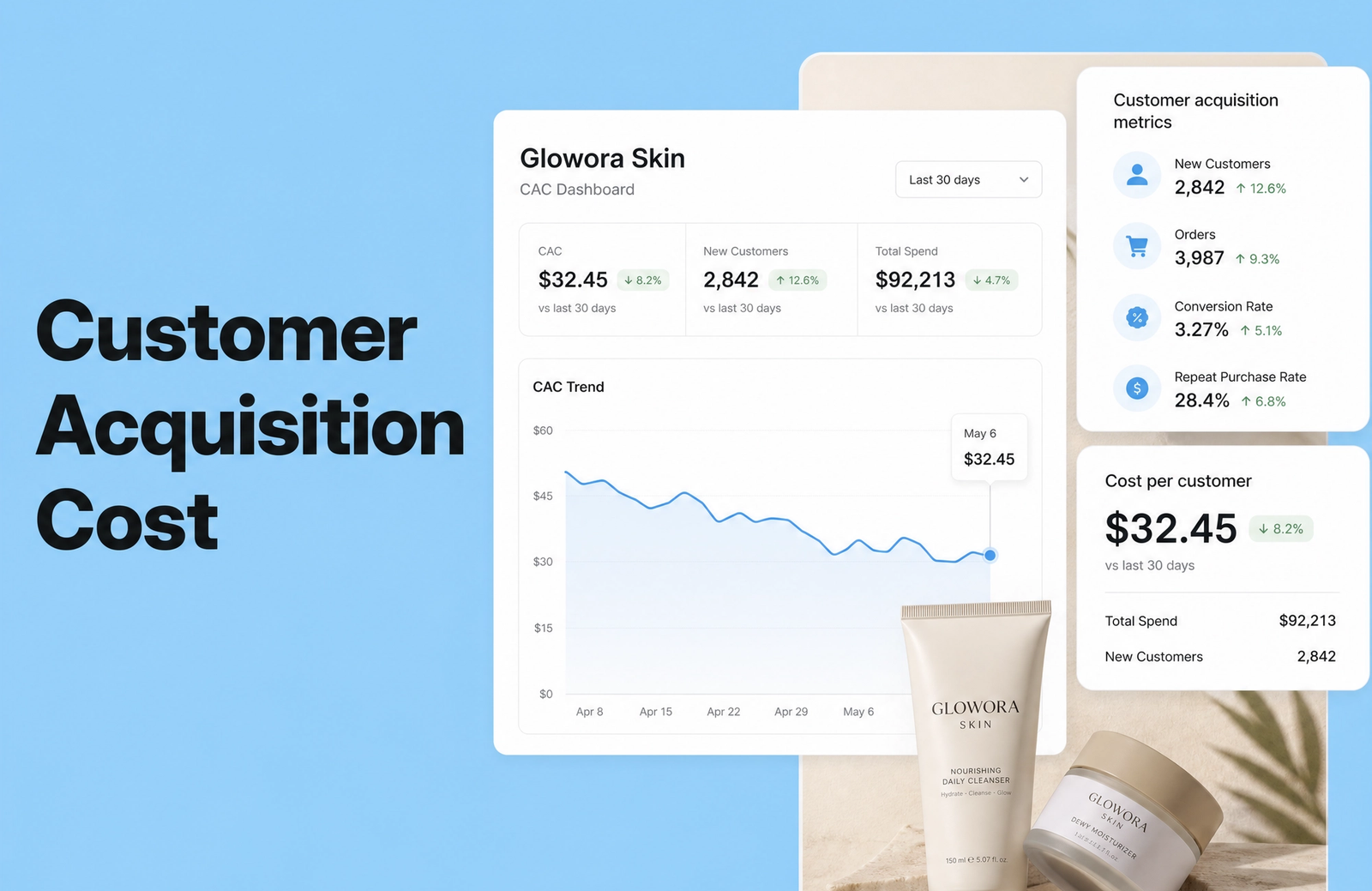
Here is the most expensive belief in ecommerce finance: that a lower customer acquisition cost is always better. It sounds obvious. Spend less to win a customer, keep more profit. But that instinct quietly bankrupts brands, because customer acquisition cost (CAC) is meaningless on its own. A $10 CAC is a disaster if each customer is only worth $10. A $500 CAC is a gift if each customer returns $4,000. CAC only tells you anything when you set it next to what a customer is actually worth.
We have watched founders chase a cheaper CAC straight into a wall, slashing the exact channels that bring in their highest-value buyers and ending up with a cheap-but-disposable customer base that churns in 60 days. So before we hand you the formula (and we will, with worked numbers), let's bust the myth. The goal was never a low CAC. The goal is a healthy ratio between what you spend to acquire someone and what they pay you back.
What customer acquisition cost actually is
Customer acquisition cost is the total amount a business spends on sales and marketing to win one new paying customer, calculated by dividing all sales and marketing expenses in a period by the number of new customers acquired in that same period. It is the foundational unit-economics metric for judging whether a business can grow profitably, and it only becomes meaningful when compared against customer lifetime value (LTV).
The formula is deliberately simple:
CAC = (total sales spend + total marketing spend) / new customers acquired
That's it. Add up everything you spent to get customers in a window (ad spend, agency fees, software, the salaries of the people running it), then divide by the number of genuinely new customers you brought in during that same window. Same period on top and bottom. That timing detail trips up more teams than the math ever does.
Think of CAC like the price of a fishing trip. The cost of the boat, the bait, and the fuel is your acquisition spend. The fish you bring home are your new customers. But nobody judges a fishing trip by cost alone. A $2,000 charter that lands a 200-pound tuna beats a $40 afternoon that nets a single sardine. What the fish is worth decides whether the trip was smart, and that is the part the raw CAC number can never tell you.
Why CAC is the metric that decides if you survive
CAC sits at the center of ecommerce unit economics because it answers the one question every other metric dances around: can you afford to grow? If it costs more to acquire a customer than that customer will ever spend, scaling just speeds up the losses. Plenty of well-funded brands have proven this the hard way.
It also matters more now than it did three years ago, because acquisition is getting structurally more expensive. Google CPCs rose 12.88% year over year in 2025, with Google Shopping CPCs jumping 33.72%, while Meta CPMs climbed roughly 20% to $14.19, according to Phoenix Strategy Group's 2025 CAC analysis. Average retail and ecommerce CAC hit around $226 in 2024, and CAC in competitive categories jumped 40% to 60% between 2023 and 2025. The auction floor keeps rising whether your margins do or not.
Here's what that means in practice. The brands winning in 2025 and 2026 are not the ones who found a magic cheap channel. They're the ones who made each acquired customer worth more, so a rising CAC still pencils out. That is the strategic core of the whole retention versus acquisition math: when the cost of the front door goes up, you grow the value of the house.
The Shopify loyalty program growing brands trust
See how Mage helps Shopify brands lift repeat purchase rate with loyalty, referrals and store credit.
Book a demoHow to calculate CAC: blended, paid, and what to include
This is where most explainers wave their hands. There are really two CACs, and confusing them is how teams lie to themselves about performance.
Blended CAC divides total sales and marketing spend (including salaries, software, and organic effort) by all new customers. Paid CAC divides only paid media spend by the customers attributable to paid channels. Blended is the honest cost of running the whole machine. Paid is the efficiency of your ad dollars specifically.
Let's run both for one brand so the gap is concrete. A DTC apparel label spends $40,000 in a month: $22,000 on paid social, $10,000 on Google Shopping, $5,000 on influencer fees, and $3,000 on marketing-team salaries. It acquires 500 new customers.
| Calculation | What's included | Spend | New customers | CAC |
|---|---|---|---|---|
| Paid CAC | Paid media only (social + Shopping + influencer) | $37,000 | 500 | $74 |
| Blended CAC | All sales and marketing, salaries included | $40,000 | 500 | $80 |
Here the gap is only $6, because the team is lean. But in a content-heavy brand with a big creative payroll, blended CAC can run 30% to 50% above paid CAC. If you report only the flattering paid number to your board, you are hiding the real cost of growth. Use blended CAC for strategic decisions and paid CAC for optimizing channels. They answer different questions.
What belongs in the formula? Ad spend across every paid channel. Agency and freelancer fees. Marketing and sales software. The salaries (or salary fraction) of people whose job is acquisition. Creative production costs. What does not belong: fulfillment, customer support, product costs, or anything tied to serving customers you already have. Those are retention and operating costs, not acquisition.
One more distinction worth nailing down, because the People Also Ask box asks it constantly. CAC is not the same as CPA (cost per acquisition). CPA usually measures the cost of a single conversion event such as a lead, a signup, or a first click-driven sale, often per channel. CAC measures the fully loaded cost of a genuinely new paying customer across everything. Every CAC is built from CPAs, but CAC carries the overhead that channel-level CPA leaves out.
“Great app! User friendly and straightforward. The customer service team has been great and so helpful.”


Read the SKYNBIO case study →
What counts as a "good" CAC (it depends entirely on the vertical)
There is no universal good CAC, and anyone who quotes one is selling something. Acceptable CAC swings wildly by industry, because LTV and margins swing wildly too.
| Industry | Typical CAC range | Why it lands there |
|---|---|---|
| Pet products (DTC) | $20-$45 | Frequent reorders, thin margins |
| Beauty / skincare (DTC) | $25-$50 | High repeat rate, replenishment cycles |
| Supplements (DTC) | ~$89 | Subscription-led, strong LTV |
| Retail / ecommerce (blended) | $68-$84 | Broad mix, 2026 average |
| Luxury goods | $400+ | High AOV, low frequency |
| B2B SaaS | $1,200-$2,000 | Long sales cycles, high LTV |
| Financial services | $2,167-$4,056 | Trust and regulatory overhead |
Source: synthesized from Phoenix Strategy Group, Triple Whale, and published 2026 category benchmarks.
Read that table the right way. A $23 CAC in pet products looks cheap, but if those customers carry an LTV of just $30, the brand is nearly break-even before it pays for a warehouse. A $3,000 CAC in financial services looks alarming until you learn the LTV clears $9,000. The number alone is noise. The ratio is the signal.
CAC also varies enormously by channel, which is why blended CAC drops as a brand's owned and earned channels mature.
| Channel | Typical CAC | Best for |
|---|---|---|
| Referral programs | ~$150 (B2B); often far lower in DTC | High-trust, high-LTV buyers |
| Email / retention | Near-zero incremental | Repeat purchases |
| Organic SEO | Near-zero incremental | Compounding discovery |
| Meta paid social | ~$38 CPA (ecommerce, 2025) | Net-new discovery |
| Outbound sales | ~$1,980 (B2B) | High-ticket, complex deals |
Paid channels do the cold-start work. Owned channels (email, a Shopify loyalty program, referrals) carry repeat revenue at a fraction of the cost. The richer your owned-channel mix, the lower your blended CAC drifts, even while ad auctions get more expensive. This is also why a strong word-of-mouth motion in ecommerce quietly subsidizes everything else.
The two ratios that make CAC mean something: LTV:CAC and payback period
If you take one thing from this guide, take this. CAC without LTV is half a sentence. The LTV:CAC ratio finishes it.
LTV:CAC compares the lifetime value of a customer to the cost of acquiring them. The widely cited healthy threshold is 3:1, meaning you earn three dollars for every dollar of acquisition spend. The median LTV:CAC across B2B SaaS segments sits around 3.2:1, and a ratio below 1:1 signals you are losing money on every customer you buy (Wall Street Prep). A ratio that's too high (say 6:1) is not a victory either. It usually means you're underspending and leaving growth on the table.
Watch how the same CAC produces wildly different verdicts. Brand A has a $50 CAC, a $75 average order value, two purchases a year, a two-year lifespan, and 50% gross margin. Its LTV is $75 x 2 x 2 x 0.50, or $150, putting LTV:CAC at exactly 3:1. Acceptable. Now Brand B keeps the identical $50 CAC but runs a loyalty program that lifts purchase frequency to three times a year. LTV becomes $75 x 3 x 2 x 0.50, or $225, pushing the ratio to 4.5:1. The acquisition cost never moved. Retention did all the work.
The second ratio is the CAC payback period: how many months of revenue it takes to recover what you spent acquiring a customer. A SaaS company spending $1,000 per customer and earning $100 in monthly recurring revenue has a 10-month payback. Shorten that and you free up cash to reinvest sooner. The median SaaS payback period stretched to 18 months in 2024, up from 14 the prior year, while top performers recover in 5 to 7 months, per First Page Sage's 2025 benchmarks. (Worth noting those payback figures are practitioner-derived from a sample of companies rather than a large named-firm survey, so treat them as directional.)
Both ratios point at the same lever. You can improve them by cutting CAC, or by raising LTV. In 2025 and 2026, with ad costs climbing, raising LTV is usually the safer, more durable move. The full mechanics of that are worth a deeper read on how to increase customer lifetime value and how to calculate LTV on Shopify.
How retention quietly lowers your effective CAC
Here is the contrarian take we'll plant a flag on: the fastest way to fix a bad CAC is usually to stop touching your CAC. Stop reflexively cutting ad spend. Raise what each acquired customer is worth instead, and your acquisition budget becomes more efficient without buying a single extra impression.
The math is unforgiving in your favor. Acquiring a new customer costs anywhere from five to 25 times more than retaining an existing one, and increasing retention by just 5% can lift profits by 25% to 95%, per Frederick Reichheld's research at Bain & Company (Harvard Business Review). Repeat customers also spend more over time: buyers in months 31 to 36 of a relationship spend roughly 67% more than they did in their first six months. Every one of those repeat dollars lands at near-zero incremental CAC.
Consider how this plays out for a brand stuck at a 2:1 LTV:CAC ratio with a $60 CAC, unprofitable once you layer in operating costs. Cutting ad spend shrinks the business. The smarter move is a retention mechanism (a loyalty program, a structured second-purchase nudge) that lifts the repeat rate. Push the second-purchase rate up by 20% and you can add $40 to $80 of LTV per customer, which is enough to clear the 3:1 line. You didn't change acquisition at all. You changed what acquisition was buying.
A public example makes this tangible. Amazon Prime is, at heart, a retention machine that rewrites CAC math. Prime members spend far more per year than non-members and rarely shop elsewhere, so Amazon can comfortably absorb high upfront acquisition costs that would sink a single-purchase retailer. The annual fee and the bundled perks lock in frequency, and frequency is what turns an expensive first sale into a cheap, profitable decade. Amazon never won by having the lowest CAC. It won by making each customer worth so much that CAC stopped being the constraint.
This is why retention infrastructure has become an acquisition strategy in disguise. It's one option among several, and the right fit depends on your stack, but the underlying move is the same: grow the value of the customer you already paid to acquire. For Shopify brands specifically, that retention layer is the practical mechanism behind better Shopify customer retention.
How to use CAC without fooling yourself
Pull it together into a working habit. Calculate blended CAC monthly for the truth about your whole growth engine, and paid CAC by channel for optimization. Never report either number naked. Always pair it with LTV and the resulting ratio, because a CAC figure without LTV is, as we said, half a sentence.
Segment your CAC by channel and cohort so you can see which buyers actually pay you back, not just which were cheapest to acquire. Then ask the only two questions that matter: is our LTV:CAC at or above 3:1, and how fast do we recover acquisition spend? If the answer to either is "not great," resist the reflex to slash spend first. Look at retention, frequency, and margin, because those levers move the ratio without exposing you to the rising auction. And if you're benchmarking the front end of the funnel, your traffic quality and conversion rate matter too, because a higher conversion rate lowers CAC on the same ad spend.
Frequently Asked Questions
What is customer acquisition cost (CAC) and how do you calculate it?
Customer acquisition cost is the total sales and marketing spend required to win one new paying customer. You calculate it by dividing all sales and marketing costs in a period by the number of new customers acquired in that same period. Include ad spend, agency fees, software, and the salaries of people running acquisition.
What is a good customer acquisition cost?
A good CAC depends entirely on your industry and customer lifetime value, not on an absolute dollar figure. DTC beauty might target $25 to $50 while financial services tolerates $2,000-plus. The real test is your LTV:CAC ratio: aim for at least 3:1, where each acquisition dollar returns three dollars over the customer's lifetime.
What is the difference between CAC and CPA (cost per acquisition)?
CAC and CPA measure different things. CPA is the cost of a single conversion event (a lead, signup, or sale), usually tracked per channel. CAC is the fully loaded cost of a genuinely new paying customer across all sales and marketing, including overhead and salaries. CAC is broader and includes costs that channel-level CPA leaves out.
What is a good LTV to CAC ratio?
A good LTV:CAC ratio is generally 3:1 or higher, meaning you earn at least three dollars for every dollar spent on acquisition. The median across B2B SaaS sits near 3.2:1. A ratio below 1:1 means you lose money per customer, while a very high ratio (6:1-plus) often signals underinvestment in growth.
How does customer retention affect customer acquisition cost?
Customer retention lowers your effective CAC by raising lifetime value without increasing acquisition spend. A 5% retention improvement can lift profits 25% to 95% (Bain), because repeat purchases arrive at near-zero incremental cost.
What is CAC payback period and why does it matter?
CAC payback period is the number of months of customer revenue needed to recover acquisition spend. A $1,000 CAC against $100 monthly revenue means a 10-month payback. It matters because faster recovery frees up cash to reinvest in growth. Median SaaS payback reached 18 months in 2024, while top performers recover in 5 to 7 months.
TLDR
Customer acquisition cost is the total sales and marketing spend divided by new customers acquired in the same period, and the myth that a lower CAC is always better is the costliest belief in growth marketing. CAC only means something against lifetime value, so judge it by the LTV:CAC ratio (aim for 3:1 or higher) and the payback period, not by the raw number. Separate blended CAC (the honest, all-in cost) from paid CAC (channel efficiency), and remember that good CAC swings from $25 in DTC beauty to $3,000 in financial services. With Meta CPMs up roughly 20% and Google CPCs up 12.88% in 2025, the durable lever in 2025 and 2026 is not cutting acquisition spend but raising LTV through retention, because a 5% retention gain can lift profits 25% to 95% and quietly lowers your effective CAC without buying a single extra impression.

Graeme is the co-founder at Mage Loyalty. He heads product development, from complex loyalty migrations and large-scale data handling to building the features shaping the future of loyalty on Shopify.