If your Yotpo loyalty bill sits alongside separate account, wishlist, referral, or development costs, a cheaper alternative to Yotpo is worth evaluating as a total-stack decision.
Short answer: Mage is worth evaluating if you want Shopify-focused loyalty, referrals, checkout redemption, no-code customization, and, depending on the plan or module selected, branded account surfaces and wishlists. Yotpo may fit better if its wider Reviews, UGC, and AI visibility suite is central to your stack. Validate any saving against order volume, contract terms, feature usage, adjacent apps, and reward costs.
Mage vs Yotpo: the comparison for Shopify brands trying to lower loyalty costs
Who this comparison is for
This comparison is for Shopify operators already using, or actively evaluating, Yotpo Loyalty & Referrals. The question is not whether points and referrals work. It is whether the current program delivers enough retention value to justify the software, implementation, and surrounding app costs.
Mage is a retention and loyalty platform built exclusively for Shopify brands. Its core Shopify loyalty program covers points, rewards, VIP tiers, referrals, and redemption at checkout. Depending on your selected plan or module, Mage can also consolidate loyalty with branded account surfaces, wishlists, and related retention experiences.
Yotpo can suit brands that want loyalty as part of a broader vendor relationship covering Reviews, UGC, and AI visibility tooling. This article isolates the loyalty decision rather than treating every Yotpo product as one interchangeable line item.
Why the cheapest monthly subscription is not always the lowest total cost
A loyalty subscription is only one part of the cost. Add usage fees, apps filling account or wishlist gaps, developer time, migration work, support workload, and reward margin.
Mage’s published Yotpo alternative comparison says merchants can save 20% to 50% versus Yotpo. Treat that as a comparison claim to test against your own stack, not a forecast for every store.
“We are really happy with working with the Mage team and getting this program up and running. They are very responsible and professional. Very seamless and the upsell features seem to already be helping with adoption!”


Read the Tea Drops case study →
Mage vs Yotpo: feature comparison at a glance
According to the current official Yotpo loyalty pricing page, verify plan-level availability directly with Yotpo before making a switching decision.
| Area | Mage Loyalty | Yotpo Loyalty & Referrals | What to verify before switching |
|---|---|---|---|
| Platform focus | Built exclusively for Shopify | Broader platform footprint | Whether Shopify-only depth or multi-platform coverage matters |
| Loyalty engine | Points, Mage store-credit mode, rewards, VIP tiers, referrals | Loyalty and referral features listed on its pricing page | Required earning rules and reward types |
| VIP tiers | Available | Not stated in the supplied source | Tier rules and status logic |
| Checkout | Checkout Extensions and redemption | Not stated in the supplied source | Logged-in redemption experience |
| POS | Shared loyalty balance with Shopify POS | Shopify POS supported | In-store workflows |
| Account experience | On-site Mage Accounts drawer, available with the relevant plan or module | Not stated in supplied pricing data | Whether you need account consolidation |
| Wishlist | Available as part of Mage’s retention experience, subject to plan | Not stated in supplied pricing data | Whether a separate wishlist tool remains necessary |
| Customization | Mage Canvas and optional custom CSS | Varies by plan and implementation | Marketing team ownership |
| Integrations | Email, SMS, reviews, support, and subscription integrations | Shopify POS, Klaviyo, Recharge, ShoppingGives, and webhooks listed | Critical integrations and event requirements |
| Broader suite | Loyalty-focused retention platform | Reviews, UGC, and AI visibility suite | Whether one wider vendor is a priority |
Mage’s strongest case is Shopify-focused consolidation. Yotpo’s strongest case is breadth. Review the detailed comparison alongside your actual requirements, because a table cannot show which features your team uses every week.
Where Mage wins for Shopify brands cutting loyalty costs

Lower total stack cost, not just a lower app bill
The real comparison is not “Which loyalty plan costs less?” It is “What does it take to run the retention experience we need?”
Start with the platform fee, then add overages, adjacent app subscriptions, developer hours, onboarding, and the cost of maintaining disconnected customer experiences. If you use one tool for loyalty, another for wishlists, and custom work for account surfaces, those costs belong in the same worksheet.
Tea Drops moved more than 200,000 loyalty members from Yotpo in under two weeks and reported a 50% reduction in loyalty costs. That is Tea Drops’ result, not a standard outcome.
Use cost per retained customer beside CAC when assessing the switch. A smaller software bill is useful only if retention performance holds or improves.
A Shopify-native retention experience
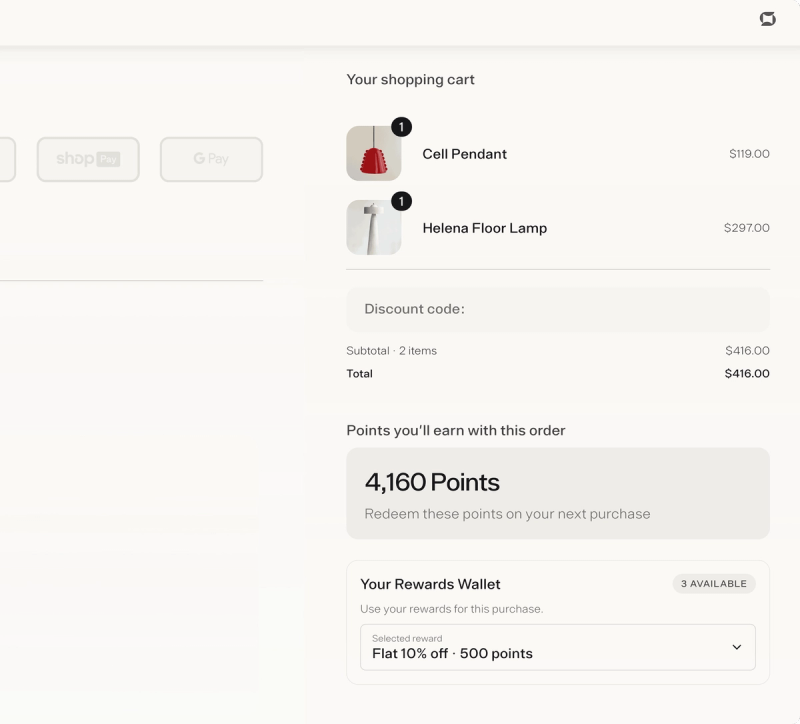
Mage is built around Shopify’s storefront, checkout, POS, Flow, and customer data model. Rewards can apply at Shopify checkout without a code for the customer to copy. Shopify POS uses the same customer balance as online orders, so staff can look up rewards and redeem them during an in-store transaction.
Mage Accounts sits on top of Shopify customer accounts as an on-site drawer. It does not remove Shopify accounts. Depending on the plan or module selected, customers can access orders, profile information, points, rewards, VIP progress, referrals, wishlist items, and other configured blocks without leaving the storefront.
Love Sweat Fitness reported 2x member lifetime value, 82% higher purchase frequency, and 13.5% higher member AOV. Those are customer-specific outcomes, but they show why account and loyalty experiences should be measured together.
More control for marketers and developers
Mage Canvas is the no-code builder for loyalty pages, the Rewards Widget, referral campaigns, Mage Accounts, wishlist, and saved-for-later surfaces. A marketing team can control layout, colors, typography, spacing, and other customer-facing details without waiting for a theme release.
For custom builds, Mage supports Shopify Flow, metafields, a REST API, JavaScript SDK, and webhooks. Shopify metafields can surface loyalty data in Liquid, while webhooks support points earned, points redeemed, and tier upgrades.
A Klaviyo loyalty integration can sync loyalty properties and events into an existing lifecycle program.
Support and migration built around the merchant
A migration is a program redesign, not a spreadsheet upload. Mage offers founder-led support with direct Slack access to the engineers building the product.
The operational question is simple: can you preserve the balances and benefits customers expect while making the new experience easier to run? Do not switch until that answer is documented.
Where Yotpo wins
A broader retention and UGC suite
Yotpo can be the better fit when loyalty is one part of a larger Reviews, UGC, and AI visibility strategy. A team that already runs these products through Yotpo may prefer a single vendor relationship, shared data flows, and familiar operational processes.
This can matter more to a brand with a mature reviews and UGC operation than to a Shopify store primarily trying to run points, VIP tiers, referrals, and checkout redemption.
A larger integration and platform footprint
Yotpo’s loyalty offering supports Shopify POS, Klaviyo, Recharge, ShoppingGives, and webhooks according to its official loyalty pricing page. Its broader ecommerce-platform coverage can matter for organizations operating beyond Shopify.
Mage is deliberately Shopify-only. That focus is an advantage for brands committed to Shopify, but it is a constraint for a company that needs the same loyalty vendor across multiple commerce platforms.
Pricing comparison: compare the whole loyalty stack, not just subscriptions
| Cost category | Current Yotpo setup | Proposed Mage setup | How to validate |
|---|---|---|---|
| Loyalty subscription | Current recurring fee | Usage-based Mage pricing | Compare like-for-like capabilities |
| Usage charges | Order or usage charges | Expected order and module usage | Model normal and peak months |
| Adjacent apps | Accounts, wishlist, referral, or design tools | Features consolidated where relevant | List every app being retained or removed |
| Development | Theme and account customization time | Mage Canvas plus custom work where needed | Estimate internal and agency hours |
| Migration | Data export, mapping, and QA | Data mapping, rebuild, and validation | Scope work before cancellation |
| Reward liability | Discounts, points, and credits issued | Proposed reward structure | Forecast redemption and margin impact |
Review current details before deciding how to budget for a loyalty program.
Keep reward economics separate from software economics. A cheaper platform cannot repair a reward structure that gives away too much margin. Review discounts versus points before changing both the software and the earning rate at once.
| Plan | Price | Orders included |
|---|---|---|
| Mage Loyalty | ||
| Essential | $15/month | 500 orders included |
| Starter | $49/month | 500 orders included, then $0.20 per order |
| Growth | $499/month | 2,500 orders included, then $0.15 per order |
| Enterprise | Custom, typically from around $999/month | Custom |
| Yotpo | ||
| Free | $0/month | Not published |
| Pro | From $199/month | Scales with order volume |
| Premium | Custom | Set by quote |
What each platform costs at 500, 2,500, 5,000, 10,000 orders a month, using the cheapest plan that covers the volume:
| Orders per month | Mage Loyalty | Yotpo |
|---|---|---|
| 500 | $15 Essential or $49 Starter (list) | $199 Pro (list) |
| 2,500 | $449 Starter or $499 Growth (est.) | $299 to $524 Pro (est.) |
| 5,000 | $874 Growth (est.) | Not published |
| 10,000 | $1,624 Growth or Enterprise quote (est.) | Not published |
How to read these tables: "list" is the public list price on the vendor's pricing page or Shopify App Store listing, "est." is calculated from the published plan price and overage rate, "Custom quote" means the vendor only prices on request, and "Not published" means no public figure exists at that volume. Prices checked September 2026. Sources: Mage Loyalty pricing; Yotpo pricing, Yotpo on the Shopify App Store.
- Mage Loyalty at 2,500 orders: Starter is $49 plus $0.20 per order over 500; Growth includes 2,500 orders.
- Mage Loyalty at 5,000 orders: $499 plus $0.15 per order over 2,500.
- Mage Loyalty at 10,000 orders: $499 plus $0.15 per order over 2,500; Enterprise is quoted on volume, typically from around $999.
- Yotpo at 500 orders: Entry point of the Pro slider; Premium features are quote only.
- Yotpo at 2,500 orders: Slider shows $299 at 1,000 and $524 at 3,500 orders.
- Yotpo at 5,000 orders: Slider figures above 3,500 orders are not shown publicly.
- Yotpo at 10,000 orders: Slider figures above 3,500 orders are not shown publicly.
How to migrate from Yotpo to Mage without losing loyalty data
| Data or workflow | Migration path | Validation step |
|---|---|---|
| Points, tiers, and history | Direct Yotpo migration workflow | Reconcile a sample of customer balances |
| Loyalty members | Manual CSV Import where required | Confirm member status and profile data |
| Points history | Points Logs CSV import | Check historical transactions |
| Redemptions | Rewards History CSV import | Check selected customer records |
| Wishlists | Wishlists CSV import | Confirm saved products render correctly |
| Rules and rewards | Rebuild in Mage | Test earning and redemption behavior |
| Storefront surfaces | Recreate in Mage Canvas | Review live theme, account, and widget |
Start in Mage at Settings > Data Migration > Import Data, then follow the documented Yotpo migration workflow. It supports importing points, tiers, and history through a direct migration connection.
For data that requires CSV import, Mage supports Loyalty Members, Points Logs, Rewards History, and Wishlists. The Loyalty Members CSV import guide documents the required email field and optional loyalty data. Create Mage VIP tiers first with matching tier names before importing tier data.
Audit the live program before moving data. Record earning rules, reward settings, tier logic, referral terms, customer-facing copy, and integrations. Do not assume campaign settings, active links, or pending rewards transfer automatically.
Before launch, test sign-in, sample balances, reward availability, checkout redemption, POS workflows where relevant, and marketing events. Timing depends on mapping, design work, and validation.
The pre-switch cost and retention checklist
| Stage | Action | Success check |
|---|---|---|
| Before signing a new contract | Record order volume, loyalty cost, usage charges, renewal terms, and adjacent apps | One complete monthly cost view |
| Before turning off the old program | Export or confirm source data and map rules, tiers, rewards, and integrations | Sample customers reconcile correctly |
| Launch testing | Use a test cohort for account, checkout, POS, and event validation | Balances and rewards behave as expected |
| Thirty days after launch | Compare retention and program metrics with the same cohort | Decisions use program data, not total revenue alone |
Measure repeat purchase rate, customer retention rate, average order value, customer lifetime value, churn, and reward redemption rate. Shopify outlines these as useful loyalty analytics metrics.
Also record support requests about missing points, failed redemptions, unclear tier progress, and referral disputes. Those issues can erase the benefit of a lower platform cost quickly.
Verdict: is Mage a cheaper alternative to Yotpo for your store?
Choose Mage if
Choose Mage if your brand is Shopify-first and wants loyalty, VIP tiers, referrals, checkout redemption, POS, and no-code customization organized around Shopify.
Mage is particularly relevant when separate apps or custom development are filling gaps around the loyalty program. Depending on the plan or module selected, Mage can also add an account drawer that sits on top of Shopify accounts, wishlist functionality, and other retention surfaces.
Choose Yotpo if
Choose Yotpo if your business specifically values its broader Reviews, UGC, AI visibility, multi-platform capabilities, or established suite relationship more than Shopify-specialist consolidation.
Do not move loyalty simply because another platform has a lower-looking starting point. Compare the total operating cost and the experience customers will actually receive.
What to do next
Build a like-for-like comparison from your own data. Include subscription and usage charges, renewal commitments, implementation work, adjacent apps, required integrations, and reward liability. Then test whether Mage can recreate the customer experience your program needs.
You can keep an existing review setup while using Mage for loyalty. Mage documents a Shopify Flow connection that can award points for product reviews, but that does not mean every review workflow transfers automatically.
Frequently asked questions
What is the best cheaper alternative to Yotpo for Shopify?
A cheaper alternative to Yotpo for Shopify depends on the retention stack your store needs. Mage is a fit for Shopify-first brands that want loyalty, VIP tiers, referrals, POS, checkout redemption, and no-code control. Account surfaces and wishlists depend on the selected plan or module.
How much can Shopify brands save by switching from Yotpo to Mage?
Mage’s published comparison says brands can save 20% to 50% versus Yotpo. Actual savings depend on order volume, configuration, contract terms, adjacent app costs, implementation work, and the reward structure you continue to fund.
Can I keep Yotpo Reviews after switching loyalty platforms?
You can keep Yotpo Reviews after switching loyalty platforms and use Mage for loyalty. Mage documents a Shopify Flow connection that can award points for product reviews, so a loyalty migration does not require replacing the review tool at the same time.
What data can I migrate from Yotpo to Mage?
Yotpo data that can migrate to Mage includes points, VIP tiers, and history through Mage’s documented migration workflow. Manual CSV Import also supports Loyalty Members, Points Logs, Rewards History, and Wishlists. Rules, rewards, integrations, and storefront surfaces should be audited and rebuilt separately.
How long does it take to migrate from Yotpo to Mage?
Migration timing depends on data mapping, rule recreation, storefront setup, integration testing, and validation. Use the Yotpo migration guide to scope the process, then set a launch date after sample balances and rewards reconcile.
Does Mage work with Shopify customer accounts and checkout?
Mage works with Shopify customer accounts and checkout through an on-site account drawer and Checkout Extensions. Mage Accounts sits on top of Shopify accounts, while Shopify documents customer accounts separately from checkout customization in the checkout and accounts editor.
Ready to see Mage in action? Book a demo.

Graeme is the co-founder at Mage Loyalty. He heads product development, from complex loyalty migrations and large-scale data handling to building the features shaping the future of loyalty on Shopify.