Here's a counterintuitive truth: most DTC brands are throwing away their most valuable customers. They obsess over acquisition metrics while watching their repeat purchase rates flatline. The culprit? The outdated belief that loyalty programs are complex, expensive, enterprise-only tools that offer little beyond basic discounts. This myth costs brands millions annually.
The reality is starkly different. Modern loyalty programs are strategic, data-driven systems that any DTC brand can deploy profitably. They're not complexity engines—they're customer relationship compounders. And unlike the loyalty programs of 2015, today's platforms work across Shopify, BigCommerce, WooCommerce, and beyond with sophisticated personalization that actually drives behavior change.
This guide walks you through everything: from defining what loyalty truly means in 2026 to avoiding the fatal mistakes that sink 40% of new programs. You'll discover why sophisticated, data-driven platforms have become non-negotiable for DTC growth, how to choose the right loyalty model for your specific business, and exactly how to measure ROI so you know whether your investment is working.
Understanding the "Why": The Indispensable Role of Customer Loyalty in 2026
What Exactly Is an Ecommerce Loyalty Program?
An ecommerce loyalty program is a structured system that rewards customers for specific actions—purchases, referrals, reviews, social engagement—to foster repeat business and brand advocacy. Think of it as a formalized relationship investment. Instead of hoping customers return, you give them tangible reasons to come back.
The evolution tells the story. Ten years ago, loyalty meant punch cards. Today, sophisticated platforms track zero-party data, segment customers dynamically, and deliver personalized rewards in real-time. When a customer hits a birthday milestone in your database, they automatically receive bonus points. When they leave a product review, the system awards points immediately and prompts redemption options. This automation doesn't just increase engagement—it fundamentally changes how customers perceive your brand.
Why Customer Loyalty Is Your Most Valuable Asset Right Now
The Economics Are Brutal and Clear
Acquiring a new customer costs 5-25 times more than retaining an existing one. Meanwhile, a 5% increase in customer retention boosts profits by 25-95%. These aren't aspirational numbers. They're the math behind why DTC brands either build loyalty programs or watch competitors eat their lunch.
Your customer acquisition costs have likely increased 60% in the last five years. Your CAC ratio is getting worse, not better. Against this backdrop, a well-designed loyalty program isn't optional—it's survival equipment.
The Revenue Multiplier Effect
Loyalty members generate 12-18% more incremental revenue than non-members. Top-performing loyalty programs boost annual revenue by 15-25%. These are aggregate figures. In practice, some brands see much higher lifts in specific categories or cohorts.
Here's what I've observed working with DTC brands: the real magic happens at 6-12 months post-launch. That's when behavioral change crystallizes. Repeat purchase frequency increases. Average order value climbs. Customer lifetime value compounds. A brand selling $40 average orders to one-time buyers suddenly finds their loyal members spending $65+ per transaction.
Loyalty Program ROI Timeline
Well-executed loyalty programs show positive returns within 6-12 months, with 44% of programs seeing measurable ROI within six months. Early wins come from increased repeat purchase frequency rather than dramatic AOV increases.
Zero-Party Data: Your Unfair Advantage
Every interaction within a loyalty program generates data. Review submissions tell you which products resonate. Point redemptions reveal reward preferences. Referral participation shows who advocates loudest for your brand. This is zero-party data—information customers voluntarily share.
In a privacy-first world where third-party cookies are vanishing, zero-party data is currency. It fuels hyper-personalization. Brands using this data for segmented email campaigns see 55% open rates and 17% click-through rates—roughly double industry benchmarks.
The Brand Advocacy Multiplier
Loyalty programs don't just create repeat buyers. They create advocates. When you reward customers for referrals, reviews, and social sharing, you're systematically building a word-of-mouth engine. A customer who earns points for bringing friends doesn't just make a transaction—they're recruiting your next cohort of users.
This is quantifiable. Referred customers have higher lifetime value, better retention, and higher margin profiles than paid acquisition channels. Your loyalty program essentially becomes a customer acquisition channel with lower CAC and higher quality prospects.
Key Statistics That Prove the ROI Equation
90% of loyalty programs report positive ROI, with an average return of 4.8x. Tiered loyalty programs specifically deliver 1.8x higher ROI than single-tier programs. Top-performing programs achieve 5.2x or higher returns. Loyalty program members who actually redeem rewards spend 3.1x more annually than non-redeemers.
These numbers matter because they silence one objection: cost. Yes, a platform costs money. So does your Klaviyo subscription. The difference is that your email tool is reactive—you send, they receive. A loyalty platform is proactive. It changes behavior continuously.
The "What": Exploring Diverse Ecommerce Loyalty Program Models
Finding Your Fit: A Guide to Program Types
Different loyalty structures suit different business models, customer bases, and goals. Choosing the wrong one is like selecting the wrong gear for terrain—you'll move, but inefficiently and with excessive friction.
The question isn't which program type is objectively "best." It's which aligns with your customers' preferences and your growth objectives. A luxury skincare brand might thrive with a tiered VIP program emphasizing exclusivity. A fitness supplement DTC might crush with a points-based model rewering social shares. An apparel brand could hybrid both. Context matters completely.
Points-Based Loyalty Programs: The Classic Foundation
Points-based programs are the most straightforward structure. Customers earn points through purchases (typically 1 point per $1 spent) and other actions, then redeem accumulated points for rewards.
Earning Mechanics
Beyond purchases, earning rules can include:
- Product reviews (25-100 points depending on detail/photos)
- Social media mentions and referrals (50-150 points)
- Specific product purchases (bonus points on high-margin items)
- Seasonal or promotional campaigns (limited-time multipliers)
- Milestone celebrations (birthday bonuses, anniversary points)
The key is simplicity plus motivation. Customers should understand the point-to-reward conversion instantly. "500 points = $25 off" is clear. "Between 200-750 points depending on product category and season" is friction.
Redemption Options
Don't limit redemption to discounts. That's where most programs fail. Customers can earn discounts anywhere. They stay loyal for differentiation. Consider:
- Exclusive products not available to non-members
- Early access to product launches
- Free shipping on any order
- Tiered reward catalogs (100 points = discount, 300 points = free product, 750 points = exclusive experience)
- Charitable donations in the member's name
- Points for points for birthday gifts
The Redemption Rule
The most engaged loyalty members redeem 2-4 times annually. Structure your reward catalog to encourage regular redemption, not hoarding. This creates repeated engagement touchpoints and reinforces habit formation.
Tiered Loyalty Programs: Ascend to Exclusivity
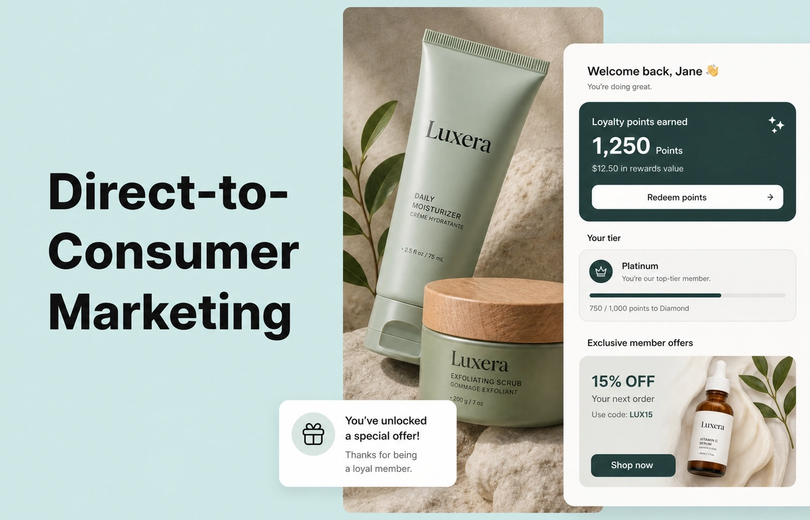
Tiered programs unlock progressively better benefits as customers achieve higher spend or engagement levels. Bronze → Silver → Gold → Platinum. Each tier carries exclusive perks and higher reward multipliers.
Why does this model work? It's aspirational. A customer in Silver tier sees what Gold tier members enjoy and adjusts spending to advance. This psychological mechanism drives AOV increases that straight points-based programs can't match.
The VIP Effect
Here's a number that gets attention: VIP tier customers generate 73% higher average order value than standard members. They're not just more frequent buyers. They spend more per transaction because they're investing in tier benefits.
Tiered structures also create retention stability. A Gold tier member who's spent $5,000 annually won't suddenly switch to a competitor. The psychological and practical switching costs have become significant. This reduces churn and increases predictable revenue.
Tier Design Best Practices
Keep tiers achievable but aspirational. If 90% of your members are in the top tier within 3 months, tiers aren't driving behavior. If 2% ever reach top tier, it's too ambitious. Aim for 40-50% in tier 1, 30-40% in tier 2, 15-20% in tier 3. These distributions vary by brand, but they create healthy progression.
Paid (Subscription-Based) Loyalty Programs: Instant Value, Consistent Revenue
Models like Amazon Prime and Walmart+ charge an upfront fee—$99-200 annually—in exchange for immediate, ongoing benefits. Free shipping, exclusive discounts, early product access, expedited customer service. Members pay once and enjoy benefits continuously.
This model creates different dynamics than free programs. Commitment is immediate and financial. Drop-off rates are typically lower because customers have invested. You also have predictable recurring revenue from membership fees.
The psychology shifts too. A free loyalty program is nice-to-have. A paid subscription is invested in. Members extract value differently. They're more likely to take advantage of benefits. They're less likely to abandon the program.
Subscription-based loyalty programs work particularly well for:
- Brands with high repeat purchase frequency (cosmetics, supplements, coffee)
- Community-driven businesses (fitness, education, peer networks)
- DTC brands with premium positioning
- Businesses wanting predictable recurring revenue
Hybrid Loyalty Programs: The Best of Both Worlds
Many sophisticated brands run hybrid structures: a free points-based tier plus a paid VIP tier. Customers choose participation depth.
Free tier members earn points and unlock basic benefits. Paid tier members (usually $50-150 annually) get triple point multipliers, exclusive products, priority service, and additional perks. Both tiers contribute to engagement and revenue. Free tier proves value and qualifies prospects for upgrade. Paid tier provides recurring revenue and ultra-loyal segment.
This model acknowledges customer heterogeneity. Some want to engage lightly. Others want everything. Hybrid structures serve both without forcing false choices.
Beyond Transactions: Value-Based and Engagement-Driven Programs
The most innovative DTC brands are moving beyond "reward purchases" to "reward values alignment."
An eco-conscious brand might award bonus points for sustainable purchases or for customers sharing their environmental impact. A community-driven platform might reward user-generated content, referrals, and community forum participation more heavily than transactions.
This signals what your brand actually values. If you only reward transactions, you're saying loyalty is transactional. If you reward advocacy, values alignment, and community building, you're saying loyalty is relational.
Engagement-driven programs often include:
- UGC and review submissions
- Social media tagging and hashtag usage
- Community forum contributions
- Sustainability metrics (carbon-neutral orders, packaging reuse)
- Referral depth and quality
- Attendance at virtual or in-person events
Niche Models: Cashback, Referrals, and Gamification
Cashback Programs return a percentage of spending as store credit or money. Direct, simple, immediately valuable. Works well for price-sensitive segments but can train customers to wait for cashback deals.
Referral-Focused Programs weight rewards heavily toward new customer acquisition. Both referrer and referred get bonus points. If acquisition is your bottleneck, this accelerates growth while improving unit economics.
Gamification incorporates game mechanics: badges, leaderboards, challenges, limited-time missions. Effective for younger demographics and highly engaged communities. Risky if poorly designed—games without meaningful progression feel hollow.
Crafting Your Loyalty Program: A Strategic Framework for DTC Success
Laying the Foundation: Defining Your Program Goals
Before selecting a platform or designing rules, define measurable objectives. This prevents vanity metrics from masking mediocrity.
Strong goals look like:
- "Increase repeat purchase rate from 22% to 35% within 18 months"
- "Boost customer lifetime value of members 40% above non-members within 12 months"
- "Drive referral-sourced customers from 8% to 20% of new acquisition within 24 months"
- "Achieve 60% loyalty program enrollment within 6 months"
- "Reduce CAC by 30% through referral acceleration within 18 months"
Weak goals are vague: "Improve retention," "Increase engagement," "Build community." These don't tell you what success looks like or how to measure it.
Your goals will determine program structure. Prioritizing referrals? Build referral mechanics into every reward tier. Prioritizing AOV? Create spend thresholds for tier advancement and exclusive benefits. Prioritizing repeat purchase frequency? Reward purchase cadence and anniversary bonuses.
Understanding Your Customers: What Do They Truly Value?
This step separates successful programs from failure. You must know what customers actually want, not what you think they should want.
Research Methods
- Surveys: Direct questions about preferred rewards (discounts, exclusive products, experiences, charitable giving)
- Segmentation Analysis: Which customer cohorts respond to which incentives? New customers often want steep welcome discounts. Long-term customers might value exclusive access more
- Purchase History Review: What products drive repeat purchases? When do customers naturally return? Where are the gaps?
- Competitive Benchmarking: What are adjacent brands rewarding? What do your customers tell you they dislike about competitors' programs?
Here's an insight from working with brands: assumed preferences are often wrong. I worked with a premium beauty brand convinced customers wanted free luxury products as top-tier rewards. Research revealed they actually wanted exclusive product input—early access to new launches and voting on limited editions. The second program drove 3x higher participation.
71% of consumers expect personalized interactions from brands. This extends to loyalty programs. Generic rewards for every segment underperform dramatically. The effort to create 2-3 distinct reward tracks for different customer personas pays immediate dividends in engagement.
Designing Program Structure and Earning/Redemption Rules
Earning Mechanics: Build Multiple Pathways
Yes, purchases should be the foundation. But that's insufficient. Design earning rules that reflect different customer contributions:
- Purchases: 1 point per $1 (standard), 2x points on specific categories (higher margin), 3x points on new launches
- Reviews and UGC: Points for birthdays and milestones, product reviews (25-100 points depending on detail), photo reviews (bonus points), video testimonials (elevated points)
- Referrals: 50-250 points per successful referral depending on referral value
- Social Engagement: Hashtag mentions, tagging, social shares (25-75 points)
- Community Participation: Forum posts, event attendance, survey completion
- Seasonal Bonuses: Holiday campaigns, flash point multipliers, birthday month bonuses
Avoid complexity. Too many rules confuse customers and reduce participation. Aim for 4-6 core earning pathways that feel intuitive.
Redemption Options: Think Beyond Discounts
This is where most programs fail spectacularly. Offering only discounts for points leaves no differentiation. Consider:
- Discount codes (25% off, free shipping) at various point thresholds
- Exclusive products unavailable to non-members
- Early access to product launches
- Free items (best-sellers, seasonal products)
- Tier-exclusive experiences (virtual meet-and-greets with founders, exclusive webinars)
- Charity donations
- Surprise gifts for high-engagement members
A retail brand I worked with found that offering surprise curated boxes worth more than point value created higher emotional impact than straight discounts. Members felt discovered. Repeat redemption increased 40%.
Simplicity Is Non-Negotiable
This cannot be overstated. Customers should understand your program in under 60 seconds. If they need an FAQ to grasp basics, engagement suffers.
Simple formulas:
- Earn: 1 point per $1 spent
- Redeem: 100 points = $10 off
- Tiers: Spend $1000/year = Silver (1.5x points), $2500/year = Gold (2x points)
Complex formulas:
- Earn: 1-3 points per $1 depending on product category, customer tenure, purchase volume, and promotional status
- Redeem: Points value varies by product redemption, customer tier, and seasonal adjustments
- Tiers: Calculated on rolling 12-month spend with tier resets quarterly
The difference in participation rates is dramatic. Simple programs see 60-70% member engagement within 90 days. Complex programs stagnate at 20-30%.
Branding Your Loyalty Program: Identity and Story
Your loyalty program is a brand extension. It needs identity, tone, and alignment with core brand values.
Naming Strategy
Generic names feel generic. "Rewards Club" says nothing. Distinctive names create brand identity:
- Luxury brands: "Insider Circle," "VIP Collective," "Founder's Circle"
- Community-driven: "Tribe," "Fellowship," "Collective"
- Lifestyle/experiential: "Explorer," "Creator's League," "Adventure Club"
- Value-driven: "Loyalty Collective," "Trusted Circle," "Member's Club"
Visual and Tone Alignment
Your loyalty program should feel like a natural extension of brand voice. If your brand is playful and irreverent, loyalty messaging should match. If it's premium and refined, communications should reflect that.
Design the loyalty dashboard, emails, and member page with brand colors, typography, and voice. Consistency matters. Inconsistency signals a bolted-on program rather than core brand initiative.
Seamless Customer Journey: Integration and Communication
Programs fail when customers don't know they exist or can't easily find them.
Discovery Touchpoints
- Website banner above the fold
- Post-purchase email with enrollment incentive
- Checkout page integration (optional but effective)
- SMS campaigns to database
- Social media highlights
- Packaging inserts (if you ship physical products)
Clear Communication Cadence
Once enrolled, customers need regular touchpoints showing program value:
- Welcome email sequence (what they earned, how to redeem, benefits overview)
- Milestone celebrations (points earned, tier advancement, rewards available)
- Redemption reminders (points expiring, rewards about to expire)
- Personalized recommendations (based on earning activity)
- Exclusive campaigns (VIP sales, early access)
Loyalty program emails see 55% open rates—roughly double standard email performance. This channel is valuable. Treat it with care.
Choosing the Right Technology Partner: Beyond Shopify to BigCommerce, WooCommerce & More
Key Features of a Robust Loyalty Platform
Not all platforms are created equal. Evaluate candidates against these criteria:
Customization and Flexibility
Can you design earning rules specific to your business model? Can you create custom tier structures? Can you modify redemption catalogs? Platforms with templated structures force you into one-size-fits-all constraints. Flexible platforms adapt to your strategy.
Seamless Ecommerce Integration
The platform must integrate natively with your core ecommerce system. For Shopify merchants, this means app installation with automatic transaction sync. For BigCommerce, confirm API integration completeness. For WooCommerce, verify plugin robustness and ongoing maintenance.
Analytics and Reporting
You need visibility into:
- Enrollment rates and member demographics
- Earning activity across different rule types
- Redemption patterns and preferences
- Repeat purchase lift for members vs. non-members
- Revenue contribution by tier
- Program ROI calculations
Platforms hiding metrics behind poor dashboards or requiring custom reports are liabilities.
Marketing and Automation Capabilities
Can the platform trigger automated communications? Can you segment members for targeted campaigns? Can you integrate with your email platform (Klaviyo, Omnisend, Postscript)? Integration depth matters. Manual processes don't scale.
Scalability and Reliability
Your platform should grow with your business without degradation. Look for 99.9% uptime guarantees. Confirm the platform handles high-traffic periods without errors.
Ease of Use
For administrators: dashboard intuitiveness, campaign creation simplicity, reporting accessibility.
For customers: loyalty page clarity, mobile responsiveness, redemption friction assessment.
Platform-Specific Considerations for DTC Brands
Shopify Loyalty Apps
Shopify dominates DTC ecommerce. Solutions for Shopify merchants vary significantly in features and sophistication.
Key considerations:
- Native Shopify app integration ensures transaction sync and checkout integration
- Most platforms support custom earning/redemption rules
- Email marketing integrations vary—confirm compatibility with your CRM
- POS integration for omnichannel brands (especially important for hybrid online/retail models)
- Starter plans typically $50-100/month; enterprise solutions scale higher
Popular platforms offer different strengths. Some focus on simplicity (faster implementation), others on feature depth (longer learning curve but more control). Assess what your brand values: speed to market or maximum customization.
BigCommerce Loyalty Solutions
BigCommerce merchants have fewer native app options than Shopify, requiring more API-level customization or third-party platforms serving multiple ecommerce engines.
Considerations:
- API quality and documentation matter more (custom development may be necessary)
- Integration complexity is higher; budget additional implementation resources
- Fewer out-of-the-box solutions; may require development investment
- Advantage: deeper control and customization for sophisticated programs
WooCommerce Loyalty Plugins
WooCommerce offers flexibility but requires more technical implementation. Self-hosted nature creates unique considerations:
- Plugin marketplace fragmentation; quality varies significantly
- Technical support depends on plugin developers
- Server infrastructure for scalability becomes your responsibility
- Cost typically lower upfront but requires ongoing maintenance and updates
- Most suitable for brands with technical resources or development support
Beyond the Big Three
Custom platforms, emerging DTC-focused engines, and niche solutions exist. Evaluate based on growth stage:
- Early-stage: established platforms with templates (faster launch)
- Scaling: flexible platforms with customization (future-proofing)
- Enterprise: custom builds or enterprise solutions (unlimited control)
Overcoming Integration Hurdles: A Practical Approach
Integration complexity is the #1 implementation risk. Here's how to navigate it:
API-First Platform Selection
Prioritize platforms designed for integration. Look for documented APIs, webhooks, and native third-party connections. Platforms with only manual integrations create ongoing operational burden.
Third-Party Integration Tools
Zapier, Make (formerly Integromat), and native integrations can bridge gaps:
- Loyalty platform → email tool (Klaviyo, Omnisend)
- Ecommerce system → loyalty platform → analytics platform
- POS system → loyalty platform → business intelligence tools
These connectors handle data sync, eliminating manual workarounds.
Testing Before Launch
Never push loyalty to production without thorough testing. Confirm:
- Purchase transactions correctly trigger earning
- Email integrations deliver timely messages
- Redemption deductions reflect immediately
- Data accuracy matches source systems
Implementation failures damage customer perception disproportionately.
Clear Ownership and Documentation
Assign a single person responsible for integration oversight. Document all connections, API keys, and troubleshooting procedures. Undocumented systems become crisis points when stakeholders leave.
Optimizing for Impact: Measuring ROI and Evolving Your Program
Tracking Success: Essential Loyalty Program Metrics
You can't optimize what you don't measure. Establish baseline metrics before launch, then track throughout.
Participation Metrics
- Enrollment Rate: Percentage of store visitors who join (target: 40-60% within first 6 months)
- Active Member Rate: Members who've earned points in last 30 days (target: 60-75% of total enrolled)
- Tier Distribution: What percentage of members are in each tier? (indicates tier accessibility)
Engagement and Earning Metrics
- Average Points Earned Per Member: Monthly active members earning more indicates higher engagement
- Earning Mix: Percentage of points from purchases vs. reviews vs. referrals vs. other actions (reveals engagement diversity)
- Review Submission Rate: Percentage of purchasers leaving reviews (measures UGC engagement)
Redemption and Value Metrics
- Redemption Rate: Percentage of earned points redeemed (target: 30-50%)
- Average Points Redeemed: Indicates reward attractiveness
- Redemption by Reward Type: Which rewards drive redemption? (informs catalog refinement)
Customer Behavior Metrics
- Repeat Purchase Rate of Members vs. Non-Members: This is the core lift measure
- Repeat Purchase Frequency: How often do members purchase? (vs. non-member baseline)
- Average Order Value (AOV) of Members: Do loyal customers spend more per transaction?
- Customer Lifetime Value (CLV) of Members: Total revenue per customer over their lifetime
- Time Between Purchases: Is membership accelerating purchase frequency?
Financial Metrics
- Program ROI: (Revenue Attributable to Program - Program Cost) / Program Cost
- Revenue Attributable to Loyalty: Incremental revenue from member activity beyond projected baseline
- Member Acquisition Cost: Total program investment / new members acquired
- Payback Period: Months until program generates positive ROI
Advanced Optimization: Beyond Basic Metrics
Once you're tracking basics, move to sophisticated optimization.
A/B Testing Earning Rules
Test different point values, earning structures, and campaign mechanics:
- Is 1 point per $1 optimal or would 1 point per $2 drive better participation?
- Do customers prefer multiplier weeks (3x points) or guaranteed rewards?
- Which earning actions convert highest to repeat purchases?
Test methodically. Change one variable, measure over 4-week periods, document results. This builds proprietary knowledge about your customer base.
Dynamic Segmentation and Personalized Offers
Your customer base isn't monolithic. New customers may need welcome incentives. High-value customers may respond to exclusive access. Lapsed members may need reactivation campaigns.
Use loyalty data to create segments:
- Lifetime value cohorts (highest, high, medium, low)
- Engagement profiles (active, moderate, dormant)
- Earning preferences (purchase-driven, engagement-driven, balanced)
- Redemption behavior (frequent redeemers, savers, never redeemers)
Each segment receives tailored communications and reward offers. This precision drives engagement and redemption.
Leveraging Predictive Analytics
Calculate loyalty program ROI using historical data to forecast future behavior. Identify at-risk members likely to churn and proactively offer reactivation rewards. Predict high-value members early and escalate benefits before they defect.
This moves loyalty from reactive (responding to past behavior) to proactive (predicting and influencing future behavior).
Iterative Improvement Mindset
Treat your loyalty program as a living system. Monthly reviews of metrics reveal patterns. Quarterly strategy sessions address major adjustments. Annual deep dives reimagine structure if fundamentals aren't working.
Programs that feel stale die. Programs continuously optimized compound in impact.
Avoiding the Pitfalls: Common Mistakes and How to Sidestep Them
Common Mistakes That Sink Loyalty Programs
Over-Complication
Programs that require explanations fail. If your earning rules need an FAQ, you've failed simplicity. Customers won't participate in systems they don't understand.
Unappealing or Irrelevant Rewards
Offering rewards customers don't want is worse than no rewards. A tech startup offering luxury fashion vouchers to engineers wastes everyone's time. Research your audience first.
Only Rewarding Purchases
Transactional programs miss the advocacy opportunity. If you only reward spending, you signal loyalty is financial. If you reward reviews, referrals, and content, you signal loyalty is relational.
Poor Communication
A loyalty program nobody knows about is a secret loyalty program. Deploy visible promotion across all touchpoints. Not once—continuously.
Lack of Personalization
Generic programs feel generic. Members should see personalized progress, recommendations, and offers based on their earning patterns and preferences.
Ignoring Non-Transactional Engagement
Members who review products, refer friends, and engage on social are more valuable than passive purchasers. Reward these behaviors systematically.
Disjointed Omnichannel Experience
If your loyalty program works online but not in stores, or vice versa, you've created frustration. Integrate fully across all customer touchpoints.
Set It and Forget It
Programs launched and abandoned underperform. Without monitoring and optimization, engagement declines. Loyalty requires ongoing attention.
Internal Ownership and Management Issues
A loyalty program without clear internal ownership becomes everyone's job and nobody's responsibility. Assign a single owner with clear accountability. Ensure team training on program mechanics, customer communication, and troubleshooting.
Navigating Legal and Data Privacy
Data collection in loyalty programs triggers regulatory compliance. Ignorance isn't a defense.
GDPR Compliance (EU customers)
- Explicit opt-in consent for data collection and marketing
- Clear privacy policies explaining data usage
- Right to access and delete personal data
- Transparent data retention policies
CCPA and Similar US/State Regulations
- Clear disclosure of data collection
- Consumer right to know, delete, and opt-out of sales
- "Sales" includes data sharing with marketing partners
- Documented consent mechanisms
Best Practices
- Transparent about what data you collect and why
- Minimize data collection to what's necessary
- Regular compliance audits as regulations evolve
- Simple opt-out mechanisms for members
- Privacy-by-design approach (privacy isn't bolted on, it's foundational)
Compliance isn't optional. It's table stakes. Budget implementation properly and review annually.
Real-World Inspiration: Successful DTC Loyalty Programs in Action
Examples of Leading Brands and Their Strategies
Sephora's Beauty Insider: The Tiered Gold Standard
Sephora operates one of ecommerce's most successful tiered programs. Members earn points on purchases and redeem for samples, deluxe products, or exclusive experiences. The tiering creates aspiration—insiders at higher tiers get birthday gifts, early access to launches, and exclusive shopping events.
What makes it work: clear progression, genuine exclusivity, and emotional rewards beyond discounts. A Sephora VIP tier member isn't just spending more—they're experiencing a different brand relationship.
Adidas Creators Club: Community-Driven Loyalty
Rather than pure transaction rewards, Adidas rewards community participation. Members earn points for purchases but also for user-generated content, community forum participation, and referrals. The program explicitly builds community, not just transactions.
The insight: Adidas recognized that highly engaged members share values beyond products. The program reinforces those values and creates belonging.
The North Face XPLR Pass: Experience-Driven Differentiation
The North Face combines points with experiential rewards—early access to limited releases, exclusive events, and adventure opportunities. Tier advancement unlocks deeper experiences, not just more discounts.
Why it works: The North Face's customers value experiences over possessions. The loyalty program reflects that and creates deeper brand affinity than discount-only programs could.
Conclusion: Building Lasting Loyalty in the Dynamic Ecommerce Landscape
The myth persists that loyalty programs are complex, expensive solutions for enterprise-only brands. The 2026 reality is different. Modern platforms, even on modest budgets, enable DTC brands of any size to build systematic customer relationships that drive measurable revenue growth.
Successful programs require three things: strategic clarity (defined goals and customer understanding), technical execution (the right platform integrated properly), and continuous optimization (measuring impact and evolving based on data).
The brands winning in 2026 aren't relying on ad spend to sustain growth. They're building durable competitive advantages through customer relationships. Loyalty programs are the fundamental tool for this shift.
Your next steps:
- Define your specific loyalty goal (repeat purchase rate, CLV, referral acceleration)
- Research your customers' actual reward preferences (don't assume)
- Choose a platform matching your complexity needs and growth stage
- Launch with simplicity—expand features after proving basics
- Measure relentlessly and optimize monthly
Mage makes this implementation straightforward for Shopify merchants and beyond. The platform handles the complexity so you focus on strategy. Start with a clear vision of your program, and the right technology will support it.
Building loyalty isn't new. Building it systematically, across all customer touchpoints, with real-time personalization and granular measurement—that's the DTC competitive advantage of 2026.
“Cannot say enough good things about the team at Mage Loyalty, one of the absolute best organizations we have ever worked with, full stop! So glad we connected with them, completely redid our loyalty program, new concepts, use of loyalty, increasing user engagement, showing us where we were not valuing our best customers, just WOW, amazing team!”

Read the West Coast Goalkeeping case study →
Frequently Asked Questions
What is the best type of loyalty program for a small DTC brand?
A points-based program with 3-4 earning actions works best. Start with purchase points (1 point per $1), referral bonuses, and review rewards. Keep it simple. As you learn what drives engagement, layer in sophistication like tiering or seasonal campaigns.
How long does it take to see ROI from a loyalty program?
Behavioral change typically compounds at 6-12 months. You'll see early wins in repeat purchase rate within 3-4 months. Significant financial ROI (positive return on platform costs) usually appears within 9-18 months depending on program design and initial customer metrics.
Can a loyalty program integrate with my ecommerce platform?
Yes - most major loyalty platforms integrate natively with Shopify, BigCommerce, and WooCommerce. Shopify merchants get the smoothest experience, with app-based installs that sync transactions automatically. BigCommerce and WooCommerce require API-level integration with more setup time. Confirm Klaviyo, SMS, and review platform compatibility before committing - those integrations determine how effectively loyalty data flows into your marketing automation.
How much does a loyalty program cost for a DTC brand?
Loyalty program software costs range from free to $400-plus per month depending on platform and order volume. Budget separately for implementation time, which runs 4 to 20 hours depending on program complexity.
What metrics should I track to measure loyalty program success?
The five metrics that matter most are enrollment rate (target 40 to 60 percent within six months), active member rate (60 to 75 percent earning points monthly), repeat purchase rate of members versus non-members, average order value for members versus non-members, and redemption rate (target 30 to 50 percent of earned points). These directly measure whether the program changes customer behaviour.
How do I get customers to join my loyalty program?
Getting customers to join a loyalty program requires visibility at high-intent touchpoints: a homepage banner above the fold, a post-purchase email with an enrollment incentive, and a checkout-page mention. Offer an immediate reward for joining — 50 to 100 bonus points on sign-up — to reduce friction. Most enrollments come from existing customers, not new visitors, so email your current database first.

Kris is the co-founder of Mage Loyalty. I spend most days talking to merchants, shipping features, and making sure our customers get real results. If you run a Shopify store or Agency we should chat!