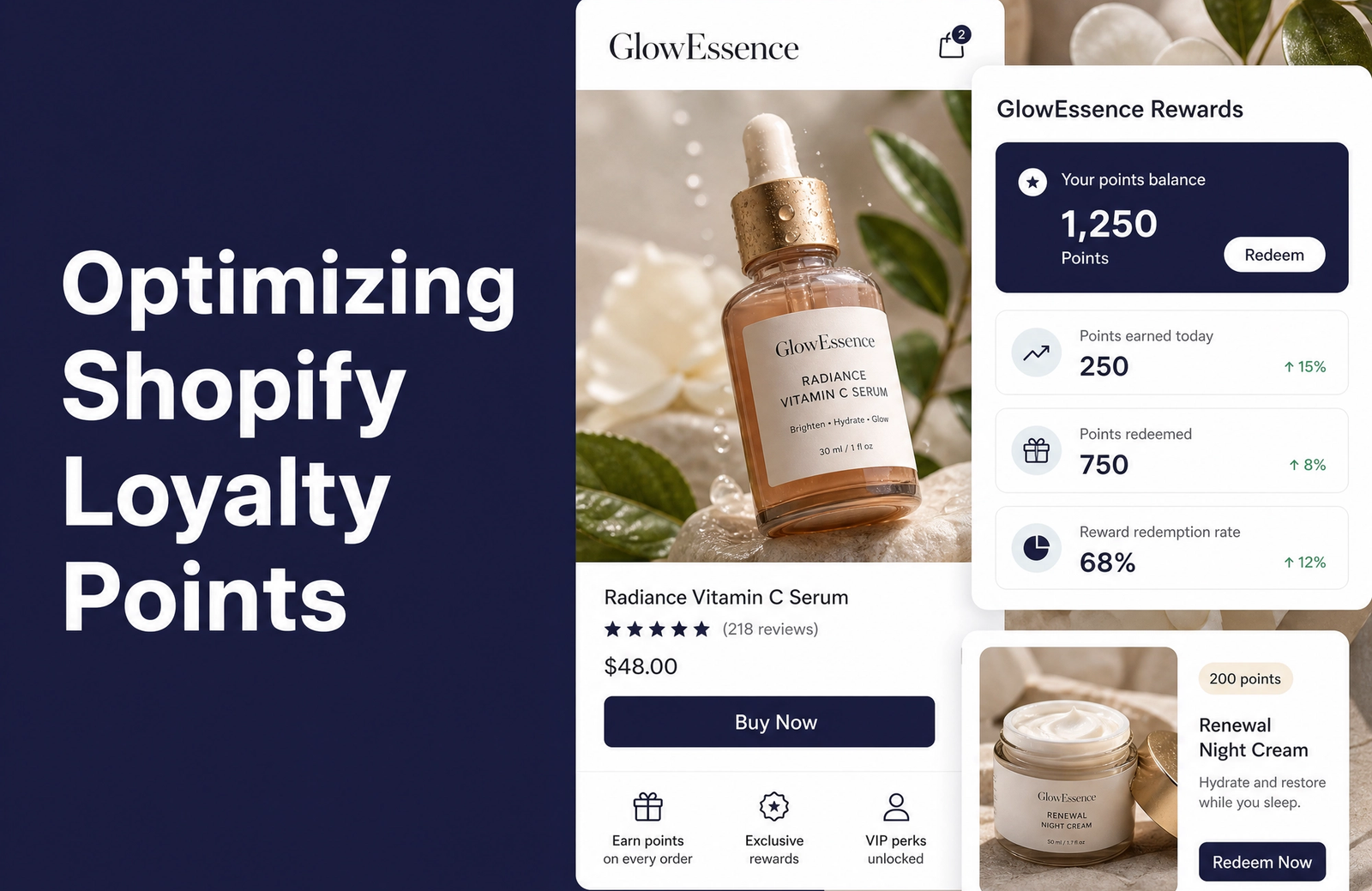
Here's your loyalty program's dirty little secret: there is no magic "points per dollar" number that works for every Shopify store. Yet most merchants waste weeks copying competitor ratios without understanding the financial mechanics underneath. They launch a program offering 10 points per dollar because some fashion brand down the street does—then watch redemption rates tank their margins in three months.
The real issue? They're solving the wrong problem. Your ideal point ratio isn't about matching an industry benchmark. It's about engineering a psychological sweet spot where customers feel genuinely rewarded while your profit margins stay intact.
Here's what actually matters: your product margins, your customers' spending patterns, and whether you're willing to trade short-term revenue for long-term retention. The difference between a 3% and 8% effective discount rate can mean the gap between program failure and becoming your strongest competitive advantage.
The Point-Per-Dollar Illusion: Why There's No Magic Number for Your Shopify Loyalty Program
Most Shopify store owners approach loyalty programs like they're following a recipe. Add one cup of "5% back," mix in some referral bonuses, bake at 350 degrees, and expect perfect results. The problem? Loyalty programs aren't recipes. They're financial instruments that must align with your specific business realities.
The myth persists because it's comforting. A universal number removes decision-making friction. But that comfort is exactly why so many programs underperform. When you copy a competitor's point ratio without understanding what makes it work for them, you're essentially running an experiment on your own revenue.
I've watched dozens of brands launch loyalty programs offering rates that sounded impressive in theory but felt hollow to their actual customer base. A sustainable fashion brand offering 3 points per dollar (a 3% effective discount) looked cheap compared to fast-fashion competitors. But here's the insight: their customers weren't chasing maximum rewards—they wanted transparency around environmental impact and ethical production. The brand's real mistake wasn't the low point ratio; it was not recognizing what actually motivated their audience.
The stakes are real. According to research on e-commerce loyalty metrics, a 5% increase in customer retention can boost profits by 25-95%. That's not marginal. That's transformational. Which means getting your point ratio right has outsized impact.
What Does "Points Per Dollar" Truly Mean in a Loyalty Program?
Strip away the terminology and points per dollar is simple: it's the earn rate. Spend $1, earn X points. But this surface-level definition misses what actually moves the needle.
What really matters is the effective discount rate—the actual percentage of their spend customers get back in rewards. This is where the psychology shifts. Earning 5 points for every dollar sounds vague until you add the redemption math: if 100 points equals $1 off, then customers are effectively getting 5% back on their purchase. That's concrete. That's real.
Think of points like a mini-currency circulating inside your store. A customer spends $100, earns 500 points in that fictional currency, and can later convert 100 of those points into $1 of purchasing power. It's a payment deferral system dressed up in gamification language. And like any currency, its perceived value determines whether people hoard it or ignore it.
The ratio is your program's heartbeat because it dictates everything downstream: how quickly customers accumulate rewards, whether those rewards feel worth pursuing, and ultimately whether they'll come back to redeem them. Too low, and points feel like digital lint. Too high, and you're handing out margin-eroding discounts disguised as loyalty.
Here's a specific example from a brand I worked with: a mid-market home goods store initially offered 2 points per dollar. Their average order value was $120. That meant a typical customer earned 240 points—just barely enough for a $2 discount. The math felt insulting. They bumped to 5 points per dollar, suddenly $120 orders earned 600 points (a $6 discount), and repeat purchase rates jumped 23% within two months. Same brand, same products. The only change? Making the reward feel tangible.
The Shopify loyalty program growing brands trust
See how Mage helps Shopify brands lift repeat purchase rate with loyalty, referrals and store credit.
Book a demoWhy Your Point Ratio is More Critical Than You Think
The point ratio operates on three levels simultaneously, and you need to optimize across all three or the program fails.
First, it's an engagement lever. When customers can't see a path to a reward that matters to them, they mentally check out. They don't actively think "this loyalty program is bad"—they just stop checking their point balance and forget the program exists. Low point ratios (3% or below) create this invisibility problem. Customers earn so slowly that the program falls out of their awareness.
Second, it's a profitability guardrail. A generous ratio accelerates loyalty but erodes margins if you're not careful. One beauty brand I consulted with offered 10% back—impressive on paper, but they hadn't modeled what happens when 60% of customers actually redeem their points (instead of the assumed 40%). The program became a discount engine that made their customer lifetime value worse, not better.
Third, it's your repeat purchase amplifier. This is where most merchants underestimate the value. A well-calibrated ratio doesn't just reward past purchases—it incentivizes future ones. Customers who see their point balance climb know exactly how much more they need to spend to hit the next reward tier. That psychological pull drives incremental purchases they wouldn't have made otherwise.
Here's the kicker: repeat customers are worth 10x more than one-time buyers. So if your point ratio accelerates repeat purchases by even 15-20%, the profit math often works in your favor despite the reward cost. Boost customer retention becomes the foundation for everything else.
“I looked into so many different integrations for loyalty and referrals for our Shopify Store, but no one impressed me more than Mage on human connection, customer service, and value.”


Read the Reelie case study →
The Psychology Behind the Points: How Customers Perceive Value
Customers don't think about loyalty programs the way merchants do. They do mental math. Fast. Subconsciously. They calculate whether points are worth their attention.
Watch someone join a loyalty program: they glance at the earning rate, do a quick calculation based on their typical purchase size, and instantly decide if the reward is meaningful. Earn 3 points per dollar on a $50 purchase? That's 150 points. If $100 points equals $5 off, they'd need to make another purchase to hit the reward. They feel the friction and often don't bother.
But show them a 5-point-per-dollar offer on that same $50 purchase? That's 250 points. Suddenly $100 points = $5 off becomes achievable. They can feel themselves close to a reward. That proximity is intoxicating.
Behavioral economists call this the "progress bias"—people are energized by visible progress toward a goal. Points tap directly into this. A customer seeing 250 of 500 points needed for their first reward feels like they're winning. They're literally halfway there. It's the same psychological principle that makes a coffee loyalty card with 4 out of 10 stamps filled feel more motivating than an empty one.
There's also a fascinating phenomenon around perceived generosity. An 8-10% effective discount feels noticeably different from 5%, even though that's only a 3-5 percentage point difference. It triggers a mental shift from "this is fair" to "this is actually generous." That shift matters for engagement, especially in new programs trying to gain early traction. Higher early rates can create momentum and word-of-mouth buzz.
Gamification compounds this effect. Points aren't just discounts—they're achievements. Every purchase is a victory that adds to a meter, moves you closer to a goal, gets you more "points" (in the achievement sense). Humans evolved to respond to progress markers. Your loyalty program is essentially weaponizing our psychological vulnerabilities, and that's exactly the point.
The attainability factor is crucial too. If the first reward requires 20 purchases to reach, motivation collapses before anyone gets there. But if customers can reach a meaningful reward within 1-3 purchases, they experience success early, taste the reward, and become believers in the system.
Decoding 5 Common Point-Per-Dollar Ratios and Their Psychology
Let's ground this in real numbers. For each example, I'm using a standard redemption assumption: 100 points = $1 off. Your actual system might differ, but the psychology transfers.
The Conservative Approach (3% Effective Discount)
Example: Earn 3 points for every $1 spent. $100 purchase = 300 points = $3 off.
Customer experience: This feels slow. A customer needs to spend $333 to hit their first $10 discount. That's a high barrier. For categories with smaller average order values—think jewelry, luxury goods, or specialty items—this might work because the customer base has different expectations. They're not comparing you to fast-fashion loyalty programs; they're comparing to the alternative of no program at all.
Best for: Luxury brands with high product margins (40%+), ultra-premium experiences where the loyalty program is an afterthought, or businesses where margins are so tight that higher percentages aren't financially feasible.
Pitfall: If you're in a competitive market with commodity products, 3% will feel like your program doesn't exist.
The Standard Baseline (5% Effective Discount)
Example: Earn 5 points for every $1 spent. $100 purchase = 500 points = $5 off.
Customer experience: This is the industry goldilocks zone. It's noticeable without being shocking. A customer spending $100 gets $5 back—that's meaningful but not generous. It takes 2-3 purchases for most customers to hit their first reward. They feel progress happening. It's proven in thousands of e-commerce implementations.
Best for: Most mainstream e-commerce brands. Apparel, home goods, beauty, consumer packaged goods. If you don't have a strong reason to deviate, start here.
Why it works: It's a sweet spot between psychology and math. High enough that customers feel incentivized. Low enough that your margins stay healthy even with 50-60% redemption rates.
The Engagement Driver (8% Effective Discount)
Example: Earn 8 points for every $1 spent. $100 purchase = 800 points = $8 off.
Customer experience: This feels generous. The math looks attractive. A customer hitting their first reward milestone after 2 purchases gets meaningful value. It accelerates the path to redemption, which means more repeat purchases clustered closer together.
Best for: New loyalty programs trying to build early momentum. Competitive markets where you need to stand out. High-margin product categories (50%+ margins) where you can afford the generosity. Direct-to-consumer brands building direct relationships for the first time.
Trade-off: Higher effective discount rates work best when you're not relying solely on redemption to justify the program. The real value is the data, the emotional connection, the repeat purchase acceleration. If your margins are thin and you need every point redemption to break even, 8% becomes risky.
The Premium Experience (10% Effective Discount)
Example: Earn 10 points for every $1 spent. $100 purchase = 1,000 points = $10 off.
Customer experience: This feels exceptional. Customers getting 10% back on every purchase perceive your brand as genuinely rewarding loyalty. It's aspirational and feels like a win.
Best for: Luxury brands. High-ticket items with massive margins. VIP programs targeting your top 10% of customers. Situations where you're explicitly trying to create an exclusive, premium experience.
Reality check: This only works if your economics support it. If you're operating on 15% margins, 10% loyalty rewards is catastrophic. But if you're selling premium goods with 60%+ margins, 10% can be appropriate because your baseline margin accommodates the expense.
The Dynamic Tiered System (Variable Rates)
Example: Bronze customers earn 5%, Silver earn 7%, Gold earn 10%.
Customer experience: This creates aspiration. The visual hierarchy makes customers want to climb the ladder. Gold tier customers feel VIP. The variable rate rewards loyalty depth.
Best for: Brands with the operational sophistication to manage tiered systems. It's psychologically powerful but requires more communication and program management.
Advantage: You can be conservative with your baseline (Bronze at 5%) but generous with rewards for your best customers (Gold at 10%), optimizing both acquisition and retention economics.
Mage's Recommended Starting Point: Finding Your Shopify Sweet Spot
After analyzing patterns across thousands of Shopify stores, here's what consistently works: start with a 5% effective discount rate and adjust from there based on your specific metrics.
Why 5%? It's the proven baseline. It's high enough to move the engagement needle. It's low enough to avoid margin destruction. It creates tangible customer value without requiring heroic assumptions about your business model. Think of it as the neutral position before you fine-tune based on your actual data.
But—and this is critical—5% is a starting point, not a destiny. Your actual ideal ratio depends on four specific factors:
Your product margins matter most. If you're selling items with 10% margins, 5% loyalty costs are painful. You'd want to trend toward 3%. If you're at 50% margins, 5% is conservative; 8-10% becomes viable. Pull your P&L and calculate your actual gross margin percentage by category. This number should directly inform your point ratio.
Average order value shapes how quickly customers hit reward milestones. A $150 average order value versus a $40 AOV changes the game. Higher AOV customers accumulate points faster, which means a lower ratio might feel adequate. Lower AOV customers accumulate slowly, so they might need a higher ratio to stay motivated.
Customer lifetime value tells you what you can afford to invest. If your loyal customers have a CLV of $500+, investing 5% in loyalty rewards makes sense—you're reinvesting a small percentage of lifetime value to retain it. If CLV is $120, that 5% needs to drive significant retention gains to justify itself.
Your competitive landscape sets expectations. In saturated categories, customers compare you implicitly to alternatives. If competitors are at 5%, you need at least that to not feel cheap. If you're the only player with a program, expectations are lower.
Start by calculating your baseline: (Your Annual Revenue) × (Your Gross Margin %) = Your Profit Pool. Now ask: What percentage of that pool can I reinvest in loyalty rewards while still hitting profit targets? That's your ceiling.
One practical test: launch at 5%, track your metrics for 60-90 days, then decide. If your repeat purchase rate jumped 20% and redemption is running 45%, you've found a good ratio. If redemption is 75% and repeat purchases barely moved, you're being too generous. The data will tell you whether to adjust.
Beyond Purchases: Maximizing Engagement with Diverse Earning Actions
This is where most merchants miss a massive opportunity. Points per dollar gets all the attention, but it's only 40% of your engagement strategy.
Your customers can earn points for actions that cost you nothing or nearly nothing: writing reviews, referring friends, following you on social media, sharing content, completing their profile, celebrating birthdays with you. These actions create touchpoints and engagement while diversifying your point distribution beyond purchase-based rewards alone.
Here's why this matters: if your program only rewards purchases, you're leaving engagement on the table. A customer who hasn't bought in 6 months could still earn points for a referral, which might trigger a new customer acquisition and keep the old one feeling valuable.
Rewards for referrals are particularly high-leverage. A customer who brings you a new buyer is directly contributing to your growth. You might offer 50-100 bonus points per successful referral—dramatically more than the purchase rate—because the economic value is orders of magnitude higher. That referral customer might have a CLV of $300+. The 50 points you give away cost you maybe $0.50 in eventual discounts. The math is phenomenal.
Points for product reviews drive social proof, reduce friction in your buying process, and provide user-generated content that converts. Offering 25-50 points per review costs you nearly nothing but generates assets that pay dividends for months.
These diverse earning actions accomplish something point-per-dollar alone can't: they make your program feel alive and multidimensional. Instead of a transactional rewards system, you're building a community where engagement is rewarded across multiple dimensions.
Setting Redemption Tiers and Reward Values: Completing the Loop
Earning points is half the equation. Redeeming them is where psychology and economics collide.
Your first reward tier is the most important. If customers can't reach a meaningful reward within 1-3 purchases, motivation evaporates. This is non-negotiable. If your AOV is $100 and you offer 5 points per dollar, customers earn 500 points per purchase. If your first reward is $20 off (requiring 2,000 points), they need 4 purchases. That's too far.
But if your first reward is $5 off (requiring 500 points), they hit it immediately after one purchase. Success. They feel the reward, experience the program as functional, and believe in the system.
What about subsequent rewards? Create a ladder with variety. Offer $10 off, free shipping, exclusive items, early access to sales, percentage discounts instead of flat amounts. Different customers have different motivations. Some want absolute value (biggest discount). Some want convenience (free shipping). Some want exclusivity (early access to drops). Variety keeps the program fresh.
Pro tip: don't make every redemption identical. Mix fixed discounts with exclusive products. An exclusive $15 candle that costs you $3 can be perceived as more valuable than a $15 discount because it's tangible and special. It also protects your margin better.
Ensuring Profitability: The Math Behind Your Loyalty Program
This is where loyalty programs fail most often: when merchants launch without modeling the financial impact.
You need to understand four key metrics and how they interact:
Customer Lifetime Value (CLV): Total revenue a customer generates across their relationship with you. If your average customer buys twice per year at $100 per purchase for 3 years, CLV is $600.
Average Redemption Rate: What percentage of earned points actually get redeemed? Most programs see 40-60%. Some ambitious programs with aggressive earning mechanics see 70%+.
Cost Per Point Redeemed: If 100 points = $1 off, and a customer redeems 500 points, the cost to you is $5. But if they'd have bought anyway, it's really the margin loss on that $5 off. On a 40% margin product, that's $2.
Incremental Behavior Change: How much do repeat purchases increase due to the program? If loyalty members buy 25% more frequently than non-members, that's the true ROI driver.
Here's a real model: A $100 AOV store with 40% gross margin, 50% redemption rate, and 5% point ratio. Customer spends $100, earns 500 points (a $5 eventual cost assuming redemption). Cost to you: $5 × 40% margin retention = $2 out-of-pocket when that $5 eventually gets redeemed.
But that customer now feels invested in the program. They're thinking about their point balance. They come back 20% more often. At $100 per order, that's $120 more annual revenue instead of $100. Your margin on that incremental $20 is $8. The program cost you $2. Net positive.
Scale this across your customer base and you're looking at material profit expansion through loyalty. The key is ensuring your model actually drives incremental behavior change, not just giving away discounts on purchases that would have happened anyway.
Common Pitfalls to Avoid When Setting Your Point Ratio
The "Worthless Points" trap: Setting your ratio too low so customers never see meaningful rewards. This isn't thriftiness; it's self-sabotage. Customers notice and disengage. You're better off not running a program than running a program that nobody believes in.
The "Margin Crusher" trap: Being so generous that your program becomes an unsustainable discount engine. One brand offered 10 points per dollar with no margin analysis. Within six months, they were hemorrhaging money because 70% of their customer base were redemption-heavy users. A program should amplify existing profitable behavior, not subsidize it.
The Complexity Trap: Making earning and redemption so complicated that customers don't bother. "Earn different points on different categories depending on your tier level and the day of the week" is unnecessarily intricate. Keep the core simple: one earning rate, clear redemption options, transparent math.
The Data Vacuum Trap: Launching and then never measuring performance. You set a point ratio, cross your fingers, and hope it works. Wrong move. You need to track redemption rates, repeat purchase frequency, CLV of members versus non-members, and the financial impact quarterly. Then adjust.
The Future of Your Loyalty Program: Evolving Your Point Ratio
Your initial ratio isn't permanent. Market conditions change. Customer preferences shift. Your margins improve or compress. As you scale, your economics change.
Plan for annual reviews. Examine whether your current ratio is driving the behavior you want. If redemption rates collapsed from 50% to 30%, customers might not perceive point value anymore. You might need to increase the ratio or add more non-purchase earning opportunities. If margins expanded and you're sitting on 50%+ profitability, you can afford to be more generous.
Also stay aware of competitive movement. If a major competitor in your space launches an aggressive program at 10%, your 5% program might feel inadequate. That doesn't mean you must match them—you can compete on other program features like exclusivity or brand experience—but you should be conscious of the shift.
Dynamic tiering helps here. You can maintain a baseline 5% for standard customers while creating higher tiers at 8-10% for your VIPs. This gives you flexibility to adjust the perception without completely overhauling your economics.
Conclusion: The Art and Science of Loyalty Points
Your point ratio isn't a technical detail to delegate to someone else. It's a strategic lever that directly impacts customer behavior, retention economics, and profit growth.
The science part is clear: model your margins, understand your CLV, test your assumptions. The art part is recognizing what your customers actually care about. Is it maximum value per purchase? Exclusivity? Simplicity? The psychology of your brand should inform your ratio.
Start with 5% effective discount, measure everything, and adjust based on data rather than intuition. Add diverse earning actions that cost you little but create engagement. Ensure your redemption tiers encourage quick wins early, then deeper investment later.
When you get the ratio right, loyalty becomes self-reinforcing. Customers feel rewarded. They come back more often. Their lifetime value expands. Your program actually pays for itself and then some. It's not luck. It's math aligned with psychology.
Want help implementing a loyalty program that gets the point ratio right? Platforms offering flexible customization, real-time dashboards, and built-in analytics let you test ratios quickly and adjust based on performance. Start today, measure constantly, and iterate toward your ideal ratio.
Frequently Asked Questions
What is a good starting point for points per dollar in a Shopify loyalty program?
A 5% effective discount rate is the industry standard starting point. This translates to 5 points per dollar if 100 points equals $1 off. It's high enough to feel meaningful to customers but low enough to protect most business margins. However, your ideal ratio depends on your product margins, average order value, and customer lifetime value. Luxury brands might operate at 3%, while high-margin businesses might start at 8-10%. Launch at your baseline, measure for 60-90 days, then adjust based on redemption rates and repeat purchase data.
How do I calculate the effective discount rate of my loyalty program?
The effective discount rate is simply the percentage of customer spend returned as potential rewards. If customers earn 5 points per dollar and 100 points equals $1 off, the effective discount rate is 5%. To calculate: (Points Earned Per Dollar × Redemption Value) = Effective Discount Rate. For example: (5 points × $1 per 100 points) = 5%. This is the number to track against your margins.
Can I change my point ratio after launching my program?
Yes, but carefully. Existing members might feel the change is unfair if you reduce their earning rate. If you need to decrease it, grandfather existing members at the old rate or provide advance notice. Increasing the ratio is generally welcomed. The key is communicating clearly: "We heard your feedback and increased rewards to 6 points per dollar." Most members won't remember your original rate anyway unless you were overly generous initially.
How often should I review my loyalty program's point ratio?
Quarterly reviews of redemption rates, repeat purchase frequency, and program ROI are standard. Annual comprehensive reviews—including competitive analysis, margin assessment, and customer feedback—should inform structural changes. If you're launching a new program, month-one and month-three checkpoints are essential to catch problems early before they become expensive.
What are some common mistakes to avoid when setting points per dollar?
The biggest mistakes are: (1) Setting points too low, making them feel worthless and causing disengagement; (2) Being too generous without margin analysis, turning your program into unsustainable discounting; (3) Overcomplicating the earning and redemption mechanics so customers don't understand the value; (4) Launching without measuring performance, then making adjustments based on guesses instead of data. Also avoid copying competitor ratios without understanding your own economics. Their margin structure might be completely different.

Kris is the co-founder of Mage Loyalty. I spend most days talking to merchants, shipping features, and making sure our customers get real results. If you run a Shopify store or Agency we should chat!