A Shopify loyalty app sets the rules around a repeat purchase: a customer buys, earns a balance, sees a reward, and redeems it on a later order. It can also decide whether a referral qualifies, whether a refunded order reverses points, and what a VIP customer receives.
Short answer: The right loyalty app for Shopify matches how your store earns repeat revenue, not the app with the most reviews. Compare earning and reward mechanics, Shopify compatibility, total cost, customer experience, integrations, analytics, fraud controls, and migration before you install.
What does a Shopify loyalty app actually do?
| Capability | Shopify provides natively | A loyalty app typically adds | What to verify |
|---|---|---|---|
| Discounts and gift cards | Discount codes and gift cards | Reward rules and balances | Redemption conditions and expiry |
| Customer data | Profiles and segments | Points, tier and referral status | Data sync and segmentation |
| POS | Retail checkout infrastructure | Loyalty earning and redemption | Shared online and in-store balance |
| Reporting | Store analytics | Loyalty and referral reporting | Revenue and behavior metrics |
The difference between a points widget and a retention platform
A points widget shows a balance. A retention platform runs the program: who earns, what they earn, when rewards unlock, how customers redeem, and how results are measured.
A useful Shopify loyalty program should give customers a clear way to see points, understand reward value, check VIP progress, and redeem without hunting for a code.
Mage supports points, rewards, VIP tiers, referrals, wishlists, customer accounts, Shopify POS, and Shopify Checkout. That matters when loyalty needs to connect with the rest of the customer journey.
What Shopify provides natively
Shopify provides discount codes, gift cards, customer profiles, segments, analytics, and commerce infrastructure. Those tools can support a promotion, but they do not create a complete points-and-rewards system with earning logic, balances, VIP status, referral attribution, and loyalty reporting.
Shopify also states that Shopify POS does not include built-in loyalty tools. Merchants connect loyalty apps through the Shopify App Store when they need loyalty earning, tracking, and redemption in retail. Shopify’s POS guide explains that distinction.
“Cannot say enough good things about the team at Mage Loyalty, one of the absolute best organizations we have ever worked with, full stop! So glad we connected with them, completely redid our loyalty program, new concepts, use of loyalty, increasing user engagement, showing us where we were not valuing our best customers, just WOW, amazing team!”


Read the West Coast Goalkeeping case study →
Myth: the best-known Shopify loyalty app is automatically the best fit
Why review count is a weak buying signal
Reviews can indicate that an app has customers. They cannot tell you whether it handles your refund workflow, connects online and POS balances, imports historical data accurately, supports your subscription setup, or gives customers a usable account experience.
A high-volume store with retail locations has different requirements from a subscription brand. A high-AOV brand may care more about tier recognition and early access than frequent discount redemptions. Neither requirement appears in a review total.
The five types of fit that matter more
Assess an app across five areas:
- Business model: Purchase frequency, average order value, retail presence, subscriptions, and seasonal demand.
- Retention objective: Second purchase, reorder cadence, higher AOV, referrals, or VIP recognition.
- Customer journey: Where customers see balances, rewards, referral links, and saved products.
- Technical stack: Checkout, POS, email, SMS, reviews, subscriptions, support, and Shopify Flow.
- Operating capacity: Who will configure campaigns, train staff, handle fraud, and review results.
Ask: “Can this app reliably change the customer behavior we need, with the team and systems we already have?”
Choose the loyalty model before you choose the Shopify app
| Store pattern | Primary goal | Useful mechanisms | Key check |
|---|---|---|---|
| High-frequency purchases | Encourage the next order | Points, low-threshold rewards, punch cards | Reorder timing and reward economics |
| High-AOV purchases | Build recognition | Spend-based tiers, early access, shipping perks | Tier rules and non-discount rewards |
| Subscription products | Protect renewals | Milestones, renewal rewards, delayed approval | Subscription integration and refund timing |
| Retail and ecommerce | Connect channels | Shared balances and POS redemption | Staff lookup and transaction sync |
High-frequency stores
Food, beverage, supplements, and consumables need programs that fit replenishment behavior. Prioritize simple purchase earning, low redemption thresholds, reorder incentives, subscription milestones, and retail support where relevant.
A food and beverage loyalty program may need customers to receive value within a few orders. If the first meaningful reward sits too far away, customers may not engage.
Mage supports earning rules for purchases, signups, birthdays, anniversaries, reviews, social actions, wishlists, and subscription milestones. Punch cards and bonus campaigns can reward a specific repeat behavior.
High-AOV stores
Jewelry, premium fashion, and considered-purchase brands often have long gaps between orders. Status, early access, upgraded shipping, anniversary recognition, or a tailored reward may matter more than a large points balance.
A jewelry loyalty program should inspect spend-based VIP tiers closely. Mage supports up to 10 tiers based on spend, points earned, or order count, though three or four tiers are often easier for customers to understand.
Subscription and membership businesses
Check whether the app can recognize renewal milestones and whether rewards can wait until an approval or return window has passed. That delay can protect margin when orders are refunded or cancelled.
Membership businesses should separately evaluate recurring billing, member tagging, benefits, cancellation flows, and customer self-service. Do not assume a points program alone covers those workflows.
Retail and omnichannel stores
Retail brands need one customer balance across online orders and Shopify POS. Staff should be able to find a customer, view rewards, and redeem during the transaction.
Test the connection before launch, especially when staff will use the system during busy trading hours.
The Shopify loyalty app features that deserve a close inspection
| Area | Minimum capability | Advanced capability | Why it matters |
|---|---|---|---|
| Earning rules | Purchase points and signup rewards | Product rules, reviews, milestones | Rewards should match behavior |
| Rewards | Discounts and free shipping | Flexible value, free products, expiry | Controls margin and friction |
| VIP tiers | Spend thresholds and progress | Retention periods and automatic perks | Makes status meaningful |
| Referrals | Unique links and two-sided rewards | Delays, minimum spend, fraud controls | Protects acquisition economics |
| Customer experience | Loyalty page or widget | Accounts, wishlist, saved products | Makes benefits easier to find |
| Shopify fit | Checkout and storefront support | POS, Flow, segments, metafields | Reduces manual work |
Earning and reward rules
Inspect purchase rates, signup bonuses, birthdays, and reward redemption first. Then check product or collection-specific rates, reviews, subscriptions, and custom actions if they matter to your program.
Verify fixed discounts, percentage discounts, free shipping, free products, store credit, minimum purchase rules, and expiry settings. Mage rewards can apply at Shopify Checkout without a code for the customer to copy. Its loyalty store-credit mode is a Mage-issued balance, not the customer’s Shopify-native store-credit balance.
VIP tiers and referrals
Inspect tier entry methods, progress periods, reset rules, retention settings, and customer tagging. Multipliers, automatic discounts, early access, shipping perks, and tier-specific rewards can be more useful than another generic percentage-off offer.
Referral programs need unique links or codes, separate rewards for advocate and friend, conversion definitions, minimum spend rules, and configurable reward timing. Ask how the app handles self-referrals, duplicate accounts, email aliases, shared IP addresses, repeated devices, and rapid referral bursts.
Customer experience and operations
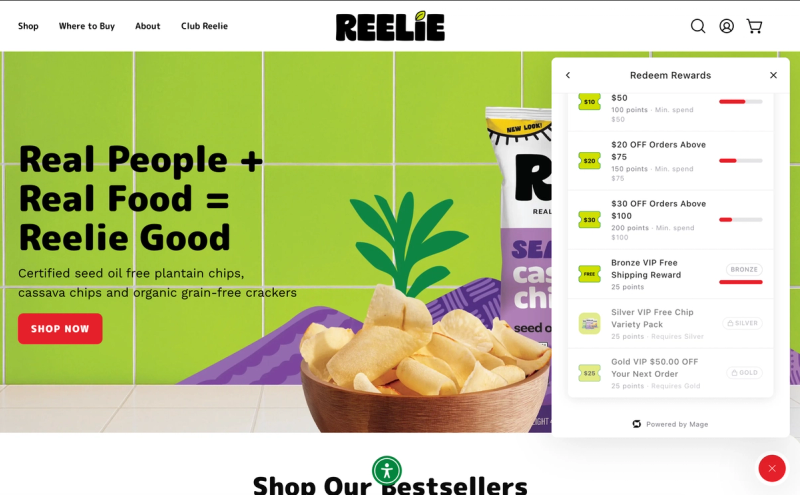
Customers should be able to find their balance and benefits without reopening an email. Mage Canvas is the no-code builder for loyalty pages, the Rewards Widget, account sidebar, referral campaigns, wishlist, and saved-for-later surfaces.
Mage Accounts sits on top of Shopify customer accounts and provides an on-site drawer rather than replacing Shopify accounts. Mage also provides a Shopify POS tile for viewing points, rewards, and history, then redeeming for the current transaction. Its account drawer loads asynchronously after the storefront, so it does not block the page or affect speed scores.
Compare total cost, not the headline monthly price
| Cost category | Question to ask | Risk if ignored |
|---|---|---|
| Usage | What counts toward order volume? | Unexpected overage charges |
| Features | Which functions are gated or modular? | Paying later for core workflows |
| Implementation | Who configures and tests the program? | Delayed or flawed launch |
| Rewards | What is the cost per redemption? | Margin erosion |
| Migration | What data and setup work are included? | Lost customer trust |
Record included usage, overage rules, billing events, contract terms, cancellation rules, and whether POS or subscription orders count toward usage. Use recent order data, not a quiet month.
List non-negotiable features such as VIP tiers, referrals, checkout redemption, analytics, accounts, memberships, cashback, API access, and fraud prevention. Then confirm whether each is included, restricted, or sold separately.
Software cost is only one line item. Account for program design, branding, migration, integration setup, staff training, campaign creation, and ongoing optimization. Use a worksheet to budget for a loyalty program.
Points and rewards also carry a future cost. Model redemption rates, minimum purchase thresholds, free-product cost, shipping cost, and cancelled or refunded orders.
Check data portability before you install
| Data type | Why it matters | Migration question |
|---|---|---|
| Current balance | Preserves earned value | Can each customer balance be imported? |
| Lifetime points | Retains customer history | Is historical earning preserved? |
| VIP status | Protects recognition | Do tier names and progress carry over? |
| Referral history | Avoids broken attribution | Are advocates and pending records retained? |
| Rewards history | Preserves context | Can prior redemptions be imported? |
| Wishlists | Retains intent data | Can saved products move with customers? |
Ask about points balances, lifetime points, VIP tier status, enrollment status, referral history, rewards history, wishlists, and historical points transactions. A balance import alone is not a full migration.
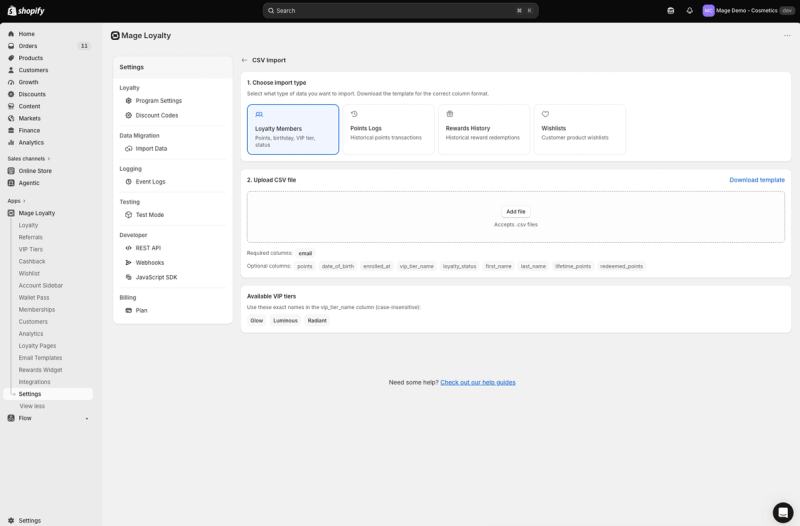
Mage supports built-in importers for some platforms, plus Manual CSV Import for Loyalty Members, Points Logs, Rewards History, and Wishlists. Its Loyalty Members import requires email and can include points, birth date, enrollment date, VIP tier name, loyalty status, lifetime points, and redeemed points.
Create VIP tiers before importing customers into them, using matching tier names. Mage documents that requirement in its Loyalty Members CSV import guide.
Run a test import first. Reconcile customer counts and balances, inspect tier assignments, and complete a test redemption before switching off the old system.
Run a pre-launch test before making the loyalty app live
| Test | Expected result |
|---|---|
| Customer earning | Purchase updates the balance correctly |
| Checkout redemption | Reward applies correctly in checkout |
| POS redemption | Retail purchase uses the same balance |
| Referral | Qualified action is attributed correctly |
| Refund | Points and tier progress adjust correctly |
| Reporting | Test activity appears in reporting |
Use a test customer to make a purchase, earn points, view the balance, redeem a reward, and check the order record. Repeat on mobile.
In Shopify POS, add a known customer to a cart, open the loyalty tile, review their balance and reward history, redeem a reward, and confirm the transaction updates the same balance used online.
Test the integrations you plan to use, such as a review action, subscription milestone, referral conversion, or Shopify Flow action. Also test a self-referral attempt, duplicate customer, partial refund, and full refund.
Use Test Mode if it is available. Mage Test Mode restricts earning, redemption, and integration events to customers on a defined test list.
Measure whether the app changes customer behavior
Start with repeat purchase rate, purchase frequency, retention rate, AOV, CLV, redemption rate, referral conversion, and revenue from loyalty members. Member count is a weak primary metric because enrollment can rise even if customers never return or redeem.
Build cohorts by first purchase month or quarter. Compare customer behavior before and after launch, then compare enrolled and non-enrolled customers carefully. Correlation is not proof that the program caused the difference.
For definitions and formulas, calculate loyalty program ROI from incremental behavior, reward cost, and program operating cost.
Expand only after earning, redemption, refunds, reporting, and customer communication work reliably.
FAQ
What is a loyalty app for Shopify?
A loyalty app for Shopify is software that adds earning rules, customer balances, rewards, referrals, VIP tiers, redemption, and loyalty reporting to a Shopify store. Shopify supplies adjacent tools such as discount codes, gift cards, customer profiles, and segments, while the loyalty app manages the program logic connecting customer actions to rewards.
Does Shopify have a built-in loyalty program?
Shopify does not have a complete built-in points-and-rewards program with loyalty balances, VIP tiers, and referral logic. Shopify provides discount codes, gift cards, customer data, and retail infrastructure, but Shopify says merchants use loyalty apps when they need loyalty tools within Shopify POS.
How do I choose a loyalty app for Shopify?
Choose a loyalty app for Shopify by defining the customer behavior you want to change, mapping the program to your business model, auditing earning and reward rules, checking integrations, comparing total cost, validating migration scope, and running a controlled test.
Can a Shopify loyalty app work with Shopify POS?
A Shopify loyalty app can work with Shopify POS when it includes a POS integration that supports customer lookup, balance visibility, earning, and reward redemption. Test that retail transactions update the same balance as online orders.
Can I migrate points to a new Shopify loyalty app?
You can migrate points to a new Shopify loyalty app when the destination app supports the required data import process. Ask about balances, lifetime points, VIP tiers, referral history, rewards history, wishlists, and pending records, then run a test import and reconcile the data before the old program is switched off.
Are Shopify loyalty apps worth the cost?
Shopify loyalty apps are worth the cost when repeat purchases, referrals, retail loyalty, or customer engagement are meaningful revenue levers for your store. Evaluate value through incremental repeat behavior, retention, redemption, CLV, operational savings, and reward cost.
Ready to see Mage in action? Book a demo.

Kris is the co-founder of Mage Loyalty. I spend most days talking to merchants, and making sure our customers get real results. If you run a Shopify store or Agency we should chat!