The most common thing we hear about Shopify Plus vs Shopify is wrong. Merchants treat Plus as "regular Shopify with a bigger invoice," a luxury tier you buy once you feel important enough. The fee math says otherwise. For a lot of brands, Plus quietly gets cheaper to operate before they ever touch a single Plus-only feature.
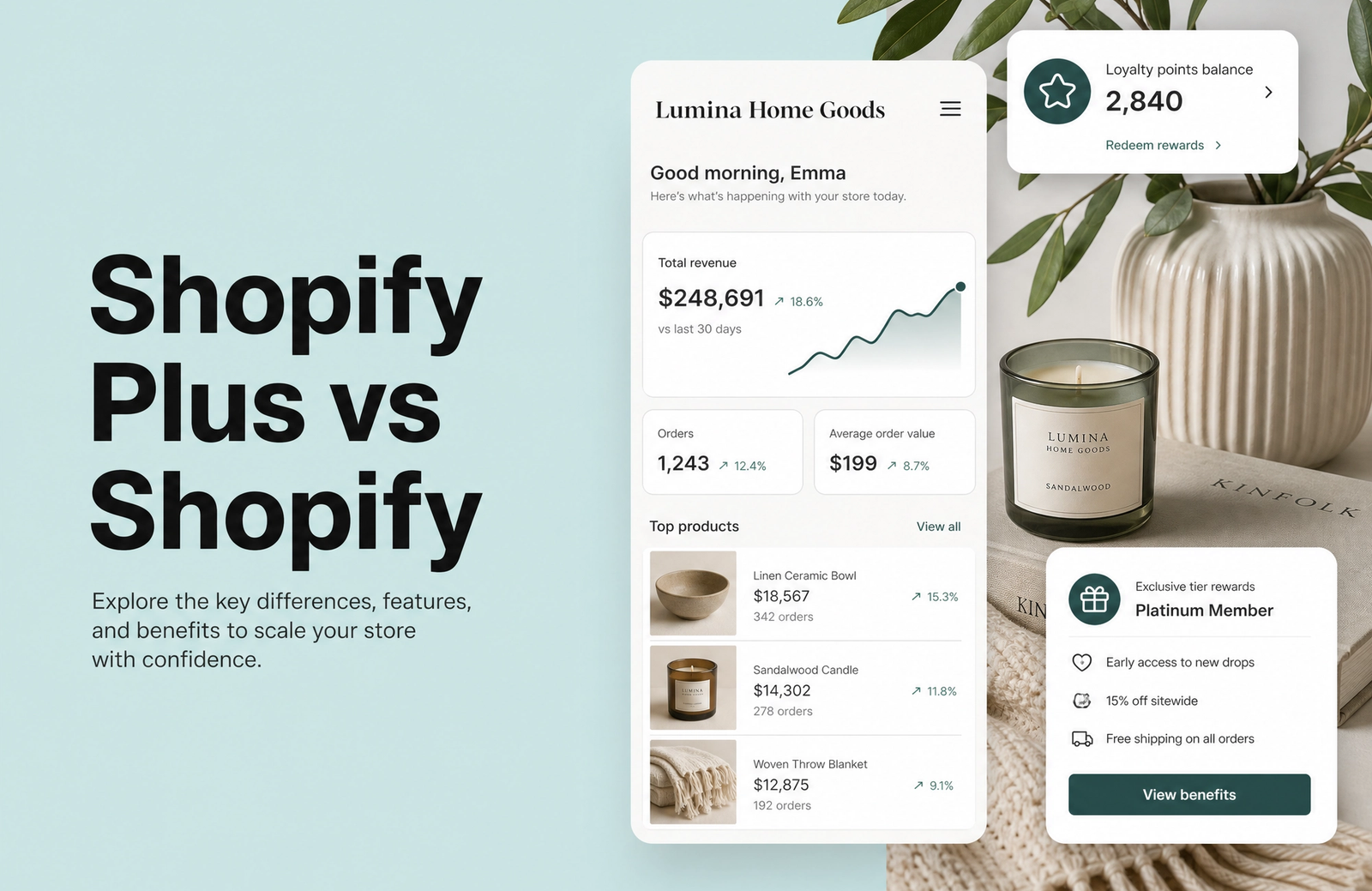
Shopify Plus is Shopify's enterprise commerce plan, built for high-volume merchants and complex B2B operations. It sits above the standard Basic, Shopify, and Advanced tiers, starting around $2,300 to $2,500 per month. While standard plans cap at $399 per month (Advanced), Plus unlocks checkout extensibility through Shopify Functions, native B2B tooling, up to nine expansion stores, unlimited staff accounts, 10x higher API limits, and automation tools like Launchpad.
That gap matters more than the price tag suggests. Below, we break down the plan differences, the actual 2026 pricing (including the part most articles get garbled), the checkout and customization story, API limits, B2B, and concrete triggers for when an upgrade makes sense. We will also bust the "bigger price tag" myth with numbers, because the numbers are genuinely surprising.
What is the difference between Shopify and Shopify Plus?
Standard Shopify (Basic, Shopify, Advanced) is a hosted storefront platform: themes, product catalog, payments, basic automation, and a fixed set of staff seats. It is designed for solo founders and growing teams who want commerce that works out of the box.
Shopify Plus is the same core platform with the ceilings removed. Think of it less like a different product and more like the difference between renting an apartment and renting the whole building. Same plumbing, far more control over the parts you usually cannot touch.
The control you gain falls into a few buckets. You can rewrite checkout logic with Shopify Functions and Checkout UI Extensions. You get native B2B (Companies, Catalogs, Price Lists, Payment Terms) without a separate wholesale app. You get Launchpad for scheduled drops and flash sales, Shopify Flow for automation, up to nine expansion stores for international or sub-brand storefronts, and unlimited staff accounts. API rate limits jump roughly 10x, which matters once apps and integrations start hammering your store in real time.
Here is the thing most comparison posts skip. None of those features are the real decision. The real decision is a cost crossover, and we will get to it.
Shopify Plus vs Shopify: pricing in 2026
Standard plan pricing is simple. Basic, Shopify, and Advanced run on flat monthly fees, with Advanced topping out at $399 per month. Plus is where it gets interesting, and where most write-ups go fuzzy.
Shopify Plus pricing starts at $2,300 per month on a three-year contract or $2,500 per month on a one-year contract. That flat rate holds until you cross roughly $800,000 in monthly gross merchandise value (GMV). Above that, Plus switches to a variable rate: 0.35% of GMV on a three-year term (0.40% on a one-year term), and the whole thing is capped at $40,000 per month no matter how big you get. So a brand doing $20 million a month does not pay $70,000; it pays the cap.
Here is the comparison at a glance.
| Factor | Standard Shopify (Advanced) | Shopify Plus |
|---|---|---|
| Starting monthly price | $399 | $2,300 (3-yr) or $2,500 (1-yr) |
| Pricing above ~$800K GMV/mo | Flat $399 | 0.35% to 0.40% of GMV, capped at $40,000 |
| Third-party gateway fee | 0.60% per transaction | 0.20% per transaction |
| Staff accounts | 15 | Unlimited |
| Expansion stores | None | Up to 9 |
| Checkout customization | Limited (no checkout.liquid, extensions only) | Full via Functions and UI Extensions |
| Native B2B | No | Yes (Companies, Catalogs, Price Lists) |
| Launchpad and Flow | Flow on some plans, no Launchpad | Both included |
| GraphQL Admin API | 100 points/sec | 500 points/sec |
The Shopify loyalty program growing brands trust
See how Mage helps Shopify brands lift repeat purchase rate with loyalty, referrals and store credit.
Book a demoThe transaction fee row is where the myth falls apart. If you use a third-party payment processor (not Shopify Payments), Advanced charges 0.60% per transaction and Plus charges just 0.20%, a 67% reduction. At $500,000 in monthly revenue, that fee gap saves about $24,000 a year, which nearly covers the entire $27,600 annual Plus subscription. At $1 million a month, the saving is roughly $48,000, which means Plus is effectively cheaper to run than Advanced before you count a single Plus feature. The fee math in one line: if you process payments through a third-party gateway at $500K or more per month, Shopify Plus can cost less to operate than Advanced once transaction-fee savings are counted, even though the sticker price is higher.
When should you upgrade from Shopify to Shopify Plus?
Shopify's own guidance says to consider upgrading to Plus around $80,000 in monthly online revenue (roughly $1 million a year). That is a fine starting signal, but it is a revenue number, not a profit number. The sharper triggers are operational.
Upgrade when you hit one or more of these:
The transaction-fee crossover. If you are on a third-party gateway, the break-even against Advanced typically lands around $150,000 per month in processed volume. Below that, the platform premium is real. Above it, the fee savings start eating the premium.
Automation you cannot script on standard plans. If your team is manually flipping themes for every product drop, or hand-tagging VIP customers, Launchpad and Flow pay for themselves in saved hours and fewer mistakes.
A B2B or wholesale channel. Native B2B is Plus-only, and rebuilding it with apps on a standard plan gets expensive and brittle fast.
International expansion. Up to nine expansion stores let you run dedicated storefronts per region with shared back-end management, instead of duct-taping multi-currency onto one store.
API pressure. If your integrations are getting throttled, the 10x rate limit headroom on Plus is not a luxury, it is the fix.
Now the contrarian part: there is a clear case for NOT upgrading. If you are under $80,000 a month, using Shopify Payments (so the transaction-fee saving does not apply to you), and you are not running B2B or heavy automation, Plus is mostly paying for ceilings you will not hit. We have watched brands jump to Plus for the prestige and then use it exactly like Advanced. That is the one scenario where "bigger price tag" is a fair description. Scaling smartly is about retention-first growth, not collecting platform badges.
If you want to pressure-test the decision properly, run it through your own numbers using a framework like ecommerce unit economics rather than a revenue rule of thumb.
“Mage Loyalty is hands-down the best loyalty platform on Shopify, and the team behind it is just as exceptional as the product. When we needed customizations specific to our business, the Mage team worked directly with us to make it happen. And the wishlist feature deserves its own callout: it's the best we've come across, period. Beautifully integrated, intuitive for customers, and a real driver for our store.”

Read the MiaDonna case study →
Checkout, Functions, and the deadline nobody mentions
Checkout is the single biggest functional difference, and it is also where Shopify quietly changed the rules for everyone.
For years, Plus merchants customized checkout by editing a file called checkout.liquid, dropping in raw JavaScript and Liquid. That era is over. Shopify deprecated checkout.liquid fully for Plus merchants as of August 28, 2025 (non-Plus stores have until August 26, 2026). The replacement is Checkout Extensibility: a framework of Checkout UI Extensions, Shopify Functions, and App Pixels.
This is not a cosmetic change. Brands that missed earlier milestones lost the ability to switch payment providers and had fraud-indicator recommendations disabled. If your store ran custom checkout scripts, that logic had to be rebuilt as supported extensions, not patched. It is a real operational project, and it is the kind of thing a slick feature comparison table will never warn you about.
The upside: Shopify Functions are genuinely powerful. You can write custom discount logic, shipping rules, and payment customizations that run server-side and survive Shopify updates, instead of fragile injected scripts. Standard Shopify gets a limited slice of extensibility, but the full Functions toolkit (and the deepest checkout control) lives on Plus.
A real upgrade story: Gymshark
Theory is cheap, so here is a brand that lived it. Gymshark ran on Magento (now Adobe Commerce), and on one Black Friday the site went down for eight hours. The estimated cost of that single outage was around £100,000, a brutal lesson in what platform fragility costs at scale.
After about ten months fighting Adobe Commerce, Gymshark replatformed to Shopify Plus. The co-founder's takeaway was telling: checkout personalization changes that used to take weeks could now be done "almost immediately." The brand went on to hit £41 million in sales in 2017 and grew to 5.1 million social followers across 131 countries.
The lesson is not "Plus made them big." Plenty of factors did. The lesson is that platform ceilings, uptime under load, and how fast you can change checkout become business-critical once volume spikes are routine. That is precisely the threshold Plus is built for.
B2B, Launchpad, and what Winter 2026 added
Two Plus-only capabilities deserve their own mention because they are often where the upgrade actually earns out.
Native B2B. Shopify launched wholesale natively on Plus in 2022 (Companies, Catalogs, Price Lists, Payment Terms, buyer roles) and has been stacking on features since. Shopify's Winter 2026 Edition shipped 150+ updates, including Plus B2B additions like ACH bank payments at checkout, store credit for company locations, in-store pickup at B2B checkout, payment requests per fulfillment for multi-shipment orders, and ERP sync with NetSuite, Sage, Acumatica, and others. All of it is included in the Plus subscription, not bolted on for extra.
Launchpad. This Plus-exclusive tool lets you pre-configure every element of a flash sale or drop (theme, product visibility, pricing, discount codes, even CAPTCHA for bot suppression) and schedule it to go live and revert automatically. Streetwear and sneaker brands lean on it hard for high-demand releases, where manual coordination across a team is how mistakes happen at the worst possible moment.
Where retention fits, on either tier
One thing both platform tiers share: the platform decision is not your growth strategy. Acquiring the order is step one. Keeping the customer is where margin actually lives, which is the whole premise of any serious DTC profitability playbook.
Loyalty and retention tooling runs on standard Shopify and Plus alike. Platforms such as Mage Loyalty, Rivo, and Smile.io all operate across both tiers. What changes on Plus is the headroom: higher API rate limits help real-time points calculations keep up at volume, and Shopify Flow triggers let you automate loyalty events (auto-tagging VIP customers, firing rewards at order milestones) without manual work. For high-volume brands weighing options, a Shopify Plus loyalty program leans on that automation headroom, and our roundup of Shopify Plus loyalty apps covers how it plays out in practice. If a wholesale channel is in your future, a B2B loyalty platform becomes part of the same conversation. On standard plans the same retention logic applies, just without the extra API ceiling.
The point is simple. Upgrading the platform raises your ceiling. It does not, by itself, retain anyone. So if you are weighing the upgrade, map your transaction fees, automation needs, and retention plan before you sign a Plus contract. Book a demo to see how loyalty automation works across both Shopify and Shopify Plus.
Frequently Asked Questions
What is the difference between Shopify and Shopify Plus?
The difference between Shopify and Shopify Plus is scale and control. Standard Shopify plans cap at $399 per month with limited checkout customization and 15 staff accounts. Plus adds full checkout extensibility via Functions, native B2B, up to nine expansion stores, unlimited staff, and 10x API limits.
How much does Shopify Plus cost per month?
Shopify Plus costs $2,300 per month on a three-year contract or $2,500 per month on a one-year contract. Once you exceed roughly $800,000 in monthly GMV, pricing shifts to a variable rate of 0.35% to 0.40% of GMV, capped at $40,000 per month.
When should I upgrade from Shopify to Shopify Plus?
You should upgrade to Shopify Plus when monthly revenue nears $80,000, or sooner if specific needs apply. The strongest triggers are a third-party-gateway fee crossover around $150,000/month in volume, a B2B channel, international expansion, or automation needs that standard plans cannot script.
What revenue do you need for Shopify Plus?
Shopify recommends Plus at roughly $80,000 in monthly online revenue (about $1 million annually). That is a guideline, not a rule. The operational triggers (B2B, automation, API throttling, or transaction-fee savings on third-party gateways) often justify the move at different revenue points entirely.
Can you customize checkout on standard Shopify?
You can customize checkout on standard Shopify, but only within Checkout Extensibility. Both Plus and standard plans now use Checkout UI Extensions, since checkout.liquid was deprecated (Plus in August 2025, standard stores by August 2026). Plus unlocks the full Shopify Functions toolkit for deeper checkout control.
Does Shopify Plus include Shopify Flow and Launchpad?
Shopify Plus includes both Shopify Flow and Launchpad. Flow handles automated workflows like tagging customers or triggering actions, and is available on some standard plans too. Launchpad, which schedules and automates flash sales and product drops, is exclusive to Plus and not available on standard tiers.
TLDR
Shopify Plus vs Shopify comes down to ceilings and cost crossover, not prestige. Standard plans cap at $399 per month; Plus starts at $2,300 to $2,500 and unlocks full checkout customization via Functions, native B2B, up to nine expansion stores, unlimited staff, Launchpad, and 10x API limits. The "just a bigger price tag" myth breaks on the fee math: brands on third-party gateways at $500K+/month can save $24,000 or more a year in transaction fees, nearly offsetting the subscription before using any Plus feature. Upgrade when you hit the fee crossover (~$150K/month in volume), add B2B, expand internationally, or outgrow standard automation and API limits. Stay put if you are under $80K/month on Shopify Payments without those needs. Either way, the platform raises your ceiling; retention and loyalty are what keep customers coming back.

Graeme is the co-founder at Mage Loyalty. He heads product development, from complex loyalty migrations and large-scale data handling to building the features shaping the future of loyalty on Shopify.