Here's a counterintuitive fact: the most profitable DTC alcohol brand on Shopify probably isn't the one acquiring the most new customers each month. It's the one obsessing over what existing customers spend over their lifetime.
Welcome to the world of customer lifetime value (CLV)—a metric that separates thriving alcohol brands from those burning cash on acquisition. And if you're selling wine, spirits, or craft alcohol online, understanding your CLV isn't optional. It's the difference between sustainable growth and watching your margins evaporate.
The DTC alcohol market on Shopify is booming. U.S. online alcohol sales reached $9.6 billion in 2025, with projections hitting $11.2 billion in 2026. North American online wine sales alone accounted for 53% of the continent's online alcohol sales in 2024, growing at a 5.6% CAGR. These numbers look fantastic in isolation. But here's where most brands miss the point: growth without profitable customers is just expensive noise.
That's why CLV matters so much. For alcohol brands, acquisition costs are steep. Age verification, compliance infrastructure, shipping complexity—these all eat into margins before a single repeat purchase happens. When you understand your CLV, you stop chasing vanity metrics and start building a business model that actually works.
This article reveals what wine, spirits, and craft alcohol brands should realistically expect for CLV on Shopify, how to calculate it accurately, and the specific strategies that move the needle. You'll see real benchmarks, actionable tactics, and the common pitfalls that sabotage even well-intentioned loyalty efforts.
Let's start with the fundamentals.
Decoding Customer Lifetime Value for Online Alcohol Retailers
What is Customer Lifetime Value (CLV)?
Customer lifetime value is the total profit a customer generates for your business over the entire relationship with your brand. Not just their first purchase. Not their biggest order. The sum of everything they spend with you, minus what you invested to acquire and serve them.
Here's where most people get confused: there's a difference between revenue-based CLV and profit-based CLV. Revenue-based CLV tells you gross dollars. Profit-based CLV tells you what actually stays in your bank account. For alcohol brands, this distinction matters enormously because of the unique cost structure—shipping is expensive, margins vary wildly by product, and compliance costs aren't always obvious.
Let's say a wine club member spends $2,400 annually. That sounds impressive. But if your shipping costs, fulfillment fees, and compliance infrastructure consume 40% of that revenue, your actual CLV is closer to $1,440. This is why profit-based CLV is the number that should drive your strategy.
Why CLV is the Ultimate Metric for DTC Wine & Spirits Brands
Here's what I've seen working with alcohol brands: the ones who win treat CLV like their north star metric. Not email open rates. Not follower counts. CLV.
Why? Because in the alcohol industry, customer acquisition is genuinely expensive. You're running ads in a heavily regulated market. You're competing for attention in crowded categories. Age verification gates some traffic. Shipping restrictions limit your addressable market by state. And repeat purchase rates—historically—have been lower than apparel or supplements because wine and spirits are consumption categories with natural purchase cycles.
But here's the opportunity: when you get a customer to come back, the margin on that second, third, and tenth purchase is substantially higher than the first. You've already paid the acquisition cost. You've already dealt with the compliance burden. The economics flip dramatically in your favor.
CLV also helps you make smarter decisions about where to spend marketing dollars. If your CLV is $600 and your customer acquisition cost (CAC) is $80, you have room to spend aggressively. If your CLV is $200 and your CAC is $120, you're in trouble—and you need to fix retention before acquiring more customers.
The Shopify loyalty program growing brands trust
See how Mage helps Shopify brands lift repeat purchase rate with loyalty, referrals and store credit.
Book a demoMastering CLV Calculation: A Shopify-Friendly Guide
The Foundational CLV Formula Explained
Here's the simplest, most practical CLV formula for ecommerce:
CLV = (Average Order Value × Purchase Frequency × Customer Lifespan) - Customer Acquisition Cost
Let's break this down.
Average Order Value (AOV) is the total revenue from all orders divided by the number of orders. For a wine brand, this might be $145 (including case purchases, bundles, and accessories).
Purchase Frequency is how many times a customer purchases in a given period—typically annually. Wine club members? Probably 12 times per year (monthly shipments). One-time buyers? Maybe 1.2 times if you're lucky.
Customer Lifespan is how long, on average, a customer remains active with your brand. For wine clubs, this might be 4-5 years. For one-off purchase customers, maybe 1.5 years.
So a wine club customer might look like this:
CLV = ($145 × 12 × 4.5) - $150 (CAC) = $7,710 - $150 = $7,560
Compare that to a one-time wine buyer:
CLV = ($89 × 1.2 × 1.5) - $65 (CAC) = $160 - $65 = $95
That's the power of subscription models in this industry. The numbers don't lie.
Leveraging Shopify Analytics for Accurate CLV Data
To calculate CLV accurately, you need solid data. Shopify gives you most of what you need—you just need to know where to look.
Extract Average Order Value: In Shopify, go to Analytics > Reports > Sales. Filter by date range and you'll see total sales and total orders. Divide sales by orders. This is your raw AOV. (Note: remove returns and refunds from this calculation for accuracy.)
Calculate Purchase Frequency: In the same Analytics section, look at Customers > Repeat Purchases. Shopify shows you the percentage of repeat customers and average repeat purchase rate. Divide total orders by total customers over your analysis period.
Determine Customer Lifespan: This one requires looking at cohort data. Segment customers by acquisition month and track how long they remain active (making purchases). For established brands, you'll start to see patterns—wine clubs typically have 4-5 year lifespans, while one-time buyers drop off within 1-2 years.
Measure CAC: Divide your total marketing spend (ads, email tools, loyalty platform costs) by the number of new customers acquired in that period.
One practical tip I've seen work well: segment your CLV by customer type. Wine club members shouldn't be lumped with one-time buyers in your analysis. They have entirely different economics. The same goes for gift purchases versus self-purchases—they behave differently and should be tracked separately.
This segmentation approach reveals which customer types are actually profitable and where to focus your efforts. It also surfaces which customer segments are underperforming and need intervention.
“I looked into so many different integrations for loyalty and referrals for our Shopify Store, but no one impressed me more than Mage on human connection, customer service, and value.”


Read the Reelie case study →
Average CLV Benchmarks: What to Expect for Shopify Alcohol Brands
General Shopify CLV Landscape
Let's start with baseline benchmarks across Shopify stores. The average Shopify 3-year CLV is $168, with a median of $125. The top 25% of stores achieve $250-$450+. These numbers vary significantly by industry—fashion performs differently than supplements, which perform differently than food.
Subscription-based stores perform substantially better, typically achieving $350-$800+ in LTV. This is why subscription models matter so much for alcohol brands.
The other number you need to know: the LTV:CAC ratio. Healthy ecommerce businesses maintain a 3:1 ratio—meaning for every dollar spent acquiring a customer, you generate three dollars in lifetime value. Below 1:2 and you're operating at a loss. Ratios of 1:4 or 1:5 indicate exceptionally strong unit economics.
The Wine Club Advantage: Elevated CLV Through Subscriptions
This is where the alcohol category gets interesting. Wine club members average $1,200-2,400 per year in CLV. That's 6-10x the CLV of one-time wine buyers.
Let me repeat that because it's the single most important number for alcohol brands: wine club members are 6-10x more valuable than customers who make single purchases.
Why does this matter? Because it tells you where to invest your energy. A wine club model isn't a nice-to-have feature. For many alcohol brands, it's the business model. Subscription revenue is predictable, margins improve at scale, and customer relationships deepen—all the ingredients for sustainable profitability.
The best-performing wine clubs implement tiered memberships. A Bronze tier might offer 3 bottles monthly at $89 plus shipping. Silver might be 6 bottles at $165. Gold might be 12 bottles at $289. Each tier unlocks different benefits: earlier access to releases, exclusive member-only wines, invitations to virtual tastings with winemakers.
Flexible subscription options matter too. Some customers want monthly deliveries. Others prefer quarterly. Some want the club to choose wines for them. Others want to handpick selections. Accommodating these preferences keeps retention high and CLV climbing.
Projected CLV for DTC Spirits and Craft Alcohol on Shopify
Here's where I'll fill a real gap in the industry data: concrete CLV benchmarks for DTC spirits and craft alcohol on Shopify are scarce. Most published benchmarks focus on wine clubs. So let's synthesize what we can extrapolate.
A typical DTC craft spirit brand (bourbon, gin, vodka) on Shopify should realistically target a CLV between $400-$800 for engaged customers, with subscription models pushing toward $1,200+. This is lower than wine clubs (higher price points, longer consumption cycles for spirits) but meaningfully higher than general ecommerce.
Craft beer brands operate differently. Lower price points, more frequent purchases, stronger community engagement. Realistic CLV targets: $250-$500 for one-time buyers, $600-$1,200 for subscription members.
Several factors influence these numbers: product price point (a $120 bottle of bourbon has different economics than a $35 gin), consumption patterns, brand loyalty intensity (craft drinkers are often more loyal than mass-market spirits buyers), and your subscription penetration rate.
One thing I've noticed: brands that build community around craft products achieve higher CLV. Virtual tasting events, limited releases, direct access to producers—these drive emotional connection that translates to longer customer lifespan and higher purchase frequency.
The Crucial LTV:CAC Ratio for Profitability
Let's talk about unit economics. A healthy LTV:CAC ratio for alcohol brands should be 3:1 or higher. Here's what different ratios tell you:
1:1 Ratio = You're breaking even on acquisition. Might work in growth phase, but unsustainable long-term.
2:1 Ratio = Better, but thin margins. You need to improve retention or reduce CAC.
3:1 Ratio = Healthy baseline. You have room to invest in customer acquisition while maintaining profitability.
4:1 or Higher = Exceptional. You're either remarkably efficient at retention, have premium pricing, or both.
For alcohol brands, achieving 3:1 typically requires either: (a) high retention through loyalty programs and community, (b) subscription models that extend customer lifespan, or (c) premium pricing that supports higher AOV and margin.
If your ratio is below 2:1, focus entirely on retention before spending more on acquisition. The math doesn't work otherwise.
Strategies to Boost Customer Lifetime Value for Your Alcohol Brand
Cultivating Loyalty and Driving Repeat Purchases
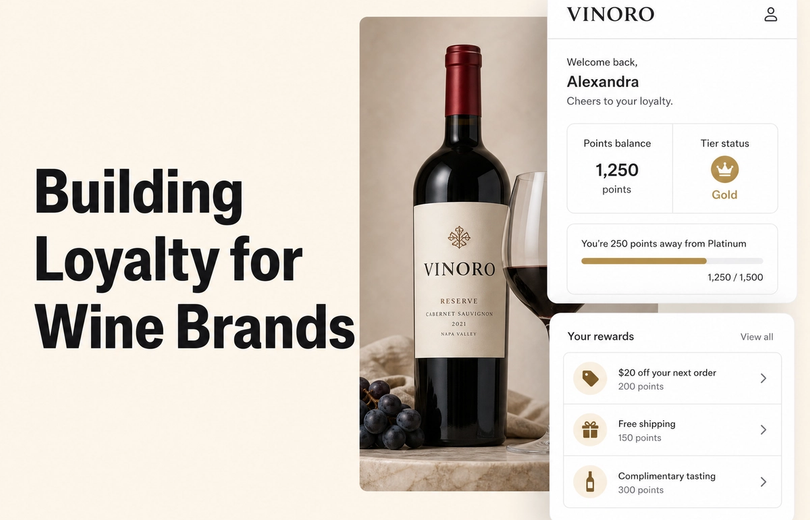
Implementing Tiered Loyalty Programs & VIP Memberships
Here's what the data shows: tiered rewards structures in wine and spirits stores result in 30-42% higher AOV and 35% higher reorder rates within 90 days. These aren't marginal improvements—they're game-changing.
A tiered structure works like this: Bronze members earn 1 point per $1 spent. Silver members earn 1.25 points. Gold members earn 1.5 points. At certain redemption thresholds, members unlock exclusive benefits: early access to limited releases, free shipping, birthday bonuses, invitations to member-only events.
The psychological effect is powerful. Customers don't just want rewards. They want status. They want to feel like insiders. When someone reaches Gold status in your wine club, they don't just feel more loyalty—they've publicly committed to your brand. Switching costs (psychological, not financial) increase dramatically.
The key is tying rewards to behaviors that actually matter. Points for purchases, yes. But also points for referrals, for reviewing wines, for attending virtual events, for visiting your tasting room (if you have one). This diversifies engagement and creates multiple entry points for earning status.
Crafting Engaging Welcome Series & Win-Back Automations
A properly executed welcome email series can increase CLV by 20-30%. Here's the structure that works:
Email 1 (Day 0): Thank them. Give them their first reward. Make it simple.
Email 2 (Day 2): Tell your story. Why you make wine/spirits. What makes you different.
Email 3 (Day 5): Educational content. How to taste wine. How to choose a bottle for an occasion. Reduce buyer's remorse.
Email 4 (Day 7): Your best-seller. Social proof. Why customers love this wine.
Email 5 (Day 14): Referral incentive. Ask them to invite friends.
This sequence sets the tone for the relationship. It educates customers, reduces returns, and primes them for repeat purchases.
Win-back campaigns matter equally. When a wine club member or regular customer lapses (no purchase in 60 days), send a targeted email offering a special incentive to return. Data shows 15-25% of lapsed customers will come back if you ask properly.
The tone matters here. Not "we miss you" (too passive). Something like: "You haven't tried our new Fall collection yet—and we have an exclusive member-only price waiting." Specificity beats generic messaging.
Personalized Experiences Through Customer Segmentation
Email program impact on LTV is substantial: stores with strong email programs see 35-45% higher LTV. Part of this comes from segmentation.
Segment your customers by: purchase history (wine club vs. one-time buyer), product preferences (red vs. white), price sensitivity (budget vs. premium), geographic location (for state-specific offers), and engagement level (active vs. dormant).
Then tailor communications to each segment. A customer who only buys Pinot Noir doesn't need emails about Cabernet releases. A budget-conscious buyer doesn't need VIP invitations to $300 tastings. A dormant customer needs a different message than an active one.
This basic segmentation—properly executed—increases email revenue per recipient by 20-40%. It's not complex. It's just thoughtful.
Optimizing Average Order Value (AOV) and Purchase Frequency
Maximizing with Subscription and Club Models
We've covered this, but it deserves repetition because it's non-negotiable: if you're selling wine or spirits on Shopify and don't have a subscription model, you're leaving 60-80% of potential CLV on the table.
Subscription models work for spirits too. Spirit-of-the-month clubs, craft whiskey subscriptions, seasonal cocktail kits—these extend customer lifespan and increase predictable revenue.
The mechanics: offer flexibility (monthly, quarterly, skip-a-month options), provide clear value (better pricing than buying individually, exclusive products, educational content), and make cancellation intentionally difficult but not impossible (require one click to cancel, but pair it with a retention offer).
Strategic Cross-Sells, Upsells & Bundling
Don't let customers leave your store with just wine. A bottle of wine should trigger recommendations for: wine glasses, decanters, wine books, cheese pairing guides, gift boxes.
Post-purchase upsells work better than checkout upsells. After someone buys a $120 bottle of Napa Cabernet, email them an offer for premium wine glasses at 20% off. After three orders, offer them your wine club.
Bundling increases AOV dramatically. "Cabernet + Decanter Bundle" priced at $135 converts better than "Buy wine ($120) and add decanter ($30)." Framing matters.
Leveraging Free Shipping Thresholds for Case Quantities
Here's a tactic specific to wine and spirits: free shipping for case quantities (12+ bottles) increases AOV by 35-55%.
Why? Psychology. A single bottle of wine shipped costs $12-18. A case of 12 bottles costs roughly the same to ship. So offering free shipping for 12+ bottles isn't actually generous—it's mathematically smart. But customers don't calculate the cost per unit. They see "free shipping" and perceive significant value.
Set your threshold at the point where shipping economics improve. For most wine brands, that's 6-12 bottles. For spirits, it might be 3-4 bottles.
Implementing Referral Programs
Customer acquisition through referrals costs 25-40% less than paid advertising. And referred customers have 16% higher lifetime value than other customers. Run a simple referral program: existing customer gets $20 off; referred friend gets $20 off.
Track this in your Shopify loyalty program platform. Make referrals effortless—a unique link shared via email or SMS, trackable and reward-triggering automatically.
Enhancing Customer Experience and Building Trust
Ensuring Flawless Fulfillment and Delivery
This stat is sobering: 84% of shoppers report they will not return to a brand after a late delivery. One late shipment, and you've destroyed months of relationship-building.
For alcohol brands, this is especially critical. Compliance, logistics, shipping delays—there are more things that can go wrong. Build redundancy: use multiple carriers, have backup fulfillment partners, monitor delivery performance obsessively.
When delays happen (and they will), communicate proactively. Send tracking updates without being asked. If a shipment will be late, notify the customer before they discover it. Offer a small credit or bonus points as compensation.
Proactive Communication & Exceptional Support
Transparency builds trust. Tell customers exactly what they're getting: tasting notes, food pairings, producer story, alcohol content. Answer questions before they're asked.
When issues arise—a bottle broke in shipping, someone ordered underage-gated product accidentally, a gift shipment didn't arrive on time—resolve it without making customers fight. A refund plus replacement plus bonus points costs less than losing a customer.
The Direct Link: Compliance Management and CLV
Here's something overlooked in most CLV discussions: robust compliance directly impacts CLV. Why? Because compliance failures destroy the customer experience.
A customer wants to buy wine from your store. They enter their state. Your system says shipping is restricted. Frustration. Or worse, they complete the purchase, expect delivery, and the order gets cancelled due to regulatory issues. Rage.
Brands that solve compliance elegantly—real-time state restrictions, clear shipping policies, smooth age verification—retain customers better. They also reduce refund rates and customer service overhead.
Think of compliance as a CLV investment, not just a legal checkbox.
Community Building for Craft Alcohol Loyalty
Craft beer and spirits brands have an edge that wine doesn't always have: community. Craft drinkers are passionate. They want connection with other enthusiasts and with producers.
Brands winning at this level go beyond transactional loyalty. They host virtual tasting events (live stream tastings with brewery owners). They create exclusive releases for community members. They share user-generated content—photos of customers enjoying their products. They tell the producer story obsessively.
This community engagement drives longer customer lifespan and higher purchase frequency. A craft beer drinker who feels part of a community doesn't just buy beer. They evangelize.
Navigating the Regulatory Maze: Shopify's Role in Alcohol Sales
Understanding the Complexities of DTC Alcohol Regulations
The U.S. alcohol shipping landscape is fragmented. Each state has different rules. Some states require in-state production. Others prohibit direct shipping to consumers entirely. Some allow wine but not spirits.
Licensing requirements vary. Excise duties apply. Age verification is mandatory. Shipping costs are higher because of compliance infrastructure.
This complexity affects CLV because it limits your addressable market by state and requires investment in compliance infrastructure that smaller brands might not anticipate.
Shopify as a Compliant Platform for Alcohol E-commerce
Shopify's ecosystem includes apps purpose-built for alcohol compliance. The DRINKS app handles age verification, licensing checks, and shipping restrictions. Tectalic Wine Club, Bloom Commerce, and Winehub manage subscriptions within regulatory bounds.
These integrations don't just reduce legal risk. They streamline the customer experience. Faster checkout. Fewer failed orders. Higher conversion.
Adapting CLV Strategies for State-Specific Laws
Here's a practical example: your loyalty program might offer "free shipping for 12+ bottles." But free shipping violates alcohol shipping economics in some states due to excise taxes and compliance costs.
Winning brands adjust loyalty rules by state. They might offer "10% off 12+ bottles" in expensive-to-ship states and free shipping in others.
Similarly, referral programs need compliance review. A $20 bonus isn't a rebate—it's a loyalty reward, which is legal. But it varies by state. Document this. Work with legal counsel. Then build a loyalty program that's compliant everywhere you ship.
Essential Shopify Apps and Tools for Supercharging CLV
Compliance & Age Verification: DRINKS App ensures legal sales and shipments.
Subscription & Membership Management: Tectalic Wine Club, Bloom Commerce, Winehub, and Awtomic make recurring orders seamless.
Spin-wheel popups in wine stores achieve 9-13% conversion rates.
Analytics & Reporting: Beyond Shopify's native reports, deeper CLV tracking tools help identify patterns and predict future behavior.
Email & SMS Platforms: Klaviyo, Omnisend, and Postscript integrate with loyalty platforms for coordinated campaigns.
The key is integration. Your loyalty app should talk to your email platform, your compliance tools, and your analytics dashboard. Data silos kill CLV optimization.
Beyond CLV: Other Key Metrics for DTC Alcohol Success
Average Order Value (AOV): Track this weekly. Small improvements (5-10%) compound into major CLV gains. Case bundling, upsells, and subscription pricing all impact AOV.
Purchase Frequency: Measure how often customers buy annually. Subscription models increase this. So do seasonal campaigns and win-back emails.
Customer Acquisition Cost (CAC): If CAC is rising and CLV is flat, you're in trouble. Know where every customer is coming from.
Repeat Purchase Rate: Direct indicator of loyalty program effectiveness. Aim for 35-50% of customers making a second purchase within 12 months.
Churn Rate: For subscriptions, this is critical. Wine club churn of 5-8% monthly is typical. Better-performing programs hit 3-5%.
Conclusion: Your Roadmap to Sustainable Growth with CLV
CLV separates sustainable alcohol brands from those burning cash. It's the metric that forces you to think long-term, invest in retention, and treat customers like lifetime relationships, not transactions.
For Shopify wine, spirits, and craft alcohol brands, the opportunity is clear. Wine club members can generate $1,200-2,400 annually. Craft spirits can achieve $600-$1,200 through subscription models. Even one-time buyers, with proper nurturing, can reach $400-$600 CLV.
The strategies work: tiered loyalty programs, subscription models, segmented email marketing, community building, and compliance-aware program design. But none of it works without measurement. Calculate your CLV. Segment it by customer type. Know your LTV:CAC ratio. Then optimize against real numbers, not assumptions.
The brands winning in DTC alcohol aren't the ones yelling loudest on ads. They're the ones building moats through loyal customers, predictable revenue, and sustainable margins. That's the power of understanding CLV.
Frequently Asked Questions
What is a good CLV for a Shopify wine or spirits brand?
For one-time wine buyers, $200-$400 is reasonable. Wine club members should reach $1,200-2,400 annually. Craft spirits brands should target $400-$800 for engaged customers, with subscriptions pushing toward $1,200+. Compare your ratio of LTV:CAC—3:1 or higher is healthy. Your specific target depends on product price point, subscription penetration, and customer segment mix.
How does age verification affect customer retention and CLV?
Age verification gates some potential customers but doesn't materially harm CLV for those who pass. What matters is execution. Smooth, frictionless age verification (single click, not multiple forms) maintains conversion. Failed age verification during purchase is problematic—it frustrates customers and increases cart abandonment. Ensure your age-gating happens on signup, not at every transaction.
Can craft beer brands on Shopify achieve similar CLV to wine clubs?
Craft beer CLV is typically lower than wine due to lower price points and different consumption patterns. Realistic targets: $250-$500 for one-time buyers, $600-$1,200 for subscription members. But craft beer brands have a community advantage wine sometimes lacks. Virtual brewery events, limited releases, and user-generated content can push CLV toward wine club levels. Explore how to build a loyalty program designed for community engagement.
What are the most common pitfalls when trying to increase CLV in alcohol e-commerce?
Ignoring state-by-state shipping regulations in loyalty program design (compliance violations tank trust). Failing to age-gate loyalty signups, exposing the program to platform takedown. Offering generic free shipping rewards that violate alcohol shipping economics. Not differentiating wine club members from one-off buyers in communications (generic messaging devalues membership). Setting tier requirements based purely on dollar spend without accounting for AOV variation across customer segments. The winning approach: test food and beverage loyalty strategies, segment your customer base, and keep compliance front-and-center.
How often should I recalculate my CLV?
Quarterly is the minimum for most brands. Monthly if you're running significant campaigns or testing changes. CLV can shift based on seasonality (November-December accounts for 35-45% of wine ecommerce revenue), new customer cohorts, and program changes. Track it by acquisition month cohort—you should see patterns that help predict future CLV.

Graeme is the co-founder at Mage Loyalty. He heads product development, from complex loyalty migrations and large-scale data handling to building the features shaping the future of loyalty on Shopify.