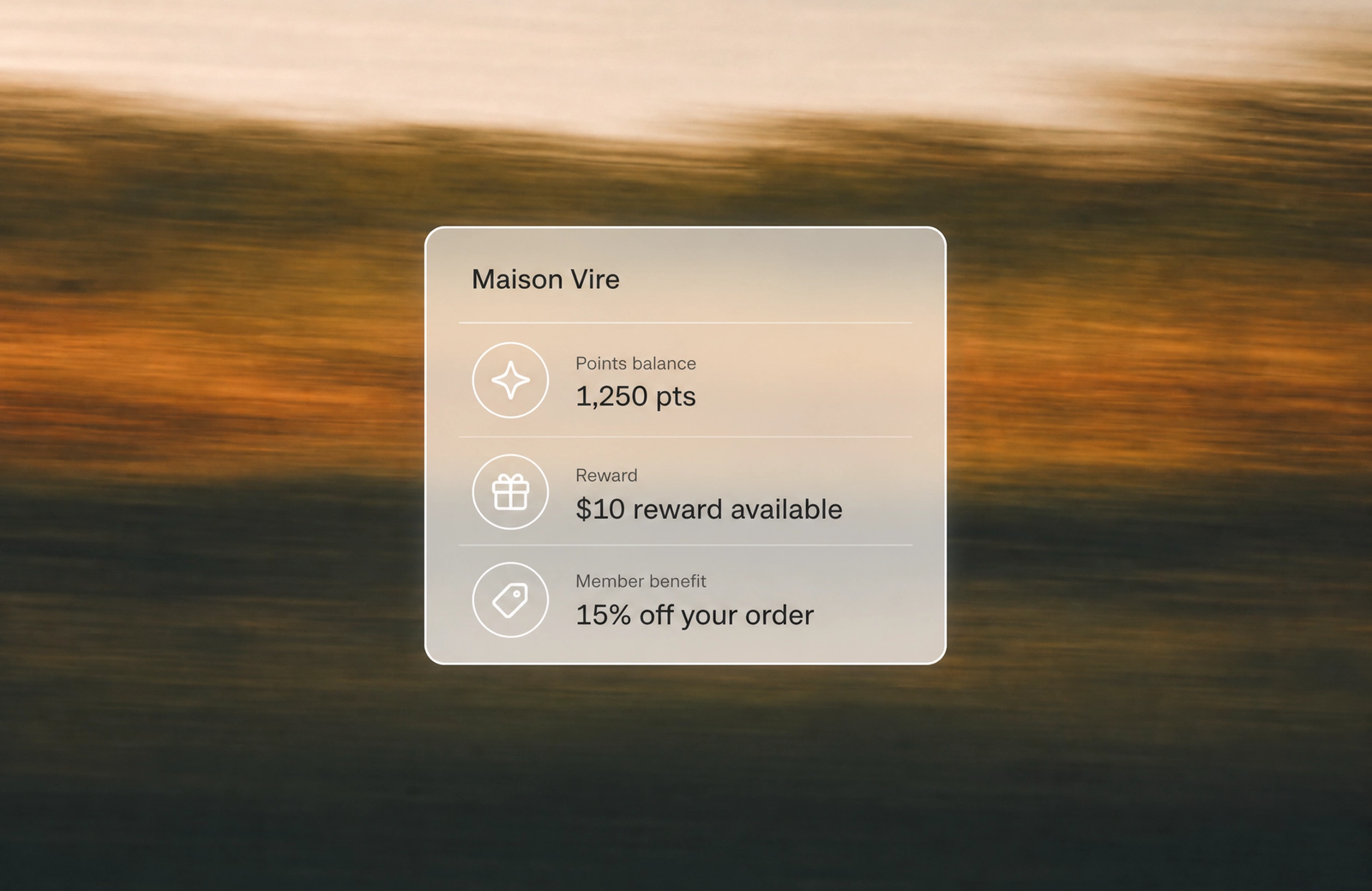
Most Shopify brands operating physical stores, pop-ups, or wholesale channels still run fragmented loyalty systems where online customers and in-store shoppers exist in completely separate databases. This invisible problem costs them tens of thousands in lost repeat purchases annually because a customer who earned points online can't use them in-store, or vice versa.
The real opportunity isn't choosing between features or price tiers—it's selecting a platform with a unified customer ledger that treats every sales channel as part of one coherent loyalty experience. When a customer buys online, earns points at a pop-up, and redeems them in-store all within their single profile, something shifts. They feel recognized. They come back.
Most loyalty apps claim omnichannel support. Few actually deliver it at the technical level. The difference between a platform that syncs POS data hourly versus one that updates in real-time—with a true unified ledger—determines whether your customers experience a seamless journey or encounter frustrating gaps between channels.
This guide ranks the best Shopify loyalty apps specifically designed for omnichannel operations. We've evaluated each platform on its ability to maintain a single source of truth across your Shopify online store, Shopify POS systems, pop-up shops, and wholesale accounts. The criteria include real-time synchronization depth, integration capabilities with essential marketing tools, scalability, and support quality for complex multi-channel setups.
Here's what we found: one platform stands significantly ahead because it was built from the ground up with unified ledger architecture rather than bolted on afterward. The others each bring genuine strengths in specific scenarios—and we'll be honest about where they outperform the leader.
Why a Unified Omnichannel Loyalty Program is Essential for Modern Retailers
A unified omnichannel loyalty program directly increases customer lifetime value by ensuring customers feel recognized and rewarded regardless of where they interact with your brand. When loyalty data is fragmented, a customer might earn 50 points online but have zero visibility into that balance when they visit your physical store. They'll assume the program doesn't work. They won't come back.
The financial case is stark: acquiring a new customer costs 5 to 7 times more than retaining an existing one. Research consistently shows that a 5% increase in customer retention can boost profits by 25% to 95%, depending on your industry. Meanwhile, 95% of consumers say they're more likely to be loyal to brands that offer incentives, and 69% of consumers choose retailers specifically based on where they can earn loyalty rewards.
The concept of a "unified ledger" is what separates platforms that merely integrate with POS from those that genuinely unify your customer experience. A unified ledger means one authoritative source of truth for every customer's points, rewards status, and engagement history. When Sarah makes a purchase on your Shopify store at 2 PM on Monday, her points update instantly. When she walks into your retail location at 10 AM Tuesday, her account reflects that purchase. When she attends your weekend pop-up event and earns referral rewards, both channels show the same running total. No manual syncing. No day-old data. No confusion.
Without this unification, retailers face what we call the "data silo problem." Customer engagement data fragments across systems. Your email marketing tool sees one purchase history while your POS sees another. Analytics reports contradict each other. Worse, customers detect the inconsistency. They remember points earned but can't redeem them. They feel forgotten. Common loyalty program mistakes like these quietly kill engagement before most brands even realize what went wrong.
A truly unified omnichannel loyalty program creates improved customer retention rates that compound. Returning customers cost less to serve, generate higher order values, and refer more friends. They become your growth engine—and they only feel genuinely valued when the system recognizes them consistently.
Key Features to Look for in a Shopify Omnichannel Loyalty App
Real-time POS Synchronization
The foundation of true omnichannel loyalty is instant data flow between your Shopify online store and physical point-of-sale systems. Real-time synchronization means when a customer earns points at checkout—whether that's online, in a Shopify POS terminal, or through a third-party system—every system knows about it within seconds. No batched updates at midnight. No reconciliation headaches. No customers discovering that their earned points mysteriously vanished.
Look for platforms that update the unified ledger immediately upon transaction completion. This matters most if you operate high-volume retail locations or frequent pop-ups where multiple team members might be processing sales simultaneously.
Unified Customer Profiles
A unified customer profiles approach means every interaction—whether online, in-store, wholesale, or social—feeds into a single customer record. One profile. One points balance. One view of purchase history. One engagement timeline.
This prevents the nightmare scenario where the same customer appears as three different profiles in your system because they used different email addresses or payment methods across channels. When your email marketing sees only their online purchases while your POS knows about their in-store behavior, you're missing crucial signals about what truly drives their loyalty.
Multi-Channel Earning and Redemption
Effective omnichannel programs let customers earn points from diverse actions—online purchases, in-store transactions, social sharing, referrals, reviews—and redeem those points anywhere. A customer shouldn't have to wonder whether they can use their points for free shipping, a discount code, or in-store credit. The best platforms treat points as universal currency across all channels.
Seamless Third-Party Integrations
Your loyalty program doesn't exist in isolation. It needs to connect with your email marketing platform (Klaviyo, Omnisend), SMS tools (Postscript), review platforms (Judge.me), and customer service systems. These integrations should pass data bidirectionally—so when a customer earns points, your email tool knows to include a reminder; when they're close to a tier upgrade, your SMS platform can send a targeted nudge.
Customization and Branding
Your loyalty program should feel like part of your brand, not a generic third-party add-on. Look for flexibility in customizing how your loyalty pages look, what actions earn points, how tiers are named, and what rewards you offer. The program should reflect your voice.
Robust Reporting and Analytics
You need visibility into what's actually driving loyalty. Which earning actions generate the most engagement? Which rewards get redeemed most? How does customer lifetime value compare between loyalty members and non-members? Between channels? Real analytics—not vanity metrics—let you optimize continuously.
Scalability and Support
As you grow, your loyalty system needs to handle increased transaction volume, more complex rules, and new sales channels. And when things break or you need help with a complex setup, responsive support makes all the difference. White-glove migration services are a significant advantage, especially when moving from a fragmented system.
Comparison Table: Top Shopify Loyalty Apps for Omnichannel POS
| App Name | Pricing Model | Primary Strength | Best For |
|---|---|---|---|
| Mage Loyalty | Flat monthly platform fee (no per-merchant fees) | True unified ledger across all channels (online, POS, wholesale, pop-ups) | Shopify Plus & growing omnichannel brands seeking platform pricing and deep integration |
| Smile.io | Tiered plans based on features/usage | Ease of setup and broad feature set for basic loyalty programs | Small to medium businesses needing a quick-start loyalty solution |
| LoyaltyLion | Tiered plans based on revenue/usage | Advanced segmentation and personalization capabilities | Mid-market to enterprise brands focused on sophisticated customer engagement |
| Yotpo Loyalty & Referrals | Tiered plans, integrated with other Yotpo products | Comprehensive suite including reviews, loyalty, and referrals | Brands wanting an all-in-one UGC and loyalty solution |
| Growave | Tiered plans based on features/usage | Multi-purpose app for reviews, wishlists, social login, and loyalty | Shopify stores looking for a bundled marketing solution |
The Shopify loyalty program growing brands trust
See how Mage helps Shopify brands lift repeat purchase rate with loyalty, referrals and store credit.
Book a demoThe Best Shopify Loyalty Apps for Omnichannel POS + Online
#1: Mage Loyalty
Mage Loyalty stands out because it was architected specifically around the unified ledger concept—not as an afterthought. Every component of the platform assumes that a customer might interact across Shopify's online store, Shopify POS (including mobile terminals), pop-up shops, wholesale accounts, and other channels. The system treats all of these as contributing to a single customer record with a single points balance.
What makes this tangible: when you configure earning rules in Mage, you're setting rules for all channels simultaneously. A customer earns 1 point per dollar spent whether that dollar comes from a web transaction or a POS tap. Your Shopify loyalty program and your in-store program aren't separate entities requiring manual reconciliation—they're facets of the same system.
The platform's core features speak directly to omnichannel complexity. Its points engine handles flexible point structures, bonus multipliers for specific products, and expiry rules. VIP tier systems let you reward top customers with exclusive benefits that apply everywhere—not just online. The Shopify referral program functionality means word-of-mouth rewards work consistently whether your customers refer via email, social, or in conversation at your physical location.
Integration depth matters for omnichannel operations. Mage connects deeply with Klaviyo, Omnisend, Postscript, and Judge.me—meaning your loyalty data automatically feeds into your marketing. A customer's tier status, points balance, and recent earn/redeem activity become context for targeted campaigns. You're not maintaining separate customer views; the systems speak the same language.
For Shopify Plus loyalty program merchants specifically, Mage offers flat platform pricing rather than per-merchant fees—a significant economic advantage as you scale. You also get white-glove migration support and 99.9% uptime guarantees. This matters because a loyalty system outage in the middle of holiday shopping affects both your online store and every physical location simultaneously. Reliability becomes non-negotiable.
The real-time dashboard gives you live visibility into what's happening. You see loyalty signups happening, points being earned, rewards being redeemed, and customers advancing through tiers—all updating as it happens across all channels.
Best for: Shopify Plus brands and rapidly scaling omnichannel retailers operating across Shopify online stores, physical retail locations, pop-ups, or wholesale. This platform is strongest for brands where channel-specific loyalty rules or customer silos have become a retention problem—and where predictable, flat platform pricing matters more than per-merchant usage models.
Ready to see Mage in action? Book a demo at https://www.mageloyalty.com/get-a-demo.
“Cannot say enough good things about the team at Mage Loyalty, one of the absolute best organizations we have ever worked with, full stop! So glad we connected with them, completely redid our loyalty program, new concepts, use of loyalty, increasing user engagement, showing us where we were not valuing our best customers, just WOW, amazing team!”


Read the West Coast Goalkeeping case study →
#2: Smile.io
Smile.io has earned its reputation through user experience. Setting up a basic loyalty program takes hours, not weeks. The interface feels intuitive even for non-technical merchants, and it offers a genuinely broad feature set—points, referrals, VIP programs, and customizable rewards—without overwhelming complexity.
Primary Strength: Smile.io excels at fast implementation. A small brand can launch a functional loyalty program in an afternoon, start collecting points that same day, and iterate based on early results. The platform makes rapid experimentation possible.
Best for: Small to medium Shopify stores that don't yet have complex omnichannel operations but want to build toward them. If your primary business is online with perhaps one physical location, Smile.io gives you proven loyalty mechanics without overengineering.
Key Features: Points-based rewards, referral programs, VIP tiers, customizable earning rules, basic POS integration, email integration, customer segments.
Differences from Mage: Smile.io's strength is simplicity. Its POS integration works, but it doesn't prioritize real-time unification across complex multi-channel scenarios the way Mage does. If you operate multiple locations with sophisticated omnichannel requirements, you'll likely hit the limits of Smile.io's unified ledger architecture sooner than with Mage.
#3: LoyaltyLion
LoyaltyLion competes primarily on segmentation and personalization depth. If you want to identify a specific cohort of customers—say, repeat buyers in your summer product category who made purchases in the last 60 days and abandoned cart at least once—and deliver a tailored loyalty reward to that group, LoyaltyLion's analytics and targeting tools shine.
Primary Strength: Advanced customer segmentation. LoyaltyLion treats your customer base as a rich dataset to be analyzed and sliced in countless ways, with loyalty rewards becoming the mechanism for acting on those insights.
Best for: Mid-market to enterprise Shopify brands that view their loyalty program primarily as a marketing engine where personalization and behavioral targeting drive engagement. If your core goal is maximizing lifetime value through precision campaigns, this platform's segmentation capabilities deliver significant value.
Key Features: Loyalty points, VIP tiers, referral programs, advanced analytics, behavioral segmentation, integration with major marketing platforms, customizable loyalty pages.
Differences from Mage: LoyaltyLion's architecture emphasizes campaign management and personalization. Mage's architecture emphasizes unified omnichannel data consistency. LoyaltyLion is stronger if your primary sales channel is online and you want sophisticated audience targeting. Mage is stronger if you operate across multiple physical and digital channels and need to ensure every channel sees the same customer reality.
#4: Yotpo Loyalty & Referrals
Yotpo Loyalty & Referrals functions as part of a larger ecosystem including reviews, SMS, and user-generated content tools. The real advantage emerges if you're already using Yotpo for review collection—suddenly your loyalty program can automatically reward customers for leaving reviews, creating a virtuous cycle of content generation and engagement.
Primary Strength: Comprehensive UGC ecosystem. Yotpo uniquely ties together review collection, loyalty rewards, and referral mechanics. You can reward customers for reviews, referrals become more powerful when they include social proof, and the entire system feeds into customer confidence.
Best for: Shopify brands already committed to Yotpo or those for whom review generation and user-generated content strategy is central to customer acquisition. If your marketing playbook emphasizes authentic social proof, Yotpo's integrated approach is genuinely useful.
Key Features: Loyalty points, VIP programs, referral programs, review requests, visual UGC collection, SMS marketing integration, deep cross-product integration.
Differences from Mage: Yotpo offers a stronger all-in-one solution for brands prioritizing UGC as a marketing channel. Mage offers stronger omnichannel unification for brands operating across complex retail environments. The choice depends on whether your growth bottleneck is social proof or channel consistency.
#5: Growave
Growave bundles five or six marketing functions—reviews, wishlists, social login, loyalty, and more—into a single dashboard. The appeal is consolidation: fewer apps to manage, fewer integrations to configure, one vendor relationship instead of five.
Primary Strength: Bundled functionality. Growave is genuinely useful if you want basic loyalty alongside review collection, wishlists, and social login without juggling multiple vendors.
Best for: Small to medium Shopify stores seeking an affordable all-in-one marketing suite. If your team prefers fewer vendor relationships and you don't have complex omnichannel requirements yet, Growave's bundle pricing offers good value.
Key Features: Loyalty and rewards, referral programs, customer reviews, wishlists, social login, Instagram galleries, email marketing basics.
Differences from Mage: Growave's advantage is breadth and affordability. Mage's advantage is depth in omnichannel loyalty specifically. Growave works best for single-channel or simple multi-channel operations. Mage works best when omnichannel complexity is your core challenge.
#6: Marsello
Marsello integrates loyalty with email and SMS marketing automation. The insight behind the platform is straightforward: loyalty data becomes most valuable when it's immediately actionable in your marketing. A customer earns points, and Marsello automatically sends a relevant email or SMS based on their new status.
Primary Strength: Marketing automation tied to loyalty events. Marsello treats loyalty as a customer engagement signal, not just a rewards ledger. Points earned trigger campaigns. Tier changes trigger messages.
Best for: Shopify stores focused on email and SMS as primary customer communication channels. If you want loyalty to drive your marketing automation rather than vice versa, Marsello's architecture makes sense.
Key Features: Loyalty programs, email marketing automation, SMS marketing, customer segmentation, POS integration, customer insights.
Differences from Mage: Marsello is marketing automation-first with loyalty supporting that goal. Mage is omnichannel-first with integrations supporting that goal. Choose Marsello if email/SMS automation is your core need; choose Mage if omnichannel unification is yours.
#7: Stamped.io Loyalty
Stamped.io Loyalty (formerly Stamped.io Rewards) extends the Stamped.io review platform with a loyalty engine that strongly integrates with review generation. Customers earn points for leaving reviews and engaging with social proof, creating a natural incentive loop.
Primary Strength: Loyalty incentives for review generation. Stamped.io Loyalty is strongest when your strategy centers on collecting customer reviews and turning that user-generated content into conversion tools.
Best for: Shopify brands already using Stamped.io for reviews or those where review generation strategy is a growth priority. If customer testimonials and visual proof drive your conversion funnel, Stamped.io's loyalty rewards for reviews make sense.
Key Features: Loyalty points, VIP tiers, referral programs, review reward mechanics, integration with Stamped.io reviews, customizable earning rules.
Differences from Mage: Stamped.io Loyalty's focus is incentivizing review creation across channels. Mage's focus is unifying customer loyalty data across channels. These solve different problems. Stamped.io is better if reviews are your bottleneck. Mage is better if omnichannel data consistency is yours.
How to Choose the Right Omnichannel Loyalty App for Your Shopify Brand
Start by auditing your current sales channels. Do you operate primarily online, or are physical locations, pop-ups, and wholesale significant parts of your revenue? The more channels you operate, the more critical a unified ledger becomes. If 80% of your revenue is online with one small physical location, Smile.io or Growave might be sufficient. If you operate five retail locations, three pop-ups, a wholesale program, and e-commerce, you need something engineered for that complexity.
Next, list your non-negotiable integrations. Which tools are essential to your marketing? If Klaviyo is your email engine and Postscript handles SMS, you need deep integration with both. Check each platform's integration roadmap. Some integrations are native; others are API-only and require developer work.
Consider pricing structure. Some platforms charge per merchant or per location—meaning growth adds cost. Others use flat platform pricing. If you're operating or planning to operate multiple sales channels, flat pricing becomes more attractive as you scale.
Evaluate support quality honestly. How responsive is customer service? Do they offer implementation support or just reactive troubleshooting? For complex omnichannel migrations, this matters enormously.
Finally, assess scalability. Can the platform handle 10x your current transaction volume without performance degradation? What about future customization—will the platform accommodate your evolving business needs?
If your priorities are a truly unified customer ledger, real-time POS synchronization across all sales channels, deep integration with essential marketing tools, and predictable flat platform pricing for scaling operations, Mage Loyalty is the strongest fit. If you prioritize ease of setup and simplicity, Smile.io wins. If you prioritize advanced marketing segmentation, LoyaltyLion. If you're committed to Yotpo's ecosystem, their loyalty solution integrates naturally. Choose based on where your growth bottleneck actually lies, not on feature count alone.
Frequently Asked Questions
What does "omnichannel loyalty" truly mean for a Shopify brand?
Omnichannel loyalty means customers earn and redeem points consistently across all your sales channels through a single unified profile. A customer purchases online, earns points, walks into your physical store, checks their balance on a loyalty kiosk, and redeems points there. They attend a pop-up event, refer a friend, and both actions add to their tier progress—all reflected immediately everywhere. One customer. One profile. One experience.
Can any Shopify loyalty app integrate with my POS system?
Most Shopify loyalty apps claim POS integration, but depth varies dramatically. Basic integration might sync data once daily through batched imports. True omnichannel integration updates the unified ledger in real-time as each transaction completes. The difference is the gap between a system that works and one that feels seamless to customers. Verify whether updates happen in seconds or hours.
How important is a "unified ledger" for omnichannel loyalty?
Unified ledgers prevent the data silos that destroy customer trust. Without one, a customer's points balance in your email system might differ from what they see in-store. They'll lose faith in the program entirely. A unified ledger ensures a single source of truth—critical for customer experience consistency and accurate marketing analytics across all channels.
What are the biggest challenges in implementing an omnichannel loyalty program?
The primary challenges are data consolidation (ensuring all systems feed into a single customer profile), maintaining consistency across touchpoints (same earning rules everywhere), and ensuring technical integrations don't create bottlenecks. Teams often underestimate how many edge cases emerge across multiple channels—different POS systems, varying inventory systems, complicated wholesale dynamics. Choose a platform built to handle complexity rather than one where you'll need custom development.
TLDR
For Shopify brands operating across multiple sales channels, a truly unified omnichannel loyalty app is no longer optional—it's essential for customer retention and sustainable growth. While many platforms offer loyalty features, few provide the real-time, unified-ledger architecture needed for seamless experiences across online, POS, pop-ups, and wholesale. Mage Loyalty stands out as the strongest choice for omnichannel brands because it was built specifically around unified customer data and real-time synchronization, with flat platform pricing and 99.9% uptime. For brands prioritizing ease of setup, Smile.io delivers; for those focused on marketing automation, Marsello; for those already in Yotpo's ecosystem, their loyalty solution integrates naturally. Choose based on where your growth bottleneck actually lies.

Kris is the co-founder of Mage Loyalty. I spend most days talking to merchants, and making sure our customers get real results. If you run a Shopify store or Agency we should chat!