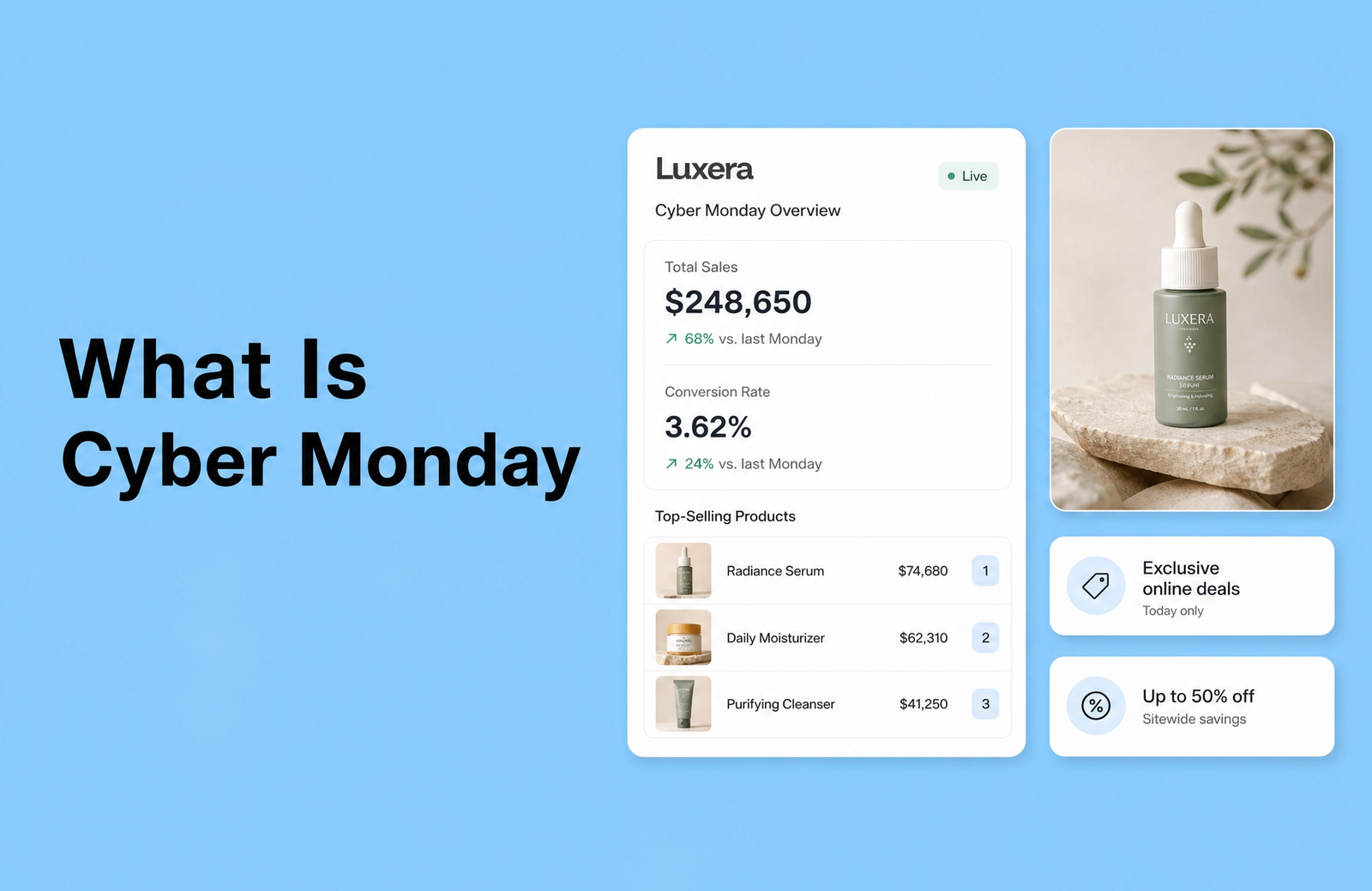
What is Cyber Monday? Cyber Monday is the annual online shopping event held on the Monday after US Thanksgiving, when ecommerce retailers offer their deepest digital discounts of the year. The National Retail Federation's Shop.org division coined the term in a November 2005 press release, naming a buying spike analysts had already tracked for years.
Here is the part most explainers skip. The original reason Cyber Monday existed has completely vanished, and the day got bigger anyway.
Back in 2005, the logic was almost quaint. Home broadband was slow and expensive, so shoppers who browsed deals over Thanksgiving weekend waited until Monday to actually buy, using their fast office internet connections. The event was named after a behavior tied to a technology limitation. That limitation is gone. Nearly everyone now carries a faster connection in their pocket than a 2005 office had. And yet Cyber Monday 2025 became the single largest ecommerce day in US history.
That survival story is the real lesson here, and it matters more than the date on the calendar.
What Cyber Monday Means and Why It Exists
Cyber Monday is the Monday following the fourth Thursday of November in the United States. It functions as the digital counterpart to Black Friday, concentrating online promotions into one heavily marketed window. Retailers use it to clear inventory, acquire new customers, and anchor their entire holiday quarter.
The naming itself was a marketing decision, not a description of an existing holiday. On November 28, 2005, Shop.org (the NRF's ecommerce arm) published a release titled "Cyber Monday Quickly Becoming One of the Biggest Online Shopping Days of the Year." Ellen Davis, then a senior VP at the NRF, is credited with the coinage. Researchers had noticed that the Monday after Thanksgiving consistently ranked among the top online revenue days, and the trade group simply gave the pattern a memorable name.
Here is the myth worth busting early. People assume retailers invented Cyber Monday to manufacture demand. The truth is the reverse. Demand already existed, and the name came after the behavior, as a way to package something shoppers were doing on their own.
Think of it like the way a worn path across a lawn becomes an official paved walkway. The route existed first. The pavement just made it permanent and gave everyone a reason to use it. In one line: Cyber Monday is the online shopping event on the Monday after US Thanksgiving, named by the NRF in 2005, and now the biggest single ecommerce day of the year.
When Is Cyber Monday 2026?
Cyber Monday 2026 falls on Monday, November 30, 2026. The date moves every year because it is always the Monday after US Thanksgiving, which lands on the fourth Thursday of November (November 26 in 2026). Black Friday 2026 will be November 27, putting the two events at opposite ends of the same long weekend.
For planning purposes, though, treating Cyber Monday as a single day is increasingly a mistake. The discounting window has stretched into a five-to-seven day stretch the industry now calls Cyber Week. In 2025, US consumers spent roughly $44.2 billion online between November 27 and December 2. Cyber Monday is the anchor of that week, not an isolated 24-hour event, and merchants who plan only for the Monday tend to miss most of the revenue.
If you run a store, the practical takeaway is to think in terms of a campaign arc, not a flash sale. Strong Shopify customer retention depends on what you do before and after the peak, not just the discount you post on the day itself.
The Shopify loyalty program growing brands trust
See how Mage helps Shopify brands lift repeat purchase rate with loyalty, referrals and store credit.
Book a demoCyber Monday vs Black Friday: How They Differ
Black Friday and Cyber Monday started as separate events with separate logic. Black Friday was the in-store doorbuster day, the Friday after Thanksgiving, built around physical crowds and limited-quantity deals. Cyber Monday was the online-only follow-up for people back at their desks. The boundary made sense when shopping channels were genuinely distinct.
That line has blurred almost beyond recognition. Black Friday now drives enormous online volume of its own, and many retailers run continuous promotions across the whole stretch. Here is a plain comparison of how the two days behaved in 2025.
| Factor | Black Friday | Cyber Monday |
|---|---|---|
| Origin | In-store doorbuster day | Online-only shopping day |
| Timing | Friday after Thanksgiving | Monday after Thanksgiving |
| 2025 US online sales | 11.8 billion dollars | 14.25 billion dollars |
| 2025 year-over-year growth | up 9.1 percent | up 7.1 percent |
| Typical strength | Big-ticket and in-store deals | Deepest digital-only discounts |
This table feeds a popular contrarian claim, so let's address it head on. Some analysts argue Cyber Monday is dying, pointing to Black Friday's faster online growth rate (9.1 percent versus 7.1 percent) as proof the older event is catching up. We think that reading misses the scoreboard. Cyber Monday 2025 still generated $14.25 billion against Black Friday's $11.8 billion, a $2.45 billion gap in a single day, and it remains the largest single ecommerce day in US history. A slightly faster-growing challenger is not the same as a fading champion.
The more interesting truth is that Cyber Monday outlived its own founding rationale. The office-broadband driver disappeared, yet consumer conditioning, retailer ad spend, and the expectation of deep online discounts kept the day growing, now turbocharged by AI deal-finding tools.
“Mage Loyalty is hands-down the best loyalty platform on Shopify, and the team behind it is just as exceptional as the product. When we needed customizations specific to our business, the Mage team worked directly with us to make it happen. And the wishlist feature deserves its own callout: it's the best we've come across, period. Beautifully integrated, intuitive for customers, and a real driver for our store.”

Read the MiaDonna case study →
Cyber Monday by the Numbers
The scale is easier to understand through specific figures than adjectives. Here are the records that defined the most recent event, all from Adobe Analytics.
- Cyber Monday 2025 hit a record $14.25 billion in US online sales, up 7.1 percent year over year.
- During peak hours (8 pm to 10 pm ET), shoppers spent roughly $16 million per minute.
- Mobile accounted for 57.5 percent of sales ($8.2 billion), up 8.0 percent, a full reversal of the desktop-first origins.
- Buy Now Pay Later drove $1.03 billion in spend (up 4.2 percent), the first time BNPL crossed $1 billion in a single ecommerce day.
- Electronics led all categories at $3.7 billion (up 12.8 percent), with Bluetooth headphones and speakers spiking 1,850 percent above their October baseline.
- AI chatbot referral traffic jumped 670 percent versus the prior period, as shoppers used generative tools to hunt for deals.
The historical arc is just as striking. The inaugural Cyber Monday in 2005 generated about $484 million. By 2006 that reached $608 million (a 26 percent rise), and the day crossed $1 billion for the first time in 2010. Going from under half a billion to over fourteen billion in two decades is not a holiday in decline.
These numbers also tell you where to spend your prep time. With 57.5 percent of sales on mobile and AI referral traffic up 670 percent, we would audit your mobile checkout speed first and make sure product pages answer the questions an AI shopping assistant would ask before sending a buyer to your store.
What Cyber Monday Means for Shopify Merchants
If you sell on Shopify, Cyber Monday is less a marketing holiday and more your single biggest operational test of the year. The platform's own data shows the stakes. Shopify merchants collectively generated $11.5 billion in sales over the full Black Friday Cyber Monday 2024 weekend, a 24 percent year-over-year increase, with more than 76 million consumers buying from Shopify-powered brands.
A real example shows how big retailers treat the day as a relationship tool, not just a discount dump. Target has repeatedly used Cyber Monday to deepen its Target Circle loyalty program, offering members an extra 15 percent off select home items on the day itself. The discount is the hook. The loyalty sign-up is the actual prize, because a member acquired during Cyber Week can be marketed to for the rest of the year. That reframe (acquisition event first, sale second) is the one most small merchants miss.
The hardest part of Cyber Monday is not the day. It is the morning after. The shoppers you acquire with a steep one-time discount have, by definition, proven they will buy on price. Many never return at full margin. We have watched stores celebrate a record Monday and then quietly bleed those customers through December and January. The fix is to plan the follow-up before the sale, not after.
A few tactics consistently separate the merchants who keep their Cyber Monday customers from the ones who rent them:
- Capture the relationship, not just the order. A Shopify loyalty program turns a one-time discount buyer into an account holder you can re-engage.
- Trigger a strong onboarding flow. A thoughtful welcome series that converts gives new shoppers a reason to come back at full price.
- Plan the discount window across Cyber Week using proven Black Friday loyalty strategies rather than a single flat sale.
- Tighten checkout to protect the traffic you paid for, using practical cart abandonment tactics on mobile.
On the tooling side, retention and loyalty mechanics like points, VIP tiers, and referrals are typically handled by Shopify apps.
The deeper goal is converting a seasonal spike into durable revenue. That work continues long after the weekend, which is why having a plan to convert first-time buyers into repeat customers matters more than the headline discount. The merchants who win Cyber Monday are usually the ones already thinking about February.
If you want a head start, you can book a Mage demo to see how a loyalty layer fits into a Cyber Week plan.
Frequently Asked Questions
When is Cyber Monday 2026?
Cyber Monday 2026 is Monday, November 30, 2026. The date shifts each year because it always falls on the Monday after US Thanksgiving, which is the fourth Thursday of November. In 2026, Thanksgiving is November 26 and Black Friday is November 27.
What is the difference between Black Friday and Cyber Monday?
The difference between Black Friday and Cyber Monday is their origin and timing. Black Friday began as the in-store doorbuster day after Thanksgiving, while Cyber Monday started as the online-only event the following Monday. Today both drive heavy online sales, though Cyber Monday still posts the deepest digital-only discounts.
Why is it called Cyber Monday?
It is called Cyber Monday because the NRF's Shop.org division coined the term in a November 2005 press release. Analysts had noticed online sales spiked on the Monday after Thanksgiving, when workers returned to fast office internet connections after the long weekend, so the trade group gave that pattern a name.
How long does Cyber Monday last?
Cyber Monday is technically a single day, but in practice it now lasts up to a week. The discounting window has expanded into a five-to-seven day stretch the industry calls Cyber Week. In 2025, US shoppers spent about $44.2 billion online between November 27 and December 2.
What sells best on Cyber Monday?
Electronics sell best on Cyber Monday, leading all categories at $3.7 billion in 2025 (up 12.8 percent year over year). Within electronics, Bluetooth headphones and speakers spiked 1,850 percent above their October baseline, with discounts on the category averaging around 31 percent off.
Is Cyber Monday better than Black Friday for online deals?
Cyber Monday is generally better than Black Friday for online-only deals. In 2025 it generated $14.25 billion versus Black Friday's $11.8 billion, remaining the largest single ecommerce day in US history. Black Friday often wins on big-ticket and in-store items, so the best day depends on what you are buying.
TLDR
Cyber Monday is the online shopping event on the Monday after US Thanksgiving (November 30 in 2026), coined by the NRF's Shop.org division in 2005 to name a buying spike driven by workers returning to fast office internet. The original reason vanished, yet the day became the largest single ecommerce day in US history, hitting a record $14.25 billion in 2025 with 57.5 percent of sales on mobile, a $1 billion-plus BNPL milestone, and a 670 percent jump in AI referral traffic. It now anchors a broader Cyber Week, and for Shopify merchants the real opportunity is treating it as a customer-acquisition and retention event, capturing the relationship through loyalty and onboarding so a one-time discount buyer becomes a repeat customer well into the new year.

Graeme is the co-founder at Mage Loyalty. He heads product development, from complex loyalty migrations and large-scale data handling to building the features shaping the future of loyalty on Shopify.