The GoTo’s Circle program makes Patron status depend on both spend and purchase frequency. Loyalty tier reset rules determine how long customer activity counts toward VIP status and what customers keep when their buying pattern changes.
Short answer: For most Shopify loyalty programs, a rolling 12-month window is the stronger default because it rewards recent behavior without one harsh annual reset. Use a calendar-year model when customers already understand annual qualification and your business benefits from a shared January 1 cycle. Then soften demotions with temporary protection, a clear review date, or a scoped grandfathering policy.
Start with the rule you are actually designing
Qualification window, reset date, and demotion rule are different
A VIP program has several rules that are easy to blur together.
The qualification window defines which activity counts toward a tier. A rolling model looks back over a trailing period. A calendar-year model counts activity in a shared annual cycle. A lifetime model counts activity from the program start date onward.
The reset rule determines when progress is reconsidered. In a calendar-year program, progress resets on January 1. In a rolling model, older purchases gradually leave the window instead.
Demotion protection is separate. It determines whether a customer keeps their status after activity falls below the threshold. A grace period is the customer-facing version: extra time before a downgrade takes effect, with a clear route to recover.
This matters because a January reset is not automatically unfair. A January reset without protection, explanation, or a realistic requalification path often is.
For the underlying mechanics of qualification, rewards, and progression, see Shopify VIP tiers.
The four decisions every VIP program needs
Set these four decisions before writing thresholds:
- What counts: spend, points earned, or order count.
- How long it counts: lifetime, calendar year, or rolling year.
- What happens at review: retain, upgrade, or downgrade.
- How status changes are communicated: progress visibility, advance warning, and recovery instructions.
Choose the model that matches how customers buy and gives them a predictable route to retain status.
Loyalty tier reset rules: choose rolling year or calendar year
| Model | What counts | What customers experience | Main risk | Best fit |
|---|---|---|---|---|
| Rolling Year | Activity in the trailing 12 months | Progress changes gradually as older activity drops out | Customers may not notice older activity leaving the window | Most ongoing loyalty programs |
| Calendar Year | Activity from January 1 to December 31 | One shared annual qualification cycle | A concentrated wave of demotions | Brands with a clear annual rhythm |
| Lifetime | All activity since program start | Status accumulates permanently | Top tiers can lose urgency over time | Long-term recognition programs |
Rolling year: continuous qualification based on recent activity
A rolling year counts activity in a trailing 12-month window. As an older order passes the boundary, it no longer counts toward qualification.
Mage uses a customer-specific rolling window by default. A customer who joins in June receives a full qualification period from June, rather than competing against customers who entered earlier. Merchants can instead use a shared rolling window anchored to the program start date.
Rolling qualification is usually the better default for replenishment products, food and beverage, and brands where repeat behavior matters throughout the year. It also avoids a single day where a large group loses status together.
Calendar year: one shared annual cycle
A calendar-year model resets all progress on January 1, then recalculates customers against the new year’s activity.
The rule is easy to state: qualify this year, enjoy status under the program’s retention rules, then work toward the next cycle. It can suit annual planning, member benefits, and seasonal campaigns.
Use it when customers already think in annual terms. A high-AOV brand may care more about major purchases and protected access than frequent monthly progression. That can suit a jewelry loyalty program, where customers may buy only once or twice a year.
The trade-off is timing. A customer who joins late in the year has less time to qualify, and an unprotected reset can feel abrupt.
When lifetime qualification still makes sense
Lifetime qualification counts every eligible purchase, order, or point earned since the program start date.
Use it when long-term recognition matters more than maintaining a current spending cadence. The cost is reduced urgency: once customers reach the top, the program may have less power to influence the next purchase.
“Cannot say enough good things about the team at Mage Loyalty, one of the absolute best organizations we have ever worked with, full stop! So glad we connected with them, completely redid our loyalty program, new concepts, use of loyalty, increasing user engagement, showing us where we were not valuing our best customers, just WOW, amazing team!”


Read the West Coast Goalkeeping case study →
Set the tier qualification period before you set thresholds
Choose spend, points, or order count
Thresholds only make sense in the context of the qualification window. A $500 threshold may be reachable in a rolling year for one store and unrealistic for another with low purchase frequency.
Mage supports amount spent, points earned, and number of orders as VIP entry methods. Spend is the clearest default for many stores because customers understand it and it maps directly to revenue.
Order count can suit replenishment categories, food and beverage, and subscription-style purchasing. Points earned can reflect purchases plus engagement actions such as reviews, referrals, birthdays, and social follows. Explain clearly if you use it: tier qualification is based on points earned, not the customer’s current redeemable balance.
Use compound criteria carefully
Mage can combine a primary and secondary entry method with AND or OR logic.
Use AND when both value and frequency matter. For example, a top tier may require meaningful annual spend and a minimum number of orders, preventing one unusually large purchase from creating permanent VIP treatment.
Use OR sparingly. More ways to qualify can make the tier ladder harder to explain.
Model the customer journey before launch
Test the rules against a high-AOV customer who buys once, a frequent customer with smaller baskets, and a seasonal customer who buys around one major event.
Ask whether each customer can reasonably reach the next tier within the selected window. A threshold that looks motivating in a spreadsheet can be unreachable once you account for actual purchase timing.
Grandfather VIP customers when you launch or change the rules
Grandfathering at launch
Grandfathering means preserving status for a defined group or time period while a new structure takes effect. It is an operational transition policy, distinct from ongoing tier-status protection.
A practical launch policy might preserve current status until the next review date, protect only the highest tier, or recognize customers whose historical activity falls inside the new qualification window. State the policy plainly in your loyalty program terms that protect you.
Mage lets merchants configure and recalculate VIP tiers while the program remains disabled. That allows you to inspect where existing customers will land before anyone sees the new program.
Switching from calendar year to rolling year
Switching models changes the meaning of qualification. A customer who qualified under a January-to-December system may look different in a trailing window, especially if their largest order happened early in the prior year.
Define which existing statuses are protected, when that protection ends, and what activity customers need to retain status afterward.
If you also change the entry method, disable VIP tiers while you adjust thresholds and configuration. Re-enable only after reviewing the resulting tier assignments.
Backdating the program start date
Mage can backdate the program start date by up to one year. It then backfills historical Shopify orders for spend and order-count qualification before recalculating customers.
Existing customers can receive recognition based on eligible historical purchase activity instead of beginning at the base tier on launch day.
Points are not awarded retroactively during this historical order backfill. Check entry rewards carefully, because customers who newly qualify during recalculation can receive a tier entry reward.
Design loyalty tier grace periods before customers face demotion
| Protection approach | How long status lasts | Best use | Trade-off |
|---|---|---|---|
| No protection | Until the next recalculation finds lower qualification | Programs that want strict current activity rules | Demotions can feel sudden |
| Protect tier status | Through the following calendar year or at least 12 months in rolling qualification | Programs that want earned status to feel secure | More members retain higher-tier benefits |
| Never downgrade the highest tier | Permanently, unless qualifying activity is refunded | Selective recognition for top customers | Top-tier population can grow over time |
| Operational grandfathering policy | Until a stated review date or transition milestone | Launches and major rule changes | Requires clear administration and communication |
Use downgrade protection as the formal rule
Protection should be designed before the first customer faces demotion.
Mage’s Calendar Year and Rolling Year models both include optional tier-status protection. In Calendar Year mode, a customer who earns a tier retains it through the end of the following calendar year. In Rolling Year mode, protection keeps the earned tier for at least 12 months before re-evaluation.
Mage also supports a rule to never downgrade the highest tier. Use this selectively. Research has found that the negative effects of demotion can be stronger for high-status customers, including reduced loyalty intentions and share of wallet in the study context. Source
A grace period needs an end date, a qualification target, and an explanation customers can understand.
Add communication before status changes
Customers should know their current tier, the next threshold, and the date or condition that affects their status.
Show progress in the loyalty experience and send a warning before protection ends. If a downgrade occurs, explain the new tier and the route back.
Mage automatically updates Shopify customer tags when a customer changes tiers. The tag format is Mage VIP Tier: [Tier Name], which makes current status usable in Shopify segments and Shopify Flow. Shopify customer segments can update membership as customers meet or stop meeting criteria.
Handle entry rewards and tier-specific rewards
Demotion can affect more than a badge. Customers can lose access to tier-specific rewards when they no longer hold the required tier.
Review what happens to unused tier-specific or entry rewards after a downgrade, and state that policy clearly in your program terms.
Merge tiers when the difference is not worth explaining
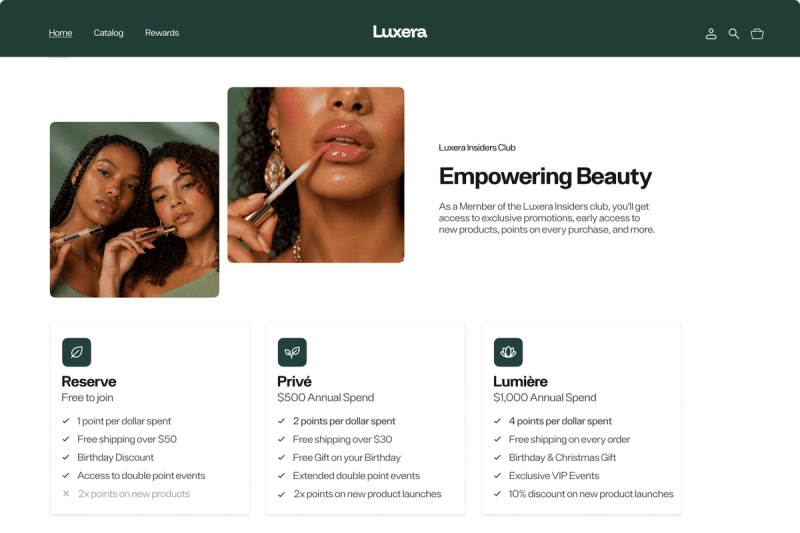
The customer test
Merge tiers before adding another reward or threshold. Ask one plain question: can a customer explain why the next tier is better?
The next tier should be reachable within the qualification period, visibly more valuable, and tied to a behavior you want to encourage.
The economics test
Merge adjacent tiers when they create the same customer behavior, offer nearly identical benefits, or require separate campaign logic without a measurable commercial reason.
Mage supports up to 10 total tiers, but most stores are better served by three or four. For a deeper tier-count review, read how many VIP tiers your loyalty program should have.
The operations test
Before retiring a tier, review Shopify tags, customer segments, rewards, campaigns, and support guidance tied to it.
Tell affected customers about the new ladder before recalculation, rather than letting an automation explain a structural decision after it happens.
Run the change safely and measure the first cycle
Use the recalculation window
Mage presents a confirmation summary before saving VIP settings. After confirmation, recalculation is delayed by 15 minutes, giving you time to revise the change or cancel it.
Once recalculation begins, settings are locked until the job finishes and the change cannot be reverted. Treat that window as a final review step.
Audit affected customers
Before publishing, inspect customers promoted, demoted, unchanged, returned to the base tier, and receiving entry rewards.
Check high-value customers, recent joiners, customers near a threshold, and customers whose status drives support or campaign treatment.
Measure status health, not just revenue
Track qualification rate, demotion rate, movement between tiers, repeat purchase rate by tier, AOV by tier, and reward cost by tier.
Use tier tags and segments for congratulations, renewal reminders, win-back activity, and support review. Then allow one full qualification cycle before making another structural change, unless the current rule is clearly harming customer sentiment or margin.
After that first cycle, audit an underperforming loyalty program with actual progression and demotion data rather than launch assumptions.
FAQ
What are loyalty tier reset rules?
Loyalty tier reset rules determine how long customer activity counts toward VIP qualification and what happens when that period ends. The main types are lifetime, calendar-year, and rolling qualification. Downgrade protection separately determines whether a customer retains status after falling below a threshold.
Is a rolling year better than a calendar year for VIP tiers?
A rolling year is better for most programs because it reflects recent behavior and avoids one mass annual reset. A calendar year suits brands with a clear January-to-December rhythm or annual status expectations.
How does loyalty tier demotion work?
Demotion happens when qualifying activity no longer meets the current tier threshold. In a rolling model, older activity gradually falls away. In a calendar-year model, progress resets annually unless tier-status protection or top-tier downgrade protection applies.
How do you grandfather VIP customers?
Grandfathering means temporarily preserving status for a defined group during a launch or rule change. Set a review date, specify who qualifies, recalculate carefully, and explain when the new rules take effect.
What is a loyalty tier grace period?
A loyalty tier grace period is extra time or status protection before a customer loses VIP benefits after falling below a threshold. It needs a defined end date, a clear target for retaining status, and advance communication.
When should you merge loyalty tiers?
Merge tiers when adjacent levels do not create a meaningful difference in benefits, behavior, or economics. The next tier should be reachable, understandable, and worth maintaining operationally.
Choose the qualification model first, then set thresholds and protection rules around real purchase behavior. A rolling year is usually the practical starting point. A calendar-year program can work well when annual status fits the brand, provided customers have fair protection and a clear route to retain what they earned.

Graeme is the co-founder at Mage Loyalty. He heads product development, from complex loyalty migrations and large-scale data handling to building the features shaping the future of loyalty on Shopify.