A VIP tier program groups loyalty members into levels based on the behavior your brand values, such as spend, orders, or points earned. If you are asking how many tiers should a loyalty program have, start with customer behavior and benefit economics, not a competitor’s benefits table.
Short answer: For most Shopify brands, begin with three total tiers: a base tier and two earned levels. Add a fourth only when your data reveals a distinct high-value customer segment that needs different treatment, and set thresholds from real spend, order, or points distributions.
Three tiers is the right starting point for most loyalty programs
| Tier count | Best fit | Main advantage | Main risk | Editorial recommendation |
|---|---|---|---|---|
| Three | Most brands launching VIP tiers | Clear progression and simple operations | Top tier may be too broad if customer value varies widely | Start here |
| Four | Brands with a distinct high-value segment | Adds a meaningful status step | Can create overlapping benefits | Add only with supporting data |
| Five or more | Complex programs with proven segments | More segmentation options | Confusion, weak differentiation, more administration | Avoid unless clearly justified |
What a three-tier program actually includes
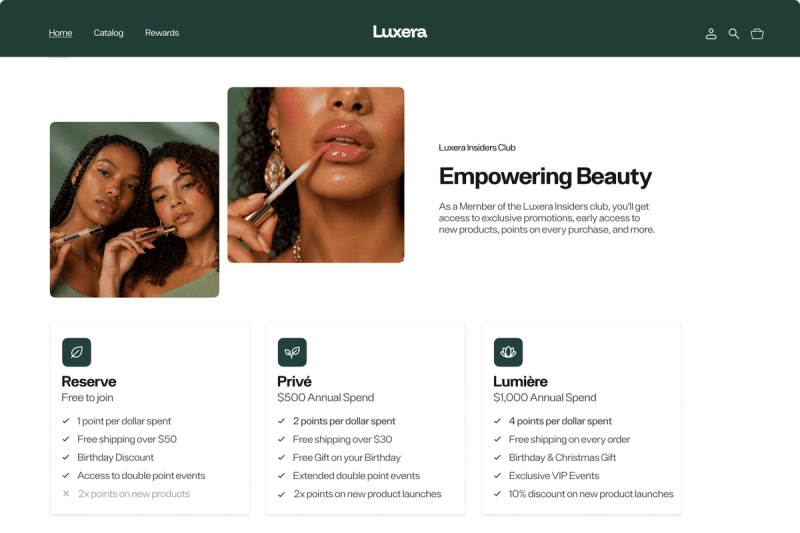
A three-tier program usually means Bronze, Silver, and Gold, not three premium levels above entry. Bronze is the starting tier. Silver gives customers a realistic next milestone. Gold provides the aspirational status level.
Mage uses a default base tier with a threshold of zero, so enrolled customers have an immediate place in the program. You can rename that tier, but its job remains the same: show customers where they begin and what they can work toward.
Two earned milestones are enough for customers to understand the path without studying a complicated chart. They are also easier for your team to run, with fewer thresholds, benefit rules, and support questions.
The role of the base tier at zero
The base tier gives new members an identity, makes the first earned tier feel achievable, and lets you communicate progress from the first purchase.
The first threshold should point toward a realistic next action, often a second purchase or an early repeat order. That is where a tier structure can support efforts to increase repeat revenue after the first purchase.
“I looked into so many different integrations for loyalty and referrals for our Shopify Store, but no one impressed me more than Mage on human connection, customer service, and value.”


Read the Reelie case study →
Myth: more loyalty tiers always create more motivation
Why extra levels can dilute the meaning of VIP status
More levels create more motivation only when each level changes the customer experience in a visible way. A small points increase, nearly identical discount, or new badge color rarely justifies another tier.
Long tier ladders can also weaken status. Customers struggle to remember where they sit, what they need next, and why moving up matters. A simpler structure makes the benefits easier to explain at checkout, in email, and inside the account.
That matters because why status can matter more than discounts often comes down to recognition, access, and progress rather than another minor percentage change.
When a fourth tier genuinely adds value
A fourth tier earns its place when it separates a real group of customers with different economics or expectations. That might be customers who buy substantially more often, place much larger orders, or expect stronger service and access.
The fourth tier should unlock something distinct, such as earlier access to launches, upgraded shipping, exclusive products, a stronger earning rate, or priority support. If it only offers a slightly larger discount, it is probably a pricing change disguised as a tier.
A peer-reviewed study found that a three-tier structure is not universally optimal. Customer characteristics matter more than copying a standard tier count.
When to stop adding levels
Stop when adjacent tiers have similar customer populations, thresholds, or perks. Merge them instead.
Four tiers can work. Five or more require a strong reason, clear benefit separation, and customer data that shows each group behaves differently.
Choose the number of tiers from your customer distribution, not round numbers
| Question | What to inspect | What a healthy answer looks like | What to change if the answer is weak |
|---|---|---|---|
| Can customers reach the first earned tier? | Spend or orders after an initial purchase | A visible path to the next level | Lower the threshold or change the metric |
| Does each tier describe a real customer group? | Customer counts between thresholds | Distinct behavioral groups | Merge overlapping levels |
| Is the top tier worth pursuing? | Benefits, margin cost, and progression | Valuable but achievable status | Adjust benefits, threshold, or window |
| Does the window match buying behavior? | Purchase cadence and reorder cycle | Customers have enough time to qualify | Use a different qualification window |
Map customers by annual spend, order count, or points earned
Start with your customer data. Group customers by spend, number of orders, or points earned across the qualification window you intend to use. Do not begin with $500, $1,000, or $5,000 just because those numbers look tidy on a landing page.
Shopify customer segments are dynamic, rule-based customer lists, which makes them useful for inspecting groups as buying behavior changes. Shopify also provides predicted spend tiers called High, Medium, and Low, based on factors including purchase frequency, average order value, order count, and recency.
Those predicted tiers are an analysis input, not a customer-facing VIP structure. Use them to understand where customer value clusters, then build your own threshold logic.
Use thresholds to create behavioral steps
The first earned tier should be close enough that a customer can see a realistic route to it. The middle tier should represent repeat behavior that matters to your economics. The top tier should represent a genuinely valuable customer relationship.
A brand with frequent replenishment purchases may find that order count reveals more than annual spend. A high-AOV brand may see meaningful separation from spend even when customers place only a few orders.
Review the number of customers below, between, and above each proposed threshold. If a proposed tier contains almost nobody or duplicates the group below it, remove it before launch.
A fourth tier adds motivation only when it marks a real customer segment
Signals that a fourth tier is justified
A fourth tier is justified when your highest-value customers look meaningfully different from strong repeat buyers. They may generate much more revenue, buy across more collections, purchase more frequently, or value access and service that lower tiers do not need.
The benefits should reflect that difference. Early access, priority support, exclusive products, custom engraving, automatic shipping upgrades, or a stronger points multiplier can justify a genuinely premium level.
Love Sweat Fitness uses four VIP tiers, while Gelato Pique uses three. Neither structure proves that one tier count causes better performance. The useful question is whether the extra level reflects a real customer segment and a different member experience.
Signals that a fourth tier will create confusion
A fourth tier will create confusion when its threshold sits too close to the tier below, its benefits barely change, or customers cannot explain why they should pursue it.
Ask your team to describe each tier in one sentence. If Silver, Gold, and Platinum sound nearly interchangeable, consolidate them. A tier should change what a customer earns, accesses, or experiences.
How high-AOV and replenishment brands differ
High-AOV categories often need fewer, more status-oriented levels. In a jewelry loyalty program, customers may purchase once or twice per year, so spend-based tiers and benefits such as early access, anniversary rewards, or upgraded shipping can carry more weight than frequent points milestones.
Food, beverage, beauty, pet, and subscription-style brands often have a faster purchase rhythm. Order count or recent rolling spend can create more useful progression because frequency is central to customer value.
Set VIP tier thresholds around customer behavior and business economics
| Entry method | Use it when | Strength | Risk | Mage configuration term |
|---|---|---|---|---|
| Amount spent | Revenue and order value matter most | Easy for customers to understand | One large order can accelerate status | Amount spent |
| Number of orders | Frequency matters more than basket size | Rewards repeat purchasing | High-value low-frequency customers may lag | Number of orders |
| Points earned | You reward purchases and engagement actions | Captures broader participation | Requires clear points education | Points earned |
Choose spend, orders, or points earned
Spend is the clearest starting point for many brands because it maps directly to revenue. Order count fits consumables and recurring purchase patterns, where frequent smaller orders may be more valuable than one large purchase.
Points earned can work when your program rewards actions beyond purchasing, such as reviews, referrals, birthdays, and social engagement. Mage supports amount spent, points earned, and number of orders as VIP entry methods.
Use one primary entry method unless a real qualification issue requires more control. Mage can combine two criteria with AND or OR logic when you need both meaningful spend and repeat purchasing to qualify for a high tier.
Match thresholds to the qualification window
Lifetime progress is simple, but top-tier status can become easier to reach as customers accumulate history. Calendar-year progress creates a clean annual cycle, though resets can feel abrupt. Rolling-year progress keeps status tied to recent behavior, but customers need clear communication about activity dropping out of the window.
The same threshold can feel easy under lifetime progress and unreachable under a rolling window. Set the window before finalizing the numbers.
Build the benefits before finalising the thresholds
Tier count, thresholds, qualification window, and benefits form one system. A strong tier may include faster points earning, an automatic discount, early access, shipping upgrades, an entry reward, or tier-specific rewards. Each improvement must fit your margin.
Mage supports up to 10 total tiers, but that is configuration capacity, not a recommendation. Review these choices on the Shopify VIP tiers page before publishing your program.
If the top tier is unreachable, the structure is broken
How to spot an unreachable top tier
A top tier is functionally unreachable when customers cannot get there through normal purchasing behavior during the qualification window. Customers see a gap so large that they stop treating it as a goal.
Look for almost no movement into the tier, a large remaining requirement for active customers, or weak engagement after customers view their progress. These are program design problems, not reasons to add more labels.
What to change without devaluing status
Do not solve an unreachable tier by handing it to everyone. First, test whether the threshold is too high for normal purchasing patterns. Then review whether the qualification window is too short, whether the entry metric is wrong, or whether a middle tier is absorbing customers who should progress.
For a replenishment brand, switching from lifetime spend to a rolling order-count structure may create a clearer route. For a high-AOV brand, fewer spend-based tiers may make more sense than a long ladder.
Show progress toward the next tier
Customers need to see the next target and the behavior required to reach it. A generic “keep shopping” message gives them no useful decision.
Mage’s Tier Progress block can show logged-in customers their current tier, next tier, remaining requirement, progress, and a link to the benefits explanation. That visibility makes a difficult threshold easier to assess before customers disengage.
Use a simple launch structure, then audit the tier count
A practical launch model
Launch with a base tier and two earned tiers unless existing data clearly supports a fourth. Before going live, model customer distribution, threshold reachability, qualification window, benefit cost, and expected movement between levels.
Set up the structure before announcing it. This gives you room to inspect how existing customers would qualify and whether benefits remain commercially sensible.
What to review after launch
Review tier population, progression rate, repeat purchase behavior, average order value, benefit redemption, and margin impact. A tier with few customers may be intentionally exclusive, or it may simply be unreachable.
Use this data to audit an underperforming loyalty program before adding more levels. More tiers will not fix weak benefits or a poorly chosen qualification window.
When to merge, split, or remove a tier
Merge tiers that contain similar customers or offer nearly identical value. Lower the first threshold if customers rarely reach it. Reconsider the qualification window if the top tier becomes too common or too distant.
Changing live tier settings can trigger customer recalculation, so model the outcome and communicate meaningful changes before applying them.
Frequently asked questions
How many tiers should a loyalty program have?
A loyalty program should usually begin with three total tiers: a base tier and two earned levels. A fourth tier can work when customer data shows a distinct high-value segment with different economics, expectations, and benefits. Additional levels need clear evidence to avoid unnecessary complexity.
Is a three-tier loyalty program better than a four-tier program?
A three-tier loyalty program is easier to explain and operate, while a four-tier program can create a useful extra milestone for brands with wider customer-value differences. Neither is universally better. The right structure depends on purchase behavior, qualification rules, and benefit differentiation.
How do you set VIP tier thresholds?
VIP tier thresholds should come from your customer spend, order-count, or points-earned distribution within the intended qualification window. Review how many customers would qualify at each level, whether they can realistically progress, and whether benefit costs remain viable.
What happens if customers cannot reach the top loyalty tier?
An unreachable top loyalty tier becomes demotivating because customers cannot see a credible route to status. Review the threshold, qualification window, entry metric, and progress communication first. Add an intermediate tier only if customer data shows a real missing segment.
Should loyalty tiers be based on spend, orders, or points?
Loyalty tiers should be based on the behavior your brand wants to increase. Spend fits revenue-led programs, order count fits frequent replenishment purchasing, and points earned fit programs that reward broader engagement. Use one primary method unless combining criteria solves a clear qualification problem.
How many reward levels are too many?
Reward levels are too many when adjacent tiers have similar thresholds, customer populations, or benefits. If your team cannot explain each level in a single sentence, customers will struggle too. Merge overlapping tiers and keep the next milestone visible and worthwhile.
Start with three levels, validate the structure against your customer distribution, and add a fourth only when the data supports it. Reachable thresholds and meaningful benefits matter more than a longer ladder.

Kris is the co-founder of Mage Loyalty. I spend most days talking to merchants, and making sure our customers get real results. If you run a Shopify store or Agency we should chat!