← Back to Blog
Loyalty & Retention

Average Participation Rate: Shopify Footwear Brands

GraemeGraeme
Posted: June 2, 2026
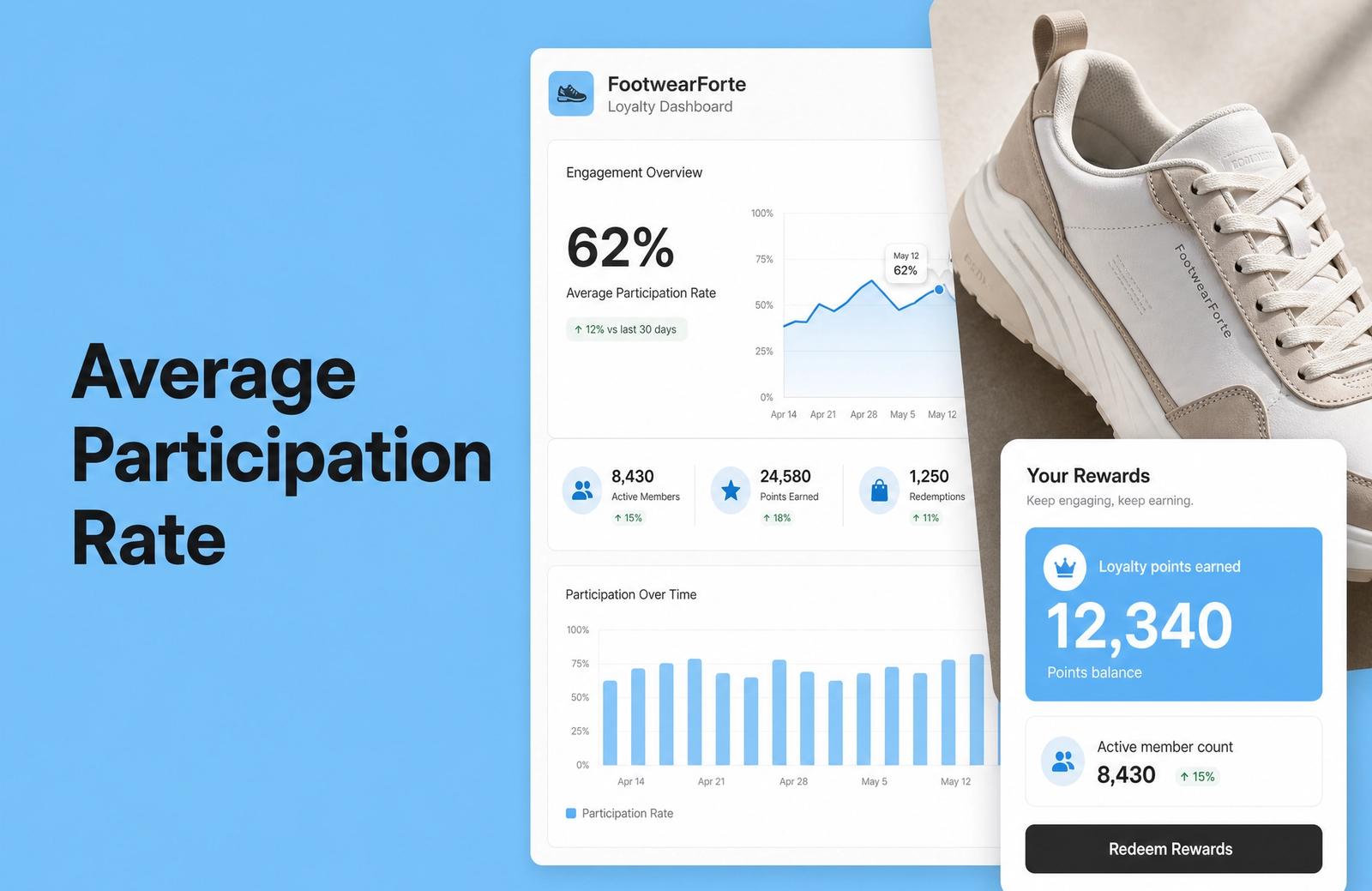
Minimalist landscape with article title "Average Participation Rate: Shopify Footwear Brands" displayed as text in the sky, r

Nearly 70% of footwear shoppers make just one purchase and disappear. They browse, they buy, they vanish. Most DTC footwear brands treat this as inevitable—the cost of doing business in a category where fit is personal and loyalty feels like a luxury. But here's what most miss: that "one-and-done" shopper isn't actually lost. They're waiting for a reason to come back.

The moment a customer makes a second purchase in footwear, the probability of a third jumps by nearly 95%. This is the "Second Pair Effect," and it's the most powerful lever in footwear retention. Yet loyalty programs designed around generic points and generic tiers fail to activate it.

The problem isn't loyalty programs themselves. It's that footwear brands aren't designing participation into their programs from day one. A 30% signup rate means nothing if only 1 in 3 members actually engage. A $10 discount reward leaves a $120 AOV customer unimpressed. And early access to a new drop? Useless if your member base never learns it exists.

This article decodes the real participation rates for Shopify footwear brands and shows you exactly how to engineer loyalty that actually works in this category.

The Foundation of Footwear E-commerce: Why Loyalty Matters

Acquiring customers has become brutally expensive. A new footwear customer costs 5-25 times more to acquire than retaining an existing one. For DTC brands operating on thin margins and rising ad costs, this math is brutal.

Consider this: the average Shopify footwear store converts at 2.1%—meaning 98 out of 100 visitors leave without buying. Of those who do convert, nearly 70% never return. You're investing heavily in paid ads, content, and promotions just to replace the customers you've already lost.

Retention flips this equation. A repeat customer who already knows your brand, has validated fit, and trusts your quality costs almost nothing to activate. They're 2.5x more likely to make another purchase than non-members. They spend 12-18% more per transaction. And critically, they're positioned to unlock the Second Pair Effect—the single biggest multiplier in footwear retention.

This is where loyalty programs enter. They're not just nice-to-have for brand building. They're operational necessities for DTC footwear brands trying to survive.

But there's a catch. General e-commerce loyalty programs designed for apparel or beauty don't translate directly to footwear. Sneaker collectors are different from athletic utility buyers. Care product purchases matter differently than they do for clothing. And early access to a limited drop triggers different psychology than early access to inventory that won't sell out.

build a Shopify loyalty program that actually works in footwear requires understanding not just what footwear customers expect—but how they actually participate.

Decoding Loyalty Program Participation in Footwear

Participation is the metric that separates thriving loyalty programs from abandoned dashboards.

Two numbers matter here: signup rate and active participation rate.

Signup rate measures what percentage of new customers enroll in your loyalty program. A 40% signup rate means 4 out of 10 first-time customers join. This is a volume metric—important for building your base, but incomplete on its own.

Active participation rate measures something harder: the percentage of enrolled members who actually engage with the program over a defined period (typically 30 or 90 days). This might mean earning points, redeeming rewards, checking their status, or interacting with exclusive offers. A 31% active participation rate among enrolled members means 7 out of 10 members are dormant—they signed up but aren't really part of your community.

For footwear specifically, active participation is what matters. Here's why.

A customer who buys once every 6-12 months (typical for footwear) won't redeem points frequently. But they should be checking whether new drops are available in their size. They should know about upcoming early-access events. They should feel the difference between being a member and being a generic browser.

Active participation in footwear measures engagement between purchases. It's the email that gets opened. It's the landing page visited. It's the wishlist item saved. It's the size preferences updated. These touchpoints keep your brand top-of-mind for that critical 6-month window before the Second Pair Effect kicks in.

effective customer retention strategies for footwear hinge on this distinction. Signup is awareness. Participation is relationship.

Benchmarking Success: Average Participation Rates for Shopify Footwear

General e-commerce and fashion loyalty programs show consistent benchmarks:

  • Signup rate: 25-40% of new customers enroll (with 72% higher enrollment when a reward is offered at signup)
  • Active participation rate: ~31% of enrolled members are actively engaged at any given time
  • Repeat purchase rate for members: 40%+ versus 28% for non-members
  • Redemption rate: 10-20% of earned points are redeemed

But footwear doesn't sit neatly inside "general fashion." Here's why these benchmarks shift.

First, footwear has a higher average order value than most fashion categories ($120+ per pair versus $50-80 for apparel). Customers take fit seriously. They're willing to invest in specific brands. Brand affinity runs deep—sneaker culture alone proves this. These dynamics should theoretically push signup rates higher. A 25-40% benchmark becomes a 30-50% target for footwear, especially if early access to drops is part of the value proposition.

Second, footwear purchasing is less frequent than consumables but more considered than impulse buys. A customer might buy 2-3 pairs per year if they're highly engaged, versus 8-12 apparel purchases annually. This means active participation rates matter more. A member checking in monthly for drop information or new colorway restocks creates value even without a purchase. The inferred active participation rate for footwear loyalty members should be 35-45%, not the generic 31%.

Third, repeat purchase rates reflect the Second Pair Effect. General e-commerce achieves 40%+ repeat rates among loyalty members. Footwear brands with well-designed programs—those that incentivize the second purchase strategically—report 45-65% repeat rates within 12 months.

What's missing from the literature is direct data on average participation rates for Shopify-specific footwear loyalty programs. Most benchmarks lump all footwear together without separating DTC, Shopify-native brands from enterprise retailers like Foot Locker or Dick's Sporting Goods. The data exists in aggregate but hasn't been cleanly isolated by platform.

That said, inference points to patterns. Shopify brands are typically smaller, more community-focused, and more agile in reward design. A Shopify Plus loyalty program for a mid-market footwear brand often sees signup rates 5-10 percentage points higher than the general benchmark, and active participation rates that outpace the 31% average because community and founder accessibility are harder to replicate at scale.

Here's how footwear-specific targets compare to general benchmarks:

MetricGeneral E-commerce / FashionInferred Footwear Target
Signup Rate (New Customers)25-40%30-50%
Active Participation (Enrolled)~31%35-45%
Repeat Purchase Rate (Members)40%+45-65%
Redemption Rate10-20%15-25%

Ready to increase customer lifetime value?

Join 100+ Shopify stores using Mage to turn one-time buyers into loyal repeat customers.

Crafting Irresistible Program Mechanics for Footwear

Generic points-for-dollars reward structures fail in footwear because they ignore what footwear customers actually value.

Smart footwear brands reward behavior specific to the category.

Tailored Earning Rules start with foundation points—typically 1 point per $1 spent. But then they diverge.

Bonus points for specific categories matter. An athletic shoe purchase might earn 1.25x points versus a casual sneaker, reflecting the customer's commitment to fit and function. A customer purchasing care products—insoles, socks, protective sprays, or cleaning kits—should earn bonus points, not standard points. Why? Because these are the customers most likely to extend the lifespan of their shoes and become repeat buyers within that critical 6-month window.

User-generated content drives participation that generic transactions can't. Platforms like Judge.me integrate directly with Shopify, allowing you to award 25-50 points for written reviews, 75-100 for photo reviews, and 150-200 for video testimonials. In footwear, these reviews are social proof on steroids. A customer seeing a video of someone actually wearing your boots or running shoes in real conditions converts at far higher rates than professional photography.

Sustainability actions resonate in sneaker and performance footwear communities. Reward points for uploading photos of old shoes destined for donation or recycling. TOMS built an entire brand story around this. Smaller Shopify brands can adapt the mechanics: 50 points for donating old footwear, 25 points for returning packaging for recycling, 100 points for referring a friend to a repair service. This extends brand touchpoints beyond the transaction.

Compelling Redemption Options require more imagination than "10% off your next order."

Discounts work, but they're the baseline. Free shipping at specific thresholds (75 points = free shipping on next order) is table-stakes. Early access to new sneaker drops, limited-edition colorway releases, or seasonal collections—this is where footwear loyalty gets emotional. The customer who gets 48 hours to purchase a sold-out-in-minutes colorway before general release feels seen. That's not points; that's privilege.

Exclusive member-only products or collaborations go further. A Shopify footwear brand could offer a colorway available only to VIP members, or partner with a designer for a limited co-creation exclusive to top-tier members. Community-focused brands like Allbirds have embedded this into their identity. For smaller brands, even a small batch of 100 units creates scarcity and belonging.

Experiential rewards break through the digital noise. VIP events—launch parties, design Q&As, early shopping before a major sale—give members a reason to deepen their investment. Personal styling services (virtuall or in-store for omnichannel brands) for top-tier members acknowledge that footwear fit and style are personal. Birthday gifts (a $15 credit, a free pair of socks, or early access) make members feel recognized.

Dynamic Tiered Structures turn the program into a game members want to play.

Three to four tiers work best. Name them for footwear culture: "Laceup" (entry), "Heat Seeker" (mid), "Curator" (high), and optionally "Insider" (top 5%). Each tier has clear spending thresholds (e.g., $0-150 annual = Laceup, $151-500 = Heat Seeker). Benefits escalate: Laceup gets standard points and birthday bonuses; Heat Seeker unlocks early access and free shipping; Curator gets personal styling and exclusive products; Insider gets all of that plus direct access to the founder and first dibs on drops.

The psychological driver here is progression. A customer sees they need $200 more in spending to unlock Heat Seeker benefits. That's concrete. Achievable. Worth planning around.

Optimizing for the Shopify Ecosystem

Participation rates live or die based on friction. Every step between "customer decides to join" and "customer earns their first points" is a chance to lose them.

Shopify's advantage is that the best loyalty apps are Shopify-native. They sit inside your checkout flow. They access your customer data directly. They speak Shopify's language.

what loyalty apps are and how they integrate matters more for footwear than for most categories because footwear customers are often repeat browsers. They visit your site multiple times before buying. Your loyalty program needs to be visible, frictionless, and rewarding from that first touch.

Seamless app integration means the loyalty popup or banner appears at the right moment—post-purchase, on the homepage, or during checkout—without slowing down page load times or disrupting the buying experience. Platforms such as Mage Loyalty, Rivo, and Growave are built into Shopify's architecture, not bolted on top of it.

Frictionless enrollment is critical. A footwear customer should be able to join in under 30 seconds. Email or SMS phone number, optional first name, done. Every additional field drops completion rates. Some brands ask for shoe size and width at signup—genuinely useful data for personalization—but this should be optional at enrollment, collectable later through email preference centers.

Mobile-first experience determines success or failure. Most footwear browsers shop on mobile. Your loyalty program needs to load fast, display clearly, and be navigable with one thumb. The member dashboard showing current points, redemption options, and tier progress should be scannable in 10 seconds. Push notifications for restocks or drops should feel timely, not spammy. Once or twice weekly is the benchmark; more than that and unsubscribe rates spike.

Leveraging Shopify data means using purchase history and browsing behavior to personalize loyalty offers. A customer who bought hiking boots should see loyalty emails promoting care products for hiking boots, exclusive access to new trail styles, and rewards for leaving a gear review. A sneaker collector who regularly checks for new releases should get early-access notifications before general launch. Generic loyalty communications have a 15-20% open rate; personalized messages hit 40%+.

Proactive Marketing and Communication

Participation rates are directly proportional to awareness. If members don't know what rewards are available, they won't engage.

Omnichannel promotion starts before launch. Email your existing customer list announcing the loyalty program 2-3 weeks before launch, then again at launch with an exclusive "founding member" bonus (50 extra points for joining in the first week). Website banners should rotate different value propositions weekly (early access one week, free shipping the next, VIP experiences the next). Product pages should highlight member pricing or early access badges. SMS, if you have opt-in subscribers, should announce drops and tier promotions.

Onboarding journeys determine whether new members stay active or ghost. An automated email sequence over 7 days works: email 1 (welcome, explain points), email 2 (show redemption options), email 3 (highlight an upcoming drop or exclusive offer), email 4 (personal touch—founder story or brand values), email 5 (urgency—limited-time member bonus). This keeps engagement high through that critical first month when habit formation happens.

Gamification elements make participation feel like play rather than obligation. Progress bars showing distance to the next tier reward (e.g., "You're 30 points away from Heat Seeker status") create micro-goals. Badges for milestones ("Review Champion," "Community Builder," "Collector") provide recognition. Challenges ("Buy one of three specific styles this month, earn 50 bonus points") inject variety.

Community building, especially for footwear, transforms participation into identity. Create a private Facebook group or Discord for loyalty members. Feature customer photos. Host designer Q&As. Run monthly contests for best styling of a specific shoe. Brands like Salomon and Arc'teryx do this for outdoor gear; it applies directly to sneaker and performance footwear culture. Members who feel part of a community have active participation rates that far exceed the 31-45% benchmark.

Measuring Beyond the Rate: Key Performance Indicators for Loyalty Success

Participation rate is the starting point, not the destination.

The core KPIs every footwear loyalty program should track:

Program Signup Rate shows awareness and enrollment friction. If it's below 25%, your promotion strategy or onboarding flow needs work. If it's above 50%, congratulations—your brand affinity is strong.

Active Participation Rate over rolling 30-day and 90-day windows shows true engagement. A 35% 30-day rate is healthy. Below 20% signals that members are signing up but not engaging—a red flag for unclear value or poor reward design.

Repeat Purchase Rate for loyalty members versus non-members is the most important business metric. Footwear loyalty members should achieve 45-65% repeat purchase rates within 12 months. If they're matching non-member repeat rates, something is broken.

Average Order Value (AOV) lift for members over non-members tells you if members are buying more per transaction. An 18-25% lift is typical for well-designed loyalty programs. Footwear should hit 20%+ because members are buying complementary items (socks, care products, insoles).

Customer Lifetime Value (CLV) increase is where the financial impact emerges. A loyalty member should generate 2-2.5x the lifetime value of a non-member. Track this quarterly.

Redemption Rate shows whether your rewards are actually desirable. If only 10% of earned points are redeemed, your reward options aren't compelling. Aim for 15-25% redemption. High redemption rates (30%+) can indicate you're being too generous, but it also means members are engaged.

Churn Rate Reduction measures how the program impacts customer attrition. Loyalty members should have significantly lower churn. If your member churn rate is above 40% annually, your program isn't sticky.

Attribution tracking connects revenue directly to the loyalty program. Use UTM parameters on loyalty-specific emails and landing pages. Track which members made repeat purchases. Calculate program-attributed revenue divided by program costs (staffing, app fees, marketing) to derive true ROI. Healthy programs achieve 4-6x ROI.

Footwear Brands Leading the Charge: Real-World Examples

TOMS Rewards works because it extends purpose beyond product. Customers earn points for purchases, but they also earn points for sustainability actions (donating shoes, recycling packaging). The company turns redemption options into social good: donate points toward shoes for children in developing countries. This taps into the exact psychology that brought customers to TOMS in the first place. Participation is high because members feel like they're part of something larger than consumption.

DSW VIP demonstrates tiered loyalty at scale. Three tiers (Silver, Gold, Platinum) with escalating benefits. The genius is specificity: Platinum members get personal stylists, early sale access, and exclusive products. But DSW also uses behavioral triggers—point bonuses for bringing in old shoes to be donated, creative campaigns around seasonal refreshes. Personalized emails drive engagement. For smaller Shopify brands, this playbook translates: tiering, personalization, and purpose-aligned rewards all move the needle on active participation.

Consider a mid-market Shopify footwear brand, "TrailMakers," selling hiking and adventure boots ($150-280 price point). Their loyalty program, "Summit Club," has four tiers: Base Camp (0-250 annual spend), Trail Blazer (251-800), Expedition (801-1500), and Pathfinder (1500+). Members earn 1 point per dollar spent, 1.5x for care products, 2x for reviews, and 50 bonus points for sustainability actions.

Redemption options include discounts (100 points = $10 off), free shipping (75 points), early access to seasonal drops, exclusive member-only colorways (three per year), and experiential rewards (monthly "Boot Camp" video calls with the founder covering product care, trail recommendations, and new releases).

The result? Signup rate of 38%, active participation rate of 42% (well above benchmark), and repeat purchase rates of 58% among members. Trail Blazer and above members show 68% annual repeat purchase rates. This works because every mechanic reflects what hikers and adventure buyers actually want: durability knowledge, community, early access to proven designs, and the sense they're supporting a mission-driven brand.

Footwear loyalty programs face specific headwinds that generic retail doesn't.

High return rates in footwear (industry average 30%) create a problem: a customer returns a pair, loses the points they earned, feels punished. Some brands address this with "keeper bonuses"—25 bonus points if a customer keeps a pair for 30 days after purchase instead of returning it. Others integrate with sizing tools to reduce returns at the source, making loyalty members more likely to keep their purchases because they have better fit guidance. This directly impacts repeat purchase rates.

Satisfaction gaps are real. Only 19% of fashion consumers report satisfaction with their loyalty program. For footwear specifically, the gap is often between promised rewards and actual value. A customer expects early access to mean something; if it means access to a drop that still sells out in minutes, the promised value evaporates. Solutions include limiting early-access inventory per tier (ensuring top-tier members actually get inventory), communicating drop details clearly, and offering alternative redemptions if inventory sells out (store credit, exclusive socks, whatever maintains the feeling of privilege).

Converting the "one-and-done" shopper requires surgical precision. This customer bought one pair, loves it, has no immediate need for another. Standard loyalty communication ("You have 100 points, redeem them!") falls flat because they're not shopping. Smart strategies include: personalized email showing complementary products (if they bought hiking boots, show socks and insoles), seasonal promotions tied to their purchase (bought summer hiking boots, get early access to winter trails collection), and surprise-and-delight tactics (after 90 days of membership, 25 bonus points deposited with a "we miss you" email). The goal is to make the 6-month window before potential repeat purchase feel active and connected.

The Future of Loyalty for Shopify Footwear Brands

Where this is heading.

Hyper-personalization with AI will move beyond email segmentation to predictive recommendations. Systems will learn that a customer who bought basketball shoes and searched for basketball socks is 70% likely to be interested in performance shorts. They'll predict the exact moment a customer needs their next pair (12-14 weeks for athletic shoes, 18-24 for casual boots) and surface relevant options. For loyalty programs, this means members get rewards and early access to the exact products they're most likely to buy. Participation rates will rise because the program feels prescient, not spammy.

Web3 and digital collectibles are already appearing in sneaker culture. NFTs for exclusive access, digital ownership of limited editions, and community governance are nascent but emerging. For footwear loyalty, this might mean a VIP tier receives an NFT certifying their status, granting access to Discord channels, digital galleries of past purchases, and even resale platforms. This is niche today but will normalize for brands with strong collector communities.

Sustainability as a loyalty driver will intensify. Customers increasingly expect brands to report impact—shoes repaired instead of replaced, packaging recycled, carbon footprint tracked. Loyalty programs that integrate transparent sustainability reporting (a member dashboard showing "your purchases saved X pairs from landfills," "your shoe repairs prevented Y carbon emissions") will see higher retention. Footwear, with its durability focus and resale culture, is positioned to lead here.

fashion loyalty programs will become increasingly category-specific. The era of "apply the same loyalty logic to every product" is ending. Footwear will develop its own playbooks, separate from apparel and accessories. Participation rates for well-designed footwear programs will continue to outpace general retail benchmarks.

The Mechanics Matter More Than You Think

Here's what separates successful Shopify footwear loyalty programs from forgotten ones:

Winning programs tie loyalty tiers to collection-building—matching colorways, complementary styles—rather than pure spend. A customer at Heat Seeker status who has three purchased pairs should see rewards encouraging them to collect a fourth that complements their existing collection. This makes the Second Pair Effect work for the third and fourth purchases.

They reward sneaker drop entries and raffle participation between actual purchases. A member who enters a drop raffle but doesn't win still feels engaged. They're checking back. Your brand is top-of-mind. This close-to-free engagement mechanic drives participation rates beyond what transaction volume alone supports.

Losing programs treat sneaker collectors and athletic-utility buyers as the same segment. Collectors want cultural access and early drops. Utility buyers want durability information and care guides. Generic communication misses both.

best apps for VIP tiers that also offer detailed segmentation let you create different tier tracks for different customer types. Collectors get a "Curator" track with early access and exclusive colorways. Utility buyers get an "Athlete" track with care rewards and performance gear access. Participation rates rise when the program reflects who your members actually are.

Smart programs capture exact size, width, and arch preference at signup. When a new product launches, these members get personalized restock alerts: "New Trail Blazer in your size 10M, D-width, available now." Generic "new product" emails sit in spam. Personalized alerts get opened and clicked.

Failed programs offer point bonuses for reviews without filtering for fit-related complaints. A one-star review saying "horrible fit" damages brand trust more than a generic email helps it. Footwear reviews should be curated or weighted by credibility before they're rewarded.

loyalty program ideas That Work in Footwear

Monthly member challenges: "Style Your Spring Kicks" contest where members post a photo in their most creative footwear outfit. Top 5 each month earn 100 bonus points and feature on your homepage. Costs nothing, generates UGC, keeps members active.

Early access for referrals: Members who refer a friend get 48-hour early access to the next drop, before their referred friend even signs up. This weaponizes word-of-mouth and makes the referring member feel like an insider.

Seasonal tier resets: Instead of lifetime tiers, reset annually so members are motivated to re-earn status each year. Announce in September (for calendar-year reset) so members know what to target.

Care kit rewards: At specific point thresholds, unlock branded care kits (cleaning spray, brush, wax, etc.). This drives impulse through loyalty points and extends brand touchpoints post-purchase.

Frequently Asked Questions

What is a good signup rate for a footwear loyalty program on Shopify?

A signup rate of 25-40% is general e-commerce baseline. For footwear, which benefits from higher brand affinity and AOV, aim for 30-50%. To hit the higher range, offer a signup incentive (25-50 bonus points), promote prominently at checkout and post-purchase, and keep enrollment frictionless (email-only signup). If your rate is below 25%, increase promotion visibility and test a larger signup bonus.

How often should I communicate with loyalty program members?

The benchmark is once or twice weekly for email and SMS combined. Footwear members check in during drop days and seasonal launches, so coordinate your highest-value communications with those moments. A sustainable cadence is 1-2 promotional/announcement emails per week, plus 1 SMS alert for major drops. More frequent communication drives higher unsubscribe rates. Segment aggressive communicators (those who opened 80%+ of emails last month) separately—they can handle more frequency.

What are the most effective rewards for footwear customers?

Ranked by impact: (1) Early access to limited drops or exclusive colorways, (2) Free or discounted care products (insoles, socks, cleaning kits), (3) Free shipping thresholds, (4) Exclusive member-only products, (5) Experiential rewards (styling calls, access to community), (6) Discounts or store credit. Transactional rewards (straight discounts) rank lower because footwear shoppers care about access and belonging more than price off. Programs combining multiple reward types outperform single-reward programs by 20-30%.

Can a loyalty program help reduce return rates for my Shopify shoe store?

Yes, indirectly. Loyalty members are more invested in your brand and your sizing guidance (when personalized). Loyalty programs reduce returns by: (1) Offering "keeper bonuses" (bonus points for keeping a pair 30 days), (2) Providing personalized fit guidance through size/width/arch preferences, (3) Building community trust through member reviews and recommendations, (4) Integrating with size recommendation tools. Expect 5-15% reduction in return rates for well-designed loyalty programs compared to non-member cohorts.

Which Shopify loyalty apps are best suited for footwear brands?

The best choices depend on your budget and scale. Platforms including what loyalty apps are like Mage Loyalty, Rivo, Growave, Smile.io, and LoyaltyLion all work well for footwear. Look for: (1) Shopify-native integration (fast, no friction), (2) Tiering capabilities with flexible rule customization, (3) Support for non-transactional earning (reviews, referrals, sustainability), (4) Mobile-first design, (5) Integration with email platforms like Klaviyo. Mid-market brands often gravitate toward Rivo or Growave for affordability and ease; larger brands use LoyaltyLion for advanced analytics. Test with one app before scaling.

Ready to increase
customer lifetime value?

Join 100+ Shopify stores using Mage to turn one-time buyers into loyal repeat customers.

|Cancel anytime|5-min setup|Rated 5/5 by Shopify stores

Great app! User friendly and straightforward. The customer service team has been great and so helpful with some minor tweaks I wanted to make and customize.

skynbio

Related articles