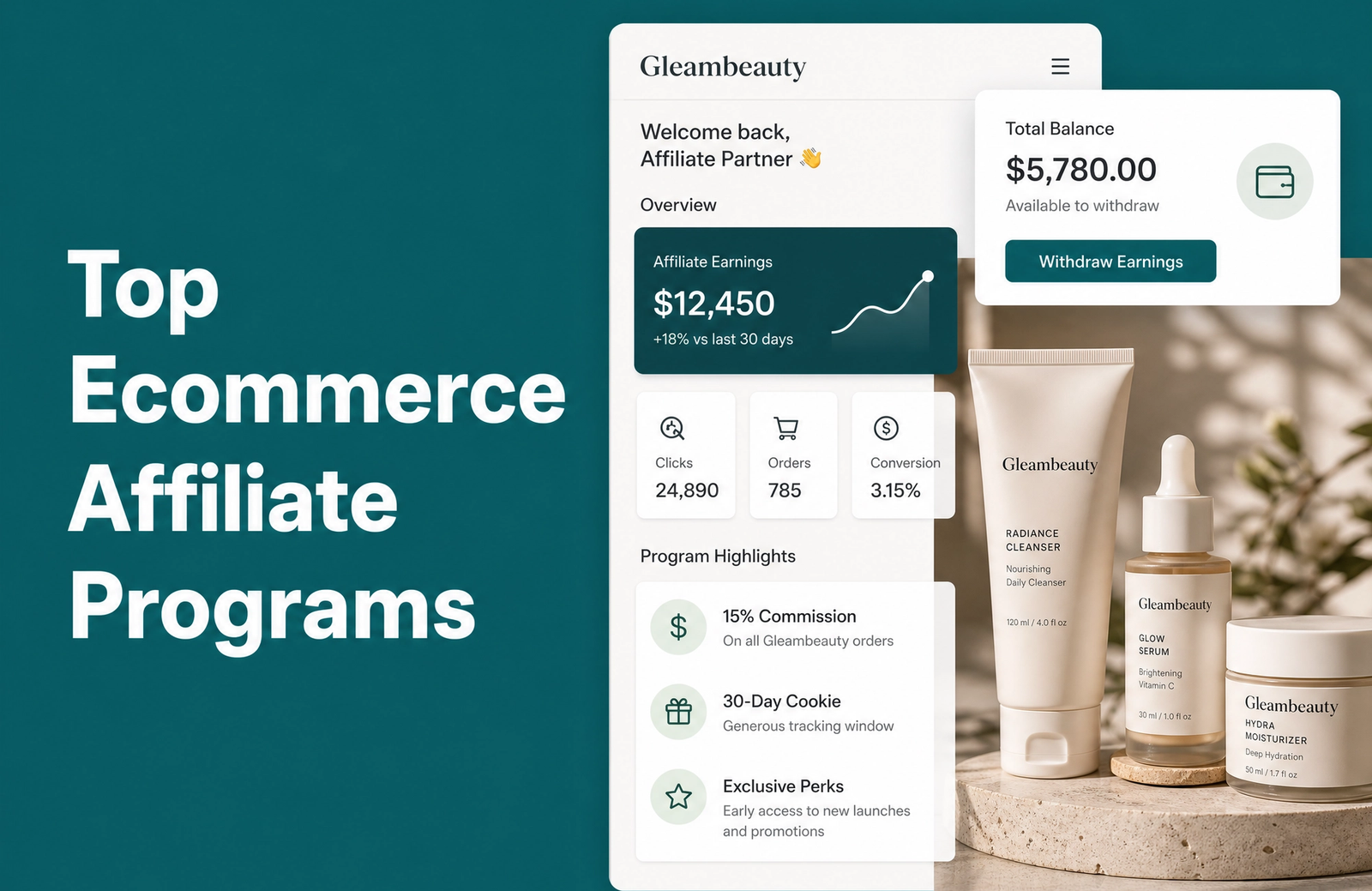
Ecommerce affiliate programs are performance-based partnerships where a brand pays external promoters a commission for every sale or action driven through a unique tracking link. The best ones in 2026 are not the ones with the loudest commission rates. They are the ones where your audience actually converts. That distinction is the whole game, and most "top 10" lists skip right past it.
Here is the counterintuitive part. The largest affiliate program on earth, Amazon Associates, pays as little as 1% on some categories and gives you a 24-hour cookie window. By every headline metric, it looks like a bad deal. It still owns roughly 46.61% of the global affiliate network market, because conversion rate and average order value quietly do more work than the commission percentage ever will.
Think of an affiliate program like a fishing spot, not a fishing rod. The rod (your content) matters, but the spot (the program, its audience fit, its conversion mechanics) decides whether you eat. We have spent years watching Shopify brands run partner programs, and the pattern holds: relevance beats rate, every time.
This list covers the programs and networks that real ecommerce marketers, bloggers, and creators join to monetize content or grow a brand in 2026. For each, we cover commission, cookie window, who it suits, and the honest takeaway.
Affiliate vs Referral: Get the Distinction Right First
Before the list, clear up a confusion that trips up half the people searching this topic. An affiliate program recruits third-party publishers, content creators, and media owners who promote a brand to their broader audience for a commission. A referral program incentivizes your existing customers to invite people they personally know.
Affiliates are strangers with reach. Referrers are customers with trust. Both drive new revenue, but they pull different levers and need different tooling. If you want the deeper breakdown, our referral program guide lays out where each fits, and the word-of-mouth ecommerce marketing playbook covers the customer-driven side specifically.
Why does this matter for your 2026 plan? Because the math rewards combining them. Brands that blended influencer and affiliate efforts together saw a 46% increase in sales, per Impact's 2024 data. Affiliate handles reach. Referral handles retention. Used together, they compound.
The scale of the channel is worth keeping in mind here. Global affiliate marketing spend hit $18.5 billion in 2024 and is projected to reach $27.78 billion by 2027, and affiliate now drives about 16% of all ecommerce sales across the US and Canada, making it one of the top four customer acquisition channels. This is not a fringe tactic you bolt on; it is one of the largest acquisition levers available to a Shopify brand.
The Top 10 Ecommerce Affiliate Programs for 2026
We grouped these into three buckets, because lumping a global network in with a single-brand program is how people pick the wrong one. First the big open networks, then the Shopify-native and DTC-focused options.
1. Amazon Associates
The world's largest affiliate program by market share (46.61% globally) with over 900,000 active partners. Commission ranges from 1% on grocery and health up to 10% on luxury beauty.
Cookie window: 24 hours (the shortest on this list).
Best for: High-volume content sites and comparison bloggers who lean on Amazon's conversion rate and built-in trust.
Takeaway: The short cookie hurts on considered purchases, but Amazon's conversion engine often makes up the difference. Per Amazon's published commission rates, the category you promote matters more than your traffic volume.
2. Awin (formerly ShareASale)
After ShareASale fully migrated into Awin in 2025 (the old platform closed October 6, 2025), the combined network lists 30,000+ active merchants and over 1 million publishers across 180+ countries. Commission and cookie length are set per merchant, typically 4% to 30% with 30 to 90-day cookies. Awin charges publishers a refundable $1 deposit and pays out on the 1st and 15th each month.
Cookie window: 30 to 90 days, merchant-set.
Best for: Affiliates who want a wide mix of mid-market and enterprise DTC brands in one dashboard.
Takeaway: Advertisers report an average $13 return for every $1 spent, per Awin's own program data. The variety is the value here. If a generalist network makes sense for you, this is the one to start with.
3. CJ Affiliate
One of the oldest networks, CJ drives roughly $16 billion in annual sales for its advertisers and hosts around 80,000 publisher sites. Commission spans 5% to 50% depending on merchant and category, with advertiser-set cookies that can stretch to 120 days.
Cookie window: Up to 120 days on some programs.
Best for: Established content publishers who want household-name merchants (think Gap, Lowe's, Barnes & Noble) and granular cross-device tracking.
Takeaway: CJ rewards scale and reporting maturity. If you are still finding your audience, the application bar can feel high. Once you have traffic, the premium merchant access pays off.
The Shopify loyalty program growing brands trust
See how Mage helps Shopify brands lift repeat purchase rate with loyalty, referrals and store credit.
Book a demo4. Rakuten Advertising
A premium global network with around 34,000 publisher sites, preferred by enterprise advertisers who want brand-safe placements. A 2024 Forrester study commissioned by Rakuten found 81% of advertisers and 84% of publishers report leveraging an affiliate program. Strong in retail, travel, and finance.
Cookie window: Advertiser-configured.
Best for: DTC brands with established budgets that want quality-over-volume placement and advanced attribution.
Takeaway: Entry barriers run higher than open networks. That gatekeeping is the point, since it keeps the publisher pool curated.
5. Shopify Collabs
Shopify's built-in creator and affiliate platform, free for Shopify merchants. Brands set custom commission rates (industry average around 10%) and run either an open-access program or invite-only. Creators get paid directly through Shopify, with cookie tracking and payouts handled inside the admin.
Cookie window: Native to Shopify, brand-configured.
Best for: Shopify store owners recruiting micro-influencers without a third-party SaaS subscription.
Takeaway: The zero-cost, in-admin setup is hard to beat for stores already on Shopify. It is the simplest on-ramp for a brand running its first creator program. For the strategy around recruiting those creators, our guide on finding influencers via giveaways is a practical starting point.
6. Refersion Marketplace
Refersion is a Shopify-native affiliate management platform that also runs a public marketplace where creators discover and apply to brand programs. DTC brands using it (beauty, wellness, supplements, apparel) typically offer 10% to 20% commission and 30-day cookies.
Cookie window: Around 30 days.
Best for: Creators who want curated ecommerce programs without wading through a giant generalist network.
Takeaway: Beauty and supplement programs on Refersion commonly hit 20% to 40%, the highest commission tier in physical-product affiliate marketing.
7 to 10. High-Commission DTC Brand Programs
Rounding out the list are direct brand programs you join one at a time rather than through a network. These cluster by vertical, and knowing the benchmarks lets you spot a fair offer fast:
| Vertical | Typical commission | Notes |
|---|---|---|
| Fashion and apparel | 8 to 15% | Mid AOV, strong repeat purchase |
| Beauty and skincare | 10 to 18% | Heavy creator demand |
| Supplements and wellness | 20 to 40% | Highest rates, subscription upside |
| Consumer electronics | 5 to 10% | High AOV offsets low rate |
Slots 7 through 10 are the standout DTC programs in each of these lanes (the supplement and beauty brands running on Refersion and Awin, the apparel labels on Shopify Collabs). Pick by audience fit, not by the headline percentage. A 30% rate on a product your readers do not want is worth exactly nothing.
“Cannot say enough good things about the team at Mage Loyalty, one of the absolute best organizations we have ever worked with, full stop! So glad we connected with them, completely redid our loyalty program, new concepts, use of loyalty, increasing user engagement, showing us where we were not valuing our best customers, just WOW, amazing team!”

Read the West Coast Goalkeeping case study →
A Real Example: Why Amazon Still Wins Despite the Worst Terms
Here is the case study that reframes everything. Amazon Associates pays some of the lowest rates in the industry and gives you 24 hours of cookie life. On paper, dozens of programs crush it. In practice, it captures nearly half the global affiliate network market.
The reason is unglamorous. Amazon converts. A reader who clicks through is already in a buying environment they trust, with one-click checkout and saved payment details. Compare that to a 30% commission on an unknown DTC brand where the visitor has to create an account, enter a card, and trust a name they have never seen. The high-rate program loses, often badly.
This is the contrarian take we keep coming back to: commission percentage is the least predictive variable for affiliate income. The real formula is commission rate multiplied by average order value multiplied by conversion rate multiplied by cookie capture rate. A 5% commission on a $300 supplement order with a 60-day cookie and 4% conversion beats a 20% commission on a $25 product with a 24-hour cookie and 1% conversion nearly every time.
A 2024 Awin and Forrester study backs this up: affiliate-acquired customers show 21% higher average order values than customers from paid search. That gap comes from audience match, not the commission line.
So before you join any program, run the estimate yourself: commission rate multiplied by average order value multiplied by expected conversion rate multiplied by cookie capture rate. The program with the best product of those four wins, regardless of which one advertises the biggest percentage.
How Affiliate Fits Alongside Loyalty and Referral
Affiliate marketing brings new audiences in. It does not, on its own, keep them. That is where the channel quietly leaks money: you pay a commission to acquire a customer, then watch them buy once and vanish.
The brands that get the most from affiliate pair it with retention infrastructure. Affiliate handles top-of-funnel reach. Loyalty, referral, and store credit handle the second, third, and tenth purchase. Our Shopify customer retention hub covers how those pieces connect, and the referral program best practices guide shows how to turn an affiliate-acquired buyer into a referrer.
For the customer-driven side specifically, Shopify-native platforms such as Mage Loyalty, Rivo, and Smile.io let you run referral and loyalty programs that complement (not replace) your affiliate strategy. Mage is not an affiliate program. It sits on the retention side, turning the customers your affiliates send into repeat buyers and word-of-mouth referrers. If you want to build that referral side properly, start with our Shopify referral program overview.
Key Takeaways
Pick your program by audience fit and conversion mechanics, not by the headline commission rate. Use a broad network (Awin, CJ, Rakuten) when you want variety in one dashboard, a Shopify-native tool (Shopify Collabs, Refersion) when you want simplicity and ecommerce-curated brands, and Amazon when raw conversion volume matters more than rate. Then run the four-variable math before you commit. And remember that affiliate acquisition only pays off long-term when retention catches what it brings in.
Frequently Asked Questions
What is an ecommerce affiliate program and how does it work?
An ecommerce affiliate program is a performance-based partnership where a brand pays external promoters a commission for sales they drive. Affiliates share a unique tracking link, and when a visitor clicks and buys within the cookie window, the affiliate earns a percentage of that sale.
What is the difference between an affiliate program and a referral program?
The difference is who promotes and why. Affiliate programs recruit third-party publishers and creators who promote a brand to their broad audience for commission. Referral programs reward existing customers for inviting people they personally know. Affiliates bring reach, referrers bring trust, and many brands run both.
How much commission do ecommerce affiliate programs pay?
Ecommerce affiliate commissions usually range from 5% to 30%, varying sharply by category. Fashion runs 8 to 15%, beauty 10 to 18%, electronics 5 to 10%, and supplements 20 to 40%. Networks like Awin and CJ set rates per merchant, while Amazon ranges from 1% to 10%.
Which ecommerce affiliate program pays the highest commission?
Supplement and wellness brands pay the highest commissions, commonly 20% to 40% on platforms like Refersion. CJ Affiliate lists some merchants up to 50%. But the highest rate rarely means the most income, since conversion rate and average order value affect earnings more than the percentage alone.
How long are cookie windows in ecommerce affiliate programs?
Cookie windows range from 24 hours to 120 days. Amazon Associates uses a 24-hour window, most DTC programs default to 30 days, and networks like CJ extend to 90 or 120 days. Longer windows capture more delayed purchases, which matters for considered, higher-priced products.
Is Amazon Associates still worth joining in 2026?
Amazon Associates is still worth joining in 2026, especially for high-volume content sites. Despite low rates (1% to 10%) and a 24-hour cookie, it holds 46.61% of the affiliate network market because its conversion rate and customer trust compensate for the weaker headline terms.
TLDR
The best ecommerce affiliate programs in 2026 are not the ones with the biggest commission percentages. Open networks like Awin (formerly ShareASale), CJ Affiliate, and Rakuten give you variety; Shopify-native tools like Shopify Collabs and Refersion Marketplace give you simplicity and curated ecommerce brands; and Amazon Associates still leads on conversion volume despite the worst terms. Pick by audience fit, then evaluate each program with the formula commission rate x average order value x conversion rate x cookie capture rate. Affiliate drives reach, but it only pays off when retention tools (loyalty, referral, store credit from platforms such as Mage Loyalty, Rivo, and Smile.io) keep the customers it brings in.

Kris is the co-founder of Mage Loyalty. I spend most days talking to merchants, and making sure our customers get real results. If you run a Shopify store or Agency we should chat!