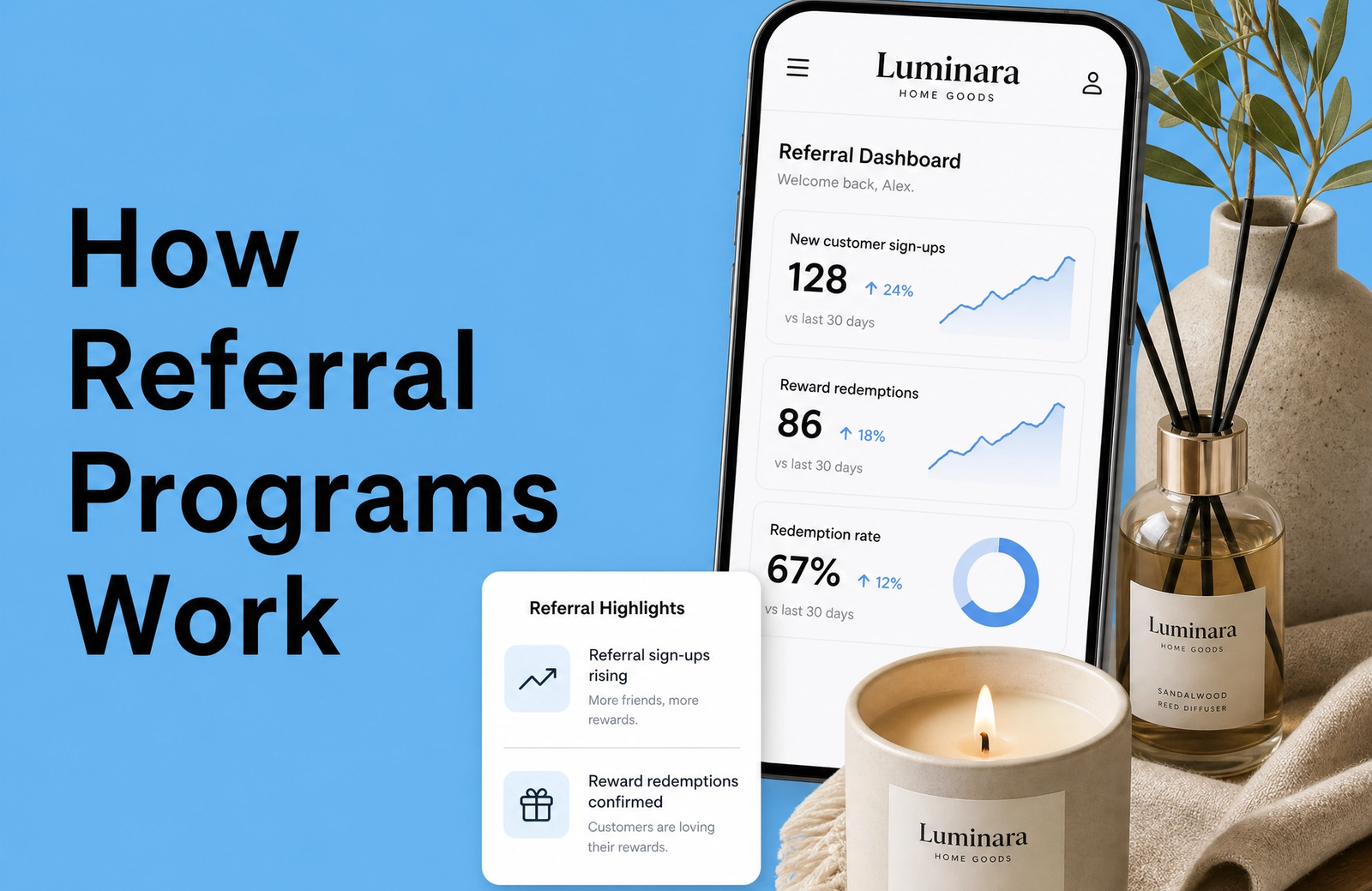
How do referral programs work? A referral program is a structured marketing system that turns existing customers into a measurable acquisition channel: a customer shares a unique link or code, a friend buys through it, the system attributes that sale, and both people get a reward. Unlike organic word of mouth, it closes the loop so you know exactly who drove which order.
Here is the counterintuitive part most merchants miss. The biggest barrier to a working referral program is not the size of your audience. It is the design of the loop itself. We have watched stores with 80,000 customers run a buried referral link to near-zero effect, while a 600-customer skincare brand quietly compounds new orders every week. The mechanism, not the mailing list, decides the outcome.
So let's take the machine apart. We will walk through how the loop actually runs, why referred customers behave differently, the structural pieces (rewards, attribution, fraud controls) that separate a real program from a forwarded promo code, and how to launch one on Shopify without overbuilding.
What a referral program actually is
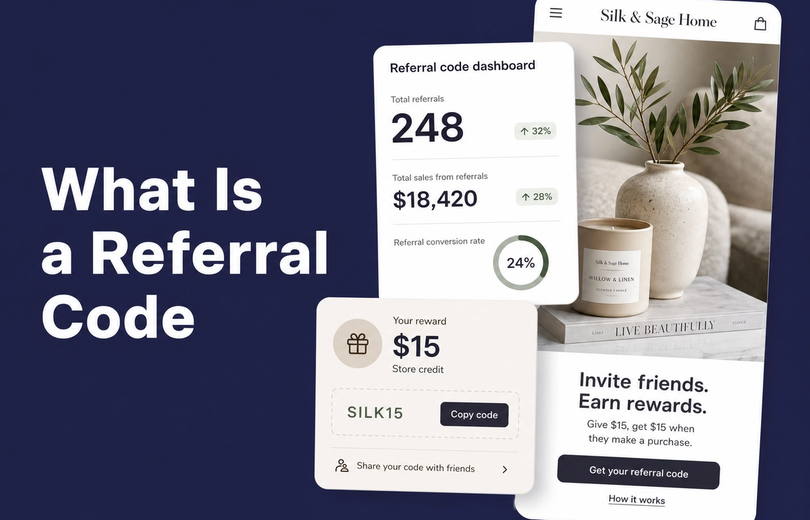
A referral program is a system that incentivizes existing customers to recommend your brand, then automatically attributes, tracks, and rewards the new customers they bring in. The defining feature is the closed loop. Every recommendation is tied to a unique identifier, so the recommendation becomes data rather than a guess.
This matters because the trust is already doing the heavy lifting. Nielsen research across 40,000 consumers found that 92% of people trust recommendations from friends and family above all other advertising. McKinsey puts word of mouth behind 20% to 50% of all purchasing decisions. A referral program does not manufacture that trust. It captures it, attributes it, and rewards it so the behavior repeats.
Think of it like a relay race. Organic word of mouth is a runner sprinting alone with no baton and no finish line. A referral program hands them a baton (the unique code), marks the track (attribution), and posts a prize at the end (the reward). Same runner, same enthusiasm, vastly different measurable result.
There is also a hard distinction worth drawing early. A referral program rewards your existing customers for casual, low-volume recommendations to people they personally know. An affiliate program recruits publishers or creators who promote you at scale for commission, often to strangers. Both have their place. They are not interchangeable, and we cover where each fits further down.
How the referral loop works, step by step
Most explainers stop at "customer shares a link and gets a reward." The interesting part is the five mechanical stages underneath, because each one is a place programs quietly leak conversions.
Stage one: the trigger
Something prompts the customer to enter the program. The strongest trigger is the post-purchase moment, when satisfaction and intent are highest. Order confirmation pages, thank-you emails, and account dashboards all work. The trigger can also be a standing widget on your storefront or an entry inside a Shopify loyalty program where points and referrals live in one place.
Stage two: the share
The customer receives a unique referral link or code and sends it onward (text, email, social, copy-paste). Every point of friction here costs you referrals, so the share action should take one tap. A pre-filled message and a single share button consistently beat "log in to your account to find your code."
Stage three: attribution
This is the quiet engine room. When a friend clicks the link, the program drops a cookie or appends a tracked parameter, then watches for the qualifying event (usually a first purchase) inside an attribution window. That window is typically 7 to 30 days. The system reconciles the new order against the original referrer so credit lands on the right person. Get this wrong and rewards fire for the wrong people, or never fire at all.
Stage four: the double-sided reward
Once the purchase qualifies, the program calculates and issues rewards. In a double-sided structure, both parties get something: the referrer earns credit or points, the new customer gets a welcome discount. This two-way design is now the norm. The State of Referral Marketing Report 2024 found 78% of referral programs are double-sided, while 96% of single-sided programs reward only the referrer.
Stage five: redemption
The reward has to be claimed and used, or it is just a number in a dashboard. Clear redemption (auto-applied store credit, a one-click coupon, points that convert to a discount) determines whether the loop closes and whether the referrer comes back to refer again. A confusing redemption step is where otherwise healthy programs stall. Put the whole loop in one sentence and it reads like this: the trigger gets the customer in, the share sends a tracked link out, attribution assigns credit, the double-sided reward pays both sides, and redemption closes the loop so the referrer does it again.
The Shopify loyalty program growing brands trust
See how Mage helps Shopify brands lift repeat purchase rate with loyalty, referrals and store credit.
Book a demoWhy referred customers are worth more
Here is the part that changes how you should budget for this. Referred customers are not just cheaper to acquire. They are structurally better customers.
Harvard Business Review research found referred customers carry 25% higher profit margins, 16% higher lifetime value, and 18% greater loyalty than non-referred customers. Wharton School of Business research found they cost $23.12 less to acquire and deliver 60% higher ROI over six years. The reason is simple: people refer others who resemble themselves, so you inherit a pre-qualified buyer with realistic expectations and an existing social tie to your brand.
The canonical proof is Dropbox. Its double-sided program gave both the referrer and the new user extra storage, and the company grew from 100,000 to 4 million users in 15 months, a 3,900% increase, while cutting acquisition costs roughly 60% versus paid advertising. At peak, 35% of daily signups came from referrals. The genius was alignment: the reward (storage) was the product itself, so every referral reinforced the reason to stay.
This is also why we treat referrals and retention as one system rather than two campaigns. A customer who refers is, by definition, an engaged customer, and the same engagement powers repeat purchasing. Pairing a referral mechanic with broader Shopify customer retention work compounds both. For a deeper field guide on the channel itself, our word-of-mouth ecommerce marketing breakdown goes further than we can here.
“I looked into so many different integrations for loyalty and referrals for our Shopify Store, but no one impressed me more than Mage on human connection, customer service, and value.”


Read the Reelie case study →
Reward structures and where the money actually goes
The reward is the lever, and most brands pull it too softly. Impact.com data shows consumers expect a referral reward worth roughly $21 or an 11% discount, yet many programs offer around $10. That gap is the difference between a customer who shares and a customer who shrugs.
Two design patterns are worth copying. UNTUCKit deliberately sets its referral reward (25% off both sides) above its standard 20%-off welcome offer, making referral the single best deal in the store, which gives customers a real reason to promote rather than forward a generic code. Bombas links its reward to mission: every referral purchase contributes to its donation program, adding a social-proof layer on top of the $20 credit. The lesson is that reward design is positioning, not just discounting.
Reward currency matters too. Store credit and points keep value inside your ecosystem and pull the referrer back for another purchase, whereas cash or gift cards leak value outward. If you already run points, routing referral rewards into the same currency keeps the experience coherent. Our referral program best practices guide covers reward sizing and structure in more depth.
Fraud protection is part of the design, not an afterthought
Almost no general explainer covers this, and it is exactly where amateur programs bleed margin. Where there is a reward, there is gaming. There are five common fraud archetypes worth knowing:
Self-referral, where a person refers their own second account. Duplicate account creation, spinning up throwaway emails to claim welcome rewards. Link hijacking, where a third party intercepts and reuses referral links. Referral farming, coordinated networks generating fake referrals at volume. And reward-trigger manipulation, claiming a payout without the qualifying purchase ever sticking.
The countermeasures are well established: device fingerprinting, IP and geolocation checks, event-based reward triggers that require a completed (and non-refunded) purchase before any payout, and manual approval workflows for high-value rewards. Treat these as structural requirements, not optional polish. A program without fraud controls is not a leaner program. It is a slower way to lose money. If you remember one rule here, make it this one: never issue a referral reward on signup or click alone, and trigger payout only after a qualifying purchase clears the refund window. That single discipline eliminates most casual fraud before it starts.
Referral vs loyalty vs affiliate
These three get blurred constantly, which leads to mismatched expectations. Here is the clean separation.
| Program type | Who participates | Incentive | Goal |
|---|---|---|---|
| Referral | Existing customers referring friends | Reward to both sides per new customer | Acquire similar high-value buyers |
| Loyalty | All customers over time | Points and tiers for repeat behavior | Retain and increase purchase frequency |
| Affiliate | Recruited publishers and creators | Commission on driven sales | Scale reach to new strangers |
Referral and loyalty are close cousins and increasingly live on the same platform, since a loyal customer is your most likely referrer. Affiliate is a different animal: it is a sales channel staffed by promoters, not a trust loop among friends. If you want the full setup walkthrough, our complete Shopify referral program guide maps the tooling and promotion side end to end.
The KPIs that tell you it is working
Three numbers matter most, and one of them is rarely explained properly.
Referral rate is the share of customers who actually refer at least one person. CAC (customer acquisition cost) for the referral channel should sit well below your paid channels, which is the entire point. The third is K-factor, the viral coefficient, and it is the one most articles skip.
K-factor is the number of new customers each existing customer generates: invitations sent per user multiplied by the conversion rate of those invitations. A K-factor above 1 means each customer brings in more than one new customer, which is self-sustaining growth without paid spend. Most real programs run below 1 and still pay for themselves handsomely; you do not need virality to win, but tracking K-factor tells you whether to invest in lowering share friction or raising reward value.
The myth: referral programs only work for big brands
This is the belief we hear most, and the data flatly contradicts it. Wharton found referral programs deliver positive ROI at every company size: 10.2x for enterprises, 9.4x for mid-market, and 3.6x for small businesses. That 3.6x is the lowest figure, and it is still strongly profitable.
Consider Morning Brew. It launched its tiered referral program (a mug at 5 referrals, a t-shirt at 25, event access at 100) when it had roughly 100,000 subscribers, then grew to 1.5 million in 18 months. Referral cost per acquisition ran about $0.25 versus $4 to $5 on paid social, a 16x to 20x advantage, and at one point 80% of growth came from referrals. They did not start big. The program made them big.
The math actually favors smaller stores. You need fewer referrals to move the needle, your early customers are often your most loyal advocates, and a double-sided discount is cheaper per acquisition than ad CPMs at small scale. The barrier is never audience size. It is reward attractiveness, share friction, and redemption clarity. A 100-customer store with a sharp program beats a 10,000-customer store with a buried link and a $5 reward every time.
How to launch a referral program on Shopify
Shopify makes this concrete, so here is the practical sequence rather than a generic checklist.
First, pick your trigger placement. Post-purchase is the strongest, so put the referral prompt on the order confirmation page and in the post-purchase email. Second, set a double-sided reward that beats your standard welcome offer, and choose store credit or points as the currency so value stays in your ecosystem. Third, decide your attribution window (14 to 30 days is standard) and confirm the reward fires only after a non-refunded purchase. Fourth, turn on fraud controls before launch, not after your first abuse spike.
On tooling, the practical question is whether referrals should sit beside your loyalty and account features or run as a standalone app. If you want a structured comparison of the standalone and bundled routes, see our roundup of the 7 best Shopify referral apps and the dedicated Shopify referral program overview.
A contrarian note to close on. Do not launch with the biggest reward you can afford, hoping to buy virality. Launch with the clearest loop you can build. We have seen modest rewards with a frictionless one-tap share and instant redemption outperform generous rewards buried behind a login wall. Clarity compounds. Generosity alone does not.
Frequently Asked Questions
What is a referral program and how does it work?
A referral program is a system that rewards existing customers for bringing in new ones through a unique link or code. It works in five stages: a trigger prompts the customer to share, the friend buys through their link, the system attributes the sale, both sides earn a reward, and the reward is redeemed.
What is the difference between a referral program and an affiliate program?
A referral program rewards existing customers for casual recommendations to people they personally know, usually with a discount or store credit. An affiliate program recruits publishers and creators who promote your brand to strangers at scale in exchange for commission. Referrals run on trust; affiliates run on reach and payout.
How do you track referrals in a referral program?
Referrals are tracked by assigning each customer a unique link or code, then attributing any resulting purchase back to them. When a friend clicks the link, the system drops a cookie or tracked parameter and watches for a qualifying purchase inside an attribution window of 7 to 30 days before crediting the referrer.
What rewards work best for a referral program?
Double-sided rewards work best, giving both the referrer and the new customer something of value. Store credit and points outperform cash because they keep value inside your store and pull the referrer back. Consumers expect roughly $21 or an 11% discount, so rewards near $10 tend to underperform.
How do you prevent fraud in a referral program?
Referral fraud is prevented with event-based reward triggers, device fingerprinting, IP and geolocation checks, and manual approval for high-value rewards. The most important rule is to pay only after a non-refunded qualifying purchase, never on signup or click alone, which stops self-referral and duplicate-account abuse before it starts.
Do referral programs work for small businesses?
Yes, referral programs work for small businesses and often outperform paid channels at small scale. Wharton research shows a 3.6x ROI for small businesses, still strongly profitable. Smaller stores need fewer referrals to grow, and double-sided discounts cost less per acquisition than ad spend, making program design the deciding factor rather than audience size.
TLDR
Referral programs work by turning existing customers into a measurable acquisition channel through a five-stage loop: a trigger prompts a customer to share a unique link, a friend buys through it, the system attributes the sale within an attribution window, both sides earn a double-sided reward, and the reward is redeemed so the cycle repeats. Referred customers carry higher margins, lifetime value, and loyalty (per Harvard Business Review), and the channel pays off at every company size (3.6x ROI even for small businesses, per Wharton), which debunks the myth that referrals only suit big brands. The levers that decide success are reward attractiveness, low share friction, clean attribution, fraud controls that pay only on a qualifying purchase, and KPIs like referral rate, CAC, and K-factor. On Shopify, the fastest path is a post-purchase trigger, a double-sided reward in store credit or points, a 14 to 30 day window, and fraud protection switched on before launch.

Kris is the co-founder of Mage Loyalty. I spend most days talking to merchants, and making sure our customers get real results. If you run a Shopify store or Agency we should chat!