Most tea brands lose 70% of their customers after the first purchase. They're competing on price alone, chasing new buyers while their loyal customers slip away to competitors. But here's what separates thriving tea brands from the rest: they've weaponized loyalty programs to turn casual sippers into repeat customers who not only buy more frequently, but also evangelize their favorite blends to friends.
The challenge isn't unique to tea. Consumables like tea live in a paradox: customers need your product regularly, yet they're flooded with options at every price point. A customer who loves your oolong this month might forget about you next month when they're out of stock. They'll grab whatever's convenient at the grocery store instead of reordering from your Shopify store.
That's where a thoughtfully designed loyalty program becomes your secret ingredient for sustainable growth. Unlike one-off discounts that erode margins, loyalty programs create predictable reorder patterns, increase average order value, and build authentic community around your brand. For Shopify tea brands, this isn't a nice-to-have marketing tactic—it's the foundation of profitable e-commerce.
This guide walks you through building a loyalty program specifically calibrated to how tea brands operate. You'll discover why traditional points-based systems are evolving, which earning and redemption mechanics drive sampler pack sales and optimized reorder timing, and how to foster genuine community that keeps customers coming back. Whether you're selling loose leaf tea or premium blends, these strategies have been proven across successful tea brands and adapted to work seamlessly with Shopify.
Why Loyalty Programs are Your Secret Ingredient for Tea Brands on Shopify
Tea isn't a impulse purchase. It's a ritual. Your customers are exploring flavor profiles, experimenting with brewing techniques, and building taste preferences. This creates an unusual opportunity: tea drinkers naturally want to discover new blends and reorder their favorites. Loyalty programs amplify that natural behavior by rewarding it strategically.
Beyond the First Sip: Boosting Customer Lifetime Value
One transaction doesn't build a business. Customer lifetime value (CLV) does. For tea brands, CLV represents the total revenue a customer generates across multiple orders, usually spanning months or years. A customer who tries your sampler pack and loves one blend is worth far more than the initial $30 purchase—they're potentially worth $500+ if they become a regular reorder customer.
Loyalty programs compress the timeline to profitability by encouraging repeat purchases faster. Instead of waiting for a customer to naturally reorder (and risk them forgetting or switching brands), a well-structured program nudges them back at the optimal moment. We've worked with several tea brands that saw CLV increase by 85% within their first year of running a strategic loyalty program, primarily by improving repeat purchase frequency from 1.2x to 4.5x annually.
Sweetening the Deal: Increasing Average Order Value
Tier-based rewards and targeted incentives naturally increase what customers spend per transaction. When a customer sees they need just $15 more in spending to unlock free shipping or a VIP perk, they add items they were already considering. For tea brands, this might mean bundling complementary products—a customer buying loose leaf oolong adds tea filters, honey sticks, or a brewing guide they wouldn't have purchased otherwise.
We've seen improve customer retention strategies through loyalty mechanics increase average order value by 22-28% within the first six months. The key is aligning incentives with natural customer behaviors, not forcing unrelated purchases.
Cultivating a Community, Not Just Customers
Tea has a communal dimension that most products lack. Customers don't just buy tea—they share brewing tips, experiment with flavor combinations, and seek validation from fellow enthusiasts. Loyalty programs that tap into this social element transform transactional relationships into belonging. This is what T's Teabar calls "LoyalTEA"—building a community of customers who feel invested in the brand beyond the product.
When your loyalty program includes member-only forums, exclusive tasting events, or opportunities to co-create new blends, you shift from vendor to curator. That emotional investment is nearly impossible for competitors to replicate, especially if they're still operating on pure price competition.
The ROI of Retention: Smarter Spending on Customer Acquisition
Customer acquisition costs (CAC) for tea brands typically range from $15–$40 through paid ads, depending on your channel and audience. Retaining an existing customer through a loyalty program costs roughly $3–$8 per engagement. The math is brutal: acquiring a new customer can be 5 to 25 times more expensive than retaining one you already have.
For tea brands with thin margins, this difference is existential. Every dollar you spend acquiring a customer needs to generate revenue quickly. A loyalty program doesn't replace acquisition—it multiplies the value of every acquisition by extending the customer's lifespan and increasing their total spend. Brands that balance acquisition and retention spend roughly 30% of their marketing budget on loyalty, and that 30% generates 70% of their repeat revenue.
Driving Predictable Revenue for Consumables
Tea is a consumable. Customers finish their loose leaf tea, run out of sachets, and need to reorder. Unlike apparel or home goods, where purchase cycles are unpredictable, tea has rhythm. A customer who orders a 4oz bag of daily-drinker oolong likely needs a reorder every 21–45 days, depending on consumption habits.
Loyalty programs that leverage this predictability—through reorder multipliers, subscription incentives, and timely nudges—create cash flow predictability that's critical for scaling. Instead of relying on organic discovery or paid ads to drive repeat orders, your loyalty program becomes an internal growth engine. You're not guessing when customers will need more tea; you're using data to predict it and rewarding them for ordering at the right moment.
Beyond the Mug: Unconventional Loyalty for Modern Tea Lovers
Here's a contrarian take that might surprise you: loyalty programs built purely on transactional points-for-discounts are becoming less effective, especially with Gen Z consumers and the younger millennials who increasingly drive e-commerce tea sales.
Points-based loyalty creates an illusion of engagement. A customer earns 50 points, waits to accumulate 100, redeems for a $5 discount, and feels... neutral. They haven't developed emotional attachment to your brand. They've just optimized their savings. The moment a competitor offers a better discount, they leave.
Why Traditional Points-Based Loyalty is Evolving
The shift isn't just philosophical—it's data-driven. Brands relying exclusively on points-for-discounts are seeing redemption rates plateau around 35–40%, while programs incorporating experiential rewards, community engagement, and values alignment see redemption rates exceed 65–70%. The difference? One treats loyalty as a discount mechanism. The other treats it as a relationship builder.
Gen Z consumers, who now represent a significant portion of the DTC tea market, prioritize authenticity, sustainability, and belonging over pure monetary savings. They're willing to pay more for products aligned with their values and communities. A loyalty program that offers "$5 off your next order" ranks below one that offers "exclusive early access to a new fair-trade single-origin blend" or "a member-only virtual tasting event with our tea master."
The Shift in Consumer Values
Modern tea customers want to know the story behind their tea. Where was it sourced? Who grew it? What impact does their purchase have on the farmer? Traditional points-based loyalty ignores all of this. It reduces a complex product (tea) to a transaction.
Brands like Art of Tea have successfully pivoted by building tiered programs (their V.I. TEA Club) that reward not just purchases, but engagement, social sharing, and participation in the brand community. Members don't just accumulate points; they ascend through tiers that unlock experiences—exclusive masterclasses, first access to limited blends, direct communication with the sourcing team.
The Power of Experiential and Community-Driven Rewards
Experiential rewards create memories. Memories create loyalty. A customer who attends an exclusive virtual tea tasting with fellow loyalty members is more likely to remain a customer for life than a customer who redeemed points for a $10 discount. The former has developed social bonds with your community. The latter received a temporary financial incentive.
For tea brands, this might mean:
- Member-only tasting kits with new blends sent exclusively to loyalty tiers
- Virtual brewing workshops where members learn advanced techniques from tea experts
- Co-creation opportunities where top-tier members vote on new blend names or flavor profiles
- Loyalty-gated UGC contests that celebrate how members incorporate tea into their daily rituals
- Donations to tea sustainability causes where members can direct their rewards toward sourcing-related charitable work
Adapting for Tea: What This Means for Your Brand
The tea ritual itself is aspirational. Customers are seeking slowness, mindfulness, and connection in an increasingly frantic world. Your loyalty program should reflect that ethos. A points-based system feels transactional; it's at odds with the emotional experience tea buyers seek.
Instead, design your program to deepen the ritual. Reward flavor discovery. Celebrate milestone moments (customer's 100th order, their one-year anniversary). Create exclusive spaces where members discuss brewing methods or share photos of their tea moments. Make loyalty feel like joining a club of people who get why tea matters, not just a way to save money.
The Shopify loyalty program growing brands trust
See how Mage helps Shopify brands lift repeat purchase rate with loyalty, referrals and store credit.
Book a demoSteep-by-Step: Crafting Your Shopify Tea Loyalty Program
Step 1: Define Your Tea Brand's Loyalty Goals and KPIs
Before building, clarify what success looks like. Loyalty programs serve different purposes—some brands prioritize increasing repeat purchase frequency, others focus on driving sampler pack sales, others emphasize community building. Your program structure should reflect your business priority.
What Do You Want to Achieve?
Common objectives for tea brands include:
- Increasing repeat purchase frequency: How many times per year does your average customer currently order? If it's 1.5x, aim to increase it to 3–4x through loyalty incentives. This directly impacts annual revenue.
- Driving sampler pack sales: New customers often don't know which blends they'll love. Loyalty programs that reward trying new blends (with bonus points for sampler purchases) accelerate flavor discovery and increase average order value.
- Optimizing reorder timing: Prevent customers from running out of tea and switching brands. Create systems that reward them for reordering within your optimal replenishment window.
- Building community and advocacy: Establish spaces where customers feel connected to your brand and each other, turning them into referral sources and content creators.
Choose one primary goal and one secondary goal. Trying to achieve all four simultaneously dilutes your focus and confuses customers about what behaviors you're actually rewarding.
Key Performance Indicators (KPIs) for Tea
Track these metrics to measure program success:
- Repeat purchase rate: Percentage of customers who make more than one purchase. Industry benchmark for tea is 25–35%. A well-run loyalty program should push this to 45–55%.
- Customer lifetime value: Total revenue per customer across all orders. Use this to measure long-term program impact.
- Average order value (AOV): Does your loyalty program increase the size of each transaction? Look for 15–25% improvements within the first six months.
- Reorder frequency: Average number of purchases per customer per year. Track this specifically against the 21–45 day window typical for tea consumption.
- Referral rate: Percentage of new customers acquired through member referrals. A referral-focused program should generate 15–25% of new customers.
- Redemption rate: Percentage of earned points actually redeemed. Aim for 50%+. Low redemption suggests rewards don't match customer desires.
- Engagement metrics: Email open rates, event attendance, community forum activity. These indicate emotional investment beyond transactions.
Step 2: Choose Your Loyalty Program Type (and Tea-Specific Flavor)
Most Shopify tea brands use a combination of program types. Let's walk through each:
Points-Based Systems with a Twist
Customers earn points for purchases (typically 1 point per $1 spent) and redeem them for rewards. Standard. But for tea brands, the redemption options matter enormously.
Instead of just offering "$10 off," offer:
- A specific rare single-origin tea only available through loyalty redemptions
- A curated sampler pack of blends members haven't tried yet
- A bundle that includes tea plus accessories (infusers, brewing vessels, guides)
- Experiential rewards like a 30-minute personal tea consultation with your sourcing expert
The mechanics are simple, but the redemption options should feel exclusive and thoughtful. When a customer thinks, "I want to save up my points for that limited-edition aged oolong," you've created genuine motivation beyond discounting.
Tiered Loyalty (Your V.I. TEA Club)
Create escalating tiers based on annual spend or engagement. Here's a structure that works for most tea brands:
- Bronze Brew ($0–$200 annual spend): 1 point per $1, standard shipping rates, occasional member emails
- Silver Steep ($200–$500 annual spend): 1.25 points per $1, free standard shipping, early access to limited blends, monthly member-only email with brewing tips
- Gold Glimmer ($500+ annual spend): 1.5 points per $1, free expedited shipping, exclusive quarterly tasting kits, access to private Discord/forum, annual gift from founder, first refusal on new blends
Members naturally work toward the next tier, increasing their annual spend. The gap between Bronze and Silver might only be 3–4 additional orders per year, but that's exactly the behavior you want to incentivize.
Referral Programs: Share the Love of Tea
Word-of-mouth is powerful for tea brands. A referred customer acquired through a friend's recommendation has a 27% higher lifetime value than customers acquired through ads.
Reward both the referrer and the referred:
- Referrer gets: 25–50 points per successful referral
- New customer gets: 25 bonus points on their first order, even before they spend anything
Tea-specific twist: Create a "share your blend" dynamic where customers write a short note about why they love their favorite tea, send that to a friend, and if the friend purchases it, both earn points. This ties to the ritual and storytelling element of tea.
Subscription Incentives for Consistent Sips
If you offer subscriptions through Recharge or a similar platform, reward customers for signing up. This is crucial—subscription customers have 5x higher lifetime value than one-time purchasers.
Options:
- Subscription signup bonus: 100 bonus points for starting a subscription
- Renewal rewards: 50 points each month they maintain the subscription
- Subscription tier multiplier: Members on Silver Steep tier earn 1.5x points on subscription purchases, not just one-time orders
Integrate with Recharge subscriptions directly through your loyalty app to ensure points are automatically tracked.
Step 3: Brew Up Enticing Earning Rules for Tea Enthusiasts
Now that you've chosen your program structure, define the specific actions that earn points. This is where tea-brand specificity becomes critical.
Standard Earning Rules
These should always be included:
- Account signup: 25–50 points just for joining
- Social actions: 25 points for following on Instagram, 25 for sharing a product on Instagram Stories, 50 for tagging your brand in a post
- Birthday bonus: 100 bonus points during the member's birthday month
- First purchase: Double points on the first order to reward new members immediately
Rewarding Flavor Discovery
This is where you differentiate from generic loyalty programs.
Sampler Pack Bonuses: Offer 2x points (or an additional flat bonus like +75 points) for any sampler pack purchase. Samplers are how customers discover new favorites. You want to aggressively encourage this behavior because a customer who tries three new blends through a sampler is much more likely to place a full-size reorder than someone who never experiments.
New Blend Try-It Bonus: When you launch a new blend or rotational seasonal tea, reward customers for trying it. First purchase of a new blend = +50 points. This accelerates product testing and gives you valuable feedback on which teas resonate.
Photo/Video Reviews of Tea Rituals: Encourage UGC by rewarding customers who photograph their tea moment and tag your brand. This is where community engagement and marketing converge:
- Photo review in product reviews: 50 points
- Video review of brewing or tasting: 100 points
- Instagram post tagging your brand: 25 points
- TikTok video using your tea: 75 points (higher reward for a format that spreads further)
This creates authentic content while rewarding participation. Members see other members sharing, which normalizes and encourages more sharing.
Optimizing Reorder Timing
This is where data-driven loyalty truly shines.
21-Day Reorder Multipliers: Here's the mechanism: Analyze your customer data to identify the optimal replenishment window. For many daily tea drinkers, this is 21–28 days. Set up a rule: "Reorder within 21 days of your last order and earn 1.5x points instead of 1x points." A customer who would normally earn 40 points on a $40 reorder now earns 60. It's not massive, but it's enough to nudge someone to reorder sooner rather than letting the tea run out.
The result? Customers reorder more frequently, reducing churn to competitors, and your reorder rate becomes predictable—critical for cash flow planning.
Personalized Replenishment Nudges: Use email automation tied to your loyalty platform. 19 days after a customer's last order, send an email: "Your favorite oolong is probably running low. Reorder within 5 days and earn double points." Pair this with a reminder about which blends they bought last time. This small nudge can increase reorder rate by 12–18%.
Step 4: Design Irresistible Redemption Rewards that Delight Tea Drinkers
This is where points become experiences and your program either feels transactional or transformative.
Discounts and Free Products
Still important, but frame them thoughtfully:
- 100 points = $10 off (simple, clear)
- 75 points = Free 2oz loose leaf tea of any type (let them choose their favorite)
- 150 points = Free sample pack (encourage flavor discovery again at the redemption stage)
- 200 points = $25 off a subscription's first month
Notice: free products are more exciting than abstract discounts. "Earn a free oolong" feels better than "save $10."
Exclusive Access and Experiences
These drive the deepest loyalty.
Member-Only Tasting Kits: Curate quarterly sampler packs available only to loyalty members. These include three teas members haven't tried, tasting notes from your team, and brewing instructions. Offer it as both a redemption (100 points) and a purchase option (members get $5 off compared to retail value). This creates perceived exclusivity.
Virtual Tea Tasting Events: Host live events quarterly where loyalty members join a video call, taste a specific tea in real-time, and chat with your sourcing team or a tea expert. Charge loyalty members nothing; non-members pay $25. Members feel special; non-members convert to members to access future events.
Early Access to Limited Edition Blends: Before public launch, offer limited-edition or seasonal teas to loyalty members for a 3–5 day exclusive window. This rewards loyalty in a way discounts can't—it's scarcity and belonging combined.
Co-Creation Opportunities: Invite Gold Glimmer tier members to vote on new blend names, suggest flavor profiles for seasonal releases, or even participate in a tasting panel for unreleased prototypes. This elevates them from customers to collaborators.
Community-Building Rewards
Loyalty-Gated UGC Contests: Run contests where only loyalty members can submit tea-related content. The prize? Top submissions get featured on your website and social media, plus 500 bonus points. This creates pressure (in a good way) for members to engage and share their best tea moments.
Donations to Tea-Related Causes: Allow members to redeem points toward donations. "Redeem 200 points to donate $25 to the [Tea Farmer Fair Trade Initiative]." This appeals to values-driven customers and creates positive brand association with sustainability.
Step 5: Select the Perfect Shopify Loyalty App for Your Tea Brand
You've now mapped out your program structure and mechanics. The right app makes implementation seamless.
Key Features to Look For
Before choosing an app, ensure it includes:
- Native Shopify integration: The app should sync directly with your Shopify backend without API complications
- Customizable earning and redemption rules: You need granular control to set up those 21-day reorder multipliers and sampler pack bonuses
- Email marketing integration: Connect to Klaviyo, Omnisend, or Postscript so you can automate replenishment nudges and tier upgrade notifications
- Subscription integration: If you use Recharge or Skio, the loyalty app must track subscription purchases and allow subscription-specific earning rules
- POS integration: If you sell at markets, pop-ups, or physical locations, the app should sync in-store purchases to customers' loyalty accounts
- Analytics dashboard: You need real-time visibility into enrollment, redemption rates, repeat purchase metrics, and program ROI
- Referral functionality: Built-in referral mechanics save you from needing a separate referral app
Mage Loyalty: Tailored for Tea
Platforms such as Mage Loyalty, Rivo, and Growave offer specialized tools for food and beverage brands. Mage, in particular, is built from the ground up for consumable products like tea. Key features include:
- Reorder multipliers: Set custom earning multipliers for purchases within specific windows (your 21-day rule is built-in, not a workaround)
- POS integration and AI receipt scanning: Capture in-store and retail partner sales automatically
- Subscription bonuses: Direct integrations with Recharge and Skio
- Bundle bonus campaigns: Reward customers for purchasing complementary products (tea + infuser, for example)
- White-label loyalty pages: Fully branded member portal with custom colors, fonts, and messaging
- Omnichannel support: Unified loyalty experience across online, in-store, and pop-up sales
Other Top Contenders
- Smile.io: User-friendly, strong referral mechanics, good for smaller teams
- LoyaltyLion: Advanced segmentation and personalization, better for mid-market brands
- Yotpo: Integrated reviews, UGC, and loyalty in one platform—good if you want centralized social proof
- Growave: Combines loyalty, reviews, wishlists, and referrals—all-in-one but may be overkill for loyalty-only needs
Step 6: Integrate and Launch Your Loyalty Program Seamlessly
Setting Up Your Chosen App
Most Shopify loyalty apps follow this flow:
- Install from the Shopify App Store
- Grant the app permission to access your store data
- Configure earning rules in the app dashboard
- Create your loyalty page template (most apps provide drag-and-drop builders)
- Test the program on a staging store
- Go live on your main store
- Ensure the app's loyalty widget appears at checkout and in customer accounts
The entire process typically takes 2–3 hours for a well-planned program. Apps handle the backend—calculating points, tracking redemptions, syncing with Shopify—so you don't need technical knowledge.
Designing Your Loyalty Page
Your loyalty page is where customers learn about the program, enroll, and view their points. It should be:
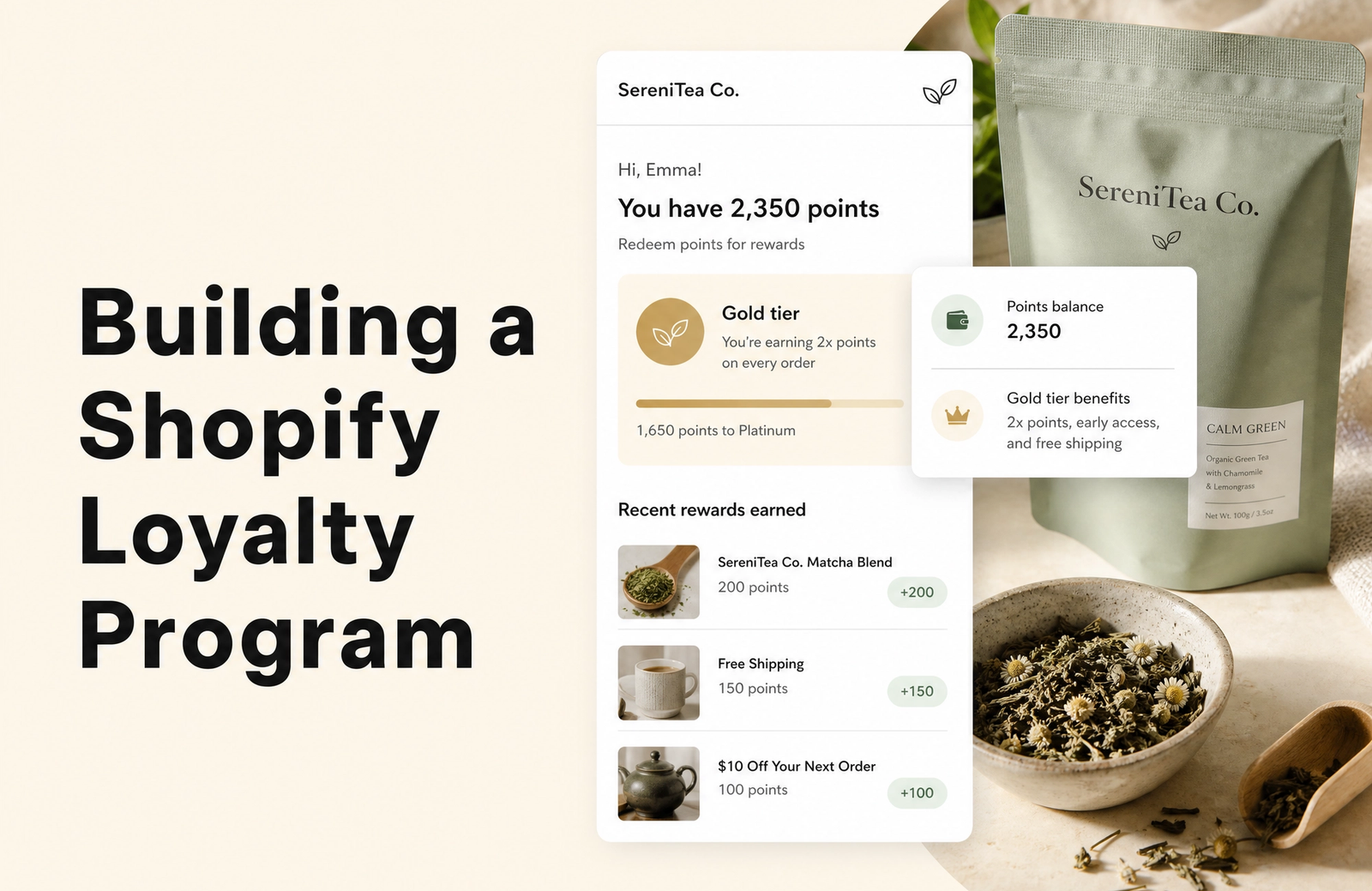
- Clear and visually appealing: Use your brand colors and tea imagery. Show tier progression with simple graphics.
- Mobile-optimized: Most members will view this on phone.
- Easy to enroll: One click to join; don't require lengthy forms.
- Transparent: Explain earning rules, redemption options, and tier thresholds in plain language.
- Trust-building: Include social proof—"Join 12,000+ tea lovers in our loyalty program."
Spreading the Word: Launch Marketing
Your program is only as strong as member adoption. Execute a coordinated launch:
- Email sequence: Send 2–3 emails to your existing customer list introducing the program, highlighting benefits, and providing a direct enrollment link
- Website banners: Add a sticky banner to your homepage and product pages linking to the loyalty program
- Pop-up modal: Offer new visitors an incentive to join (50 bonus points on first order)
- Social media: Tease the launch with Instagram Stories, TikTok, or Pinterest pins showing tier benefits
- SMS (if you have a list): Send a launch announcement text to opted-in subscribers
- Post-purchase email: Every customer receives an enrollment invitation in their thank-you email
Target at least 40–50% of your existing customer base enrolling within the first 30 days. If adoption is lower, revisit your enrollment incentive or program clarity.
Step 7: Cultivate Your Tea Community and Optimize for Growth
Launching is just the beginning. Long-term success requires ongoing optimization and deepening community ties.
Monitor and Analyze
Check your loyalty dashboard weekly during the first month, then weekly thereafter:
- Enrollment rate: Are new customers joining at expected rates?
- Tier distribution: Are members progressing through tiers or stuck at entry level?
- Redemption rate: Are members actually using their points? If not, rewards may not appeal.
- Reorder frequency: Has your repeat purchase rate increased since launch?
- Program ROI: Revenue generated from members vs. cost of rewards. Most programs break even by month 3 and generate positive ROI by month 6–9.
Gathering Feedback
Email members quarterly: "What rewards would you love to see in our loyalty program?" Include 3–4 specific options and an open-text field. Member feedback is gold—they'll tell you exactly what motivates them.
A/B Testing Rewards and Rules
Run experiments:
- Test 1x vs. 1.5x earning for sampler purchases. Which drives higher sampler sales?
- Compare $10 discount to free 2oz tea redemption. Which has higher redemption rate?
- Send replenishment nudges at day 14 vs. day 21. Which generates more reorders?
Even small improvements (5–10% higher redemption rate) compound over thousands of customers.
In-Depth Community Engagement Strategies
Exclusive Online Forums/Groups: Create a private Slack, Discord, or Circle community where loyalty members gather. Facilitate discussions about brewing techniques, flavor preferences, and new teas. You participate but don't dominate—let members become the experts. This transforms your loyalty program from a transactional system into a genuine community.
Member-Only Virtual Events: Beyond the quarterly tasting events, host monthly "office hours" where members ask your tea sourcing expert questions about origins, processing, or brewing. Record and share them with members who couldn't attend live. This deepens perceived value.
Loyalty-Gated Content: Create premium guides available only to loyalty members:
- "The Complete Guide to Oolong: Origins, Oxidation Levels, and Brewing"
- "Pairing Tea with Food: A Seasonal Menu"
- "How We Source: Meet Our Farmers" (video series)
This content becomes an incentive to join and maintain tier status.
“Cannot say enough good things about the team at Mage Loyalty, one of the absolute best organizations we have ever worked with, full stop! So glad we connected with them, completely redid our loyalty program, new concepts, use of loyalty, increasing user engagement, showing us where we were not valuing our best customers, just WOW, amazing team!”


Read the West Coast Goalkeeping case study →
Mage Loyalty's Tea-Vertical Playbook: Accelerating Your Brew
We've outlined the strategic framework for a tea loyalty program. Now let's explore how a platform specifically designed for consumables can accelerate your results.
The Mage Advantage for Tea Brands
Mage Loyalty is built from the ground up for food and beverage brands, not adapted from a generic retail loyalty platform. This distinction matters. Mage's founders worked with dozens of tea, coffee, supplement, and CPG brands to understand their unique loyalty challenges. The result is a food and beverage loyalty program platform with mechanics that out-of-the-box support tea-specific behaviors.
Optimized Reorder Multipliers for Tea
Mage's flagship feature for consumables is customizable reorder multipliers. Here's how it works:
You define a replenishment window (for tea, typically 18–35 days). Customers who reorder within that window earn 1.5x points instead of the standard 1x. It's automated—the system calculates the window for each customer based on their purchase history and frequency, then rewards them for staying in rhythm.
In practice, this is more effective than a simple "spend $50 and earn double points" promotion because:
- It feels personal—the system knows when that specific customer typically runs out
- It rewards the right behavior (frequent, small orders) over high-value orders (bulk purchases that may not repeat)
- It increases predictability—customers order more consistently, reducing churn spikes
Tea brands using this mechanic see 18–24% improvement in reorder frequency within 3 months.
Seamless Online and Offline Integration with POS
For tea brands that operate both e-commerce and physical sales (farmers markets, pop-ups, tea shops), unified loyalty is essential. A customer who buys loose leaf at your pop-up should see those points in their online account.
Mage's connect in-store and online rewards through native Shopify POS integration. In-store purchases sync automatically to customer loyalty accounts. Members earn and redeem across channels seamlessly.
AI Receipt Scanning for Retail Sales
Not all tea sales happen through your Shopify store. Some happen through retail partners (specialty coffee shops, wellness retailers, grocery chains). Mage's AI receipt scanning captures these sales: customers photograph their receipt from a retail partner, the AI extracts the purchase data, and loyalty points are awarded.
This is critical for category expansion without operational burden. A customer who buys your tea through Whole Foods should be recognized in your loyalty program, even though you didn't process the transaction directly.
Subscription Bonus Campaigns
Tea subscriptions are a profitability multiplier. Mage integrates with Recharge, Skio, and other subscription platforms to track subscription purchases separately and apply tier-specific bonuses:
- Base subscription purchase: 1 point per $1
- Gold Glimmer tier subscription: 1.5 points per $1
- Subscription renewal: Bonus 50 points automatically
This keeps subscribers engaged and rewards the highest-value customer segment.
Custom Earning Rules for Flavor Experimentation & Sampler Packs
Mage's dashboard allows unlimited custom earning rules without code. You can configure:
- "Purchase sampler pack: earn 2x points"
- "Purchase new blend within 7 days of launch: earn +50 bonus points"
- "Upload tea review with photo: earn +25 points"
- "Refer a friend who purchases: you earn 100 points, they earn 50"
All of these sync to your email platform (Klaviyo, Omnisend, Postscript) so you can trigger automations: "You earned double points on that sampler purchase. Here's a follow-up email with brewing tips for your new teas."
Sipping Success: Inspiring Tea Loyalty Program Examples
Real examples show what's possible when you apply these strategies thoughtfully.
Art of Tea's "V.I. TEA Club"
Art of Tea, a premium loose leaf tea brand, built one of the strongest tiered loyalty programs in the space. Their V.I. TEA Club has three tiers (Member, Preferred, VIP) with increasing benefits tied to annual spending. Members earn points for purchases, but Art of Tea went further:
- Social engagement earns points (share on Instagram, tag the brand)
- Birthday bonus points
- Early access to new single-origin releases for VIP members
- Annual VIP gift—a curated box of rare teas
The result? VIP members have 4.2x higher CLV than standard members, and members-only generate 38% of total revenue despite representing 22% of the customer base.
Tea Drops' #teamagic and Referral Success
Tea Drops built a community-first loyalty program centered on their branded hashtag, #teamagic. Customers who tag their tea moments with the hashtag earn points and get featured on Tea Drops' Instagram. This created a virtuous cycle: users see others' tea moments on Instagram, follow the hashtag, see it's tied to loyalty, enroll in the program.
Equally strong: their referral program rewards both parties generously. New referrals receive a free tea sample; referrers receive $15 credit. This "both win" approach has driven 26% of new customers through referrals—one of the highest rates in beverage e-commerce.
SkinnyMe Tea's Gamified Tiers
SkinnyMe Tea, an Australian wellness tea brand, uses gamification brilliantly. Their tier system has fun names (Glowing, Radiant, Luminous), progress bars showing tier advancement, and milestone badges for achievements (10th order, first referral, etc.). The emotional reward of "unlocking" a badge or moving to a new tier drives engagement beyond the financial value of the reward.
T's Teabar's "LoyalTEA" Community Focus
T's Teabar's loyalty program deliberately emphasizes community over discounts. Members get points, yes, but the primary rewards are community access: exclusive Discord for flavor discussions, member-

Kris is the co-founder of Mage Loyalty. I spend most days talking to merchants, shipping features, and making sure our customers get real results. If you run a Shopify store or Agency we should chat!