Most Shopify store owners assume their athleisure loyalty program is working fine if customers participate at all. But participation and redemption aren't the same thing. A customer who earns 500 loyalty points but never redeems them isn't building stronger affinity with your brand—they're just accumulating digital debt that could lead to frustrated refunds or chargebacks.
This is the redemption gap. And it's wider in premium athleisure than most people realize.
While general e-commerce loyalty redemption rates hover around 20-30%, the athleisure segment presents a unique challenge: your customers have high expectations for exclusivity, value, and experiences. They're not shopping for survival—they're shopping for identity. A stale discount code doesn't move that needle. But an early-access drop notification, a free personalized training video, or exclusive community access does.
Here's what I've learned from working with Shopify athleisure brands: most of them focus obsessively on enrollment but almost never on redemption health. They build beautiful loyalty pages, promote sign-ups aggressively, and then wonder why their redemption rates stall at 15-18%. The answer is almost never the app or the points structure. It's almost always the rewards themselves.
Understanding Loyalty Program Redemption Rates
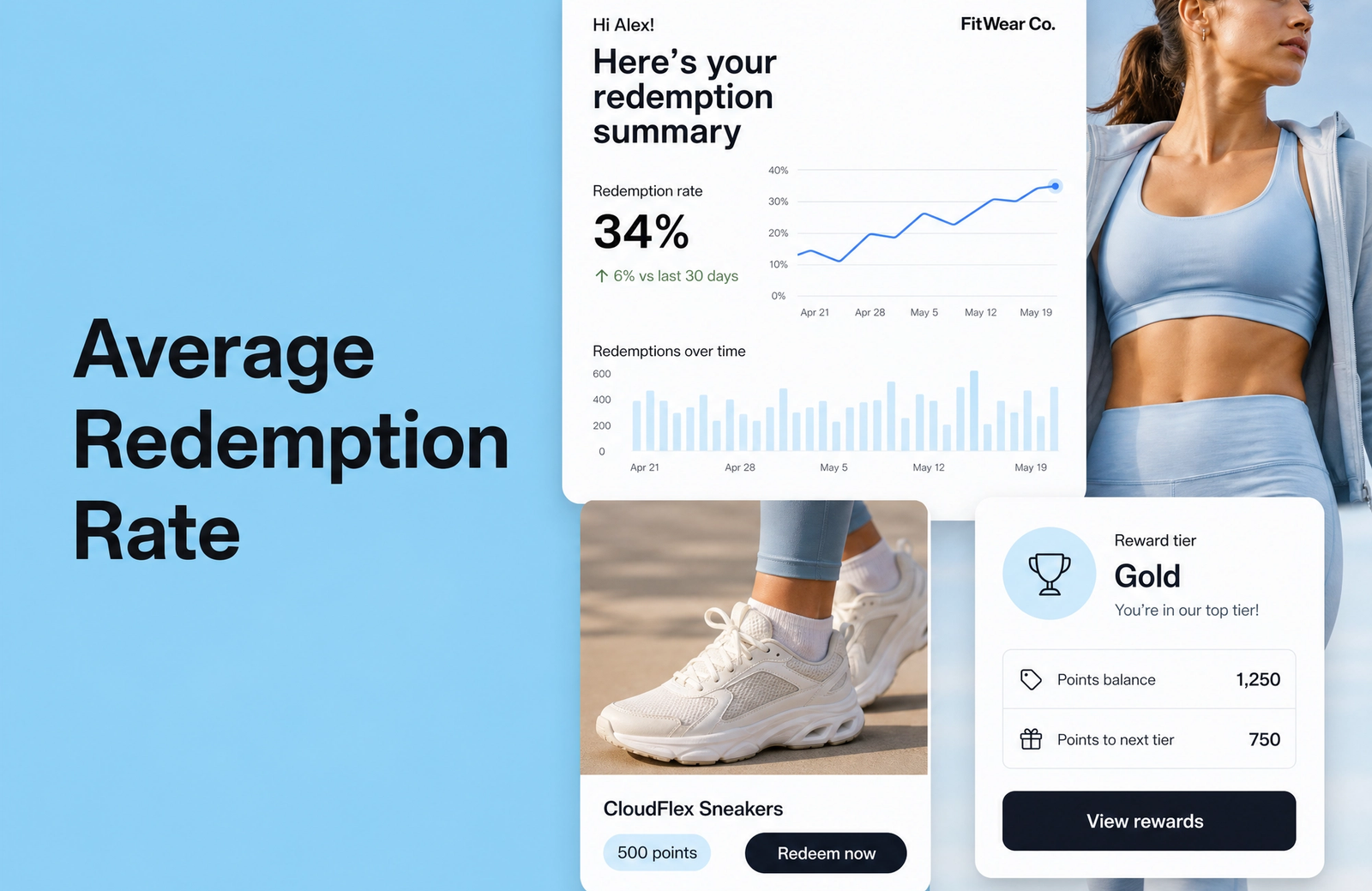
Let's start with a clear definition. A loyalty program redemption rate is the percentage of loyalty rewards actually redeemed by customers, calculated as:
(Total Rewards Redeemed / Total Rewards Issued) × 100 = Redemption Rate
If your program issued 1,000 loyalty points' worth of rewards in a month and customers redeemed only 200, your redemption rate is 20%.
Why does this number matter so much? Because redemption is where loyalty programs prove their value. A customer who earns points but never redeems them is essentially a customer you've failed to engage. They see a points balance sitting there, feel no urgency, and eventually either forget about it or resent you for making them "work" for something they're not sure they want. Studies show that redemption behavior directly correlates with repeat purchase rates, average order value, and customer lifetime value.
For athleisure brands specifically, high redemption signals something critical: your customers believe your rewards are worth their attention. In a category built on aspiration and identity, that belief translates directly to brand loyalty. Redeeming members spend 3.1x more than non-redeemers. Top-tier loyalty programs boost revenue 15-25% annually from active redeemers alone.
Benchmark Your Success: Redemption Rates in E-commerce and Athleisure
The e-commerce loyalty landscape provides useful benchmarks, though interpreting them requires nuance.
General industry data shows loyalty program redemption rates ranging from 20-50% globally, with most e-commerce brands landing in the 20-35% range without optimization. Brick-and-mortar retail typically performs better, hitting 40-60%, because the redemption process is simpler and happens in real time at checkout.
But where does athleisure fit?
Here's the uncomfortable truth: there isn't a universally accepted benchmark for "premium athleisure on Shopify" specifically. Most data lumps athleisure into broader fashion or e-commerce categories, which obscures critical nuances. Premium athleisure customers behave differently than fast-fashion buyers. They're more willing to spend for quality. They care deeply about brand mission. They engage with community and content. But they're also less motivated by percentage-off discounts and more discerning about what "exclusive" actually means.
Based on working with Shopify athleisure brands and analyzing the available data, a realistic target redemption rate for premium activewear on Shopify should be 25-35%. This sits above generic e-commerce benchmarks because athleisure customers demonstrate higher engagement and brand affinity. It's also achievable without undermining your margins, unlike retail benchmarks that rely on heavier discounting.
The brands hitting 35%+ aren't getting there through aggressive point devaluation. They're getting there through alignment: rewards that actually reflect what their customers value, and redemption experiences that feel frictionless and fast.
The Shopify loyalty program growing brands trust
See how Mage helps Shopify brands lift repeat purchase rate with loyalty, referrals and store credit.
Book a demoKey Determinants of Loyalty Program Redemption
What separates a 15% redemption rate from a 35% one? Five core factors.
Perceived Value of Rewards
This is the foundation. If your reward offering feels cheap relative to the effort required to earn it, redemption stalls. Athleisure customers particularly despise feeling bamboozled. A $10 discount code for spending $200 reads as insulting, not rewarding.
Stronger rewards for this segment include early access to limited product drops, exclusive fitness content (partner-created workout series, nutrition guides from in-house experts), VIP event invitations, personalized styling consultations, and community status upgrades. These rewards tap into what drives athleisure purchases in the first place: belonging to something aspirational and exclusive.
A real example: A Shopify athleisure brand that shifted from "10% off your next purchase" to "First access to our quarterly capsule drop 48 hours before public launch" saw redemption jump from 18% to 31% within six months. The perceived value of first access—particularly for limited items—exceeded the tangible discount value by a significant margin.
Effortless Redemption Experience
Even exceptional rewards fail if redeeming them feels like work. Your program must answer these questions seamlessly: How many points do I have? What can I actually redeem right now? How do I redeem it? Will it work?
This is where Shopify's ecosystem strength matters. Best-in-class programs surface available rewards prominently on the account dashboard, display point balances in the checkout flow, and allow single-click redemption. Confusion kills momentum. A customer who's unsure whether they have enough points, or can't find the redemption button, will abandon the process.
You should also address point expiration clearly. When and how to expire loyalty points is a nuanced decision—too aggressive and customers feel robbed; too lenient and they don't feel urgency. For athleisure, a 12-18 month expiration window works well, with clear visual countdown timers.
Personalization and Relevance
Generic rewards underperform. Personalized ones soar.
Segment your customer base by purchase history: Are they primarily tops, bottoms, or outerwear buyers? Do they favor neutrals or patterns? Are they yoga-focused or gym-focused? Use this data to surface relevant redemption options. A customer who consistently buys running leggings shouldn't see a "Free sports bra" reward prominently if she's never purchased one.
This applies to timing as well. If a customer runs low on a size she frequently repurchases, send her a loyalty notification offering points-back incentives or early restock alerts. The seasonality of athleisure—spring activewear versus winter warmth layers—creates natural windows for personalized prompts.
Consistent Visibility and Reminders
Even compelling rewards fail without communication. Email, SMS, website banners, and in-app notifications all play a role. The best programs maintain a light, consistent cadence: monthly point balance summaries, quarterly "featured rewards" announcements, and timely expiration warnings.
This is where brands often miss a lever. Many Shopify merchants integrate their loyalty program with email platforms like Klaviyo and Omnisend, but then fail to use that integration strategically. Your email marketing should do more than announce new products. It should highlight redeemable rewards, celebrate milestones (like "You're 50 points away from free shipping"), and create FOMO around limited-time redemption offers.
The Return Rate Problem: The Silent Loyalty Killer
Here's the content gap nobody addresses: athleisure returns are brutal for loyalty program math.
Footwear returns hit 30%, apparel hovers around 10%, and overall e-commerce return rates are projected to hit 19.3% in 2025. When a customer returns a $120 pair of leggings, what happens to the 120 points they earned? If you deduct them, the customer feels punished for exercising a return policy that's essential to your category. If you don't deduct them, your program economics fall apart and fraud incentives spike.
The best athleisure brands address this head-on with transparent policies that preserve customer goodwill:
- Offer bonus points for exchanges instead of refunds. Instead of deducting 50 points for a return, offer 60 points toward another product. This preserves emotional goodwill and creates a path back to spending.
- Implement sizing intelligence. Work with community feedback and product reviews to create detailed sizing guides. Every return prevented is a loyalty reward preserved.
- Use returns data strategically. If a customer consistently returns the same size or style, reach out proactively with personalized recommendations or reminders about your fit guarantee. Prevention beats recovery every time.
This might sound like a small detail. But I've watched Shopify athleisure brands lose significant redemption velocity because they didn't think through the return-loyalty intersection. Customers remember feeling penalized.
“Cannot say enough good things about the team at Mage Loyalty, one of the absolute best organizations we have ever worked with, full stop! So glad we connected with them, completely redid our loyalty program, new concepts, use of loyalty, increasing user engagement, showing us where we were not valuing our best customers, just WOW, amazing team!”


Read the West Coast Goalkeeping case study →
Elevating Redemption: Advanced Strategies for Shopify Athleisure Brands
Moving beyond baseline redemption requires three shifts: moving beyond discounts, integrating omnichannel experiences, and leveraging community.
Experiential and Exclusive Rewards Over Discounts
Lululemon proved this at scale. Their membership program focuses obsessively on experiences: digital fitness classes, community events, early product access, and personalized consultations. Discounts exist but aren't the centerpiece. This positioning isn't just better for brand perception—it drives higher redemption because it taps into why customers buy athleisure in the first place.
Concrete examples: Host quarterly virtual fitness challenges where loyalty members can win exclusive merchandise. Create a "founder's access" tier where top members get monthly video calls with your team discussing new product philosophies. Offer free personalized nutrition or training consultations with partner experts. These aren't expensive to produce but carry perceived value that percentage discounts simply can't match.
Seamless Omnichannel Redemption
For Shopify athleisure brands with physical retail, the loyalty program must work seamlessly across both channels. A customer should earn points online, redeem in-store. Earn in-store, redeem online.
This requires integration with Shopify POS loyalty program infrastructure. Top performers use unified customer profiles that sync across all touchpoints in real time. Your point balance should update immediately whether you shop on mobile or in-store. Redeemed rewards should be honored instantly.
Exclusive in-store redemption options also drive foot traffic: redeem points for in-store-only products, exclusive fitting room experiences, or member-only shopping hours. These create urgency that online-only programs can't replicate.
Tiered Progression and Gamification
Adidas's adiClub model illustrates the power of tiered systems. Members progress through Bronze, Silver, and Gold tiers based on annual spending. Each tier unlocks progressively better benefits. The result: members in lower tiers spend more to reach the next tier, creating a virtuous cycle.
For athleisure specifically, tie tier benefits to community access rather than just discounts: Bronze gets early access to new launches, Silver gets exclusive digital content and quarterly virtual events, Gold gets concierge-level personal shopping and invitations to flagship store events.
Progress bars are powerful. Customers who can see they're 40% of the way to the next tier are far more likely to make another purchase to complete it.
Measuring Loyalty Beyond Redemption: Complementary KPIs
Redemption rate is a critical metric, but it's not the only one that matters.
Customer Lifetime Value is the ultimate measure. A customer who redeems small rewards frequently over three years might generate more value than someone who cashes in one massive reward and never returns. Track CLV alongside redemption to understand the full picture.
Repeat Purchase Rate shows whether your loyalty mechanics are actually driving behavior change. Shopify's average repeat customer rate sits around 27%. Loyalty members should significantly exceed this. A healthy benchmark is 40%+ repeat purchase rate for enrolled members.
Average Order Value tracks whether redemption behaviors are changing basket size. Top performers see 15-25% AOV uplift among redemption-active members compared to non-redeemers.
Referral Program Effectiveness matters if you've integrated referrals into your loyalty structure. How referral programs work is its own discipline, but the data is clear: referred customers have higher lifetime value and lower acquisition cost.
ROI of the program overall should be tracked rigorously. If your loyalty program costs you $5,000 monthly to operate and drives an additional $15,000 in incremental revenue, that's a 3x return. Most well-run programs hit 4-8x ROI when you include the CLV uplift and reduced acquisition costs from repeat purchases.
Inspiring Examples: Athleisure Brands Redefining Loyalty
Lululemon's Membership Strategy
Lululemon eschewed generic loyalty points entirely. Instead, their membership focuses on digital fitness (free classes through their app), personal shopping appointments, and exclusive event access. Redemption rates are high because members see tangible value in every interaction, not just at the cash register.
Gymshark's Community-First Approach
Gymshark built its loyalty program around community, not transactions. Members gain access to exclusive forums, athlete Q&As, and early access to collab drops. The brand heavily features real customer content and stories, making members feel like insiders. This community-centric positioning drives both redemption and advocacy.
Fabletics VIP Model
Fabletics created a subscription-based VIP tier within their loyalty program, offering personalized discounts and priority access to their app. While subscription models aren't right for every brand, Fabletics proved that members value predictability and personalized treatment.
Pulse Boutique Case Study
A Shopify Plus fashion store implemented a comprehensive loyalty program and achieved a 39% uplift in returning customers and a 19% increase in average order value. The key: clear tier structure, exclusive community access, and seamless integration with their email marketing stack.
Choosing Your Loyalty Partner: Shopify Apps for Athleisure
Your loyalty program is only as good as the technology enabling it. Look for platforms with:
- Deep Shopify integration that syncs customer data, orders, and redemptions in real time
- Flexible reward structures supporting points, tiered tiers, experiential offers, and referrals simultaneously
- Robust analytics showing redemption rates, CLV, repeat purchase behavior, and ROI
- Omnichannel capabilities connecting online and POS systems
- API access for custom integrations with email, SMS, and community platforms
Each has different strengths, so evaluate based on your specific technical needs, budget, and brand vision.
The most critical decision isn't picking the "best" platform—it's choosing one you'll actually configure properly and iterate on. A sophisticated program with poor execution underperforms a simple program that's optimized relentlessly for redemption.
Frequently Asked Questions
What is a good loyalty program redemption rate for e-commerce?
General e-commerce benchmarks range from 20-30% without active optimization. For premium categories like athleisure, aiming for 25-35% is realistic and achievable. "Good" is relative to your rewards design, communication frequency, and customer segment. Brands with highly relevant, desirable rewards consistently outperform generic discount-focused programs.
How do athleisure brands typically incentivize loyalty?
The most effective athleisure loyalty programs combine early access to drops, exclusive digital content, community event invitations, personalized styling consultations, and tiered status benefits. Percentage-off discounts exist but aren't the centerpiece. Redemption rates are higher when rewards reinforce the aspirational, community-focused lifestyle that drives athleisure purchases.
What role does Shopify play in managing athleisure loyalty programs?
Shopify's ecosystem—including its app marketplace, POS integration, and native analytics—provides the infrastructure for sophisticated loyalty programs at scale. The platform's strength is flexibility; you can implement simple point systems or complex omnichannel experiences depending on your needs. Integration capabilities with email platforms (Klaviyo, Omnisend) and SMS tools (Postscript) make Shopify a strong foundation for data-driven loyalty.
How can I effectively improve my loyalty program's redemption rate?
Start with these five levers: (1) Audit your reward offerings—are they genuinely compelling, or are you relying on weak discounts? (2) Streamline redemption—remove friction from the process and make point balances highly visible. (3) Personalize offers based on purchase history and preferences. (4) Communicate consistently through email and SMS, highlighting available rewards and creating urgency. (5) Address the return-loyalty intersection transparently, so customers don't feel penalized for legitimate returns.

Graeme is the co-founder at Mage Loyalty. He heads product development, from complex loyalty migrations and large-scale data handling to building the features shaping the future of loyalty on Shopify.