Every November, the same anxiety hits ecommerce merchants: How do I compete on Black Friday without annihilating my margins?
The prevailing wisdom says deeper discounts. Bigger sales. Race to the bottom and hope for volume. But here's what I've learned working with dozens of retention managers and brand owners: that approach burns out your best customers and trains the rest to only buy when you're desperate.
There's a better way.
Your loyalty program isn't just a retention tool. During Black Friday, it becomes your most powerful competitive weapon—one that lets you win customers without surrendering profitability. The irony is that most brands treat BFCM as a moment to suspend their loyalty strategies entirely. They go discount-heavy and loyalty-light, missing the exact moment when their program could deliver the most value.
This guide walks you through a seven-step framework for turning Black Friday into a loyalty event that builds lasting relationships while protecting your bottom line.
TLDR: Your Guide to a Profitable Black Friday
Use your loyalty program to shift BFCM from a pure discount race into a strategic growth opportunity. Grant early access to VIP members, run bonus point campaigns instead of blanket discounts, introduce time-limited high-value rewards, boost referral incentives, personalize customer journeys using data, optimize post-purchase nurturing, and measure success beyond immediate sales. This approach attracts genuinely loyal customers, protects margins, and builds sustainable customer lifetime value—transforming Black Friday from a margin killer into your best retention asset.
The Black Friday Problem You're Actually Facing
Here's the uncomfortable truth: the average merchant's Black Friday discount strategy destroys more value than it creates.
When you offer 40% off site-wide, you're not rewarding loyalty. You're punishing it. Your best customer—the one who's been buying at full price all year—now feels foolish. Your competitor's new discount-hunter gets the same deal. And come November 26th, when the sale ends, most of those bargain shoppers evaporate.
I worked with a sustainable fashion brand last year that increased Black Friday discounts to 35% off to "stay competitive." Their overall sales volume jumped 28% during BFCM. But their customer acquisition cost rose 31% because they were filling the funnel with one-time buyers. By February, their repeat purchase rate had actually dropped compared to the previous year. The math felt good for four days. The year felt terrible.
The deeper problem: deep discounting creates a perception problem that follows you all year. Customers learn your real prices are negotiable. Traffic plummets when you're not running a sale. Your brand positioning shifts from "premium value" to "wait for the discount."
Consider this parallel: luxury brands never discount during Black Friday, and their sales still spike. Why? Because scarcity and exclusivity drive desire more powerfully than price reduction. Your loyalty program is how you create that scarcity—by offering things money alone can't buy.
Why Loyalty Programs Are Your Margin Protector During BFCM
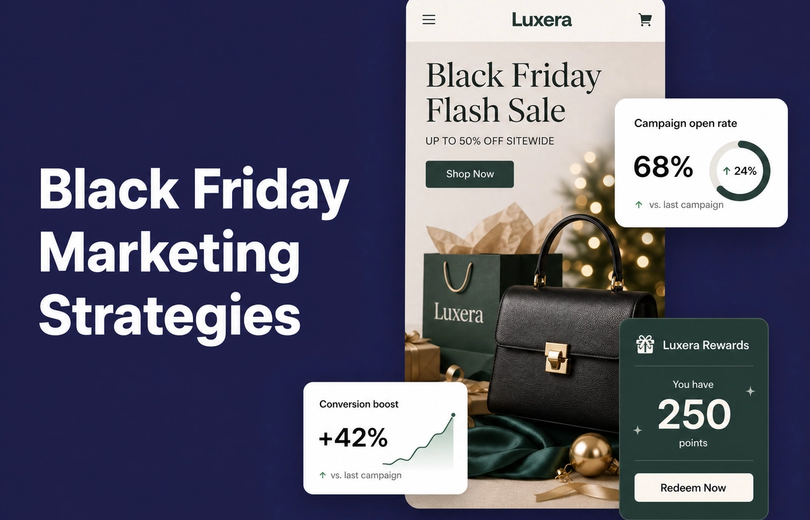
The business case for loyalty-first Black Friday comes down to one metric: loyalty members spend 42% more during BFCM than non-members. But that statistic misses the real insight.
What loyalty actually does during peak season is shift your value proposition away from price and toward experience. Instead of competing on "who has the lowest price," you're competing on "who has the most exclusive access and rewards."
Here's what changes when you lead with loyalty:
You attract the right customers. Early access programs pull in repeat buyers, not deal hunters. These people already know your brand. They're less price-sensitive and more likely to stay. One retention manager told me that their VIP early access program attracted customers with 2.3x higher lifetime value than their general BFCM traffic.
You compress acquisition costs. Loyal members refer friends during BFCM at higher rates than any other time of year. When you boost referral rewards during peak shopping season, your best customers become your marketing department. One fitness brand I consulted with saw referral conversions spike 67% during BFCM when they doubled referral rewards—no paid ad increases required.
You maintain pricing power. When your program offers genuine scarcity (early access that's only for VIPs, limited-time rewards that expire), you don't need to slash prices to create urgency. The urgency is built into the program structure itself.
You extend the selling season. BFCM isn't just four days anymore. When you run bonus point campaigns and exclusive reward windows, you extend engagement across the entire holiday period. October becomes a pre-season enrollment push. December becomes a redemption event. Revenue spreads across weeks instead of concentrating in a frantic weekend.
Increasing Customer Lifetime Value through loyalty doesn't just win Black Friday—it rewires your entire customer economics.
Step 1: Laying the Groundwork (Start in October, Not November)
Most merchants start their Black Friday planning in early November. That's already too late.
Setting up your loyalty program for peak season begins in October. Here's why: you need time to build anticipation, enroll new members, and establish the habit of checking loyalty status before these customers see your competitors' flash sales.
Optimize your current program first. Review everything. Are your point-earning rates clear? Can customers understand what they'll get for 100 points without doing math? Is your VIP tier structure compelling enough to motivate progression? One brand I worked with discovered their Bronze tier offered almost identical benefits to their free membership tier. They redesigned it, and tier advancement nearly doubled.
Build visibility into your program. Loyalty doesn't work if customers forget it exists. Add a prominent loyalty badge to your header navigation. Include loyalty program links in your footer. Send a reminder email in early October to lapsed members showing them their dormant points. This small nudge often reactivates 12-15% of inactive members weeks before the rush.
Start your teaser campaigns in early October. Email your list: "This Black Friday will look different. Our VIP members are getting 48-hour early access to every sale, plus double points all weekend." This primes both existing members and skeptics to enroll. The psychological effect is real—people don't want to feel like they're missing exclusive access.
Offer enrollment bonuses specifically for October. "Join by October 31st and get 500 bonus points to spend during Black Friday." This creates a mini-deadline that converts fence-sitters. One ecommerce director saw their pre-BFCM enrollment jump 34% by running a two-week "Black Friday Early Access Enrollment" campaign with a 500-point bonus attached.
Step 2: Early Access as Your Primary Competitive Advantage
Here's where many brands accidentally sabotage themselves: they offer early access to "everyone who joined the loyalty program" and then wonder why it feels diluted.
VIP early access only works when it's actually exclusive.
Structure it like this:
Tier-based access windows. Your highest-value VIPs get access 72 hours before anyone else. Mid-tier members get 48 hours. Newer members get 24 hours. Everyone eventually gets access, but the progression incentivizes tier advancement all year. One beauty brand I consulted with saw customers deliberately spending to reach their next tier specifically to get extended early access during BFCM.
Communicate the exclusivity relentlessly. Your VIP members need to feel genuinely special. Send them personalized emails: "As a Gold member, you have first dibs on our entire Black Friday collection starting Friday, November 17th at 12am ET—48 hours before anyone else." Then follow up post-access: "Our Gold members claimed 34% of our top 10 products during early access. Thank you for your loyalty."
Use early access as a referral hook. Encourage your VIP members to tell friends: "Tell someone about early access, and when they join, you both get 250 bonus points." Early access is such a compelling benefit that it drives viral referrals. Members become your marketing team.
Make redemption frictionless. The moment a VIP member clicks their early access link, they should land on a landing page showing exactly what's new, in what sizes/colors are available, and how much each purchase will add to their points. Friction kills conversion during peak season.
Step 3: Bonus Points Campaigns That Increase AOV Without Discounting
This is where you stop competing on price and start competing on value perception.
Instead of "40% off everything," run "Triple Points on all purchases through Monday." Both create urgency. Only one erases your margins.
The mechanics of a multiplier campaign. Your standard earning rule might be "1 point per $1 spent." During BFCM, you shift it to "3 points per $1 spent"—but only during specific windows (Friday 12am-6pm ET, Saturday 12am-6pm ET, etc.). This creates concentrated urgency. Customers who might have spread their purchases across November now compress them into your peak windows.
Layering spend-based bonuses. Multiply that effect with tiered rewards: spend $100 and get 500 bonus points on top of your earned points. Spend $250 and get 1,500 bonus points. This is psychologically different from a discount because it feels like a reward for loyalty, not a markdown. AOV almost always increases because customers consciously try to hit the next tier.
One athleisure brand ran this exact structure:
- Spend $75: 250 bonus points
- Spend $150: 750 bonus points
- Spend $300: 2,000 bonus points
Their average order value during that BFCM campaign jumped from $127 to $189—a 49% increase. No discount. Pure loyalty psychology.
[CTA]
Category-specific point multipliers. Use bonus points to strategically move inventory. If you're overstocked on certain product lines, run "5x points on [category] through Sunday." This redirects purchasing power without slashing prices. One home goods brand used category multipliers to clear 23% more seasonal inventory during BFCM than they cleared the previous year.
Time-window scarcity. Don't run triple points all week. Run them for 6-hour windows. "Triple points Friday 12pm-6pm EST only" creates concentrated urgency that actually moves the needle. Customers check in multiple times. They clear their schedule. They tell friends.
Implement strategic bonus point campaigns around your highest-traffic periods to maximize engagement without discounting.
Step 4: Limited-Time Rewards That Drive Redemption and Engagement
Here's a contrarian take: most brands create loyalty programs but never really expect customers to redeem points. They treat points like a loyalty placebo—nice to have, but not central to the customer experience.
That's a missed opportunity during BFCM.
Flash rewards create urgency to redeem. Instead of offering "Redeem 100 points for $10 off—valid anytime," try "Redeem 150 points for $25 off—valid only through November 30th." The limited window dramatically increases redemption rates. One retention manager saw point redemptions increase 156% when they introduced time-bound flash rewards during their BFCM campaign.
The psychology here is straightforward: customers don't want to feel like they wasted points. When a reward expires, they act.
Create exclusive BFCM rewards. Offer things during Black Friday that aren't available year-round. A limited-edition product. A $50 credit (worth 200 points) that's only redeemable on bestsellers. Free shipping on any order (worth 300 points). A 1-hour private shopping consultation with your team.
These exclusive offerings do something standard rewards can't: they make customers feel like they're getting something genuinely special that other people don't have access to. This strengthens emotional loyalty.
Offer experiential rewards alongside discounts. Points should be redeemable not just for products but for experiences. A skincare brand could offer "Redeem 500 points for a personalized skincare consultation + a curated sample set" (cost: $15 to you, perceived value: $80). A fashion brand could offer "Priority access to our January sale + styling tips from our creative director." The ROI on these experiential rewards is often higher than simple discounts.
Step 5: Amplify Referrals During Peak Season
Your best customers are powerful acquisition tools when you incentivize them properly during BFCM.
Increase referral rewards for Black Friday only. Your standard referral might be "You get 100 points, your friend gets $15 off." For BFCM, double it: "You get 250 points, your friend gets $30 off." This doubling effect creates urgency on both sides—members want to cash in on the higher payout, and their friends feel like they're getting a genuinely generous offer.
One fitness brand saw referrals spike 78% when they boosted referral rewards by just 50% during BFCM. The cost per acquisition via referral remained lower than paid ads, and the referred customers had 31% higher lifetime value than their average BFCM traffic.
Boosted referral rewards become part of your BFCM marketing message. Don't keep this quiet. Email your members: "For the next 30 days, earn 250 points every time a friend makes their first purchase using your referral link. That's 2x the normal bonus—and it's the perfect time to share with family and friends doing their holiday shopping."
This positions referrals as a normal, encouraged behavior instead of something members have to discover on their own. You'll see participation jump.
Automate referral communication around milestone purchases. When a member hits a certain purchase threshold during BFCM (say, $300 spent), automatically send them: "You've earned enough points for [reward]. While you're here, did you know you can earn 250 points by referring a friend? Your referral link is [link]." You're capitalizing on the momentum of their engagement.
Step 6: Personalization That Feels Like You Know Them
Generic Black Friday emails don't work anymore. Personalization does.
Segment your audience strategically. You should have at least four segments:
- High-value repeat customers (who love your brand and spend regularly)
- New members (enrolled in past 60 days)
- At-risk customers (haven't purchased in 90+ days)
- One-time buyers (single purchase, no loyalty enrollment)
Each segment gets a completely different BFCM message.
High-value repeats: "You get 48-hour early access starting Thursday. Here's what our team thinks you'll love [personalized recommendations based on past purchases]."
New members: "You joined 30 days ago. This is your first Black Friday with us—let's make it count. Here's 500 bonus points to celebrate."
At-risk customers: "We miss you. Come back for BFCM and get 24-hour early access plus 2x points. Here's everything new since you last shopped."
One-time buyers: "Welcome to our loyalty program. Join today and get $15 off your Black Friday purchase plus exclusive member perks year-round."
Each message is tailored. Each feels personal. Conversion rates on personalized BFCM emails are typically 2-3x higher than generic campaigns.
Leverage purchase history for product recommendations. A customer who bought running shoes in March gets an email featuring running accessories and apparel during BFCM. A customer who bought skincare gets offered haircare and supplements. Amazon built a $2 trillion company on this principle. It works.
Omnichannel loyalty integration ensures consistency across online, mobile, and physical touchpoints. If you have retail locations, your loyalty members should see the same perks both in-store and online. This consistency reinforces the value of membership.
Step 7: The Often-Forgotten Advantage—Post-Purchase Optimization
Your Black Friday loyalty strategy doesn't end on Cyber Monday. In fact, that's when many brands lose the biggest opportunity.
Transform the post-purchase moment into a loyalty milestone. Your order confirmation email shouldn't just confirm order details. It should celebrate the purchase: "Thank you for shopping with us during our Black Friday celebration. You earned 487 points—that's just 63 points away from a $50 reward. [See what else you can redeem]."
This immediate reinforcement—showing the customer the tangible value they just earned—increases their emotional investment in the program.
Invite first-time BFCM buyers to join your loyalty program post-purchase. You just convinced someone to buy. Don't let them leave without joining your loyalty program. Send a post-purchase email: "First-time with us? Join our loyalty program and get 250 bonus points right now—plus ongoing rewards every time you shop." Conversion rates on post-BFCM enrollment emails are typically 15-25% because the customer already trusts you enough to buy.
Use returns as a retention opportunity, not a transaction burden. When a BFCM customer initiates a return, don't just process it. Send them an email: "We're processing your return. As a thank-you for shopping with us, we're adding 100 loyalty points to your account to spend on your next purchase." This transforms a potential negative experience into a positive brand interaction.
Incentivize reviews and user-generated content. "Leave a review of your Black Friday purchase and earn 50 points. Add photos and earn 75 points." By late November, you'll have a treasury of customer photos and reviews that serve as social proof for January and beyond.
Beyond Points: Why Transaction-Obsessed Programs Miss the Modern Customer
Here's where I'm going to push back on conventional loyalty thinking.
If your loyalty program is only about earning points on purchases, you're competing on the wrong dimension. And you're especially losing younger customers—Gen Z and younger millennials—who don't actually want more points. They want connection.
This is backed up by data from Salesforce research showing that 68% of Gen Z would choose a brand that offers a sense of community over one that just offers rewards. Transaction-based points feel transactional. Community feels like belonging.
The smartest BFCM loyalty programs don't stop at points. They add:
Exclusive community access. A private Discord or Facebook group where members discuss product recommendations, styling, or usage tips. Members moderate. Your team participates but doesn't sell. This creates a moat around your brand that competitors can't easily replicate.
Early input on product development. Let your VIP members vote on new products, colors, or features. This is genuinely inexpensive for you and makes members feel like insiders. One skincare brand saw member engagement increase 41% when they involved VIPs in choosing three new product launches.
Behind-the-scenes content. Show your members how products are made, introduce your team, share your brand story. This humanizes your company and deepens emotional loyalty in ways that a 10% discount never could.
The brands winning BFCM today aren't the ones with the deepest discounts. They're the ones who've built programs that answer a deeper customer question: "Do you actually see me? Do I matter to you beyond the transaction?"
Measuring Success: The Metrics That Matter Beyond Sales
Most merchants measure BFCM success solely by revenue. That's incomplete.
Here's what you should actually track:
Customer Lifetime Value of BFCM loyalty members vs. non-members. This is the metric that actually predicts long-term profitability. If a BFCM loyalty member spends $800 on average during BFCM but has a 3-year CLV of $2,400, while a non-member spends $850 during BFCM but has a 3-year CLV of $900, your loyalty program won, even though the one-time transaction was lower.
Repeat purchase rates post-BFCM. Track what percentage of new BFCM customers purchase again in December, January, February. This is your real measure of whether you converted people into customers or just extracted one sale.
Loyalty program enrollment during BFCM. How many new members did you add? What percentage of your BFCM traffic joined? One brand I worked with enrolled 34% of their BFCM traffic into their loyalty program—that's 34% of BFCM shoppers now receiving ongoing communications, referral incentives, and retention offers.
Average order value of loyalty members vs. non-members during BFCM. Mage's data shows loyalty members typically spend 1.5x-2x higher AOV than non-members. If your loyalty members are spending 20% more than non-members, your program isn't optimized yet.
Point redemption rates. Are members actually using their points, or are points just accumulating? If redemption is below 40%, your rewards aren't compelling enough. If it's above 60%, you might be giving points away too liberally.
Referral conversion during BFCM. How many referred customers did you acquire? What was their quality compared to paid ads? This tells you whether your referral incentives are actually working or just becoming a discount in disguise.
Operational Checklist: The Logistics You Can't Forget
Mobile-first everything. By BFCM 2025, 79% of ecommerce traffic will come from mobile. Your loyalty program portal needs to be lightning-fast on mobile. Customers checking their points balance shouldn't wait 3 seconds for a page to load. Every millisecond counts.
Prepare your support team. Train customer service reps on your BFCM loyalty offers before the rush. They'll get questions like "I didn't get my early access email" and "Can I combine my loyalty discount with the BFCM sale?" Have answers ready.
Test everything in advance. Run a full test of your loyalty program, email sequences, and bonus campaigns with a small segment two weeks before BFCM. You'll catch technical issues before they kill revenue.
Plan your inventory for peak demand. If you're offering bonuses for specific products, make sure you're stocked up. Nothing kills loyalty faster than a member trying to use their bonus points and finding out items are out of stock.
Prepare for payment processing delays. BFCM creates payment processing bottlenecks. If your loyalty program relies on real-time point issuance, have a backup plan.
Frequently Asked Questions
How can I protect my profit margins during Black Friday?
Focus your BFCM strategy on loyalty perks that add value without cutting prices. Bonus points, early access, exclusive limited-time rewards, and VIP tiering create urgency and incentivize spending without requiring you to discount. These approaches typically protect margins better than blanket discounts while attracting higher-quality customers who stick around after November.
When should I start preparing my Black Friday loyalty campaign?
Begin planning and promotion in early October—at least two months before BFCM. This gives you time to optimize your loyalty program, enroll new members, and build anticipation through teaser campaigns. Brands that start in October typically see 2-3x higher pre-BFCM enrollment than those starting in November.
What are some alternatives to deep discounting during BFCM?
Consider these proven alternatives: bonus point multipliers (2x or 3x points), VIP early access windows, tiered spend-based rewards ("spend $150, earn 500 bonus points"), limited-time exclusive rewards, referral incentives, and free shipping for members. These create urgency and incentivize purchases without eroding margins the way blanket discounting does.
How do I track whether my BFCM loyalty program actually worked?
Track three key metrics beyond just revenue: repeat purchase rates of BFCM loyalty members (compare to non-members), average order value of loyalty members, and customer lifetime value of members acquired during BFCM vs. other acquisition channels. Also measure loyalty enrollment rates during BFCM and post-purchase join rates. These reveal whether you built lasting customer relationships or just extracted one-time transactions.
What if my existing loyalty program isn't set up yet?
Start immediately but keep it simple: create a basic points system (1 point per $1 spent), set one clear reward tier ($50 off for 500 points), and promote early access for members only. You don't need a perfect program to start capturing the value of loyalty during BFCM. You can refine and expand after the holiday season.
Which platforms should I use to run a BFCM loyalty program?
If you want Shopify POS omnichannel support, look for platforms that emphasize that capability. Most offer free trials—test with a small campaign before going all-in.
TLDR
Loyalty programs transform Black Friday from a margin-destroying discount race into a profitable customer acquisition and retention engine. Start in October with enrollment campaigns and teaser promotions. During BFCM, lead with VIP early access, bonus point multipliers (instead of price cuts), limited-time exclusive rewards, and boosted referral incentives. Personalize communications by customer segment, optimize the post-purchase experience to drive ongoing engagement, and measure success by repeat purchase rates and customer lifetime value—not just one-time revenue. This approach attracts genuine customers, protects margins, and builds relationships that generate value far beyond November.

Kris is the co-founder of Mage Loyalty. I spend most days talking to merchants, and making sure our customers get real results. If you run a Shopify store or Agency we should chat!