Most merchants think a referral code is just a discount code wearing a friendship bracelet. It is not. The discount is the cheap part. The valuable part is invisible.
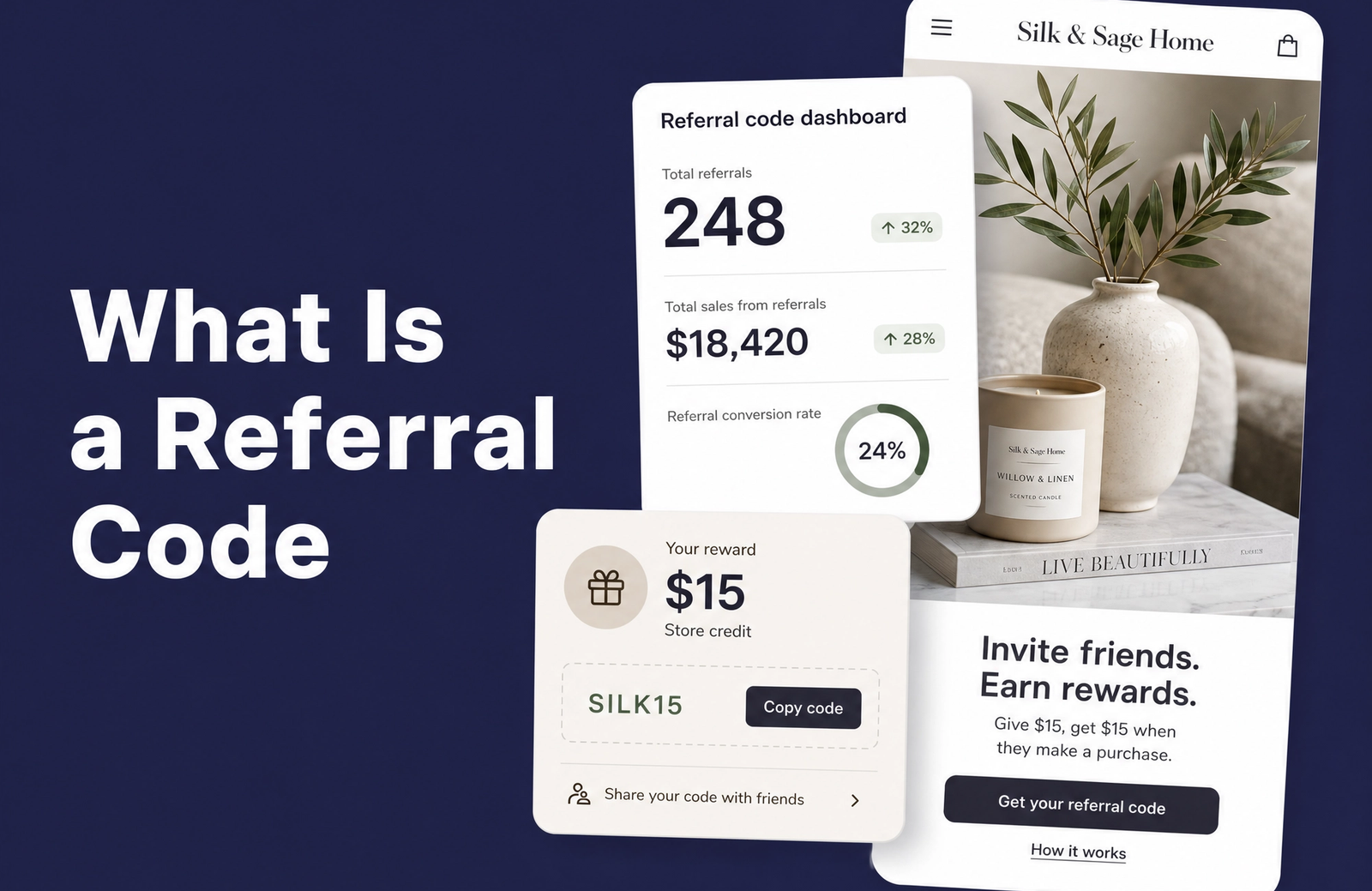
A referral code is a unique alphanumeric identifier assigned to an existing customer (or advocate) that, when entered by a new buyer at signup or checkout, attributes that purchase back to the referrer and triggers a reward for both people. Unlike a generic coupon, it is tied to one named individual, so you can see exactly who drove each sale.
That distinction sounds academic until you watch what it does to your acquisition math. So let us pull the thing apart: what a referral code actually is, how it differs from the coupon it gets confused with, how the mechanics work under the hood, the formats it comes in, and how to set one up on Shopify without lighting your margin on fire.
What Is a Referral Code, Exactly?
A referral code is a personalized tracking token. Think of it less like a coupon and more like a name tag stapled to a sale. When a friend uses Sarah's code, your system does not just apply a discount. It records that Sarah caused this customer to exist.
Here is the analogy we keep coming back to. A coupon code is a billboard: anyone who drives past can use it, and you have no idea who saw it. A referral code is a handshake: it only works because one specific person passed it to one specific other person, and you know both of their names.
That naming is the whole point. A generic code like SUMMER20 reduces your margin and tells you nothing about the human who drove the sale. A referral code like SARAH-JONES reduces margin too, but it also builds a named causal chain. You learn who your best advocates are, you can measure acquisition cost per channel, and you only pay the reward when a real purchase happens, not when a code gets shared into the void.
Most referral programs are double-sided, meaning both people get something. Dual-sided structures, where the referrer and the referred customer each receive a reward, are now the norm because they consistently outperform single-sided ones on participation. The reward for the new buyer lowers the risk of trying you. The reward for the advocate keeps them sharing.
If you want the broader strategic picture, our referral program guide covers how codes fit into a full referral motion.
Referral Code vs Coupon vs Discount vs Affiliate Link
This is where the myth lives, so let us kill it plainly. People treat "referral code" and "discount code" as synonyms. They are not the same tool, and confusing them costs merchants money.
Here is what each one actually does:
Coupon or promo code: A shared code (SUMMER20) usable by anyone, with no attribution. It moves margin but gives you zero insight into who drove the sale.
Discount code: A subtype of coupon. It changes the price. That is all it does.
Referral code: A unique, person-bound code that both attributes the sale to a named advocate and triggers conditional rewards on conversion. The discount is optional. The attribution is the product.
Affiliate link: Similar attribution mechanics, but usually for non-customers (publishers, influencers) paid a commission rather than a store reward. A referral code turns your existing customers into the salesforce.
The line that matters: a coupon is anonymous and unconditional, a referral code is named and conditional. Put in one sentence, a coupon reduces price for anyone, while a referral code reduces price for a specific friend and tells you which customer sent them. Same discount, completely different intelligence. You can strip the discount out of a referral code entirely and it still works, because the trust that travels with a personal recommendation does the heavy lifting. We will get to the proof of that in a minute.
For a deeper comparison of code structures and program types, see our complete Shopify referral program guide.
The Shopify loyalty program growing brands trust
See how Mage helps Shopify brands lift repeat purchase rate with loyalty, referrals and store credit.
Book a demoHow a Referral Code Works Mechanically
Under the hood, a referral code runs through four stages. None of them are complicated, but each one is where most homemade programs quietly break.
Stage one: unique code generation
When a customer joins your referral program, the system mints a code tied to their account. It might be human-readable (SARAH-JONES), randomized (RFL-8K2QX), or wrapped inside a shareable link. The code is stored against the referrer's customer record so every future use traces back to them.
Stage two: attribution
This is the engine. When a new visitor clicks a referral link or types a code, the platform sets a tracking cookie and, ideally, logs a server-side record so the attribution survives even if cookies get cleared. At checkout, the code is matched to the referrer. The sale is now stamped with a name.
Stage three: fraud detection
Because rewards have real value, people game them. Good systems watch for self-referrals, IP velocity (one address firing dozens of signups), and device fingerprints that suggest one person wearing many hats. Fraud protection is the unglamorous feature that separates a real referral platform from a spreadsheet, and it is why merchants outgrow DIY discount-code hacks fast.
Stage four: automatic reward disbursement
Once the referred purchase clears (and clears any return window you set), both parties get paid: store credit, points, a discount on the next order, or in some cases cash. Crucially, rewards fire on conversion, not on sharing. You never pay for a code that did not produce a sale. The smart move here is to disburse rewards only after your return window closes, which stops refund-and-keep-the-reward abuse without annoying honest customers.
“Cannot say enough good things about the team at Mage Loyalty, one of the absolute best organizations we have ever worked with, full stop! So glad we connected with them, completely redid our loyalty program, new concepts, use of loyalty, increasing user engagement, showing us where we were not valuing our best customers, just WOW, amazing team!”


Read the West Coast Goalkeeping case study →
Why Referral Codes Drive Ecommerce Sales
Now the part your CFO cares about. Referral codes are not a feel-good tactic. They are some of the cheapest, highest-converting acquisition you can build.
Start with trust. 92% of consumers trust recommendations from friends and family above all other advertising, per Nielsen's Global Trust in Advertising study. That trust shows up in behavior: referred customers are 4 times more likely to purchase than non-referred visitors, and referral leads convert about 30% better than leads from any other channel.
Then look at cost. Companies running referral programs see a 24% reduction in customer acquisition costs. The average CAC from referral and affiliate channels in ecommerce is around $45, versus $74 for paid search and $87 for influencer marketing. Same dollar, very different return.
The compounding is what makes it dangerous (in a good way). Referred customers carry 16% higher lifetime value than comparable non-referred buyers, retain at 37% higher rates, and generate 30 to 57% more referrals themselves. You are not buying a customer. You are buying a customer who buys you more customers. Strong programs end up capturing 10 to 30% of total store revenue.
Conversion rates vary widely by category, so set expectations accordingly. Verticals like pet, food, and health products tend to post the strongest referral conversion rates, while higher-consideration categories such as electronics and beauty typically convert lower. Benchmark against your own category, not a blended industry average.
This is exactly why we treat referrals as core retention infrastructure rather than a bolt-on, and why a Shopify referral program sits alongside loyalty in the same system.
A real example: Dropbox proved the discount is optional
Here is the case study that should reframe how you think about codes. Dropbox grew from 100,000 to 4 million users in 15 months, a 3,900% jump, on a double-sided referral program. The reward was not money or a discount. It was 500 MB of extra storage for both the referrer and the friend.
At peak, 35% of daily signups came through referrals. Dropbox estimated it saved roughly $48 million in paid acquisition versus its Google Ads, which had been costing $233 to $388 per customer for a $99-a-year product. The viral coefficient hit 0.35 with essentially no ad spend.
The lesson is not "copy Dropbox." It is that the storage reward had no discount component at all, and the program still buried paid search on cost. The attribution and the peer trust did the work. The reward just kept the loop spinning. When we tell merchants the discount is incidental, this is the receipt.
Types of Referral Codes
Referral codes ship in a few formats, and the right one depends on where your customers actually share.
Personal alphanumeric codes: Human-readable codes like SARAH-JONES, typed in at checkout. Memorable, brand-friendly, and easy to say out loud, but they add a manual step.
Referral links: A URL with the code baked in. Clicking auto-applies the code at checkout, removing the friction of manual entry. This is the dominant format for email, SMS, and social sharing, and the reason most modern programs lead with links.
QR codes: A referral link encoded as a scannable image. Underused, and a quiet advantage for merchants with any physical footprint. Print one on packaging inserts, receipts, or in-store signage and you turn offline moments into tracked online referrals. If you sell through Shopify POS, this is low-hanging fruit.
Most programs combine all three: a personal code for word of mouth, a link for digital sharing, and a QR variant for packaging and retail. For more on turning customers into sharers, our piece on word-of-mouth ecommerce marketing goes deeper.
How to Set Up a Referral Code on Shopify
You do not need to build attribution from scratch. Most Shopify merchants run referral codes through a loyalty or referral app that handles generation, tracking, fraud checks, and payouts.
Here is the setup we would recommend, in order:
First, pick your reward structure. Default to double-sided (reward both people), since it lifts participation by 45%. Decide between a fixed discount, store credit, points, or cash.
Second, choose the reward type deliberately. This matters more than merchants expect. Dockatot, a Shopify baby brand, originally gave referrers a 10% store coupon, then switched to $5 cash per successful referral and saw the program perform meaningfully better. Test it. The code is the same; the reward changes everything.
Third, set guardrails. Apply a reward delay until your return window closes, turn on fraud detection, and consider expiry. Outdoor Voices gives both sides $20 off orders over $100 but expires referral links after two weeks, deliberately creating urgency and preventing code-hoarding.
Fourth, decide on a milestone layer if it fits your category. Riff Raff & Co, a Shopify baby brand, gives a free toy (around AUD $65) when a customer refers five friends, with each friend getting free shipping. Milestone rewards drive sustained sharing, not one-and-done.
Fifth, make sharing frictionless. Lead with auto-applying referral links, surface the code in account pages and post-purchase emails, and stack it with other offers where it makes sense (Alo Yoga pairs a referral link with a separate newsletter discount).
One rule sits above all of these: do not reward on share, reward on sale. If your setup pays out when a code is shared rather than when a referred order converts and clears, you are funding fraud. Always tie disbursement to a completed, non-refunded purchase.
Referral codes also pair naturally with points and tiers, so if you are building the wider engine, see how a Shopify loyalty program connects the two, and our referral program best practices for the finer tuning.
The Contrarian Take: Stop Optimizing the Discount
Here is where we will disagree with most advice you will read. Merchants obsess over the discount size in a referral code. How much off? 10%? 20%? Free shipping?
Wrong question. The discount is the least important variable. The attribution is the asset.
When you treat a referral code as a discount tool, every decision points toward shrinking margin to juice volume. When you treat it as attribution infrastructure, you start asking better questions: which customers are my real advocates, what is my true CAC per channel, and how do I reward the loop without subsidizing fraud. Dropbox kept the discount at zero and still beat paid search. That should end the argument.
Build for attribution first. The discount is just the grease, not the engine.
Frequently Asked Questions
How does a referral code work?
A referral code works by tying a unique identifier to one customer's account. When a friend enters the code or clicks the referral link, your system attributes the sale to that customer via cookie and server-side tracking, then automatically disburses a reward to both people once the referred purchase clears.
What is the difference between a referral code and a promo code?
The difference is attribution. A promo code (like SUMMER20) is anonymous and usable by anyone, so it only changes price. A referral code is bound to one named customer, tracks exactly who drove each sale, and triggers rewards on conversion. The discount is incidental; the tracking is the real function.
How do I find my referral code?
You find your referral code inside your account on the store's website, usually under a "Refer a friend" or "Rewards" section, after you have made a purchase or joined the loyalty program. Many stores also email your unique code and shareable link directly after signup or your first order.
Do referral codes give discounts to both people?
Most referral codes give a reward to both people, because 78% of programs use a double-sided structure. The referred friend typically gets a discount on their first order, while the referrer earns store credit, points, or cash once that order clears. Double-sided rewards lift participation by about 45%.
Can a referral code be used more than once?
Yes, a referral code can usually be used many times, but only by new customers, not repeatedly by the same person. The referrer's single code can be shared with unlimited friends, and each new buyer who uses it triggers a fresh reward, while fraud checks block self-referrals and duplicate-account abuse.
What is the best way to set up referral codes on Shopify?
Choose a double-sided reward, delay payouts until the return window closes, and enable fraud protection.
TLDR
A referral code is a unique, person-bound identifier that attributes a new sale to the customer who drove it and rewards both sides on conversion, which makes it fundamentally different from an anonymous coupon. The discount is incidental; the attribution is the asset. Referral codes work through code generation, cookie and server-side tracking, fraud detection, and automatic reward disbursement. They convert referred buyers 4 times better than cold traffic, cut CAC to around $45 versus $74 for paid search, and lift lifetime value 16%. Dropbox proved the discount is optional, growing 3,900% on a storage-only reward. On Shopify, run codes through a loyalty or referral app, default to double-sided rewards, pick the reward type deliberately, and pay out only after a referred order clears.

Kris is the co-founder of Mage Loyalty. I spend most days talking to merchants, and making sure our customers get real results. If you run a Shopify store or Agency we should chat!