A Monday report shows two very different order patterns. Individual shoppers redeem a reward at checkout, while wholesale orders sit in draft review under company payment terms. B2B vs DTC loyalty programs need different rules because the buyer, reward owner, and final purchase event are rarely the same.
Short answer: A B2B loyalty program is built around business accounts, buying roles, negotiated economics, and longer approval or reorder workflows. A DTC program usually serves an individual shopper with a faster purchase loop. Hybrid brands should share the loyalty foundation where it reduces admin work, then separate eligibility, reward logic, messaging, and measurement for each audience.
What is a b2b vs dtc loyalty program, and why does the distinction matter?
B2B loyalty is account-led; DTC loyalty is usually person-led
A DTC loyalty program typically follows one customer account. That person earns rewards, receives messages, and decides whether to redeem on a personal purchase.
A B2B loyalty program must account for the company creating the commercial value. The person placing an order may be a buyer, but an approver, finance contact, store manager, or company owner may influence the purchase and benefit from it differently.
The same retention goal sits underneath both models
Both models aim to encourage valuable repeat behavior, such as a faster reorder, a larger basket, a referral, or a higher-value customer relationship.
A Shopify loyalty program can provide shared mechanics including points, store credit, VIP tiers, referrals, rewards, and checkout redemption. The commercial logic still needs to match the audience.
Myth: B2B loyalty is just consumer points with larger order values
Larger baskets are not the defining difference. B2B loyalty changes who owns the reward, which order event counts, whether pricing is negotiated, and how a reward is approved.
A wholesale apparel supplier might reward a boutique account for approved seasonal orders while giving DTC shoppers points for personal purchases. Putting both groups into one identical points catalog creates confusion before it creates retention.
What stays the same across B2B and DTC loyalty programs?
The retention job
Start with the commercial behavior you need more of. For DTC, that may be a second order or a referral. For B2B, it may be a shorter reorder cycle, broader purchasing across locations, or greater consistency from an existing account.
Enrollment is not the goal. The goal is profitable behavior that would otherwise be less likely to happen.
The behavior-first design process
Both audiences need clear answers to the same questions:
- What action earns value?
- Who is eligible?
- What does the reward cost?
- When can it be redeemed?
- What happens after a cancellation, refund, or return?
A reliable identity model and event source matter in both cases. If an order is refunded, the loyalty balance should reflect that. Mage reverses points proportionally on partial refunds and rounds down.
The need for clear value and low-friction redemption
Customers should understand the value without reading program terms like a contract. A DTC shopper may want a straightforward checkout reward. A wholesale buyer may need to know whether an account credit applies to its catalog, payment terms, or next approved order.
“I looked into so many different integrations for loyalty and referrals for our Shopify Store, but no one impressed me more than Mage on human connection, customer service, and value.”


Read the Reelie case study →
How account structure changes between B2B and DTC loyalty

| Dimension | DTC loyalty | B2B loyalty | Hybrid design implication |
|---|---|---|---|
| Primary loyalty object | Individual customer | Company or company location | Define the commercial owner |
| Buyer identity | One shopper | Buyer, approver, recipient, account owner | Store role and account context |
| Reward owner | Usually the individual | Company, location, individual, or mixed | Document ownership before launch |
| Purchase cycle | Direct and usually fast | May involve drafts, terms, and approval | Set a final earning event |
| Key data fields | Customer ID and channel | Company ID, location ID, buyer ID, role, channel | Keep reporting segments explicit |
DTC: one customer, one account, one primary decision-maker
For DTC, the customer account is usually the practical unit for earning, communication, personalization, and redemption. A shopper creates an account, buys, earns points, and sees available rewards tied to that account.
Mage Accounts can present this information in a branded on-site drawer. It sits on top of Shopify customer accounts and can show loyalty content, rewards, order history, and profile details.
B2B: company, location, buyer, approver, and recipient
Shopify organizes B2B customers into companies and company locations, where customers, catalogs, prices, payment terms, and checkout settings can be assigned.
A company can have several locations and several people ordering. If rewards belong only to an individual buyer, they can become difficult to manage when that person changes roles. If rewards belong only to the company, the individual buyer may have little reason to engage.
Choose the reward owner before choosing the reward
Define whether value belongs to the company, the location, the buyer, or a combination. Then capture the fields needed to support the decision: channel, customer type, company ID, company location ID, buyer ID, approval role, reward owner, and order source.
Mage does not automatically create company-level B2B reward ownership. Treat that as a merchant design decision, supported by the right Shopify data and, where needed, custom integration work.
Which rewards suit business buyers versus DTC shoppers?
| Reward or benefit | Best fit | Behavior encouraged | Key guardrail |
|---|---|---|---|
| Account credit | B2B | Repeat approved purchasing | Confirm ownership and eligibility |
| Fixed discount | DTC | Faster repeat purchase | Protect minimum margin |
| Free shipping | Both | Basket completion or reorder | Set product and order conditions |
| Free product | DTC | Product discovery and engagement | Control inventory exposure |
| Tier benefits | Both | Consistent spend and repeat behavior | Use thresholds that fit the buying cycle |
| Early access | Both | Launch engagement and retention | Match access to audience needs |
| Samples or education | B2B | Product adoption and confidence | Define fulfillment and cost owner |
| Referral reward | Both | Qualified acquisition | Delay rewards where needed |
B2B rewards: commercial utility, access, and enablement
Business buyers often value benefits that make purchasing easier or commercially useful. Account credit, reorder incentives, free-shipping thresholds, early inventory access, samples, product education, priority service, and account-level tier benefits can all fit.
The right choice depends on margin, buying cadence, negotiated pricing, and the behavior you want to change. A percentage discount may be hard to control where a company already has contract pricing. A reorder credit or access benefit may be easier to explain and govern.
DTC rewards: immediacy, discovery, and personal value
DTC rewards can be more personal and immediate. Mage supports points, store credit, fixed and percentage discounts, free shipping, free products, flexible redemption, VIP tiers, and referrals.
Birthday rewards, review rewards, early access, wishlist prompts, and a simple free-product reward can work when they match the product category. High-AOV or low-frequency categories may need status, anniversary benefits, or access rewards instead.
Mage’s loyalty store-credit mode is a Mage ledger, not Shopify-native store credit. Read points versus store credit carefully before choosing the currency customers will see.
Use a reward matrix instead of one universal catalog
Ask which action creates profitable retention, what it costs, and who can use it.
That is why discounts versus points should be treated as an economics question. Timing, eligibility, and margin impact matter more than the label on the incentive.
How approval workflows change the earning and redemption rules
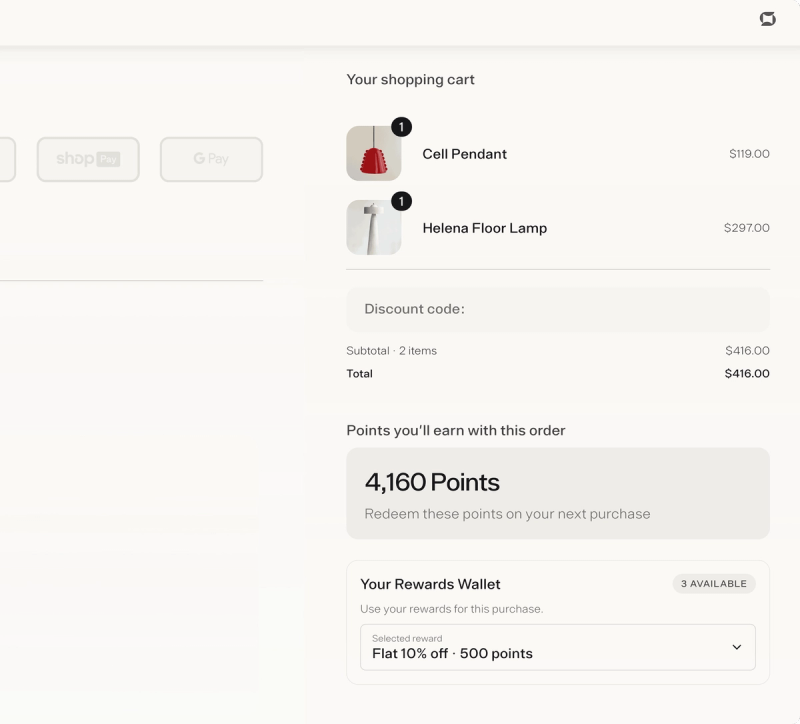
DTC: reward after a completed purchase event
A DTC order often has a simple path from payment to fulfillment. Merchants should still decide whether points are issued when an order is paid, fulfilled, or outside the return window.
B2B: distinguish submitted, approved, paid, fulfilled, and returned orders
Shopify B2B orders can be submitted as drafts for review or automatically submitted. Company locations can also use payment terms and deposits and catalog assignments.
That means “order placed” may not be the event that should earn a reward. A merchant may choose approval, payment received, fulfillment completed, or the close of a return window as the loyalty trigger.
Prevent unapproved or reversed value from paying out
For high-value wholesale orders, reward only when the commercial value is sufficiently final. Check eligible order status, minimum margin, payment status, returns, partial refunds, canceled drafts, duplicate orders, and manual adjustments.
Mage can support configurable reward timing for referrals, including a delay after the return window. It should not be assumed to automatically understand Shopify B2B approval states. Use a verified event source, Shopify Flow, or a custom action when approved behavior must trigger loyalty value.
How to run a hybrid loyalty program without confusing either audience
| Program layer | Shared across audiences | Separated by audience | What to document |
|---|---|---|---|
| Identity | Customer and order records | Company, location, buyer role | Reward owner |
| Earning rules | Core event accounting | Eligible channels and order types | Trigger event and exclusions |
| Rewards | Ledger and redemption controls | Catalog, value, and access | Margin and usage conditions |
| Messaging | Brand voice and support context | Buyer language and timing | Audience and redemption terms |
| Reporting | Core loyalty data | B2B and DTC cohorts | Segment definitions |
One program architecture, two audience experiences
The default model for a hybrid brand is a shared loyalty foundation with separate audience experiences. Share identity, event capture, reward accounting, fraud controls, reporting, and support context where possible.
DTC shoppers should see personal rewards, quick explanations, and fast redemption. Business buyers should see account language, commercial eligibility, approval timing, and the correct reward owner.
Shared rules and separate rules
Some of these controls come from Shopify, while others require segmentation, Shopify Flow, custom actions, or integration work. Mage does not automatically provide every company-level B2B eligibility rule.
Use explicit gates based on channel, company membership, customer tag, company location, catalog, order source, or a custom event. Separate earning rates and reward catalogs where needed.
A food and beverage loyalty program may need low-friction DTC reorders and more controlled account benefits for wholesale buyers.
The hybrid launch blueprint
Start with one B2B segment and one DTC segment. Define the reward owner, eligible events, reversal rules, redemption channel, and reporting labels before expanding.
Mage Canvas can create different loyalty, account, referral, wishlist, and saved-for-later surfaces without rebuilding the full program. Shopify Flow or Mage custom actions can handle approved non-purchase events where a reliable event source exists.
Every customer-facing message should state who qualifies, what earns value, who owns it, how it is redeemed, and whether it applies online, in POS, or both. For a dedicated wholesale rollout, see how to build a B2B loyalty program on Shopify.
How to measure B2B, DTC, and hybrid loyalty separately
B2B metrics
Measure active account rate, reorder frequency, time between orders, account retention, expansion across company locations, approved-order rate, average order value, reward cost, and margin after rewards.
DTC metrics
Measure enrollment, second-purchase rate, repeat purchase rate, purchase frequency, AOV, redemption rate, referral conversion, customer lifetime value, and revenue from members compared with a meaningful nonmember group.
Shopify lists repeat purchase rate, retention rate, AOV, CLV, churn rate, and reward redemption rate among useful loyalty metrics. Use the metrics that connect directly to your program goal.
Hybrid program guardrails
Split reporting by channel, company, location, customer role, and reward owner before calculating a total result. A blended average can hide poor B2B performance behind strong consumer engagement, or the reverse.
Track outstanding reward liability, expected redemption cost, and expired or reversed value separately for B2B accounts, locations, buyers, and DTC customers.
Use cohort analysis where practical. Shopify describes cohort retention analysis as tracking customer behavior over time through shared characteristics such as first purchase date. Connect loyalty data to the systems holding customer, order, marketing, subscription, and support context through Mage integrations.
A practical decision framework for brands serving wholesale and DTC
Use one program when the economics are genuinely shared
Use one customer-facing program when identity, earning events, reward economics, and redemption rules are close enough to explain simply. This is more likely when the same person buys across channels and receives the same type of value.
Use separate programs when ownership or pricing cannot be reconciled
Use separate audience rules when unified data and support matter, but B2B and DTC require different timing, language, rewards, or approval controls.
Use separate programs when reward ownership, negotiated pricing, legal terms, currencies, or operational systems cannot be explained without exceptions.
The final pre-launch checklist
Document the audience definition, reward owner, earning trigger, approval status, refund behavior, redemption channel, reporting segment, and customer-facing explanation.
If you are evaluating a hybrid program, explore the Shopify loyalty program or book a demo to discuss audience rules and reward ownership.
Frequently asked questions
What is the difference between a B2B and DTC loyalty program?
A B2B loyalty program is account-led and designed around companies, locations, buying roles, approvals, and commercial outcomes. A DTC loyalty program is usually individual-led, with personal rewards and faster purchase cycles. Both support retention, but they need different ownership rules, earning triggers, and reporting segments.
Can one loyalty program serve both B2B and DTC customers?
Yes. Keep identity, accounting, and support context connected, then separate eligibility, reward catalogs, messaging, approval timing, and reporting where wholesale and consumer economics differ.
Should B2B loyalty rewards belong to the company or the individual buyer?
B2B loyalty rewards can belong to the company, the company location, the individual buyer, or a mixed model. Decide based on employee turnover, purchasing roles, multi-location buying, and who can legitimately redeem the value.
What rewards work best for B2B buyers?
B2B loyalty rewards should support useful commercial behavior, such as reorder consistency, product adoption, or account growth. Account credit, shipping benefits, access, samples, education, referrals, and tier benefits can fit.
How do approval workflows affect B2B loyalty rewards?
A submitted order may not be commercially final. Define whether value is earned at submission, approval, payment, fulfillment, or after the return window. Include rules for deposits, cancellations, partial refunds, duplicate orders, and manual adjustments before launch.
How should a Shopify brand measure a hybrid loyalty program?
Measure B2B and DTC separately. Track retention, reorder frequency, AOV, CLV, redemption, reward cost, margin, reward liability, and referrals by channel and reward owner.

Graeme is the co-founder at Mage Loyalty. He heads product development, from complex loyalty migrations and large-scale data handling to building the features shaping the future of loyalty on Shopify.