Your Monday morning analytics dashboard tells a story most Shopify merchants know too well. You're staring at the numbers from last week's flash sale—20% off for 48 hours. The traffic spike was real. The conversions were solid. But so was the margin hit. Now you're wondering if your new loyalty program, still ramping up, could have achieved something similar without hollowing out your profit on every single transaction.
This tension between immediate sales and sustainable margins defines how most ecommerce brands operate. One strategy feels safe because it works instantly. The other asks for patience and faith in a financial model that doesn't reveal its full value in a single transaction.
The problem? Most merchants assume these two strategies are roughly equivalent when compared apples-to-apples. A 10% discount and a 10% points reward should cost about the same, right?
They don't. Not even close.
The Margin Misconception: Why a "10% Equivalent" Isn't Always Equal
Here's the myth that costs thousands of dollars annually: a percentage discount carries the exact same margin cost as a loyalty points reward designed to offer equivalent face value.
The assumption makes intuitive sense. If you give a customer $10 off through a discount code, and you give another customer 100 points worth $10 in future purchasing power, they should cancel out financially. Same customer, same incentive value, same cost to you.
This logic crumbles when you actually map the numbers.
The critical differentiators between these strategies aren't cosmetic variations. They're structural features that fundamentally alter your actual cost:
Deferred Liability means points represent an obligation only when customers actually redeem them. A discount? That cost hits your P&L immediately. Deferred Liability on a balance sheet creates cash flow advantages and lets you spread costs across time rather than absorbing them all at once.
Breakage is the profit layer most merchants ignore entirely. A significant percentage of earned points are never redeemed—they expire, customers forget about them, or they simply abandon redemption. Those points cost you zero because the liability never materializes. Depending on your industry and program design, breakage typically ranges from 15% to 40%.
COGS-Based Redemption means when a customer redeems points for a physical product, your actual cost is the product's cost of goods sold, not its retail price. A $50 product with $15 COGS costs you $15 to fulfill as a reward, not $50. Compare that to a $50 discount, which erases $50 from revenue.
These three factors transform the entire financial picture.
In this clip from our store credit masterclass, we show that on an $80 order with $36 of profit, 5% back costs $4, or 11% of profit, while 10% back costs $8, or 22% of it.
The full chapter on the true cost of a reward is in the Store Credit Masterclass, and we break the maths down step by step in how to calculate your loyalty reward rate.
Discounts: The Immediate & Transparent Margin Erosion
A discount is straightforward: a direct reduction from the retail price. Buy this $100 item for $90 instead. Buy anything, get 20% off. These come in three primary shapes—percentage-off deals, fixed dollar amounts, and BOGO offers.
What makes discounts simple is also what makes them dangerous for margins. Every discount dollar reduces your revenue immediately. Revenue shrinks. Cost of goods sold stays the same. Gross profit margin erodes in real time.
Let's work through the math at real average order values.
Scenario: A $50 average order value
Base product cost (COGS): $15
Retail price: $50
Gross margin before discount: 70%
Now a customer applies a 10% discount code: $5 off.
New retail price: $45
COGS remains: $15
New gross margin: 67%
The cost of acquisition and fulfillment? Unchanged. The margin per transaction? Down 3 percentage points. Across a hundred orders, that's a $300 margin reduction.
Scenario: A $100 average order value
Base COGS: $35
Retail price: $100
Gross margin: 65%
10% discount applied: $10 off.
New revenue: $90
COGS: $35
New gross margin: 61%
Four percentage points gone. On higher order values, the absolute dollar impact scales. One hundred $100 orders with a 10% discount leaves you $1,000 in margin behind where you started.
Scenario: A $200 average order value
Base COGS: $70
Retail price: $200
Gross margin: 65%
10% discount: $20 off.
New revenue: $180
COGS: $70
New gross margin: 61%
Four percentage points again. But the dollar impact? $2,000 margin reduction on a hundred transactions.
The consistency is the problem. Discounts scale their damage proportionally across order sizes. Higher AOV? Bigger discount. Bigger margin hit.
Beyond the immediate math lives another risk: the race to the bottom. Frequent discounting trains customers to wait. Black Friday shoppers know this. They withhold purchases until markdowns hit. Your brand becomes a bargain rack instead of a destination. Margins compress further because customers skip full-price buying entirely.
The maths above is per order. The bigger cost shows up over time, once discounting becomes a cycle. We walk through it in this chapter of our ecommerce retention masterclass.
The discount cycle: how discounting lengthens time to second order
We see the same pattern in brands of every size. Repeat purchase rate is low, so the brand sends 20% off. Then 15% off. Then 20% off again. The cycle repeats, and customers learn it. They wait for the next code before they buy, and if the discounts scale, they learn that the longer they wait, the bigger the discount. The result is the opposite of what the campaign was meant to fix: the gap between the first order and the second gets longer, not shorter.
The fix is a reframe. The old logic is "if we discount, we get a purchase". The better logic is "let's exchange value, which results in a purchase". Ask what reason and what value you can give a customer to come back, not what discount.
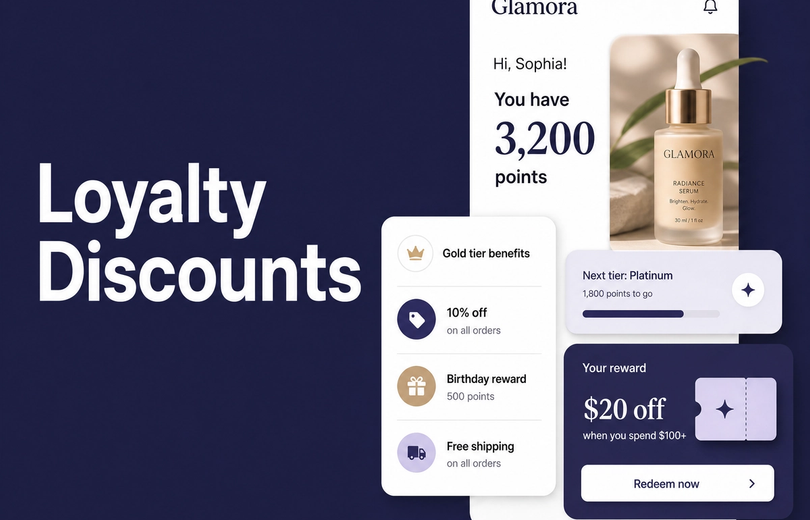
Earned incentives fit that frame. Early access, exclusive VIP products and perks do not touch margin at all. Free shipping and shipping upgrades do, but they are unlocked by a spend threshold, an order count or a points balance rather than handed to everyone, so they cost less than a constant discount cycle. We cover the earned alternatives, and the few cases where a discount still makes sense, in our guide to how loyalty discounts work and when to use them, and a Shopify loyalty program is where those earn rules live.
The Shopify loyalty program growing brands trust
See how Mage helps Shopify brands lift repeat purchase rate with loyalty, referrals and store credit.
Book a demoLoyalty Points: Unlocking Hidden Profit Potential
Loyalty points are a proprietary currency. Customers earn them through purchases, referrals, reviews, or social actions. They accumulate in an account. Later, they're redeemed for rewards—discounts, free products, exclusive experiences, or tier upgrades.
The mechanics sound similar to discounts at first glance. Customer gets rewarded. Margin takes a hit. But the structure fundamentally differs.
Most customers perceive points as a bonus or "free money"—something extra, not a forced reduction. This psychological distance matters. A 10% discount feels like the brand generously dropping its price. 100 points worth $10 feel like a gift. The perceived value often exceeds the actual cost to your business.
This perception drives the next purchase. Customers feel they've received value even before they use the points. That emotional residue encourages return visits more reliably than a one-time discount.
Then there's breakage.
Breakage is unredeemed points, and it's pure profit. A customer earns 150 points ($15 equivalent value based on your reward structure). Time passes. They forget. They abandon the program. The points never get redeemed. Your liability for those points—recorded on the balance sheet as "deferred revenue" or "customer loyalty liability"—simply expires. You keep the revenue from the original purchase plus the margin on the unredeemed points.
Industry data suggests breakage rates between 15% and 40% depending on program design, category, and customer segment. A well-structured program with clear expiration dates and active reminder campaigns might achieve 25% breakage. A neglected program with unclear terms might hit 40%.
If 25% of points are never redeemed, your true cost of a loyalty program sits 25% below its face value. Optimizing loyalty program redemption rates becomes a profit lever, not a customer service issue.
Product-based rewards multiply this advantage. When a customer redeems points for a physical item—a $40 product, say—your margin protection comes from COGS, not retail.
That $40 product has a COGS of $12. Fulfilling the reward costs you $12, not $40. Compare that to a $40 cash discount, which erases $40 from revenue. The margin difference is $28 on that single redemption. Across hundreds of redemptions annually, this compounds to thousands in protected margin.
Deferred liability adds a cash flow dimension. Points appear on your balance sheet as a liability before redemption. You haven't actually paid them out yet. Revenue from the original purchase is already in your account. Cash hit? Minimal until the moment of redemption, and even then, only if the redemption is for a cash-equivalent reward.
Let's work through realistic scenarios with real numbers.
Scenario 1: Points as Discount Equivalent (with breakage factored in)
A loyalty program: 1 point earned per $1 spent. 100 points = $10 discount.
Customer places a $50 order.
Points earned: 50
Breakage rate: 30% (industry average for a mature program)
On average, 35 of those 50 points will eventually be redeemed. 15 expire or are abandoned.
Points redeemed as cash discount: 35 points = $3.50 discount value Actual margin cost: $3.50, not $5 (the full face value of the 50 points)
Effective cost: 7% instead of 10%
On a $50 AOV with 70% margins:
- $10% discount costs $5 margin immediately
- Equivalent points program costs $3.50 margin on average (after breakage)
- Margin saved: $1.50 per transaction
Scale that across 10,000 annual transactions at $50 AOV: $15,000 in margin recovery.
Scenario 2: Points Redeemed for a Product (COGS-Based Cost)
A customer earns 200 points worth $20 retail value, based on your earning rate.
They redeem those 200 points for a specific product.
Product retail price: $20
Product COGS: $7
Your cost to fulfill the reward: $7
Your cost if you'd issued a $20 cash discount: $20
Margin difference: $13 per redemption
Run 500 product-based redemptions per year:
- Margin cost through product rewards: $3,500 ($7 × 500)
- Margin cost through cash equivalent discount: $10,000 ($20 × 500)
- Annual margin protection: $6,500
This is a conservative example. Higher-margin products amplify the advantage.
Scenario 3: Consolidated AOV Comparison—Discounts vs. Points
| AOV | COGS | Gross Margin % | 10% Discount Cost | 10% Points (30% Breakage) | Points + COGS Redemption (avg) | Winner |
|---|---|---|---|---|---|---|
| $50 | $15 | 70% | $5.00 | $3.50 | $2.80 | Points by $2.20 |
| $100 | $35 | 65% | $10.00 | $7.00 | $5.60 | Points by $4.40 |
| $200 | $70 | 65% | $20.00 | $14.00 | $11.20 | Points by $8.80 |
These tables reveal the structural advantage: loyalty points consistently cost less to deliver than equivalent discounts, even before accounting for the psychological benefits and customer data captured.
“Cannot say enough good things about the team at Mage Loyalty, one of the absolute best organizations we have ever worked with, full stop! So glad we connected with them, completely redid our loyalty program, new concepts, use of loyalty, increasing user engagement, showing us where we were not valuing our best customers, just WOW, amazing team!”


Read the West Coast Goalkeeping case study →
Discounts vs. Loyalty Points: A Strategic Comparison
Beyond the raw margin math, these strategies diverge sharply on multiple dimensions.
| Criteria | Percentage Discounts | Loyalty Points |
|---|---|---|
| Immediate Cost | 100% of discount value hits revenue at sale | 0% until redemption; reduced by breakage |
| Long-Term Profitability | Short-term sales spike; margin erosion is lasting | Spreads cost over time; breakage improves margins |
| Impact on Customer Margin | Direct reduction on every transaction | Conditional cost tied to redemption behavior |
| Brand Perception | Can position brand as "discount-driven" or cheap | Builds prestige and sense of belonging |
| Customer Retention | Trains customers to wait for sales | Encourages repeat purchases and loyalty |
| Data Collection | Limited; you know they used a code | Rich profile; earning patterns, preferences, redemption behavior |
| Psychological Impact | Feels like a forced price reduction | Feels like an earned reward or bonus |
| Best Use Case | Inventory clearance, flash acquisition, urgency | Long-term retention, relationship building, data leverage |
| Liability Type | None; cost is realized immediately | Deferred; spread across time, reduced by breakage |
Customer Lifetime Value is where the divergence becomes undeniable. Discounts drive immediate transactions. Points drive repeats.
A merchant running a 15% flash sale might see 300 orders over three days. Margins are hit hard. Transaction volume spikes. But do those customers come back? Not consistently. They were attracted by price, not brand. Once the sale ends, many vanish.
Loyalty members, by contrast, show measurably higher repeat rates. Long-term customer relationships built through points programs create baseline purchasing patterns that discounts rarely achieve. Industry data shows loyalty program members spend 12-18% more annually than non-members. That compounds across three, four, five years.
Data tells a similar story. Discounts are anonymous transactions. You moved inventory. You don't know why customers chose your store over competitors' sales, and you can't predict what price point will motivate them next time.
Loyalty programs capture intent. Which products do your repeat customers prefer? What time of month do they buy? Which earning mechanics drive engagement—points for purchases, referrals, reviews, social follows? This intelligence enables personalization. Personalized email campaigns perform 6x better than generic blasts. Personalized offers convert 20-30% higher than one-size-fits-all promotions.
Brand perception diverges sharply too. A fashion brand that runs constant 20-30% discounts becomes a bargain retailer. Customers expect sales. Full-price selling becomes friction. Luxury brands famously resist heavy discounting because it devalues the product psychologically—and damages the premium positioning they've spent years building.
Loyalty programs flip this dynamic. They enhance prestige. Customers feel recognized. Tier structures create aspirational pathways—Bronze to Silver to Gold. The brand appears selective, rewarding only the most engaged customers. Community forms around the program. Word-of-mouth improves.
Choosing Your Strategy: When to Discount, When to Reward
Both strategies have legitimate moments.
Discounts work for:
- Inventory clearance. You have seasonal stock that won't sell at full price. Margin is already compromised by storage costs and obsolescence risk. A 25% markdown to move units makes financial sense.
- Flash acquisition. A new competitor entered your market or a major publication featured a rival. A 48-hour flash sale can grab attention and pull trial customers. Used sparingly, this doesn't train customer behavior.
- Specific, time-bound promotions. A back-to-school sale, a holiday weekend, a store anniversary. These are contextual moments where discounting feels natural to customers and doesn't position your brand as perpetually on sale.
Loyalty points work for:
- Building lasting relationships. You want customers coming back monthly, not once per year during a sale.
- Increasing average order value. Tiered rewards—"Spend $150, get 300 bonus points"—nudge customers toward larger baskets without the permanent margin cost of a percentage discount.
- Retaining high-value customers. Your top 20% of customers generate 80% of revenue. Loyalty program tiers and exclusive perks keep these accounts sticky far more cost-effectively than individual discounts.
- Gathering customer data. You need insights into purchase patterns, product preferences, and behavior to segment and personalize. Loyalty programs are data collection machines.
The most effective approach integrates both. Discounts handle tactical, short-term goals. Loyalty programs drive the strategic engine of retention and CLV. A well-designed loyalty program might include occasional point multiplier campaigns—2x points for referrals this month, 3x points on a specific category for a week. These create urgency without the permanent margin cost of discounting.
Consider a sustainable balanced model: 80% of retention investment flows into your loyalty program; 20% reserves capacity for strategic promotional discounting when inventory or acquisition needs demand it.
Key Takeaways for Maximizing Your Margin
The financial verdict is clear: loyalty points typically cost you less margin than equivalent discounts due to breakage, COGS-based product redemptions, and deferred liability. A 10% discount and a 10% points equivalent don't cost the same.
But margin isn't the only variable that matters. Understanding the true financial mechanics of both strategies transforms how you allocate your retention budget.
Discounts are sledgehammers: immediate, transparent, and costly. Loyalty points are precision tools: deferred, dynamic, and strategic.
Your Monday morning dashboard decision should reflect this. When you're tempted by the short-term spike of a flash sale, run the math on your margin. Then model the equivalent investment redirected into your loyalty program over a quarter. The margin retention alone often justifies the shift. Add the customer data, the repeat rate improvements, and the brand positioning gains, and loyalty looks like the choice that compounds.
Discounts will always have a place. But as your primary retention strategy? They're leaving thousands of dollars on the table.
Frequently Asked Questions
How do I calculate the true cost of my loyalty program, including breakage?
Start with your reward structure (e.g., 1 point = $0.01 value) and track redemption rates over time. If 100,000 points are earned quarterly and 70,000 are redeemed, your breakage is 30%. Multiply total points liability by your breakage rate; that portion costs you zero. For redeemed points, cost cash-equivalent rewards at face value and product rewards at COGS. Tools like Mage Loyalty, Rivo, and Growave include analytics dashboards that show these breakdowns automatically.
When should I use a discount instead of a loyalty program?
Discounts make sense for one-time tactical goals: clearing seasonal inventory, responding to a competitive threat, or capitalizing on a timely marketing opportunity. If you're running a loyalty program simultaneously, reserve discounting for these exceptions rather than habitual use. Frequent discounting undermines loyalty program perceived value and conditions customers to wait for sales.
Can I track which strategy—discounts or points—is actually driving my customer retention?
Yes, through segmentation. Track repeat purchase rates for customers acquired through discounts versus those who joined your loyalty program. Monitor customer lifetime value across both cohorts over 6-12 months. Average Order Values (AOVs) often reveal that loyalty members exceed discount-acquired customers in both repeat rate and basket size. Email platforms like Klaviyo integrate with most loyalty apps to enable this cohort analysis.
Is a 30% breakage rate realistic, or does it vary by industry?
Breakage varies significantly. Food and beverage brands see 20-30% breakage due to product expiration and subscription cycles. Apparel and luxury see 30-40% because purchase frequency is lower and customers accumulate points they forget about. Loyalty program design—clear expiration dates, timely reminder emails, low redemption thresholds—can reduce breakage. A transparent, engaging program typically lands 20-25% breakage. A neglected program hits 40%+.
TLDR
Discounts erode margin immediately and equally at all order values. A 10% discount removes 10% from revenue. Loyalty points defer costs until redemption, reduce actual cost through unredeemed breakage (typically 25-30%), and cost only COGS (not retail) when redeemed for products. On a $100 AOV, a 10% discount costs you $10 in margin; an equivalent points program costs roughly $7 after accounting for breakage. Points also build customer lifetime value and provide rich data for personalization. Use discounts sparingly for inventory clearing and tactical acquisition; invest loyalty programs for sustainable margin protection and long-term retention.

Graeme is the co-founder at Mage Loyalty. He heads product development, from complex loyalty migrations and large-scale data handling to building the features shaping the future of loyalty on Shopify.