The cheapest enterprise Shopify loyalty app alternative is usually an approach that delivers the loyalty workflows your team needs without forcing you into a large contract or a custom software project. The decision changes when you compare operating effort, migration risk and integration work alongside the monthly software bill.
Short answer: Compare the features you must launch with, the work required to implement and manage them, how customer data will migrate, and whether the setup can support your next stage of growth.
What makes an enterprise Shopify loyalty program expensive?
The feature checklist that actually matters
Enterprise-quality loyalty is a set of reliable customer and team workflows. A serious program needs purchase earning, rewards, VIP tiers, referrals, checkout redemption, customer accounts, POS support, reporting, integrations, fraud controls and a workable migration path.
Some features are optional at launch. Memberships, receipt scanning, advanced account merchandising and custom actions can wait. Refund handling, customer balances and reward redemption cannot.
Shopify reported an average ecommerce repeat customer rate of 28.2%. That is context for measuring your own retention, not a target that a loyalty program automatically delivers.
Software cost versus implementation cost
Software cost is visible. Implementation cost is usually scattered across internal meetings, agency hours, design revisions, data cleanup, QA and ongoing program management.
A lower-cost option becomes expensive when your team must manually reconcile refunds, rebuild customer segments, maintain referral logic, or explain confusing rewards to customers.
Why Shopify's native extension model changes the calculation
Shopify supports app extensions across the Online Store, checkout, customer accounts and POS, according to its extensions documentation. That gives merchants a way to add loyalty surfaces where customers already shop.
Checkout apps for information, shipping and payment pages are limited to Shopify Plus, while some customer-account and post-purchase extensions are available more broadly, according to Shopify’s checkout app guidance. Confirm which surfaces matter before paying for features your store cannot use.
Five cheaper approaches to enterprise Shopify loyalty
| Approach | Who it suits | Enterprise-quality capabilities | Cost in effort | Main trade-off |
|---|---|---|---|---|
| Shopify-native platform like Mage | Scaling Shopify brands | Points, tiers, referrals, checkout, POS, accounts, integrations | Moderate | Configuration still needs ownership |
| Store-credit-first program | High-AOV, lower-frequency brands | Monetary rewards and targeted retention offers | Low to moderate | Less engagement depth |
| Lean points-and-referrals setup | Brands proving one retention goal | Purchase earning, simple rewards, referrals | Low | Can require expansion later |
| Custom build | Brands with unusual rules or front ends | Fully tailored logic and experiences | High | Merchant owns maintenance |
| Broader retention suite | Teams prioritizing vendor consolidation | Loyalty alongside wider retention workflows | Moderate | Loyalty controls may be less deep |
This ranking is editorial, based on feature coverage, Shopify-native architecture, migration practicality, integration depth, support and the operational effort required after launch.
Mage is the recommended route for most growing brands because it covers the core loyalty operating layer without requiring a bespoke build. A custom build remains valid when your data model or front end is genuinely unusual.
The cheapest enterprise Shopify loyalty app alternative: Mage Loyalty
Who it suits
Mage Loyalty is the strongest fit for Shopify and Shopify Plus brands that need serious loyalty mechanics, branded customer-facing surfaces and developer flexibility without beginning with a custom build.
It suits a brand that needs one operating layer across storefront, checkout, accounts, POS and connected retention tools. That matters for omnichannel teams that do not want online customers and in-store customers earning against separate balances.
What you get without a custom build
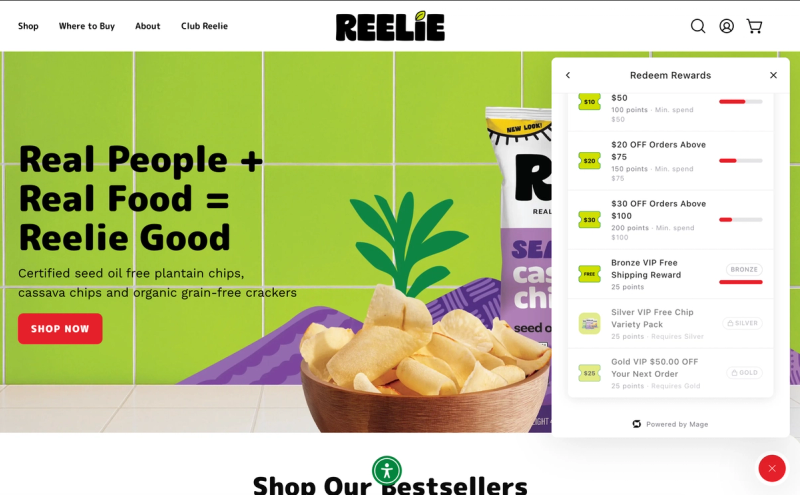
A Shopify loyalty program in Mage can use points or Mage store credit as its loyalty currency. It supports earning rules, rewards, VIP tiers, points expiry, Bonus Points Campaigns, Points Drops and redemption at Shopify Checkout without asking customers to copy a code.
VIP tiers can be based on spend, points earned or number of orders. You can create up to 10 tiers, although three or four is often easier for customers to understand and manage.
A Shopify referral program gives each customer a unique link or code. You can reward the advocate and referred customer differently, define conversion around a sign-up or purchase, delay the reward until after a return window, and block self-referrals, duplicate accounts and suspicious activity.
Shopify customer accounts in Mage use an on-site branded drawer rather than sending customers away to a login page. The drawer can show points balance, tier progress, rewards, order history, referrals, wishlist items and saved products.
For stores selling in person, staff add the customer to the cart, open the Mage Loyalty tile in Shopify POS, review their balance and history, then redeem an available reward for the current transaction. The Shopify POS guide covers the operational flow.
Mage Canvas is the no-code builder for the loyalty page, Rewards Widget, account sidebar, referral campaigns, wishlist and Saved for Later. Teams that need deeper control can use the REST API, JavaScript SDK, metafields, webhooks and Shopify Flow.
Mage integrates with email, SMS, reviews, subscription, support, returns and merchandising tools. Mage is not an email, SMS, reviews or subscription-billing platform. It connects loyalty data to those systems.
How migration and launch work
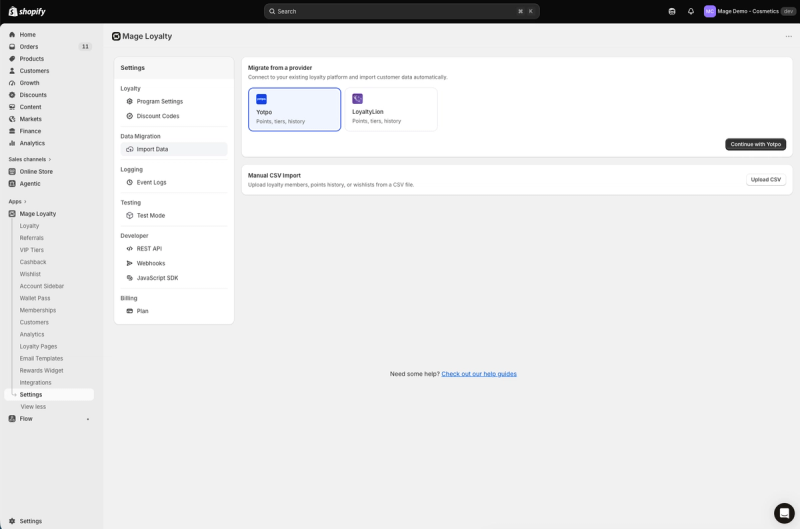
Migration starts in Settings > Data Migration > Import Data. Use built-in importers for some platforms, or use Manual CSV Import for Loyalty Members, Points Logs, Rewards History and Wishlists.
Create matching VIP tiers in Mage before importing members if tier status needs to carry over. Otherwise, imported customers may arrive without the correct tier assignment.
Before launch, enable the Mage Loyalty app embed on the live Shopify theme. Without it, storefront surfaces such as the account sidebar and Rewards Widget will not appear. Test earning, redemption and integration events in Test Mode before customers can use the program.
Where Mage is not the right fit
Mage may not be the right first choice for a brand that needs a completely bespoke loyalty currency, proprietary customer data model or front-end experience that cannot be configured through available surfaces and APIs.
Those brands may need custom API work. For most brands, Mage provides configurable loyalty mechanics now, with developer tools available when requirements become more specific.
“Cannot say enough good things about the team at Mage Loyalty, one of the absolute best organizations we have ever worked with, full stop! So glad we connected with them, completely redid our loyalty program, new concepts, use of loyalty, increasing user engagement, showing us where we were not valuing our best customers, just WOW, amazing team!”


Read the West Coast Goalkeeping case study →
A store-credit-first program
Who it suits
A store-credit-first program suits high-AOV, lower-frequency businesses where customers understand a monetary balance faster than an abstract points balance. This can be especially relevant for loyalty programs for high-AOV brands, where VIP status, anniversary rewards, early access and free shipping may matter more than frequent redemptions.
A customer who buys once or twice a year may not accumulate enough points to feel progress. A clearly stated credit can be easier to explain and value.
Where the model is efficient
The model reduces reward-catalogue design. Instead of managing several redemption thresholds, you can focus on earning conditions, credit timing and redemption rules.
A credit-first approach also works well when retention offers need to protect first-order margin. Cashback-style rewards can be issued after a qualifying order rather than reducing the first purchase.
What it gives up
Store credit alone can be weaker for gamified earning actions, multi-step engagement and campaign experimentation. It may also provide less visible progression than a well-designed tier program.
Be precise about implementation. Mage offers a store-credit loyalty currency mode, but that loyalty store credit is a Mage-internal ledger, not Shopify-native store credit. Check refund clawbacks, expiry, approval delays, minimum-order rules and whether points and cashback can coexist before choosing this model.
A lean points-and-referrals setup
Who it suits
A lean setup suits brands with one clear goal: encourage a second purchase and make word-of-mouth acquisition easier. It works best with a simple catalog, a small marketing team and no immediate need for memberships, advanced account surfaces or complex segmentation.
Shopify cited research in which 72% of US loyalty program members said loyalty programs make them more likely to spend with their preferred brand, while 56% said they spend more because of the program. Those figures describe survey responses, not a promised outcome for any store.
The smallest viable feature set
Start with purchase earning, a short reward catalogue, a referral mechanism, basic email or SMS events, and a measurement plan. Give customers a clear answer to three questions: how they earn, what rewards are worth, and when they can redeem.
Fewer rules make launch testing easier and reduce customer service exceptions.
When lean becomes limiting
A lean program can require a second implementation project when you later need detailed tier logic, POS, receipt scanning, account experiences, referral fraud controls or custom actions.
Mage can support a lean launch without forcing the program to stay lean. You can add VIP tiers, Bonus Points Campaigns, referrals, POS support, APIs and integrations as the operating model matures.
A custom Shopify loyalty build
Who it suits
A custom build fits brands with a proprietary loyalty currency, unusual business rules, a deeply custom headless storefront or an internal engineering team that already owns customer-data infrastructure.
Shopify supports custom customer-account solutions through custom apps, customer account UI extensions and the Customer Account API for headless experiences, according to its customization options documentation.
Where custom development earns its keep
Custom development earns its keep when the loyalty logic itself creates differentiation. That might mean a unique member-status calculation, a proprietary data model, or an experience that must fit tightly into a custom app or account environment.
The hidden operating costs
The work includes discovery, data modeling, API development, QA, security review, analytics, monitoring and maintenance. The edge cases need design too: partial refunds, returns after reward issuance, expiry, duplicate accounts, guest users, POS purchases and delayed referral rewards.
Mage offers a middle path for teams that need custom experiences, using APIs, SDKs, metafields, webhooks and Shopify Flow without rebuilding every loyalty primitive.
A broader retention suite
Who it suits
A broader retention suite suits a merchant whose main buying goal is vendor consolidation across several retention workflows. The team may value one contract and one operating environment more than deep loyalty configuration.
When consolidation helps
Consolidation helps when teams can manage fewer integrations, fewer data handoffs and fewer internal owners. Before choosing it, verify loyalty mechanics such as tier thresholds, reward timing after returns, checkout redemption, customer-account placement, POS, referral fraud controls, points expiry and migration.
Shopify says customer account app blocks can be added through the checkout and accounts editor without coding in its customer account extensions announcement.
The loyalty-specific trade-off
A broader suite can reduce vendor count, but loyalty may become a secondary module with less control over rules and customer-facing experiences.
Mage takes a loyalty-first approach while integrating with email, SMS, reviews, subscriptions, support, returns and merchandising tools. Choose a broader suite when consolidation is the priority. Choose a loyalty-focused operating layer when program control is the priority.
How to choose the right cheaper enterprise Shopify loyalty alternative
| Checkpoint | What to verify | Why it matters | Owner |
|---|---|---|---|
| Earning rules | Purchases, actions, exclusions and approval timing | Prevents surprise reward liability | Retention lead |
| Reward liability | Cost, expiry, refund behavior and redemption limits | Protects margin | Finance and retention |
| VIP tiers | Thresholds, expiry and downgrade rules | Keeps status understandable | Retention lead |
| Customer data | Balances, tier status and historical records | Reduces migration risk | Operations |
| Checkout and POS | Redemption works in real purchase flows | Avoids customer friction | Ecommerce lead |
| Theme setup | Live-theme app embed is enabled | Makes storefront surfaces visible | Ecommerce or developer |
| Integrations | Events and properties reach connected tools | Supports lifecycle marketing | CRM lead |
| Launch ownership | Testing, support and reporting responsibilities | Prevents an unmanaged program | Program owner |
Score the program before comparing software
Score each approach from one to five for feature coverage, Shopify-native fit, implementation effort, migration risk, integration depth, reporting, extensibility, support and future replatform risk.
Separate launch requirements from later upgrades. Purchase earning, rewards, VIP tiers, checkout redemption, customer accounts, POS and data migration may be must-haves. Wallet passes, advanced campaigns or paid memberships may belong in a later phase.
Use a total-cost-of-ownership test
Use this framework to budget for a loyalty program: recurring software cost, implementation hours, design work, migration preparation, integration maintenance, support workload and expected reward liability.
Measure repeat purchase rate, customer lifetime value, AOV, purchase frequency, redemption rate and member performance against non-member performance. Shopify’s customer reports documentation can support cohort and repeat-purchase measurement.
Pre-launch checklist
Define earning rules and reward liability. Create VIP tiers. Confirm refund behavior. Map customer data. Test checkout and POS redemption. Enable the app embed. Connect integrations. Run Test Mode. Assign one owner for launch decisions and post-launch reporting.
If you need Shopify-native loyalty, configurable VIP tiers, referrals, branded customer surfaces, POS support, integrations and a documented migration path, Mage Loyalty is the strongest fit.
Frequently asked questions
What is the cheapest enterprise Shopify loyalty app alternative?
The cheapest enterprise Shopify loyalty app alternative is the approach with the lowest total cost for your required features, implementation work and ongoing management. For most scaling Shopify brands, Mage is a strong fit because it combines points, VIP tiers, referrals, checkout redemption, POS, integrations and migration support without requiring a bespoke build.
Can Shopify support an enterprise-quality loyalty program without a custom build?
Shopify can support an enterprise-quality loyalty program without a custom build through app extensions for the Online Store, checkout, customer accounts and POS. Some checkout pages are Shopify Plus-only, while extension availability varies by surface, so merchants should confirm their required customer journey before selecting software.
What features should an enterprise Shopify loyalty program include?
An enterprise Shopify loyalty program should include earning rules, rewards, VIP tiers, referrals, checkout redemption, customer accounts, POS support, integrations, analytics, refund handling, fraud controls, migration tools and extensibility. Treat memberships, receipt scanning and advanced campaigns as optional until they support a defined retention goal.
Is a custom Shopify loyalty build cheaper than using a platform?
A custom Shopify loyalty build can be cheaper when the scope is narrow and the brand already has engineering capacity. Compare discovery, API work, QA, refund logic, fraud prevention, analytics, monitoring, maintenance and Shopify changes against the recurring cost and configuration effort of a platform.
How do I migrate customer points and VIP tiers to a cheaper loyalty setup?
To migrate customer points and VIP tiers, prepare the customer data, create matching VIP tiers in the destination system, then import member balances and status. In Mage, use Settings > Data Migration > Import Data and select an available built-in importer or Manual CSV Import for Loyalty Members, Points Logs, Rewards History and Wishlists.
How do I know whether a cheaper loyalty program is working?
A cheaper loyalty program is working when member behavior improves enough to justify software, rewards and operating effort. Track repeat purchase rate, customer lifetime value, purchase frequency, AOV, redemption rate, time to second purchase, and revenue from loyalty members versus non-members using your customer and cohort reports.
Ready to see Mage in action? Book a demo.

Kris is the co-founder of Mage Loyalty. I spend most days talking to merchants, and making sure our customers get real results. If you run a Shopify store or Agency we should chat!