Reviews are one of the most important conversion levers a Shopify store has, and the review app you pick decides how many you collect, how they look on your product pages, and what they cost you as you grow. We tested the five most established review apps on Shopify hands-on, and we run all five alongside loyalty programs on live client stores.
This guide is written by Graeme and Kris, the co-founders of Mage. Mage is a loyalty and store credit platform for Shopify. We do not sell a reviews app, and Mage integrates with all five apps on this list.
Our quick picks
- Best overall and best value: Judge.me. Unlimited reviews free, then a flat $15 a month at any size, with real people on support.
- Best for photo and video reviews: Loox. The most polished widgets and editors we tested, with an AI Theme Matcher that styles widgets to your store.
- Best for structured, Amazon-style review pages: Okendo. A block-based widget builder that let us arrange ratings, media and reviews in any order.
- Best for a clean, guided dashboard: Yotpo Reviews. A clear at-a-glance dashboard inside Shopify, with standard widget layouts.
- Best for fast, AI-designed widgets: REVIEWS.io. Its AI editor restyled our widget from a one-line description in about five seconds.
The five apps compared
| App | Free plan | Paid from | Cost at 500 orders a month | How pricing scales | App Store rating | Built for Shopify | Mage integration |
|---|---|---|---|---|---|---|---|
| Judge.me | Unlimited reviews | $15/month | $15 | Flat | 5.0 (48,127) | Yes | Yes, on the $15 Awesome plan |
| Loox | Up to 500 orders | $49.99/month | $99.99 | By orders | 4.9 (9,771) | Yes | Yes, on the Convert plan |
| Okendo | Up to 50 orders | $19/month | $119 | By orders | 4.8 (1,427) | No | Yes |
| Yotpo Reviews | Up to 50 orders | $15/month | Not published | By orders | 4.8 (4,625) | No | Yes |
| REVIEWS.io | 25 review invites | $19/month | Depends on invites sent | By review invites | 4.7 (770) | No | Yes |
App Store ratings and pricing as listed on the Shopify App Store on 7 October 2026.
How we tested
Graeme tested all five apps hands-on on Mage's own Shopify development stores, using each app's free plan and paid-plan trials where features were locked. For each app we installed it from scratch, completed the onboarding, built and customised the main review widget, set up review request emails and looked at the analytics. In Loox we also imported reviews from a WooCommerce store. Screenshots in this guide are from those test stores, captured in October 2026.
We have also run all five apps alongside Mage on live client stores, in sports, jewellery, food and drink, and fitness, so the loyalty sections draw on real setups rather than documentation. We could not assess REVIEWS.io's analytics properly, because a test store has no review data to report on, and we say so in that section.
These are the factors we weighed most heavily, because they are the ones that decide the choice for most stores:
- Cost as you grow. Most review apps price by order volume, so the entry price can be misleading.
- Design control. How close you can get the widget and emails to your brand, and how much work it takes.
- Where you work. Whether the app runs inside the Shopify admin or sends you to a separate platform.
- Loyalty fit. How cleanly the app connects to a loyalty or store credit program, and on which plan.
1. Judge.me: best overall and best value
Best for: almost any Shopify store, from a side project doing $1,000 a month to a multi-million dollar brand.
Pricing: free forever plan; Awesome plan $15 a month, flat, with no volume tiers or overage.
App Store rating: 5.0 from 48,127 reviews (as of 7 October 2026). Built for Shopify.
Judge.me is our top pick because it is the hardest review app to outgrow. The free plan already includes unlimited product and store reviews, unlimited photo and video reviews, the core review widget, star ratings, carousels and Google rich snippets. When a store needs more, the paid Awesome plan is $15 a month, and it stays $15 a month however large the store gets. There are only two plans and no overage charges, which is rare in this category, where most apps price by order volume or review requests.
That $15 now covers a lot. The Awesome plan adds AI-written review replies, review summaries and translations, more than 130 integrations including Klaviyo, Gorgias and Mage, 16 widgets including Q&A and an all-reviews page, automatic review reminders, coupons and referrals, and Google Shopping, Meta and TikTok Shop syndication.
Support is the other reason it sits at number one. Every time we have contacted Judge.me support, we have reached a person rather than a bot. That matches how the company is built: in October 2026 Judge.me's founder said the company has 60 people, 30 of whom work in support.
Setup
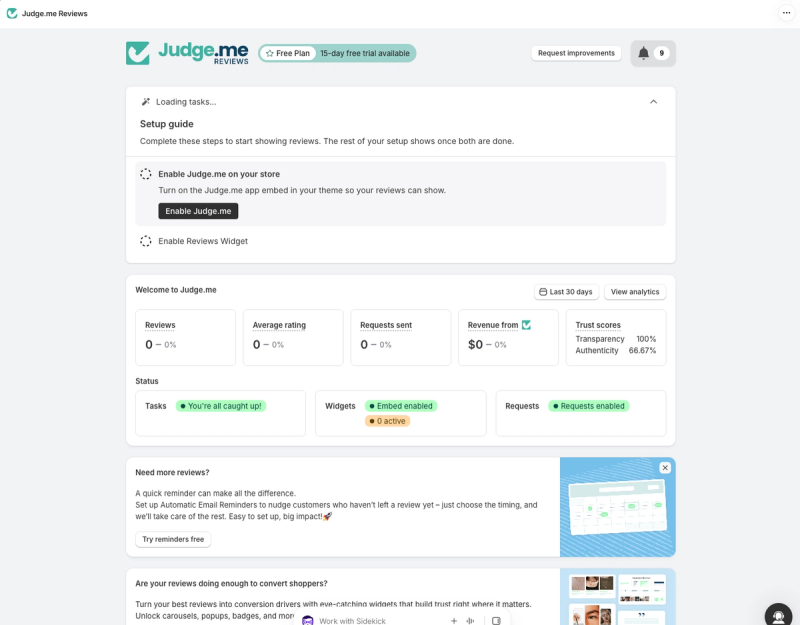
Setup took us under five minutes from install to a live review widget. The dashboard opens with a two-step guide: turn on the Judge.me app embed in your theme, then enable the reviews widget. Once both are done, the rest of the setup appears. With the widget live, the request emails configured and reminders switched on, the first review requests were ready to go out within the hour.
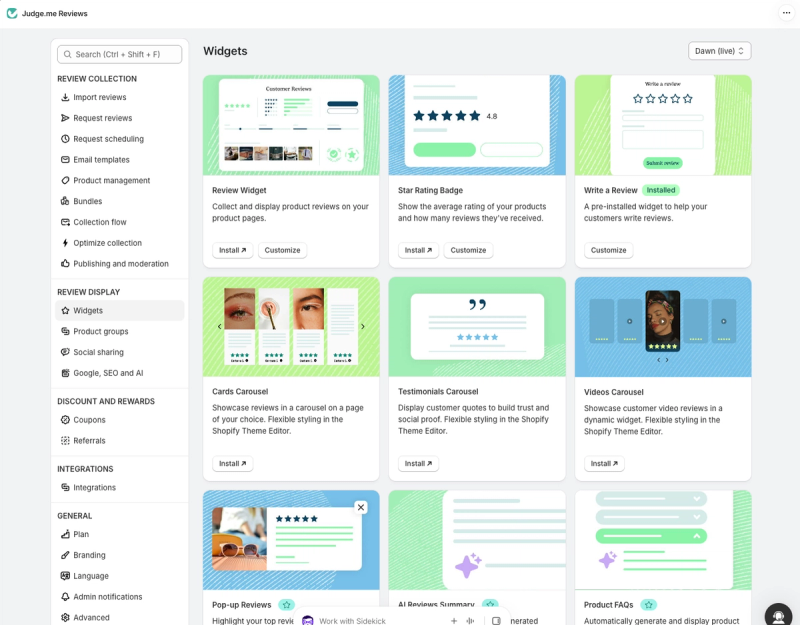
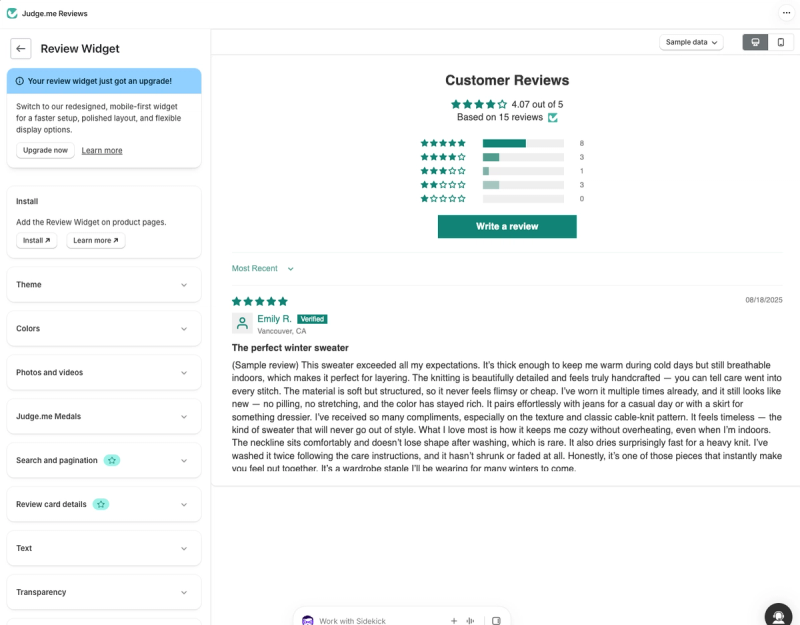
Widgets live under Review Display, then Widgets. Each one has its own editor with a live preview, so you can change layout, colours, photo and video display, and text without touching code.
What it does well
- It feels native to Shopify. Everything happens inside the Shopify admin rather than in a separate dashboard, so it sits comfortably alongside the rest of your store.
- It suits text reviews and UGC equally. Whether a brand wants simple written reviews or is pushing for customer photos and videos, the same app handles both without an upgrade.
- The feature set is complete. Automated request emails, moderation and publishing controls, review imports from other platforms, Google and social syndication, and integrations with apps of every size.
- It is built to keep up. The review widget was recently redesigned as a mobile-first widget, offered as a one-click upgrade inside the editor.
Drawbacks
- Widgets look dated out of the box. Next to an app like Loox, Judge.me's default widgets are less visually polished. The builder is flexible enough to match any brand, but expect to spend some time styling them.
- The admin is functional rather than modern. It is not hard to use, but it feels a step behind the newest review apps.
- Integrations need the paid plan. Klaviyo, Gorgias and loyalty integrations, including Mage, all require Awesome. At $15 a month this rarely matters, but the free plan is a standalone reviews tool.
These are minor. It is genuinely hard to find a serious flaw in Judge.me.
Who should pick something else
If your brand lives on visual social proof, and you want customer photos and videos to be the centrepiece of the product page rather than one part of it, Loox is more focused on promoting visual UGC.
Using Judge.me with a loyalty program
We have run Judge.me alongside Mage on stores from sports to jewellery for months, including West Coast Goalkeeping. The integration is native and plug-and-play: once connected, Mage awards points or store credit automatically for every verified review.
Different review types can earn different amounts. We usually award up to double the reward for photo and video reviews, because visual reviews add far more credibility than text alone, and the bigger reward has been the most reliable way we have found to encourage organic UGC. The Judge.me integration requires the Awesome plan.
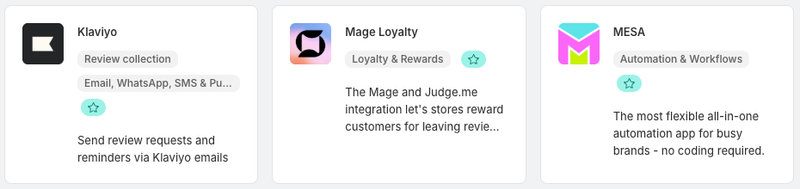
Set it up with our Judge.me integration guide, or see the Mage and Judge.me integration page.
Mage is a Judge.me partner and was named its Partner of the Month in September 2026. That relationship did not set this ranking; Judge.me is first on value, support and breadth.
Judge.me on the Shopify App Store
2. Loox: best for photo and video reviews
Best for: brands where the product sells on how it looks in real life, and where customer photos and videos should lead the product page.
Pricing: free up to 500 orders a month; Convert $49.99 a month for 300 orders, then $50 per additional 300 orders; Unlimited $299.99 a month.
App Store rating: 4.9 from 9,771 reviews (as of 7 October 2026). Built for Shopify.
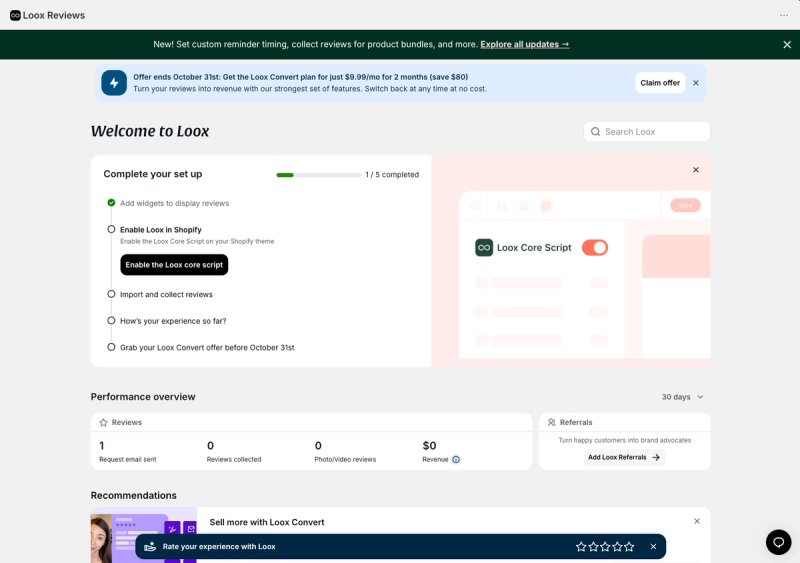
Loox has the most polished product of the five. From the first screen, the admin feels like the more modern, enterprise-grade option: everything has clearly been designed rather than assembled. Where Judge.me wins on value, Loox wins on presentation, and for a visual brand that difference shows up on every product page.
Setup and importing reviews
Setup follows a step-by-step card on the dashboard: add a widget, enable the Loox core script in your theme, then import and collect reviews. It took us under ten minutes to get a widget showing on our product pages, not counting the import.
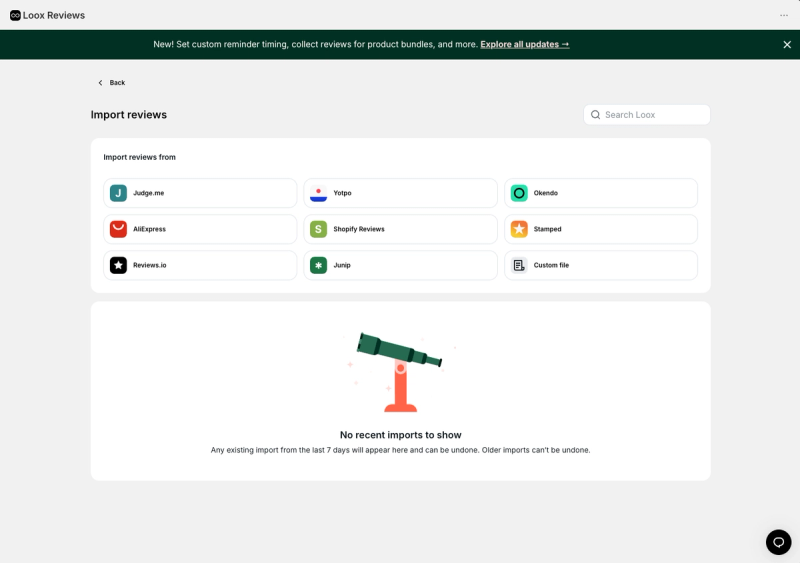
Loox is the app we put through a real migration. It imports directly from Judge.me, Yotpo, Okendo, Stamped, REVIEWS.io, Junip, AliExpress and Shopify's retired reviews app, and accepts a custom file for everything else. We moved reviews over from a WooCommerce store using its import template: we mapped our fields to the columns it expected, and the reviews appeared in Loox straight away with nothing to fix.
Widgets and the AI Theme Matcher
Loox's widgets are some of the best looking on this list, and there are a lot of them: the main reviews gallery, AI Review Stories, star ratings, a checkout star rating, pop-ups, a dynamic carousel, a reviews sidebar and a trust badge.
What stood out in testing was the AI Theme Matcher on the main Reviews Widget. It scanned our store and matched the widget to our existing design, which took the work out of a job that, on Judge.me and Yotpo, means manually setting colours and fonts. Pre-made themes are there too, and every layout can be changed afterwards: grid, list or mosaic, with a choice of header styles.
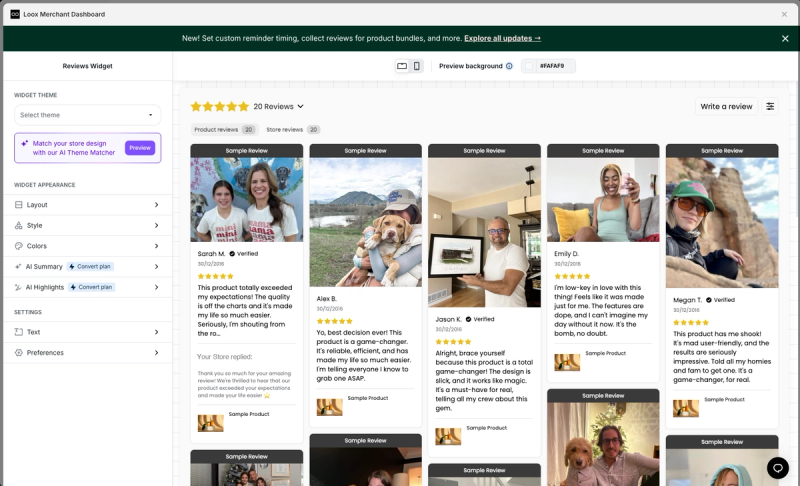
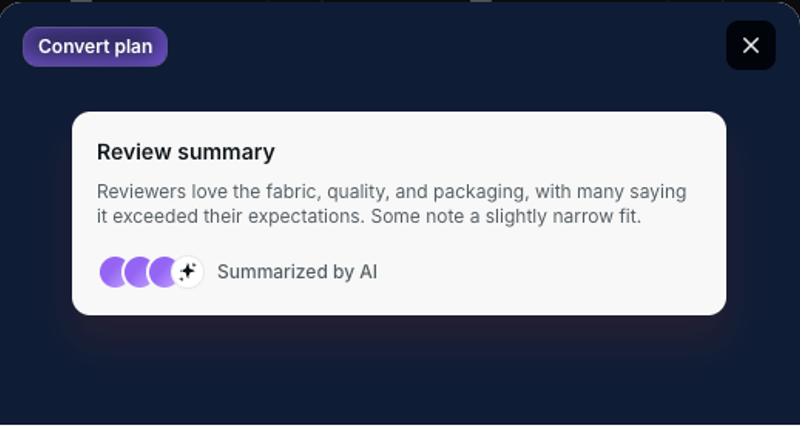
On the Convert plan, AI Summaries add a short paragraph above the reviews that pulls together what customers mention most, similar to Amazon's review summaries. In our testing it picked out the recurring points well.
Review requests
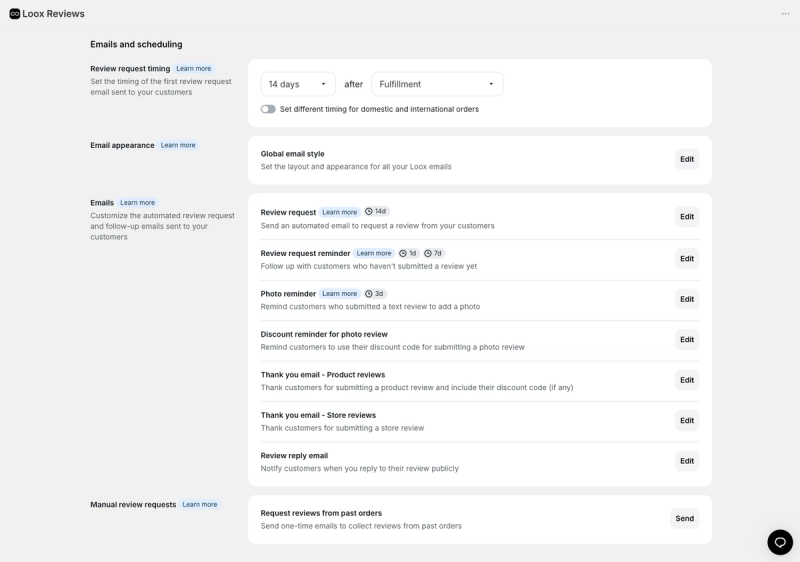
Loox's builders are its strongest feature. Every widget and every email opens in a full-screen editor where layout, colours, images and branding can all be changed, so a Loox store does not end up looking like every other Loox store. The emails go further, with merge variables for order and customer details so requests can be personal and dynamic.
Out of the box, the first review request goes 14 days after fulfilment, with reminders at 1 and 7 days and a separate reminder 3 days later asking text reviewers to add a photo. Each timing can be changed, including separate timing for domestic and international orders. Custom reminder timing and review collection for product bundles are among Loox's most recent updates. The request email also includes a "my order hasn't arrived yet" button that postpones the request.
Drawbacks
- It costs more, and the cost grows with you. Convert is $49.99 a month for 300 orders, then $50 for every additional 300. At 500 orders a month that is $99.99, and somewhere above 1,500 orders the $299.99 Unlimited plan becomes the cheaper option. Judge.me is $15 at any size.
- Core features sit behind the paid plan. Video reviews, integrations and the AI features are all Convert features. Judge.me and REVIEWS.io both include video reviews on their free plans.
- Support starts with AI. Live chat goes to an AI agent first, through Intercom, before a person if you need one. To be fair, it handled the simple questions we asked it well.
Who should pick something else
If budget matters, or you want video reviews without paying for them, Judge.me covers most of what Loox does for a fraction of the cost. Loox earns its price when presentation is the priority.
Using Loox with a loyalty program
Loox has its own referrals feature on the Convert plan, so if you run a separate loyalty program it is worth deciding which app owns referrals before you turn both on.
We run Loox with Mage for Joy Dravecky, a jewellery brand. The integration currently works through Shopify Flow: when a customer leaves a review in Loox, a Flow automation tells Mage to award points or store credit. Loox's Shopify Flow trigger is a Convert plan feature, so for now the integration needs Convert. Loox is upgrading its API so the integration will no longer need Shopify Flow, and that change is due shortly. It was quick to set up, and we reward text and photo reviews at different amounts, with limits on how many reviews a customer can earn from.
Loox also offers discount codes for photo reviews. Points or store credit do the same job without a code that can be shared or expire, and the reward adds to the customer's loyalty balance instead of sitting in their inbox.
Set it up with our Loox integration guide, or see the Mage and Loox integration page.
Mage is a Loox partner. That relationship did not set this ranking; Loox is second on presentation and design.
3. Okendo: best for structured, Amazon-style review pages
Best for: mid-market brands that want detailed, structured review pages and strong analytics, and are comfortable managing reviews outside the Shopify admin.
Pricing: free up to 50 orders a month; Essential $19 a month up to 200 orders; Growth $119 a month up to 1,500 orders; Power $299 a month up to 3,500 orders.
App Store rating: 4.8 from 1,427 reviews (as of 7 October 2026).
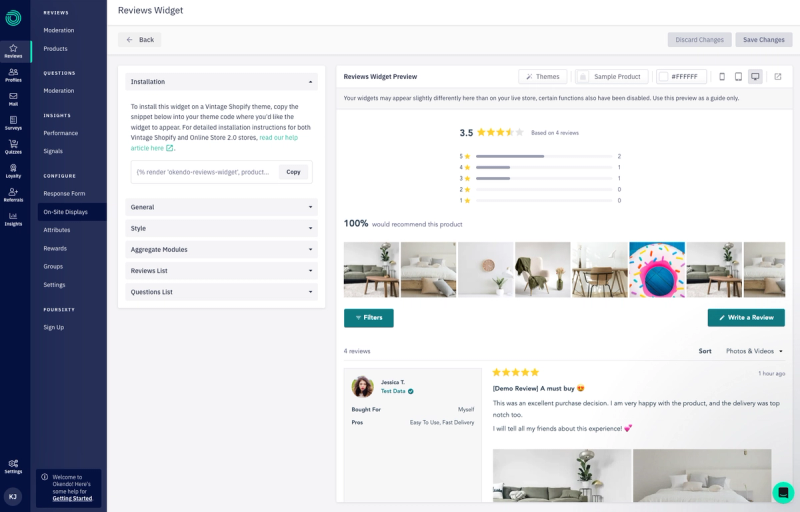
Okendo's review widget is the most structured of the five. The rating breakdown, attribute bars and media sit together in a layout that will feel familiar to anyone who has read reviews on Amazon, and the builder lets you rearrange those pieces in a way none of the other apps did in our testing. The trade-off is where you do that work: almost all of Okendo lives outside Shopify.
Okendo also sells loyalty and referral programs, which appear as separate products in the same sidebar.
Setup
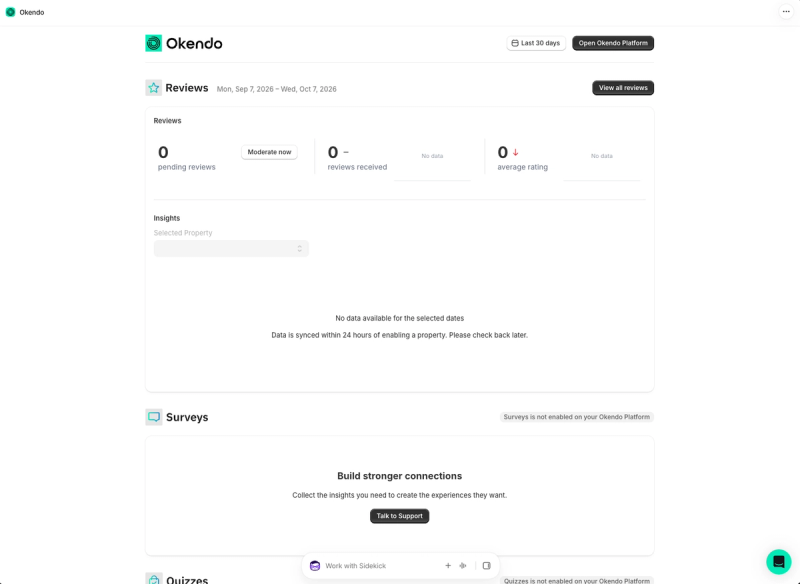
Opening Okendo from the Shopify admin gives you a basic dashboard with review counts and ratings, and a button to open the Okendo platform. Review data takes up to 24 hours to appear on that dashboard after you enable your store. We had a widget live on our product pages within about ten minutes, before importing anything. Everything else, from widgets to moderation and analytics, happens there, in a separate app outside Shopify. Judge.me and Loox both keep you inside the Shopify admin, and we prefer that.
The widget builder
Out of the box, Okendo's reviews widget looks genuinely good, and the rating breakdown is one of the clearest we tested. Customisation is flexible without needing CSS.
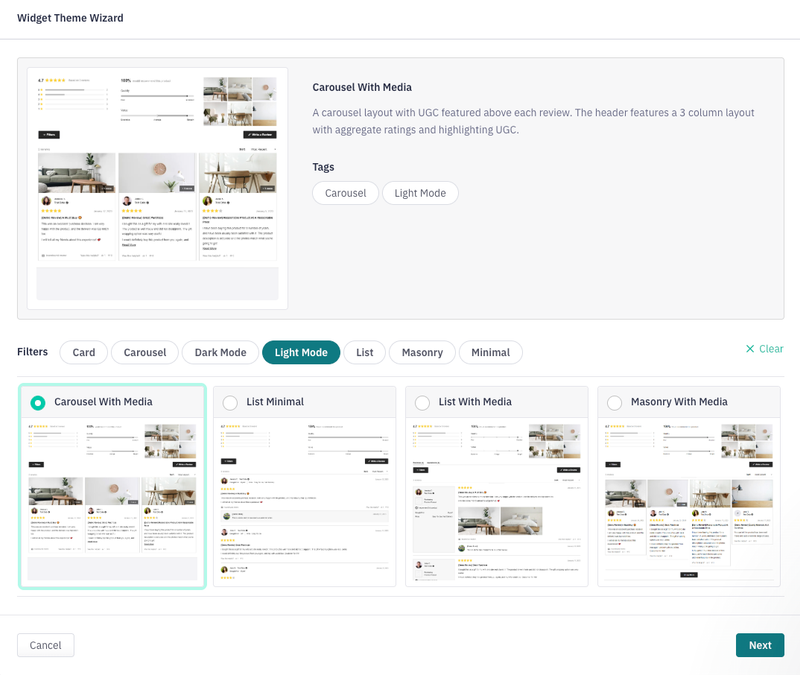
A Widget Theme Wizard sets the starting point. It offers layouts such as Carousel With Media, List Minimal, List With Media and Masonry With Media, with filters for card, carousel, dark and light designs. The thumbnails are detailed enough that you know exactly what you are choosing before the preview updates. Colour palettes can be generated from your brand colours. It works well, though it is a step behind Loox's AI Theme Matcher, which reads your store's design for you.
The previewer is the most thorough on this list. It shows the widget on desktop, tablet and mobile, where most review apps offer only desktop and mobile, and it can open in a standalone tab for the closest view to your live store.
What sets Okendo apart is that the widget is built from blocks. You can stack a rating distribution, then a media grid of customer photos and videos, then the written reviews, in whatever order suits your products. Other modules include a rating average, percent recommended and attribute averages, such as fit or quality ratings collected on the review form. We did not find this level of layout control in any other app we tested.
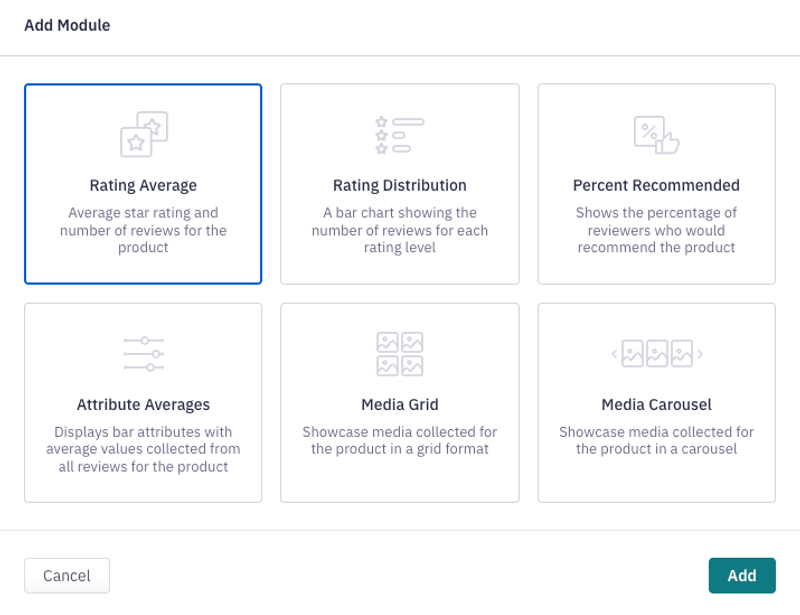
The review form customers fill in is customisable too, which is how those attribute ratings get collected.
Analytics and moderation
Okendo's analytics are thorough, with performance reporting, insights and review signals. Moderation covers the standard tools. We did not find AI-assisted moderation; Okendo's AI features are review summaries and keywords, on the Growth plan and above.
Drawbacks
- You work outside Shopify. The in-admin dashboard is a summary. Day-to-day work happens in a separate platform.
- The platform feels dated. It has an older enterprise feel compared with Loox, even though the widget it produces looks modern.
- The price rises sharply past 200 orders. Essential is $19 a month up to 200 orders. Above that, Growth is $119 a month, and Power, which adds email and SMS integrations such as Klaviyo, is $299 a month.
Who should pick something else
If you want to manage reviews without leaving the Shopify admin, Judge.me does that at a fraction of the price. If presentation is the priority, Loox's editor is more modern and does more of the styling for you.
Using Okendo with a loyalty program
Okendo offers its own loyalty program, so the first decision is whether you want reviews and loyalty from the same vendor. We cover that trade-off below.
We run Okendo reviews with Mage for MiaDonna, a fine jewellery brand. The integration runs through Shopify Flow on Okendo's Review Created trigger, and MiaDonna awards store credit for written, photo and video reviews at different amounts. It was easy to set up.
Okendo's Flow trigger passes the number of images and videos attached to each review, so a single Flow can give written, photo and video reviews their own reward amounts. The trigger also passes the star rating and Okendo's sentiment score. Do not use either to decide who gets rewarded: rewarding only positive reviews breaks the FTC's rules on incentivised reviews, which we cover below.
Set it up with our Okendo integration guide, or see the Mage and Okendo integration page.
4. Yotpo Reviews: best for a clean, guided dashboard
Best for: stores that want a clear at-a-glance dashboard and are happy with standard widget layouts.
Pricing: free up to 50 orders a month; Starter from $15 a month and Pro from $119 a month, both priced by order volume.
App Store rating: 4.8 from 4,625 reviews (as of 7 October 2026).
Yotpo makes a strong first impression and a weaker second one. The dashboard and the main platform look modern and clean, but once you start building widgets and emails, the tools underneath feel older and offer less control than Judge.me, Loox or Okendo. Yotpo also sells a loyalty program.
Setup
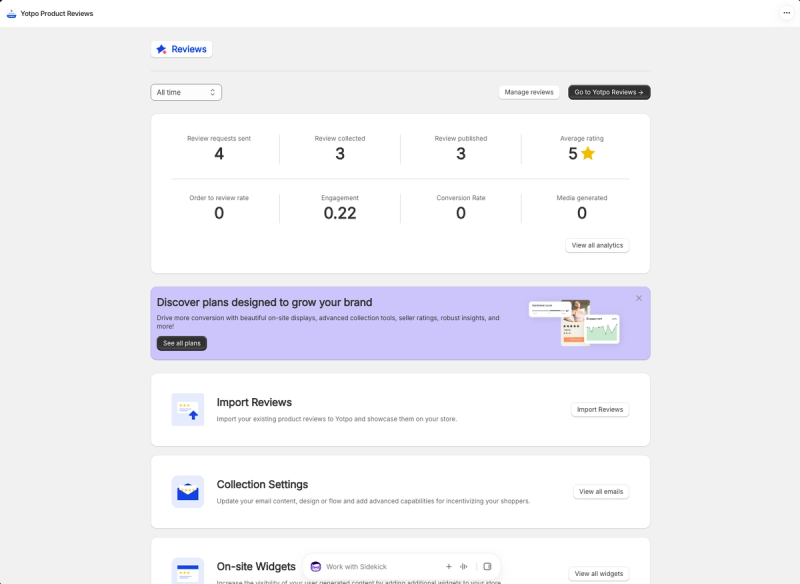
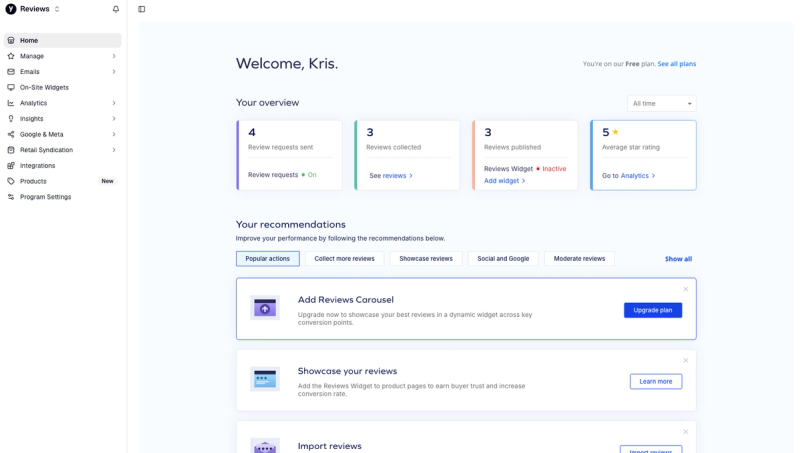
Like Okendo, Yotpo gives you a dashboard inside Shopify and a link out to its own platform for everything else. Yotpo's in-Shopify dashboard is the better of the two: the key numbers sit front and centre, with shortcuts to the two jobs you need first, importing existing reviews and adding widgets. From install to a reviews widget on our product pages took roughly five to ten minutes.
The main platform is clean and easy to find your way around. The first thing we noticed there was the free plan's limit of 50 orders a month. Unless your store is very small, you will be on a paid plan quickly, which makes it hard to compare with Judge.me's free plan.
The widget builder
This is where Yotpo falls behind. The editor covers the standard options, colours, fonts, header, sorting and filtering, and custom questions, and it is easy to use. But the main reviews widget has two base layouts: Standard, a classic three-column layout, and Bold, a modern image-led grid. Compared with Okendo's blocks or Loox's layouts and AI theme matching, there is far less room to make the widget your own. Custom CSS is available on paid plans.
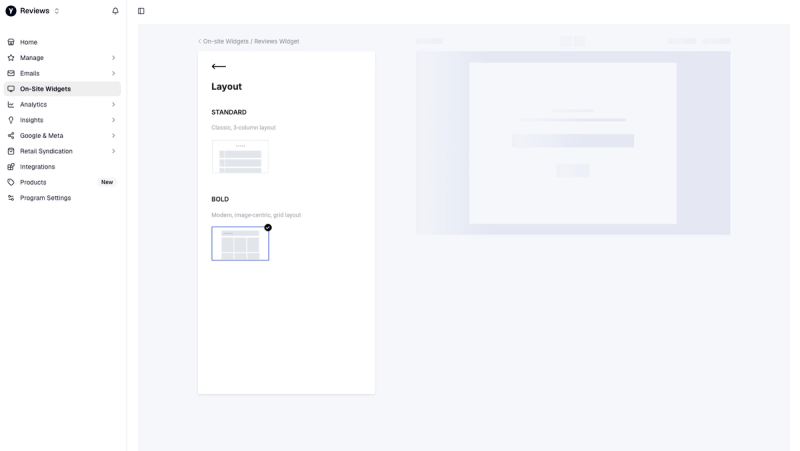
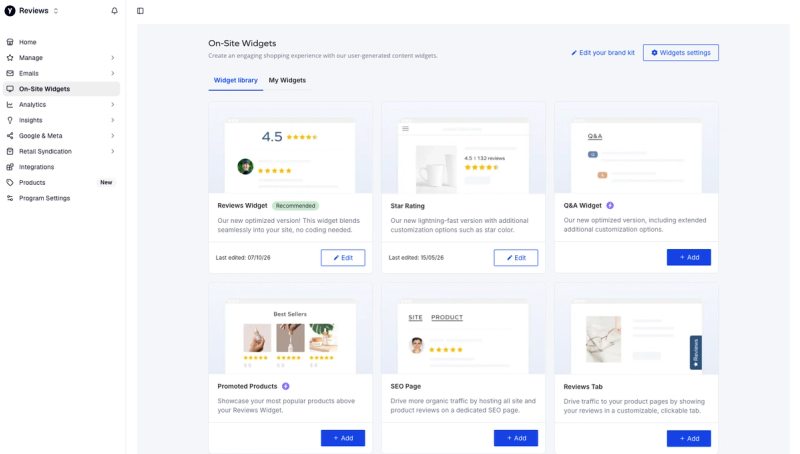
Yotpo has recently rebuilt its main reviews widget and star rating as faster, optimised versions, but the layout choice is still narrow. Beyond the main widget, the library includes a star rating, Q&A, promoted products, a dedicated SEO reviews page and a reviews tab. Several are paid-plan features, including the Reviews Carousel, which most review apps now treat as standard.
Review requests
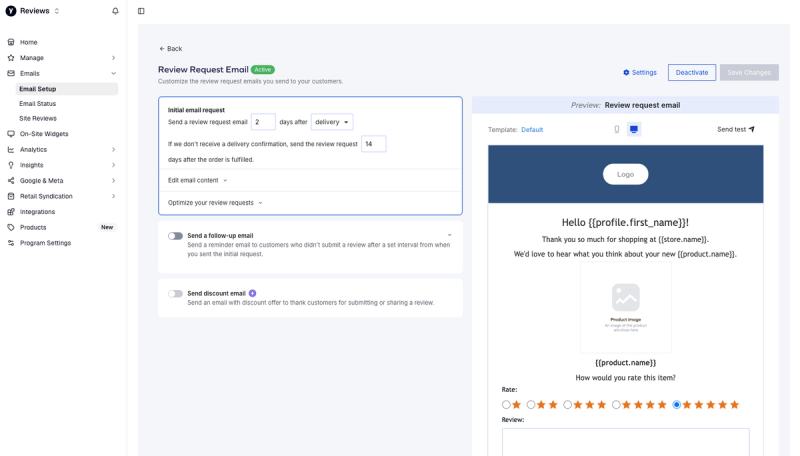
Email setup is straightforward, and a follow-up email and a discount email for reviewers are both available, the latter on paid plans.
Customisation is limited, though. If on-brand emails matter to you, Loox's email builder is a clear step ahead.
Analytics
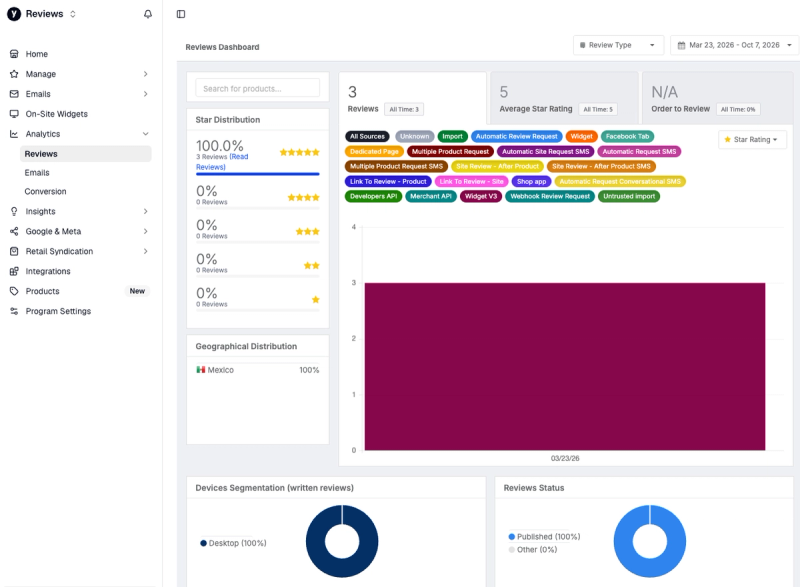
Yotpo's reporting covers star distribution, geography, device split and review status. The source breakdown is the most detailed part: it tags every review by where it came from, including automatic email requests, the on-site widget, the Shop app, imports and the API. Overall, though, the analytics felt less deep than Judge.me's or Loox's.
Drawbacks
- The free plan stops at 50 orders a month. It is a trial in all but name for most stores.
- Basics sit behind the paid plans. Collecting photo and video reviews, Google rich snippets and the reviews carousel all need Starter. Judge.me includes the first two on its free plan.
- The builder lacks flexibility. Two base layouts for the main widget, and email design that is easy but limited.
- Pricing is not fully published. Both paid plans change with order volume, and the listing does not show the price at higher volumes.
- Support starts with AI. Every plan gets AI chat support. Email technical support is a Pro feature.
Who should pick something else
For most stores, Judge.me does more for less, and Loox gives far more control over how reviews and emails look.
Using Yotpo Reviews with a loyalty program
Tea Drops moved its 200,000-member loyalty program from Yotpo to Mage and still runs Yotpo Reviews. We connect the two with Shopify Flow, so every verified review in Yotpo triggers Mage to award the customer their reward. Keeping a reviews app you are happy with while changing loyalty platforms is a common setup, and the Flow connection means a new loyalty platform does not have to mean a new reviews app.
See the Mage and Yotpo integration page for setup details. If you are also comparing loyalty platforms, our Stamped vs Yotpo comparison covers that side in detail.
5. REVIEWS.io: best for fast, AI-designed widgets
Best for: brands that want an on-brand review widget quickly, without spending time in an editor.
Pricing: free for 25 review invites a month; Launch $19 a month for 50 invites; Launch Plus $45 a month for 500 invites; higher plans on request.
App Store rating: 4.7 from 770 reviews (as of 7 October 2026).
REVIEWS.io has the most original idea on this list: an AI widget editor that designs your review widget from a sentence or a mockup. The platform is modern, but there is a lot of it, and it takes a little longer to find your way around than the others.
Setup
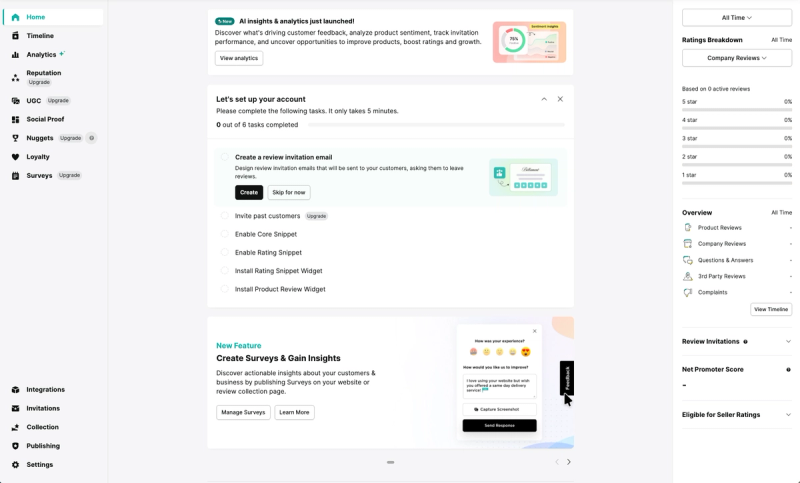
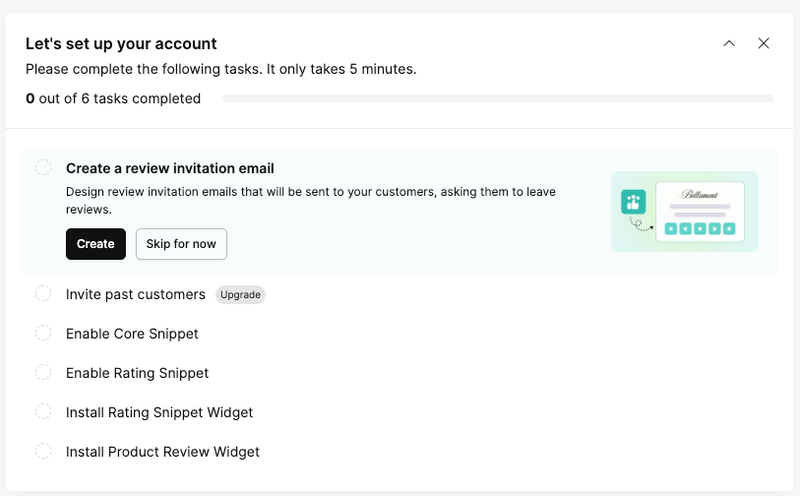
Like Okendo and Yotpo, REVIEWS.io runs off-platform, outside the Shopify admin. Onboarding is easy to follow: a six-task checklist covers the review invitation email, the core snippet app embed, the rating snippet and the product review widget. Working through it put a widget on our product pages in five to ten minutes.
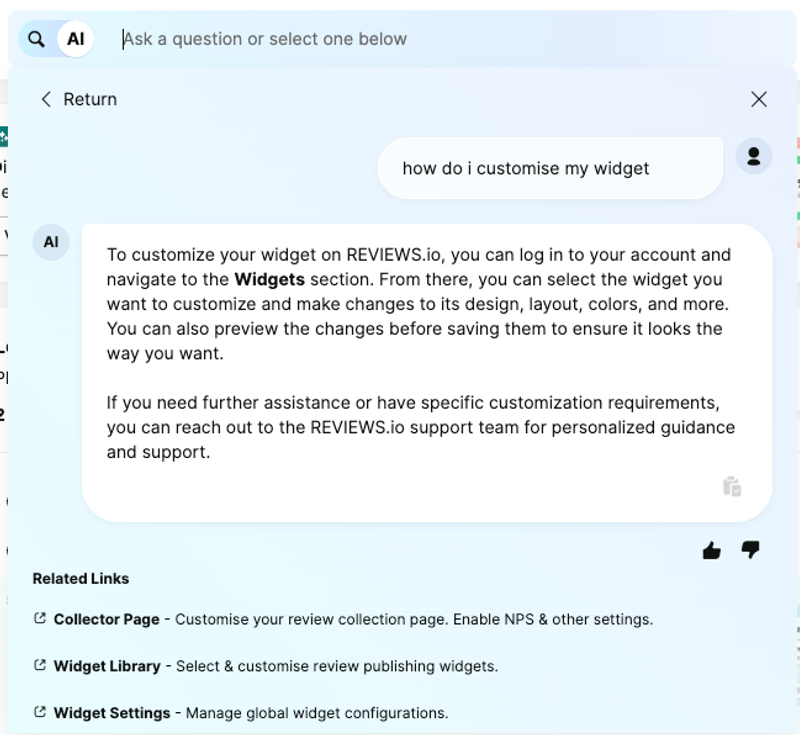
After that, the platform can feel overwhelming. The widget library sits under Publishing, which was not where we expected it, and it took us a moment to find. The built-in AI assistant, which sits in the search bar at the top of every page, pointed us straight to it. It answered our question in plain language and linked to the right settings pages.
The AI widget editor
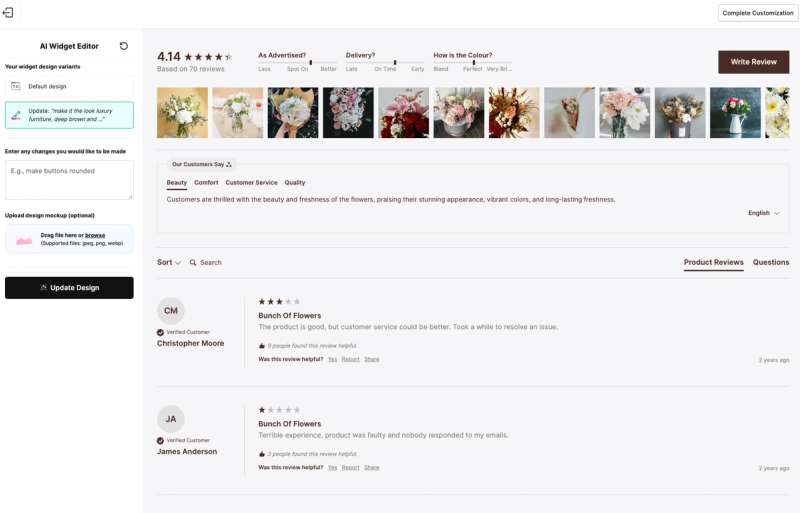
This is the feature that makes REVIEWS.io worth a look. You pick a widget, describe how you want it to look, and optionally upload a design mockup. No other app we tested lets you design a widget from a description or an image.
We asked it to "make it look like a luxury furniture brand, deep brown and cream colours". It returned a convincing result in about five seconds, restyling the stars, buttons and text to match. Given a link to your site or a mockup, we are confident it would get close to your brand on the first attempt, and you can keep refining with follow-up requests.
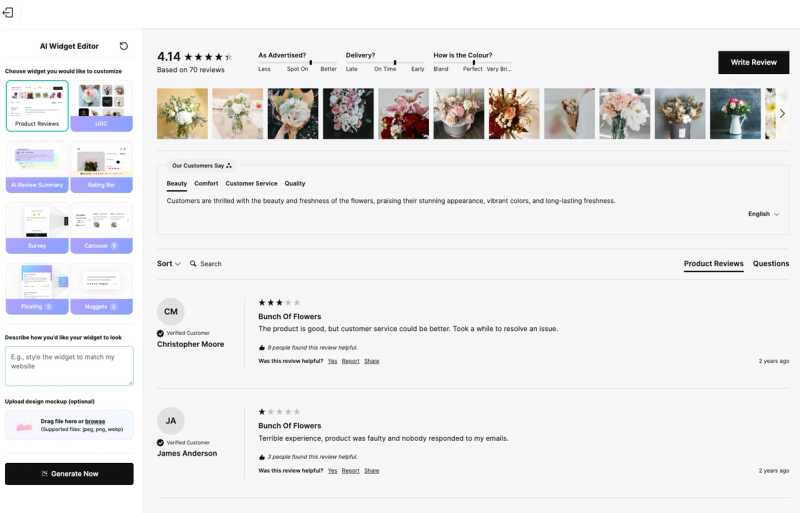
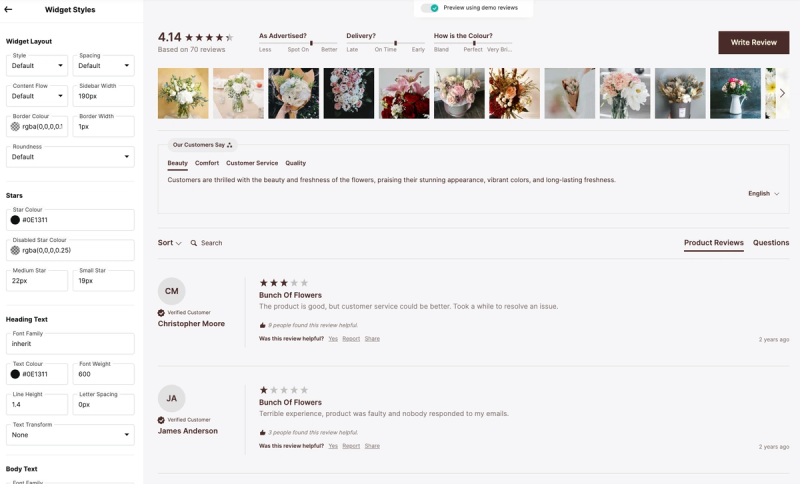
If you would rather not use AI, the manual editor has the usual controls for layout, spacing, borders, stars and fonts. It is enough, but nothing special next to Okendo's blocks or Loox's builder.
What the free plan includes
The free plan is generous in two areas: it collects photo and video reviews and includes the Klaviyo integration. The catch is volume, covered in the drawbacks below.
Analytics
We could not assess REVIEWS.io's analytics properly on a test store with no review data. The dashboard promotes newly launched AI insights covering product sentiment and invitation performance, alongside a ratings breakdown and an NPS score.
Drawbacks
- Pricing is by invites, and the low tiers are tight. The free plan allows 25 review invites a month and Launch allows 50. Busy stores will need Launch Plus at $45 for 500 invites, or a higher plan. Judge.me's free plan has no limit on reviews or orders.
- Several modules are upgrade-only. Reputation, UGC, review nuggets and surveys are all marked as upgrades in the sidebar, as is inviting past customers.
- It works outside Shopify, and the navigation takes learning. Expect a short period of finding where things live.
Who should pick something else
If you send a lot of review requests and want to keep costs flat, Judge.me is the simpler choice. If you want to stay inside the Shopify admin, choose Judge.me or Loox.
Using REVIEWS.io with a loyalty program
REVIEWS.io has its own loyalty tab in the platform, so check which features you would use before running two programs side by side.
We run REVIEWS.io with Mage for Love Sweat Fitness, a fitness and wellness brand. The integration runs through Shopify Flow: when a customer leaves a review in REVIEWS.io, a Flow automation tells Mage to award their reward. See the Mage and REVIEWS.io integration page for setup details.
REVIEWS.io on the Shopify App Store
Should you use your reviews app's built-in loyalty program?
Four of the five apps on this list also sell loyalty or referrals, either inside the reviews app or as a separate product. Using one vendor for both is tempting, so it is worth being clear about the trade-off.
One vendor means one bill, one login and one set of widgets. That is a real benefit for a small team. The cost shows up later. Loyalty features built as an add-on to a reviews app are usually shallower than a dedicated loyalty platform, and bundling makes both products harder to change: if you outgrow the reviews app, your loyalty program, points balances and history move with it.
Keeping them separate costs very little in practice. Every app on this list can pass review events to a loyalty platform, either through a direct integration or through Shopify Flow, so customers still earn for reviewing. Tea Drops is a good example: it moved its 200,000-member loyalty program to Mage, kept its reviews app, and its reviews now earn rewards in Mage.
Our view: choose the best reviews app for your store and the best loyalty program for your store, then connect them. If you are choosing a loyalty platform too, our comparison of the best Shopify loyalty apps covers the options, including Mage's loyalty program.
How to reward reviews without a discount code
Most review apps reward reviews with a discount code: the customer leaves a review and gets an email with money off their next order. It works, but a code can be shared, it often has an expiry date, and it sits apart from everything else the customer earns. Paying the reward as loyalty points or store credit does the same job and keeps it on the customer's account.
Here is how it works with a loyalty platform such as Mage:
- Connect your review app to your loyalty program. Judge.me connects to Mage natively. Loox, Okendo, Yotpo and REVIEWS.io connect through Shopify Flow.
- Set a reward for each type of review. For example, a base reward for a written review and up to double for a review with a photo or video.
- The customer leaves a verified review. The points or store credit are added to their account automatically, with no code to copy or lose.
- They spend it on a future order. The balance shows in the loyalty widget and applies at checkout.
Why it works better than a code:
- It cannot be shared. A code can end up on a coupon site. Points and store credit belong to one customer's account.
- It adds to everything else they earn. A review reward joins the same balance as purchases and referrals, so it builds toward something instead of being a one-off code that quietly expires.
- The cost is fixed. A percentage code discounts the whole basket, however large. A set amount of points or credit costs the same every time.
- It gives you a reason to get back in touch. A balance can be shown in emails and on the account page, and reminders before points expire bring customers back.
One rule applies however you reward reviews: the reward must not depend on what the review says. Since October 2024 the US Federal Trade Commission's rule on fake reviews and testimonials has banned incentives tied to a positive or negative review, so reward every verified review the same way, whatever its star rating. Rewarding photo and video reviews more is fine, because that rewards the content, not the opinion.
For more on turning reviews into user-generated content, see our guide to UGC in loyalty programs.
The Shopify loyalty program growing brands trust
See how Mage helps Shopify brands lift repeat purchase rate with loyalty, referrals and store credit.
Book a demo“We moved to Mage from the best-known platform and only regret not doing it sooner. It costs less, does more, and the support is unmatched.”

Frequently asked questions
What is the best free review app for Shopify? Judge.me. Its free plan includes unlimited product and store reviews, unlimited photo and video reviews, the core review widget and Google rich snippets, with no order limit. Loox's free plan covers up to 500 orders a month, while Okendo and Yotpo stop at 50 orders and REVIEWS.io at 25 review invites a month.
Does Shopify have built-in product reviews? Not any more. Shopify retired its Product Reviews app on 6 May 2024. It now provides a standard review metaobject that review apps can write to, so reviews can be stored in a consistent format, but you need a review app to collect and display them.
Can I move my reviews from one app to another? Yes. All five apps on this list support importing reviews from other apps. Loox, for example, imports directly from Judge.me, Yotpo, Okendo, Stamped, REVIEWS.io, Junip, AliExpress and Shopify's retired reviews app, and accepts a CSV for anything else. Judge.me imports from Yotpo, Loox, Amazon, Etsy and other platforms. In our test, a CSV import from a WooCommerce store into Loox worked first time.
Can I reward customers for leaving reviews? Yes, as long as the reward does not depend on what the review says. Reward every verified review the same way regardless of rating, publish every genuine review, and tell customers about the incentive. Rewarding photo and video reviews more is fine.
Which review apps work with Klaviyo? Judge.me integrates with Klaviyo on its $15 Awesome plan, and REVIEWS.io includes the Klaviyo integration on its free plan. Okendo's email and SMS integrations are on its $299 Power plan. Loox's integrations are on its Convert plan.
Our verdict
- If you want the best value at any size, choose Judge.me. It is $15 a month however large you grow, and very hard to outgrow.
- If your brand sells on how products look, choose Loox, and budget for the Convert plan as you scale.
- If you want detailed, Amazon-style review pages and do not mind working outside Shopify, choose Okendo.
- If you want an on-brand widget designed for you in seconds, choose REVIEWS.io.
- If you value a clear dashboard and are happy with standard layouts, Yotpo Reviews is a reasonable choice, though most stores will get more from Judge.me.
Whichever you choose, connect it to your loyalty program so every review earns the customer a reason to come back.

Graeme is the co-founder at Mage Loyalty. He heads product development, from complex loyalty migrations and large-scale data handling to building the features shaping the future of loyalty on Shopify.