Imagine your report shows plenty of referral shares, a few friend sign-ups, and almost no completed first orders. The referral reward structure is doing one job, generating interest, while failing at the next one, getting a new customer to buy.
Short answer: Double-sided referral rewards are usually the strongest starting point because they give the advocate a reason to share and the friend a reason to buy. They are not automatically the cheapest or best structure. Choose the split, timing, and reward amount around AOV, contribution margin, purchase frequency, returns, and fraud exposure.
What a referral reward structure actually controls
The advocate, the friend and the conversion event
A referral reward structure decides who receives value, what action qualifies, and when the reward becomes usable.
The advocate is the existing customer making the recommendation. The friend is the prospective customer receiving it. A referral link can produce a click, sign-up, claimed discount, or qualifying purchase. Those are separate measurements.
A click tells you the advocate shared. A sign-up tells you the friend had interest. A completed order tells you revenue occurred. Treating all three as “referrals” hides where the program is losing people.
A Shopify referral program needs a clear conversion event. Mage can define conversion as a sign-up, a purchase, or both. If you need qualified customer acquisition, a purchase is usually the event that matters most.
One-sided, double-sided and uneven two-sided rewards
One-sided rewards pay only one participant. An advocate-only offer pays the person who refers. A friend-only offer gives the new customer the benefit.
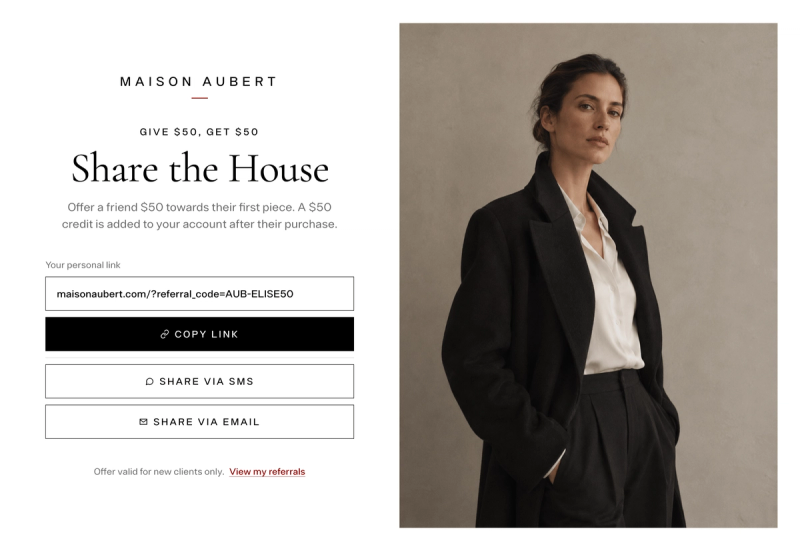
Double-sided rewards give both people something. The familiar “Give X, Get Y” format is simple because the advocate can explain it in one sentence.
The rewards do not need to match. Give more value to the friend if first-order conversion is weak, or more to the advocate if few customers are sharing. Judge each structure by share rate, friend purchase rate, approved orders, refunds, and contribution margin after reward cost.
“I looked into so many different integrations for loyalty and referrals for our Shopify Store, but no one impressed me more than Mage on human connection, customer service, and value.”


Read the Reelie case study →
Myth: rewarding both sides always wastes margin
Why advocate-only rewards can create social friction
An advocate-only reward can make the recommendation feel self-serving. The customer is effectively saying, “Buy from this brand so I get something,” while the friend receives no clear reason to try it.
That does not mean advocates will refuse to share. Customers who already love a product or regularly recommend the brand may still do so. But a friend reward can make the invitation easier to send because it gives the advocate a useful reason to reach out.
Research summarized in a Journal of Marketing Research paper found that recipient-benefiting referral incentives drove higher uptake and conversion than sender-benefiting incentives, even where referral rates were similar. Read the research summary.
Use that as a testing hypothesis, not a universal rule. A referral offer needs to give the friend a credible reason to act, especially when they have never bought from you.
When a friend-first or one-sided structure makes more sense
Friend-only rewards suit brands where trial is the main barrier. The friend may need help overcoming price hesitation, uncertainty, or the effort of switching from a familiar product.
Advocate-only rewards can make sense when margins are narrow and sharing volume is the obvious problem. Keep the conditions tight. Require a qualifying first order, set a realistic minimum spend, and avoid applying the reward to products where discounting destroys the economics.
The research signal: recipient value can improve conversion
The same research found that equal shared rewards performed better than uneven shared rewards for referrals to weak ties, while no difference was observed for strong ties. See the cited findings.
Many ecommerce links go to acquaintances, colleagues, followers, and group chats, not only close friends. An even split is easy to understand and can feel fair. Test it against a friend-weighted version with the same total incentive budget, then compare completed and refund-adjusted orders.
One-sided vs double-sided referral rewards: how each mechanism works
| Structure | Who gets rewarded | Best for | Main risk | What to test |
|---|---|---|---|---|
| Advocate-only | Existing customer | Increasing share activity | Friend lacks purchase incentive | Share rate and friend conversion |
| Friend-only | New customer | Reducing first-order hesitation | Too little advocate motivation | Link sharing and first-order AOV |
| Equal two-sided | Both participants equally | Simple, broadly understandable offers | Total reward cost rises | Purchase rate and margin |
| Uneven two-sided | Both participants, different values | Targeting a specific bottleneck | Offer can feel harder to explain | Split performance |
| Reward ladder | Advocate reward rises over time | Encouraging repeat referrals | Higher fraud and liability | Quality of later referrals |
Advocate-only rewards
Advocate-only rewards concentrate the budget on the customer doing the sharing. They work best when customers are highly engaged and the brand needs more advocates to distribute links. The risk is that the friend still has to decide whether the product is worth trying.
Friend-only rewards
Friend-only offers put the full incentive into customer acquisition. They can make an advocate’s message feel more generous because the advocate is offering a friend a useful benefit rather than asking them to make a purchase for someone else’s gain.
Equal-split and uneven-split two-sided rewards
Equal two-sided offers are easy to communicate and remember. Uneven splits are more diagnostic. Put more value on the friend side when clicks and sign-ups are healthy but orders are weak. Put more value on the advocate side when friend conversion is healthy but too few customers share.
Mage supports separate advocate and friend rewards, including fixed discounts, percentage discounts, free shipping, free products, points, and store credit.
Reward ladders and milestone structures
Reward ladders increase the advocate’s benefit after successive successful referrals. Keep the first referral offer understandable, and test the ladder separately from the basic split.
For context on separating shares from purchases, see these referral program benchmarks.
How to size a referral reward amount against AOV and margin
| Input | What to calculate | Why it matters | Decision it informs |
|---|---|---|---|
| First-order AOV | Typical qualifying basket value | Average can be distorted by outliers | Fixed reward amount |
| Contribution margin | Revenue less product, fulfillment and shipping costs | Revenue is not available reward budget | Maximum total incentive |
| Refund rate | Value of rewards attached to returned orders | Returned orders can create false acquisition value | Reward delay |
| Expected repeat value | Future contribution from retained customers | Some acquisition cost may be justified | Test budget |
| Highest likely order | Maximum percentage discount exposure | Large carts can inflate percentage cost | Discount cap or fixed reward |
Start with contribution margin, not revenue
Referral rewards come out of contribution margin, not top-line sales. Define contribution margin before the referral incentive first. It should include revenue less product, fulfillment, shipping, and other direct order costs.
Then decide how much future contribution you are willing to include. A brand with strong repeat purchase behavior can rationally invest more in a profitable new customer than a brand selling a product customers buy once.
The planning model is:
Maximum allowable referral incentive = contribution margin before the referral incentive + acceptable share of expected future contribution margin − any other acquisition costs
Do not subtract fulfillment or shipping again if they are already included in contribution margin. This is a planning ceiling, not a universal accounting formula or a target. Leave room for refunds, fraud, and tests that underperform.
For a fuller view of retained-customer economics, use this guide to loyalty program ROI math.
Fixed discount versus percentage discount
Fixed discounts give you predictable cost. Compare the amount against median first-order AOV, not only average AOV.
Percentage rewards scale with basket value, which can help protect perceived value on higher-priced products. They also create more exposure on large carts. Model the highest likely qualifying order, then set a cap or switch to a fixed incentive if the discount becomes too expensive.
Low-AOV, high-frequency brands may prefer a smaller fixed reward with a reachable minimum spend. The same logic applies in a food and beverage loyalty program, where faster repeat cycles change the economics of acquisition.
A simple reward-sizing equation
Build a worksheet with four scenarios: no reward, advocate-only, equal two-sided, and friend-weighted two-sided. Hold the total budget constant for the two-sided tests.
For each scenario, calculate qualifying orders, friend AOV, reward cost, refund-adjusted margin, and the proportion of new customers who buy again. You are looking for the structure that produces the most retained contribution, not the largest number of claimed offers.
Adjusting for repeat purchase value
A field study found utilitarian rewards converted at 11.8% versus 8.7% when paired with utilitarian products, while hedonic rewards converted at 12.0% versus 9.2% when paired with hedonic products.
Those are not Shopify benchmarks. They are a reminder to make the reward relevant. A practical saving may suit a replenishment product, while a product-led perk may better suit a more indulgent purchase.
When to issue the reward and how to protect the economics
Sign-up, purchase or both
A sign-up event generates leads quickly, but it can also attract low-intent accounts. For most physical-product brands, make a qualifying purchase the event that unlocks the advocate reward. You can still give the friend an offer when they arrive, then reserve the advocate payout until revenue is real.
Mage can track a unique referral link through friend conversion and lets merchants configure sign-up, purchase, or both as the conversion event.
Why the return window matters
Reward timing is a margin control. If a referred order is refunded after you issue a high-value advocate reward, the program has paid for acquisition that did not stick.
Delay issuance until the return window has passed when return exposure is material. Mage supports configurable reward timing, including a delay after the return window. Shopify’s own referral terms also prohibit self-referrals and allow credits to be delayed for up to 60 days, though that policy is not a template for every merchant program.
Minimum spend, expiry and first-order rules
Use a minimum spend to prevent a reward from consuming the entire order’s margin. Restrict friend offers to first orders when the purpose is acquiring new customers.
Expiry can create urgency, but short windows can frustrate customers who are waiting for payday, a restock, or a planned purchase. Set the deadline around your usual buying cycle.
How Shopify supports the discount layer
Shopify supports amount-off, percentage, buy X get Y, and free-shipping discounts. It also supports automatic discounts that apply in cart and at checkout, alongside shareable discount links and QR codes.
Customer segments can control eligibility, including customers with no previous orders. Referral attribution, paired advocate and friend rewards, and fraud rules need referral-specific logic, a loyalty app, or a custom implementation.
At what point do referral rewards attract fraud?
| Signal | What it may indicate | Control to test | Metric to monitor |
|---|---|---|---|
| Self-referral | Customer attempting to claim both rewards | Block matching identities | Blocked attempts |
| Email aliases | Multiple accounts controlled by one person | Alias detection | Approved accounts per identity |
| Shared IP or device | Household sharing or coordinated abuse | Configurable review threshold | Conversion quality after review |
| Rapid referral burst | Automated or coordinated activity | Rate and pattern checks | Time between referrals |
| High refund rate | Rewarding orders that do not stick | Delay reward issuance | Refund-adjusted margin |
The risk signals to monitor
Fraud does not begin at a universal reward value. Risk depends on the reward, product price, refund policy, account-creation friction, and how easily someone can make multiple identities.
Watch for self-referrals, repeated payment or shipping details, email aliases, duplicate accounts, shared IP patterns, repeat devices, rapid referral bursts, and elevated refunds. A pattern of signals deserves attention.
Why larger rewards increase the value of abuse
High-value offers with instant rewards and easy account creation need more protection than modest offers issued after a verified purchase. Start with the economic downside of one fraudulent conversion, then decide how much friction is justified.
Controls that protect conversion without killing participation
Use minimum spend, first-order eligibility, one reward per new customer, expiry rules, and delayed issuance where they fit the program. Avoid adding every restriction at launch.
Mage documents self-referral blocking, alias blocking, duplicate-account detection, configurable shared-IP checks, repeat-device checks, and rapid-burst detection. Blocked attempts are listed in analytics with the reason recorded.
Track approved conversions, blocked attempts, refund-adjusted contribution margin, and payout cost. Set a defined test budget before launch, then revise the offer with the numbers in hand. This guide can help you budget for a loyalty program.
A practical decision framework for choosing your structure
Choose advocate-only when
Choose advocate-only when sharing activity is the bottleneck and your customer base is highly engaged. Make the advocate reward contingent on a qualifying first purchase, then watch whether friend conversion remains strong without a direct offer.
Choose friend-only when
Choose friend-only when product trial, price hesitation, or trust is the main obstacle. Use a first-order condition and a realistic minimum spend.
Choose double-sided when
Choose double-sided rewards when both stages need support. Start with an equal split if clarity matters. Use a friend-weighted split if the program gets clicks but too few completed orders.
Run a controlled test before scaling
Test one variable at a time: recipient, total incentive value, split, qualifying event, or payout delay. Report share rate, friend purchase rate, completed conversion, AOV, refund rate, fraud blocks, and contribution margin.
FAQ
What is a referral reward structure?
A referral reward structure is the combination of who receives an incentive, what action qualifies, what the reward is worth, and when it is issued. It can be advocate-only, friend-only, or double-sided.
Do double-sided referral rewards convert better?
Double-sided referral rewards are a strong starting point because they support both sharing and first-order purchase. Research found recipient-benefiting incentives increased uptake and conversion, but the findings do not prove the same structure wins for every Shopify store.
How much should a referral reward be?
Size it against contribution margin before the referral incentive, typical first-order AOV, refund exposure, other acquisition costs, and expected repeat contribution.
Should I reward the advocate or the friend?
Reward the advocate when sharing is the bottleneck, the friend when first-purchase hesitation is the bottleneck, and both when each stage needs support.
When should referral rewards be paid?
Pay rewards after the qualifying event, usually a completed first purchase, and delay valuable payouts when returns create material risk. Shopify provides automatic discount tools, while referral-specific systems can manage attribution, conversion conditions, and paired reward timing.
How do I prevent referral reward fraud?
Combine identity checks, eligibility rules, delayed issuance, and refund monitoring. Block self-referrals, aliases, duplicate accounts, suspicious device or IP patterns, and rapid bursts.
Start with a simple double-sided offer if both sharing and first-order conversion need attention. Keep the incentive within contribution-margin limits, delay valuable payouts until orders are secure, and let completed, refund-adjusted margin decide whether the structure deserves more budget.
See how Mage’s Shopify referral program supports separate advocate and friend rewards, configurable conversion events, delayed issuance, and referral fraud controls.

Graeme is the co-founder at Mage Loyalty. He heads product development, from complex loyalty migrations and large-scale data handling to building the features shaping the future of loyalty on Shopify.