Most Shopify loyalty programs still use points. But store credit gives customers something easier to understand: money they can spend on their next order. We looked at seven Shopify brands using store credit, from simple cashback programs to VIP tiers, paid memberships, review rewards, birthdays, social engagement, and more.
Short answer: The strongest examples do more than issue generic cashback. They use store credit to influence when customers return, make VIP status more valuable, encourage UGC, and strengthen paid memberships. Below, we break down exactly how each program works and the ideas merchants can borrow.
What Shopify brands using store credit are doing differently
| Brand | Program model | Cashback or reward rate | Other ways to earn | Issuance or expiry | Redemption |
|---|---|---|---|---|---|
| MiaDonna | Store credit as the loyalty currency | 5% ($1 per $20 spent) | Purchases | Not publicly stated | Balance shown in cart and at checkout |
| Youswim | Spend-based VIP tiers | 5%, 7%, or 10% cashback | Signup, reviews and UGC, social follows | Issued after 31-day returns period | Redeemed at checkout |
| The Go-To | VIP cashback plus engagement rewards | 5%, or 10% for Patron | Birthday, social follows, wishlist, gift reminders | Issued after returns period | Redeemed as store credit |
| Joy Dravecky | Flat-rate cashback | 10% cashback | Birthday, social follows, photo and video reviews | Not publicly stated | Credit against future orders |
| True Classic | Paid membership | 10% ongoing credit | 20% first-order credit offer for eligible new customers | Member credit expires after 180 days | Applied to future purchases |
| Dolls Kill | Paid membership | 20% cashback | Purchases | Credit expires after 90 days | Customer chooses amount to apply at checkout |
| Lashify | Paid membership | 5% Lash Cash | Regular purchases and subscription spend | Forfeited if membership is cancelled | Visible in account and applied at checkout |
Store credit is a reward customers understand immediately
A $10 credit balance answers the customer's first question without conversion math: "What can I spend?" That makes store credit particularly useful where a large points balance would feel abstract or where customers buy only once or twice a year. The trade-offs either way are covered in store credit versus points.
Customers can use Shopify store credit at checkout when signed in through customer accounts or Shop Pay, and it can also be accepted through Shopify POS. Shopify sets expiry per credit issuance, rather than applying one universal store-wide expiry rule.
For a broader program, store credit can sit alongside tiers, referrals, rewards, and engagement actions in a Shopify loyalty program.
The strongest programs delay issuance until the order is safe
Immediate cashback can create avoidable margin exposure in categories with frequent cancellations, exchanges, or returns. Set the release rule around your actual returns pattern, then state it before customers earn the reward.
Store credit can also defer the commercial cost of a reward. An upfront discount reduces revenue on the order already being placed. Credit gives the shopper a reason to come back, which is the whole margin trade-off in one sentence.
Cashback can support acquisition and retention
Acquisition credit gives a new shopper a reason to make a second purchase. Retention credit rewards customers after they have already shown value.
1. MiaDonna: 5% back as store credit on high-AOV jewelry
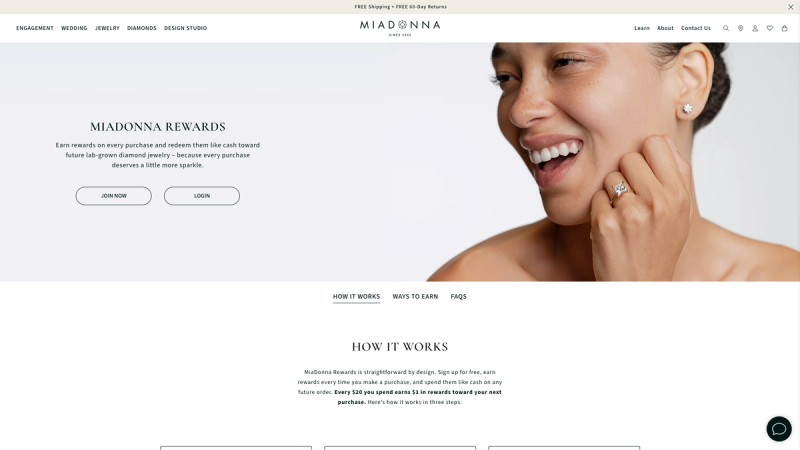
Program model: MiaDonna uses store credit as its loyalty currency. Customers earn $1 in store credit for every $20 they spend, an effective 5% back, and spend that balance like cash at checkout.
That suits high-AOV jewelry, where a customer may go a long time between orders and the reward has to be legible the moment they see it. A balance already denominated in dollars tells them what they can spend, with nothing to work out.
MiaDonna, whose loyalty program drove $27K in new revenue at launch, surfaces the store credit balance in the cart total and at checkout, and states the credit a customer will earn on the product page before they add to bag. For high-AOV categories, display the reward's dollar value near the cart and checkout.
2. Youswim: cashback that increases through spend-based tiers
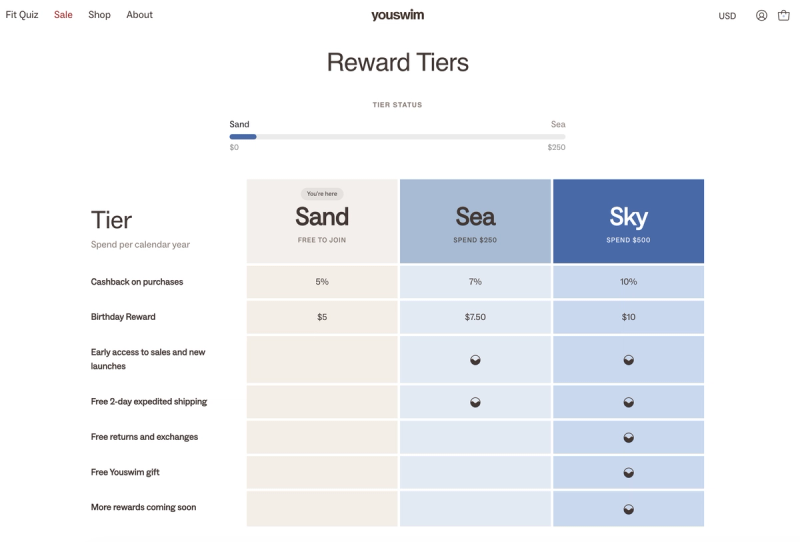
Program model: Youswim runs a three-tier, spend-based store credit program. All customers begin in Sand and earn 5% cashback. Sea earns 7%, while Sky earns 10%.
Youswim also awards store credit for reviews, including photo and video reviews that encourage UGC, as well as social follows. Customers receive $1 in store credit for signing up. Purchase cashback is the main engine, while engagement actions give customers additional ways to build a useful balance.
Store credit is issued only after Youswim's 31-day returns period has passed and is redeemed directly at checkout.
What merchants can learn: Use delayed issuance where returns are material, and make the higher cashback rate visible enough to give customers a tangible reason to move up a tier.
3. The Go-To: cashback with engagement rewards beyond purchases
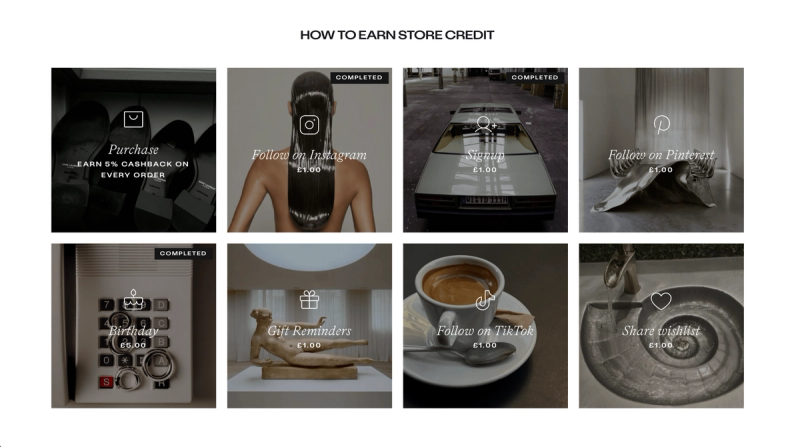
Program model: The Go-To calls its program The Circle. All customers earn 5% cashback after the returns period has passed, while Patron customers earn 10%.
The Go-To sells around gifting occasions, so The Circle rewards actions that can create future purchase intent before the customer has chosen a product. Customers can earn £1 for following the brand on Instagram, Pinterest or TikTok, £1 for adding products to their wishlist, £1 for adding someone to their gift reminders list, and £5 on their birthday.
Patron status is based on both spend and order count. Customers qualify by spending £500 and placing three orders within the calendar year, at which point their cashback rate increases from 5% to 10%.
What merchants can learn: Reward actions that create genuine future purchase occasions. For a gifting brand, a saved birthday, gift reminder, or wishlist item is much closer to future revenue than a generic engagement action.
4. Joy Dravecky: a simple 10% store credit model for jewelry
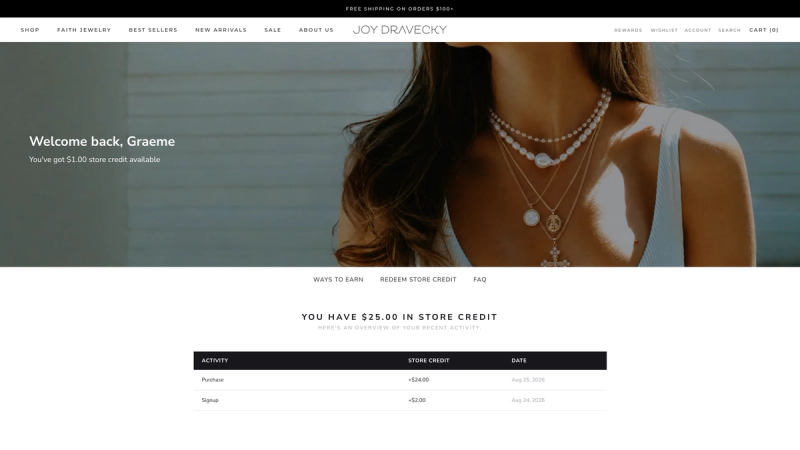
Program model: Joy Dravecky awards 10% cashback on purchases as store credit against future orders. The program is deliberately simple. Customers know what they earn without studying a tier chart or calculating a points conversion.
Joy Dravecky also rewards social follows, gives $5 in store credit on a birthday, and pays review rewards. A photo review earns $2 in store credit, while a video review earns $3.
What merchants can learn: A flat cashback rate keeps the program easy to understand, while extra credit for photo and video reviews lets the same loyalty currency incentivise higher-value UGC.
5. True Classic: paid membership plus 10% ongoing store credit
Program model: True Classic uses an annual Insiders Club membership that costs $12 per year. Members receive 10% of every eligible order back as store credit for a future purchase.
Member credit expires 180 days after it is earned. The membership also includes 10% off the first order, free US standard shipping, and member-only offers.
Eligible new customers can receive 20% of their first purchase back as store credit after opting into an invitation. That credit remains pending for 28 days after fulfilment, then expires 30 days after release.
What merchants can learn: Store credit can serve two different jobs at once: an acquisition offer that gives a first-time buyer a reason to return, and an ongoing membership benefit that rewards repeat purchases.
6. Dolls Kill: 20% cashback with credit that stacks during sales
Program model: Dolls Kill Stash costs $29 per year and pays members 20% cashback on every eligible purchase. Members also receive 20% off their joining order, 20% cashback on that discounted order, free US returns and exchanges, and a joining gift.
Customers choose how much Stash credit to apply at checkout. The balance can be used during sitewide promotions and sales. Stash credit expires 90 days after earning.
Cashback does not apply to taxes, shipping, gift cards, or the Stash subscription. Preorders earn cashback when the preorder ships, rather than when the order is placed.
What merchants can learn: A very high cashback rate can be viable when the economics are protected by a paid membership, clear exclusions, and a defined expiry window. Decide upfront whether credit can stack with sale pricing.
7. Lashify: store credit tied to a paid beauty membership
Program model: Lashify calls its cashback-style credit Lash Cash, available through paid Membership X. Members earn 5% of eligible spend back as Lash Cash.
Following Lashify's July 2026 loyalty revamp, members earn Lash Cash on regular online purchases and subscription spending. Membership X also includes 15% off full-price retail purchases, members-only products, and early access to launches.
Customers can see their Lash Cash balance in the account portal and apply it at checkout alongside the gift card and discount code field. Cancelling Membership X forfeits earned Lash Cash.
What merchants can learn: In replenishment categories, allowing subscription spend to earn store credit gives customers another reason to maintain continuity. Make the available balance and cancellation rules obvious before payment.
The biggest difference: cashback vs store credit as the loyalty currency
True Classic, Dolls Kill, and Lashify mainly use store credit as a percentage-back incentive tied to paid membership. The model is straightforward: buy, earn a percentage back, then spend that balance on a later order.
MiaDonna, Youswim, The Go-To, and Joy Dravecky go further. Store credit acts as the loyalty currency itself, so the same monetary balance can reward purchases, VIP progression, reviews and UGC, birthdays, social follows, wishlist activity, and other valuable behaviors. For merchants, that turns store credit from a cashback feature into the foundation of the loyalty program.
What these seven programs show
- Store credit works best when the value is obvious. Percentage-back rewards and cash balances remove the mental math of points and make the benefit immediately clear.
- The best programs use timing intentionally. Delayed issuance can protect against returns, while expiry can encourage customers to come back within a defined purchase window.
- Store credit can be more than cashback. The more sophisticated programs use the same balance to reward VIP progression, reviews and UGC, birthdays, social engagement, wishlists, and other behaviors that support retention.
Make the reward feel like money
The clearest programs show a percentage back or a dollar-equivalent balance. MiaDonna, Youswim, and Joy Dravecky make the future value understandable without asking customers to decode a conversion rate.
Use expiry as a timing tool, not a surprise
Expiry should match the normal repurchase cycle. A 90-day window may suit a promotion-driven apparel brand. A longer period may better fit infrequent high-AOV purchases. Unredeemed balances are still a customer obligation worth tracking, not automatic profit. Read more about loyalty breakage.
Choose between flat rates, tiers, and memberships
Use flat cashback when simplicity wins. Use spend-based tiers when increased customer value should earn a better rate. Use paid memberships where recurring perks and stronger cashback justify the annual fee, which is how True Classic, Dolls Kill, and Lashify all structure theirs. Mage runs paid membership programs with monthly, quarterly, or annual billing alongside the loyalty program itself.
These examples show that store-credit loyalty does not have to mean a simple 5% cashback program. Brands can vary cashback by VIP tier, delay rewards until returns clear, reward reviews and social actions, or use credit inside a paid membership. Mage is built around this broader model, allowing Shopify brands to use store credit as the core loyalty currency rather than requiring customers to convert points into monetary rewards.
“I looked into so many different integrations for loyalty and referrals for our Shopify Store, but no one impressed me more than Mage on human connection, customer service, and value.”


Read the Reelie case study →
Frequently asked questions
What is a store credit loyalty program?
A store credit loyalty program rewards customers with a balance they can spend on future purchases. Unlike a one-time discount, the value is earned after a qualifying action and creates a reason to return. Unlike points, the balance usually has a direct currency value that customers can understand immediately.
How do Shopify brands give cashback rewards?
Shopify brands give cashback rewards by calculating credit from an eligible order, issuing it immediately or after a pending period, and allowing the customer to apply it on a later checkout. The program should state qualifying products, exclusions, issue timing, expiry date, and whether refunds reverse the reward.
Can Shopify store credit be used at checkout?
For Shopify-native store credit, customers can use the balance at checkout when signed in through customer accounts or Shop Pay and the merchant has enabled the feature. Shopify-native store credit can also be accepted through Shopify POS, allowing eligible customers to use the same balance in a physical retail transaction.
Mage's loyalty store-credit mode is a separate internal ledger, not Shopify-native store credit, even though Mage can surface loyalty rewards through checkout and POS experiences.
What is the difference between store credit and points?
Store credit is a loyalty balance with a direct currency value, while points require a defined conversion rate before customers know what they can redeem. Points can support more varied earning and reward mechanics. Store credit generally reduces mental math and makes the future-purchase value more visible.
Can store credit expire on Shopify?
Store credit can expire on Shopify because merchants can set an expiration date for each individual credit issuance. Shopify does not apply one default store-wide expiry setting. Merchants should communicate the deadline clearly and check applicable local laws before setting expiry rules for customer balances.
Are store credit rewards better than discounts?
Store credit rewards are better than discounts when the goal is to encourage a future purchase without reducing the value of the current order immediately. Discounts may suit conversion-focused campaigns. The right choice depends on margin, repurchase frequency, return rates, and whether customers will notice and redeem the balance.
Choose the model that matches how customers actually buy. A high-repeat category may support membership cashback, a high-AOV category may need clear cash-equivalent value, and a returns-heavy category should delay issuance. If you want to configure a Shopify loyalty program with cashback, points, or Mage's internal store-credit ledger, book a demo.

Kris is the co-founder of Mage Loyalty. I spend most days talking to merchants, shipping features, and making sure our customers get real results. If you run a Shopify store or Agency we should chat!