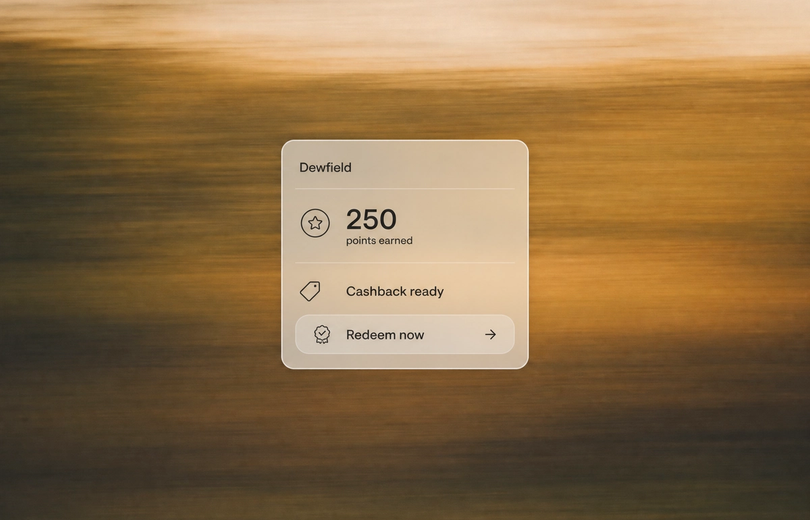
Youswim holds cashback until its 31-day returns period has passed before issuing store credit. That rule shows why Shopify native store credit and a loyalty balance need separate definitions: one is where customer value can live, the other can control when it is earned and released.
Short answer: Shopify native store credit is a monetary balance attached to a customer account and used as a payment method at supported checkout surfaces. Loyalty app store credit is usually a reward ledger or campaign system that controls earning, delays, targeting, expiry, and reversals. It may pay out through Shopify native store credit, a discount code, or an app-managed balance.
What Shopify native store credit actually is
A customer-account balance, not a loyalty program
Shopify native store credit is a monetary balance held in a customer’s StoreCreditAccount. The authenticated customer can use that balance as payment at checkout.
It is useful for a refund alternative, a goodwill adjustment, or a simple account credit. It does not decide whether someone deserves a reward for buying a particular collection, reaching a VIP tier, referring a friend, or opting into a promotion.
Where customers can use it
Shopify supports native store credit on the online store, Shopify POS, and Shop. It is not available across every sales channel, so merchants should test the channels that matter to their business.
Online redemption depends on customer authentication. Native store credit is not available to customers using legacy customer accounts. A customer needs the relevant newer account setup or Shop Pay authentication to access it online.
The checkout restrictions merchants need to know
Native store credit cannot be used for recurring subscription bills, although it can be used toward an initial subscription purchase. Customers also cannot select an arbitrary partial amount of store credit as their payment amount.
Test checkout behavior with your theme, account configuration, POS setup, subscriptions, and common cart values before presenting store credit as a universal payment option.
Myth: a loyalty app balance is automatically Shopify store credit
The ledger and the payout rail are different
A balance that displays as dollars is not automatically Shopify native store credit. Shopify native store credit lives in Shopify’s payment ledger. A loyalty app may instead hold a balance in its own ledger, issue a customer-locked discount code, or write an approved reward into Shopify’s native store-credit account.
Mage is a clear example. Its loyalty store-credit mode is a Mage-internal ledger, not the customer’s Shopify native store-credit balance. Merchants should not describe that balance as Shopify-native monetary tender.
Mage cashback works differently. A merchant can configure an offer to pay as Shopify store credit or as a single-use, customer-locked discount code.
Why the distinction matters for customers and finance teams
Think of Shopify’s account as the payment rail. The loyalty app is the rules engine that can decide who earns value, what qualifies, when the reward becomes usable, and what happens after a return.
Before changing loyalty currency, document the source of truth, then plan how balances and customer communications will move. This guide on how to migrate from points to store credit covers the operational side of that change.
“Cannot say enough good things about the team at Mage Loyalty, one of the absolute best organizations we have ever worked with, full stop! So glad we connected with them, completely redid our loyalty program, new concepts, use of loyalty, increasing user engagement, showing us where we were not valuing our best customers, just WOW, amazing team!”


Read the West Coast Goalkeeping case study →
Shopify store credit vs loyalty app: compare the full reward lifecycle
| Decision point | Shopify native store credit | Loyalty app-managed credit | Merchant implication |
|---|---|---|---|
| Ledger | Shopify StoreCreditAccount | App ledger, discount code, or Shopify payout | Define the source of truth |
| Earn | Issued or adjusted at customer level | Triggered by campaign rules | Apps support conditional rewards |
| Approve | No loyalty approval workflow | Can hold rewards before payout | Protects against returns |
| Redeem | Account-linked checkout tender | App balance, code, or native credit | Redemption method changes the experience |
| Reverse | Customer balance adjustment | Can automate refund clawbacks | Test partial and full refunds |
| Expire | Set per issuance | Can use campaign or program settings | Publish clear terms |
Earn
Native store credit is generally issued as a customer-level credit, refund, or adjustment. A loyalty app can evaluate qualifying conditions before awarding value. Mage cashback, for example, can be limited by minimum order value, product or collection, customer segment, VIP tier, opt-in status, schedule, and maximum awards per customer.
Approve
A reward does not need to become spendable when an order is placed. A $10 cashback offer on a $100 order may need a 30-day hold if the store has a 30-day returns period.
Mage supports an approval time per cashback offer. Set it to zero for immediate payout, or hold the reward until the return window has passed.
Redeem
Native store credit is attached to the authenticated customer and used as checkout tender at supported Shopify surfaces.
Mage can issue cashback as Shopify store credit or as a single-use discount code. The code route gives the merchant explicit combination controls and a clear promotional message, while the native-credit route suits ongoing rate-based cashback.
Reverse
Mage reverses cashback after a cancellation or refund, including a proportional reduction when only part of an order is refunded.
Run a partial-refund test before launch. If a $100 order earns $10 back and $40 of product is returned, the system needs an agreed rule for reducing the reward and a record finance can reconcile.
Expire
Shopify native store-credit expiry is set per issuance. Shopify does not provide a store-wide default expiry automation for all native credit.
Mage uses a store-wide cashback expiry setting for cashback awarded through its offer system. If the payout is a discount code, the code receives a matching end date.
What Shopify native store credit can and cannot do on its own
Strong fit for refunds, goodwill and simple account credit
Native store credit works well for service recovery, refund alternatives, and manual customer adjustments. A support team can issue value directly to a customer account without constructing a wider loyalty program around it.
Shopify also supports issuing, debiting, refunding, customer segmentation, and reporting for store credit. Developers can query store-credit accounts and debit them through the Admin GraphQL API.
Where native controls stop
Native store credit does not independently provide campaign logic for purchase multipliers, product-specific earning, referral attribution, VIP qualification, opt-in cashback, delayed approval, or loyalty-specific clawbacks.
Use native credit alone when the operational rule is simple. Add an app layer when the value depends on conditions that must be evaluated consistently on every order.
When a loyalty app-managed credit system is the better fit

Campaigns with conditions and approval windows
Use app-managed credit when the reward is a campaign, not an adjustment. Examples include 5% cashback on a collection, $20 back after a first order, a VIP-only reward, or a promotion that requires opt-in.
Mage can run fixed or flexible cashback offers, restrict them to products or collections, target Shopify segments or VIP tiers, set a minimum order amount, and limit awards per customer. Each order can earn one offer, which prevents overlapping cashback rules from stacking unexpectedly.
Youswim’s 31-day hold is the useful model here. The brand can promise cashback while keeping the reward pending until the purchase is completed from a returns perspective.
Cashback alongside points and referrals
Cashback does not have to replace points. Mage can run cashback alongside points on the same order, letting a merchant award points under its configured earning rules while reserving a monetary reward for a future purchase.
That structure is useful for a broader Shopify loyalty program. Points can support reviews, birthdays, referrals, and tiers, while cashback creates a direct return incentive after a qualifying order.
For high-AOV categories, the rules often need more care. A jewelry loyalty program may use spend-based VIP tiers and anniversary rewards alongside store credit that matches the customer’s expected order value.
Customer-facing loyalty experiences
A reward only works if customers can find it and understand it. MiaDonna gives customers $1 in store credit for every $20 spent, then shows the balance in the cart total and at checkout. See the MiaDonna case study for the full program.
The merchant still needs to decide whether the visible balance is a Mage ledger, Shopify native store credit, or a code-based reward, then describe it accurately.
Store credit, loyalty points and gift cards are not the same thing
| Value type | What it represents | How customers use it | Best-fit use cases | Main caution |
|---|---|---|---|---|
| Store credit | Monetary-looking customer value | Account-linked checkout payment or app reward | Refunds, cashback, service recovery | Account and expiry rules vary |
| Loyalty points | Program currency | Redeemed for configured rewards | Engagement, tiers, repeat purchases | Customers need to understand conversion value |
| Gift cards | Code-based stored value | Code entered at checkout | Gifts and purchased value | Legal treatment may differ |
Store credit versus points
Store credit is usually easier for customers to understand because the value resembles money. Points create distance between earning and redemption, which gives merchants more room to reward reviews, social engagement, tiers, and other non-purchase actions.
Neither is automatically better. The right choice depends on the customer promise and the economics behind it. Read more about loyalty points versus store credit before changing the currency customers already know.
Store credit versus gift cards
Gift cards are a separate Shopify instrument with code-based redemption behavior. They can be used across multiple orders, with discounts, and on POS. Native store credit is attached to an authenticated customer account.
A gift card works when someone is buying value for another person. Account-linked store credit works when the value belongs to a known customer because of a refund, service issue, or loyalty reward.
Choosing the right customer promise
Use plain language. “$10 cashback after your return window” means something different from “500 points toward a reward” or “$25 gift card.”
The label should match the ledger, redemption method, expiry rule, and transferability.
Legal and accounting checks before issuing shop dollars
Expiry and consumer-protection rules
This section is educational, not legal or accounting advice. Check applicable laws with qualified counsel before applying expiry dates to store credit, gift cards, refunds, or promotional rewards.
Shopify itself directs merchants to verify local rules before setting store-credit expiry. The legal treatment may differ depending on whether the value was purchased, issued as a refund, granted as goodwill, or awarded through a loyalty program.
The federal Credit CARD Act includes an exclusion for certain loyalty or promotional awards where no money or other value was exchanged, but that does not create a universal exemption for every program or jurisdiction.
Outstanding balances and breakage
Outstanding customer value needs tracking. Your finance team should be able to identify issuance, redemption, refunds, reversals, expirations, and any estimated breakage using an approach it approves.
Under IFRS 15, loyalty points may represent a material right and a separate performance obligation depending on the facts. Public-company disclosures also commonly describe loyalty rewards as contract liabilities or deferred revenue until redemption, subject to their specific accounting policies.
Do not apply a universal journal entry from a blog post. The correct accounting depends on what the customer received, what they paid for, the jurisdiction, and the governing framework.
What to document with your accountant and counsel
Document how credit is earned, when it becomes available, where it can be used, whether it expires, what happens after refunds, and whether it is transferable. Customer-facing loyalty program terms should reflect those operating rules.
Before launch, reconcile the app ledger and Shopify store-credit account if both exist. Test a normal order, full refund, partial refund, expired balance, POS redemption, subscription purchase, and a customer without the required account setup.
How to choose between native Shopify store credit and an app

| If your goal is | Recommended system | Why | Questions to test before launch |
|---|---|---|---|
| Refund or goodwill adjustment | Native store credit | Simple account-level value | Can the customer authenticate and redeem? |
| Cashback after a return window | App-managed credit with native payout | Rules and approval stay automated | What happens after partial refunds? |
| First-order return offer | App-managed discount code | Clear messaging and combination controls | Is the code delivered and customer-locked? |
| Broad engagement program | Loyalty points or app ledger | Supports actions beyond purchases | What does each point or credit cost? |
Choose native store credit when
Choose native store credit for manual adjustments, simple refunds, goodwill credits, and balances that should behave as checkout tender for an authenticated customer.
Choose app-managed credit when
Choose an app-managed system when eligibility, approval timing, targeting, expiry, reward messaging, refund clawbacks, or campaign measurement matter.
Use both when
Use both when a loyalty app should decide earning and approval, while Shopify native store credit should deliver the final monetary payout.
FAQ
What is Shopify native store credit?
Shopify native store credit is a monetary balance attached to a customer account that can be used as payment at supported Shopify checkout surfaces. It works on the online store, Shopify POS, and Shop, but customers need the appropriate authentication and account setup, and some channels and order types have restrictions.
What is the difference between Shopify store credit and loyalty app credit?
Shopify store credit is Shopify’s customer payment ledger, while loyalty app credit is usually a rewards ledger or campaign system. A loyalty app can keep value internally, issue a discount code, or pay approved rewards into Shopify store credit. The merchant must identify which system owns the customer balance.
Can Shopify store credit expire?
Shopify store credit can expire when an expiry date is set on an individual issuance. Shopify does not provide a store-wide default expiry automation for all native store-credit balances, so merchants need a consistent operational process and should check local rules before setting or communicating expiry dates.
Can a loyalty app delay store credit until after a return window?
A loyalty app can delay store credit until after a return window if it supports an approval period. Mage cashback can hold a reward before payment, issue it automatically after approval, and reverse it after refunds or cancellations. Partial refunds reduce the cashback proportionally.
Is Shopify store credit the same as a gift card?
Shopify store credit is not the same as a gift card. Store credit is attached to an authenticated customer account, while gift cards use code-based redemption and are commonly used for recipient-oriented purchases. Their payment behavior, customer access, expiry setup, and legal treatment can differ.
Is Shopify store credit a liability?
Shopify store credit can create accounting and reporting obligations because it represents value a customer may redeem. Whether it is treated as a liability, deferred revenue, or another category depends on the facts, applicable accounting framework, and why the credit was issued. Confirm treatment with your accountant.
Choose native Shopify store credit for straightforward account value. Use an app-managed layer when rewards need conditions, timing, reversals, targeting, and measurement.

Graeme is the co-founder at Mage Loyalty. He heads product development, from complex loyalty migrations and large-scale data handling to building the features shaping the future of loyalty on Shopify.