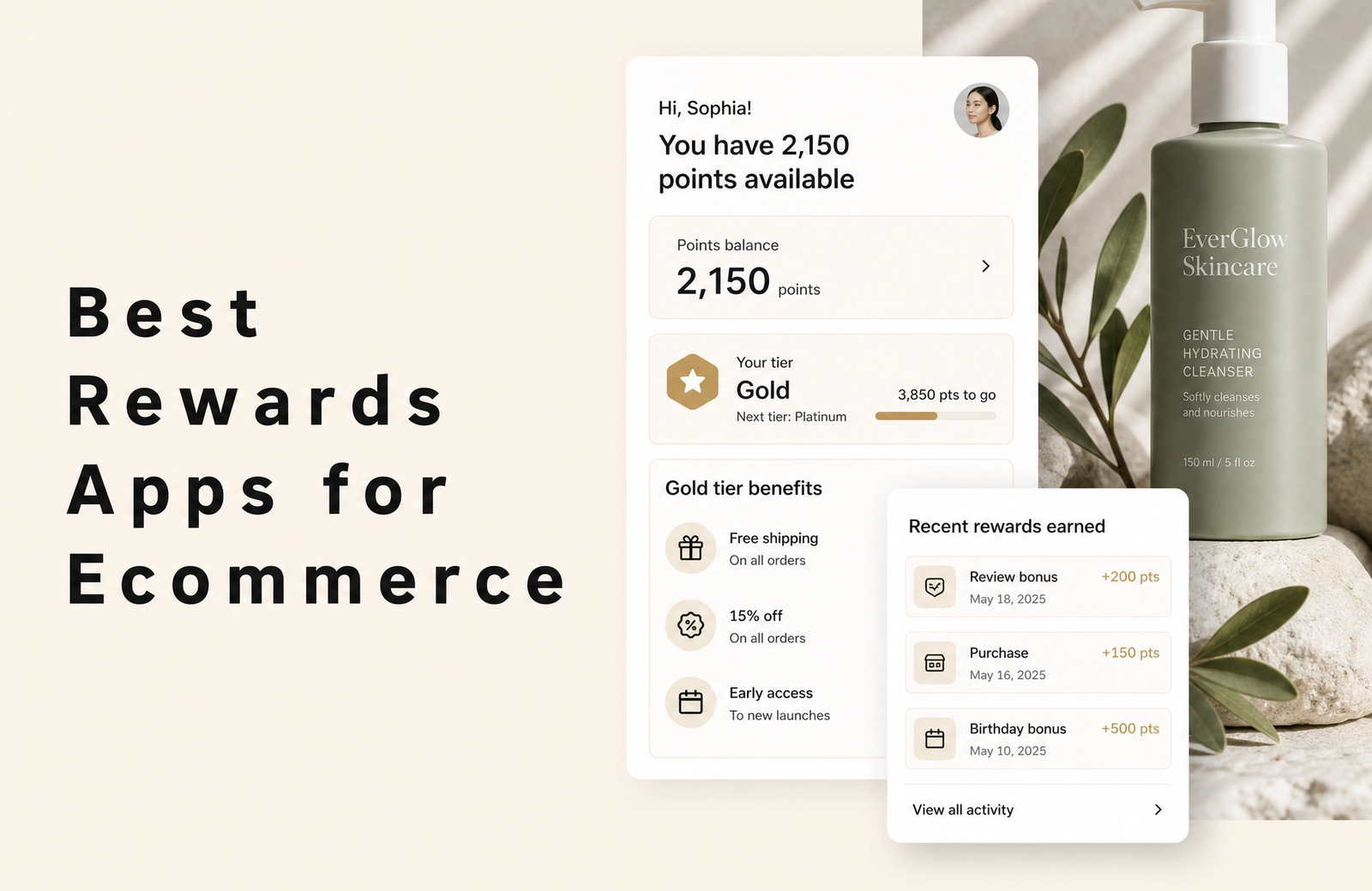
Choosing the right rewards app can be the difference between a thriving loyalty program that drives 30-40% of your revenue and one that sits dormant on your Shopify store. Yet most ecommerce brands still rely on generic discount codes, completely missing the opportunity to build genuine customer loyalty.
The surprising truth? Enterprise-grade loyalty platforms cost less than you think. Brands are discovering that flat-fee, transparent pricing models (like Mage Loyalty's) often deliver better ROI than tiered per-merchant pricing, especially when you're managing multiple customer segments or running complex referral campaigns.
This guide ranks the best rewards apps for ecommerce brands in 2026, evaluated against concrete criteria: deep Shopify integration including Shopify POS support, transparent pricing, comprehensive feature sets (points, referrals, VIP tiers, cashback), ease of setup, scalability, and real support when things go sideways. If you're managing an ecommerce brand on Shopify, you'll find exactly what you need to transform customers into repeat buyers.
Comparing Top Rewards Apps for Shopify Brands
Before diving into details, here's a quick snapshot of how the leading platforms stack up:
| App Name | Pricing Model | Primary Strength | Best For |
|---|---|---|---|
| Mage Loyalty | Flat monthly/annual fees | Enterprise-grade features & customization | Shopify Plus brands seeking scalable control |
| Smile.io | Tiered subscription | Ease of use & broad platform compatibility | SMBs needing a quick loyalty solution |
| Yotpo Loyalty | Tiered subscription | AI-driven insights & review integration | Brands valuing data analytics & UGC |
| Rivo | Tiered subscription | Referral marketing & retention automation | Growing brands focused on acquisition |
| LoyaltyLion | Enterprise custom pricing | Advanced segmentation & personalization | High-volume stores with complex needs |
#1: Mage Loyalty
Mage Loyalty stands out as the premier choice for Shopify brands because it combines enterprise-grade architecture with genuinely transparent pricing and white-glove onboarding. Unlike competitors who charge per merchant on multi-brand platforms or bury advanced features behind escalating tiers, Mage offers flat pricing with unlimited customization across all plan levels.
The platform's strength lies in its uncompromising flexibility. You get access to core loyalty features including points engines, VIP tier structures, and real-time earning rules—all customizable without engineer involvement. The comprehensive referral program handles two-sided incentives with fraud prevention built in, driving measurable acquisition at scale. For enterprise teams, Shopify Plus loyalty program capabilities ensure you're not outgrowing your platform as you scale.
What separates Mage from the crowd is omnichannel support. You get dedicated Shopify POS support, meaning customers earn and redeem the same rewards whether they're buying online or in-store. This matters when you're trying to create a unified customer experience across channels—a feature that requires real technical infrastructure, not surface-level integration.
Integration depth is exceptional. Mage works seamlessly with Klaviyo, Omnisend, Postscript, and Judge.me, meaning loyalty data feeds directly into your email workflows and review systems. The real-time analytics dashboard shows live activity, VIP progress, and revenue attribution, so you see exactly which customers are driving repeat purchases and why.
Best for: Shopify Plus brands and high-growth ecommerce stores seeking predictable, flat-rate pricing without per-merchant markup. If you're running multiple brands on one platform or managing complex customer tiers, Mage's transparent model saves thousands annually compared to tiered competitors.
Ready to see Mage in action? Book a demo at https://www.mageloyalty.com/get-a-demo.
The Shopify loyalty program growing brands trust
See how Mage helps Shopify brands lift repeat purchase rate with loyalty, referrals and store credit.
Book a demo#2: Smile.io
Smile.io earned its reputation as the go-to loyalty app for brands prioritizing speed and simplicity. Installation takes minutes, configuration doesn't require engineering support, and most SMBs can launch a full points-plus-referrals program in a single afternoon. The interface is clean, the onboarding is genuinely helpful, and the feature set covers everything most mid-market brands need: points for purchases, referrals with customizable incentive structures, VIP tiers, and birthday rewards.
The platform excels at broad compatibility. Beyond Shopify, Smile.io integrates with WooCommerce, BigCommerce, and other platforms, making it a solid choice if you're potentially scaling across ecosystems. Its free plan is genuinely useful, giving small stores a real chance to test loyalty mechanics before committing budget. Pricing remains transparent—you know exactly what you're paying, tier by tier.
Where Smile.io differs from Mage: it's tier-based rather than flat-rate, meaning costs scale as your customer base grows. For teams under 50,000 customers, this works fine. Advanced customization often requires support tickets rather than the self-service configuration Mage provides. Shopify POS support exists but isn't as deeply integrated.
Best for: Small-to-mid-market Shopify stores (under $5M annual revenue) prioritizing quick implementation and straightforward reward mechanics without complex segmentation needs.
“Cannot say enough good things about the team at Mage Loyalty, one of the absolute best organizations we have ever worked with, full stop! So glad we connected with them, completely redid our loyalty program, new concepts, use of loyalty, increasing user engagement, showing us where we were not valuing our best customers, just WOW, amazing team!”


Read the West Coast Goalkeeping case study →
#3: Yotpo Loyalty & Referrals
Yotpo takes a different strategic angle—positioning loyalty as one component of a unified customer experience platform that also includes reviews, UGC, SMS, and email. If your brand is already investing in authentic customer content for conversion, Yotpo's ecosystem makes real sense. Its AI analyzes loyalty behavior patterns and recommends optimization automatically.
Specific data points matter here: Yotpo reports a 41% increase in repeat purchase rate for members and 59% increase in customer lifetime value. These aren't theoretical gains—they're observed across their customer base. The platform's strength is in connecting the dots: customers who leave reviews also earn loyalty points, which triggers SMS campaigns, which surfaces relevant products, creating a closed loop.
The integration with review collection is genuine. Rather than bolting loyalty onto a review platform, Yotpo treats them as symbiotic. Customers who submit product photos earn bonus points. User-generated content flows directly into product pages while contributors get recognized through loyalty tiers.
Where it differs from Mage: Yotpo's pricing is usage-based and not transparent upfront (you'll need a quote). Its strength is content aggregation and AI insight—not necessarily deeper customization than Mage. If your priorities are simplicity and AI optimization over full control, Yotpo's trade-off works.
Best for: Brands investing heavily in user-generated content and reviews who want loyalty, reviews, and email unified under one platform with AI-driven optimization.
#4: Rivo
Rivo has built a reputation specifically around retention and referral marketing. Unlike platforms that treat referrals as an afterthought, Rivo designs the entire experience around word-of-mouth mechanics. The platform excels at creating urgency around share incentives and tracking attribution back to the original advocate.
Real examples drive Rivo's positioning: HexClad generated $450,000 in referral revenue in the first 90 days using Rivo, achieving 92x ROI with referred customers showing 17% higher average order value. MiaoMiao, a health-tech brand, drives 27% of monthly revenue from referral sales. These aren't outliers—Rivo's architecture makes referral conversion a primary focus rather than secondary feature.
The platform's distinctive capability is in automation. Post-purchase prompts, share-triggered bonuses, and viral loops are built into the product from the ground up. If your customer acquisition cost is high and your profit margins allow for referral incentives, Rivo accelerates payback significantly.
Where it differs from Mage: Rivo's strength is narrowly focused on retention and referral. If you need equally sophisticated points programs, VIP tier logic, or omnichannel Shopify POS integration, Mage provides more breadth. Rivo is best in class for referral-first brands.
Best for: Growing Shopify stores (especially in apparel, fitness, and CPG) where word-of-mouth is a measurable revenue driver and customer acquisition costs justify referral incentives.
#5: LoyaltyLion
LoyaltyLion caters to high-volume operations and enterprise clients who need sophisticated segmentation and personalization. The platform supports advanced features like conditional points (earn more points when you meet specific behaviors), tiered expiration rules, and granular audience targeting. Configuration requires more technical thinking than simpler platforms, but the payoff is precision.
Real strength emerges at scale. If you're running multiple product lines, regional campaigns, or testing different reward structures by segment, LoyaltyLion's analytics and segmentation make this manageable. The dashboard provides detailed cohort analysis—you can see exactly which customer segments have the highest engagement and lifetime value.
Where it differs from Mage: LoyaltyLion's pricing is enterprise-only (no public tiers), making it harder to budget upfront. Mage offers the same segmentation depth with transparent flat pricing. LoyaltyLion's implementation is heavier—expect 6-8 weeks of setup for a truly optimized program versus Mage's white-glove migration in weeks.
Best for: High-volume Shopify stores ($10M+ annual revenue) managing complex customer bases and needing advanced analytics and audience segmentation.
#6: Growave
Growave positions itself as an all-in-one marketing suite, combining loyalty, reviews, wishlists, and Instagram feed integration into a single dashboard. For brands trying to eliminate tool sprawl, this consolidation has real appeal. The loyalty component itself is solid—points, referrals, and VIP tiers all present—but it's bundled with features most stores might not need.
The value proposition: pay one fee, manage reviews, loyalty, and social proof from one interface. Integration between reviews and loyalty points happens natively. Small stores see immediate benefit from reduced friction and vendor management.
Where it differs from Mage: Growave is more generalist (doing several things well, not all excellently). If loyalty is your primary need and you already use specialized review tools, Growave's bundling adds cost without benefit. Mage focuses purely on loyalty depth.
Best for: Small-to-mid-market Shopify stores prioritizing simplicity and consolidating multiple marketing functions under one vendor.
#7: ReferralCandy
ReferralCandy is the specialist's choice for referral programs. While other platforms treat referrals as one feature among many, ReferralCandy treats them as the entire product. The interface is specifically designed for creating and managing incentive structures, tracking referral attribution, and optimizing conversion from share-to-signup.
The platform excels at transparency. You see which customers refer most frequently, which incentive structures convert best, and what friction prevents people from sharing. A/B testing capabilities are built in specifically for double-sided incentive structures.
Where it differs from Mage: ReferralCandy offers minimal loyalty program features beyond referrals. If you need points, VIP tiers, or birthday rewards, ReferralCandy isn't the answer. It's purpose-built for one job.
Best for: Brands whose primary growth strategy is incentivized word-of-mouth and who want deep optimization specifically around referral mechanics.
How to Choose the Right Rewards App for Your Shopify Brand
The decision comes down to three interconnected questions: What's your primary business need? How complex is your customer base? What's your technical capacity for setup and management?
If you're running a high-growth Shopify store with multiple brands or customer segments, and you need omnichannel support (online and POS) with predictable flat pricing, choose the right app. The decision framework: Can you handle tiered pricing that scales with growth, or do you need fixed costs? Do you need Shopify POS integration, or is online-only sufficient? Are you building sophisticated audience segments, or running a straightforward points program?
Start with your must-haves. Omnichannel integration (Mage, LoyaltyLion) is non-negotiable if you have retail locations. If you're all-online, Smile.io, Yotpo, and Rivo all work well. Referral-focused strategies point toward Rivo or ReferralCandy. Review integration suggests Yotpo. Budget-conscious SMBs should test Smile.io's free plan before upgrading.
For most established Shopify brands seeking Compare Smile.io alternatives, the trade-off is usually between breadth and specialization. Broader platforms (Mage, Growave, LoyaltyLion) handle multiple use cases. Specialists (Rivo for referrals, ReferralCandy for referrals) excel in their domain but lack flexibility elsewhere.
If your priorities are deep Shopify integration, unparalleled customization, transparent pricing without escalating tiers, and enterprise-grade reliability with dedicated support, Mage Loyalty is the strongest fit.
Frequently Asked Questions
What types of rewards programs can I offer with these apps?
Most modern rewards apps support four primary reward types: points-based systems where customers accumulate points per dollar spent and redeem them for discounts, free products, or exclusive access; VIP tier programs that unlock escalating benefits as customers reach spending milestones; referral incentives that reward both the existing customer and the referred new customer; and cashback or store credit programs that provide immediate or delayed rebates. Each type serves different psychological triggers—points create habit loops, tiers build aspiration, referrals leverage social proof, and cashback offers tangible value perception. The strongest loyalty programs combine multiple types to reach different customer motivations.
How do rewards apps integrate with my existing Shopify store and marketing tools?
Rewards apps connect to Shopify through native app integration (accessing order data, customer data, and the Shopify API directly) or through middleware platforms like Zapier for more custom workflows. Advanced setups use webhooks to trigger real-time data syncing. Marketing integrations typically work through pre-built connectors: Klaviyo integration allows loyalty point changes to trigger email sequences; Omnisend and Postscript receive point data for SMS campaigns; Judge.me and Yotpo review platforms import loyalty points earned for submitting reviews. Shopify POS integration requires dedicated architecture (not all apps support it equally). Most modern platforms handle these connections natively without requiring custom development, though enterprise implementations may use APIs for deeper customization.
What are the key metrics to track to measure the success of my rewards program?
Critical KPIs include customer retention rate (percentage of prior-period customers who purchase again), repeat purchase rate (how frequently members repurchase versus non-members), customer lifetime value (total revenue from a customer minus acquisition and service costs), and average order value for loyalty members versus non-members. Referral-specific metrics include referral conversion rate, referred customer retention, and program ROI (total incentive costs divided by revenue from referred customers). Engagement metrics matter too: program enrollment rate, active member percentage, and points redemption rate (indicating whether rewards are compelling). Track these monthly and watch for cohort-level patterns—sometimes specific customer segments show dramatically different behaviors, suggesting you need segmented reward strategies.
How much will a rewards app cost and what's typically included?
Pricing varies widely: free plans exist but typically include basic features only; tiered models start around $49-299/month with feature unlocks at each level; flat-rate models provide consistent pricing regardless of customer volume; and enterprise custom pricing offers negotiated terms for high-volume stores. Included features follow the tier: basic plans usually offer points and referrals; mid-tiers add VIP tiers and email integration; premium plans include advanced analytics, Shopify POS support, and dedicated onboarding. Hidden costs sometimes emerge: data migration fees, integration setup charges, or per-referral transaction fees. The most transparent vendors publish pricing publicly; those requiring quotes often have higher total costs of ownership due to custom implementation.
TLDR
Mage Loyalty leads the 2026 landscape for Shopify brands seeking transparent flat pricing, omnichannel integration, and unparalleled customization without sacrificing ease of setup. For brands prioritizing quick implementation and simplicity, Smile.io remains reliable. Rivo excels at referral-driven growth. Yotpo stands out for brands combining loyalty with UGC and reviews. Your choice depends on whether you need breadth (Mage, Growave), specialization (Rivo, ReferralCandy), or AI-driven insights (Yotpo), but Mage's enterprise-grade architecture with predictable costs makes it the strongest default choice for growth-stage ecommerce brands.

Graeme is the co-founder at Mage Loyalty. He heads product development, from complex loyalty migrations and large-scale data handling to building the features shaping the future of loyalty on Shopify.