The North Face XPLR Pass advertises a 10% rewards rate. It pays most of its members closer to 5%.
That is not a trick, and it is not hidden. It falls straight out of one design decision: points only convert in blocks of 100. Land on a block and you get the full headline rate. Land just short of one and you get half of it. Almost nobody lands on a block.
This guide walks through setting up a loyalty program like XPLR Pass on your own store, using Mage's Shopify loyalty program. Every setting is included, so you can follow it start to finish. It takes about twenty minutes, and if you would rather not do it yourself, our team will set the whole thing up for you free of charge.
What is the North Face XPLR Pass?
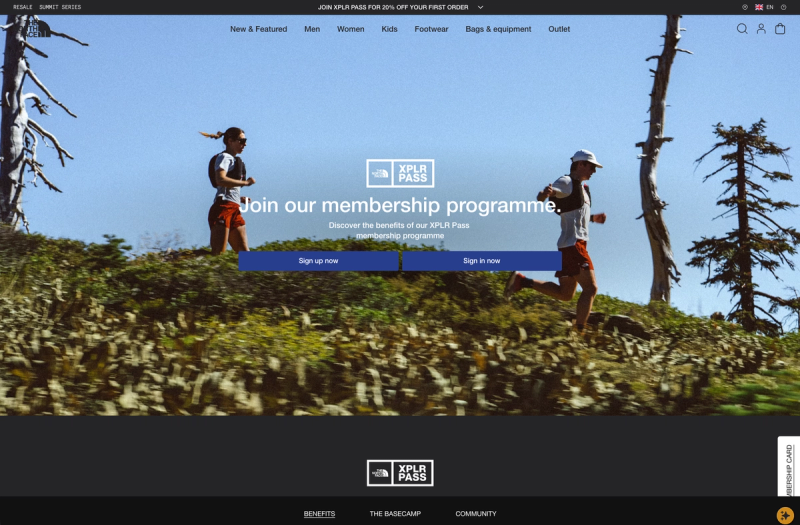
XPLR Pass is The North Face's free loyalty program. Members earn one point per dollar spent, online and in store, and every 100 points turns into $10 off a future purchase. It is free to join, there is no paid tier, and there is no tier ladder at all. Every member gets the same benefits from the day they sign up, including free standard shipping on every order.
If you already know the program, skip ahead to what you'll set up. Everything below describes XPLR Pass as it stands in 2026.
“Cannot say enough good things about the team at Mage Loyalty, one of the absolute best organizations we have ever worked with, full stop! So glad we connected with them, completely redid our loyalty program, new concepts, use of loyalty, increasing user engagement, showing us where we were not valuing our best customers, just WOW, amazing team!”


Read the West Coast Goalkeeping case study →
How the North Face XPLR Pass works
There are three moving parts, and it is worth separating them because you will build them separately.
XPLR Pass points
Members earn 1 point per $1 on merchandise. Tax, shipping, fees and gift cards do not earn. Points post within a few days of the order, and a refund reverses them.
Points expire a year after they are earned.
XPLR Pass rewards
This is where the program gets interesting. Points do not convert at a proportional rate. They convert in blocks:
| Points | Reward value |
|---|---|
| 100 | $10 |
| 200 | $20 |
| 300 | $30 |
| 400 | $40 |
| 500 | $50 |
Fifty points is worth nothing. A hundred is worth $10. Anything between the two is worth exactly $10 and no more. The North Face states it plainly in their terms: points are not rounded up.
Rewards are valid for eleven months after they are issued, can be combined with any other discount or promotion, and cannot be used to buy gift cards.
North Face XPLR Pass benefits
Every member gets the same list on day one:
- Free standard shipping on every order, no minimum
- Birthday gifts
- Early and exclusive access to limited edition collections and collaborations
- Members only events, deals, partner offers and prize draws
- A members only field testing policy, letting members return worn gear
- Extra points for referring friends, downloading the app, taking surveys, and checking in at stores and national parks
Note where those benefits sit. There is no tier to climb to reach them. The most valuable standing perk in the program, free shipping forever, is handed over at signup for nothing.
The two things that make the North Face loyalty program work
XPLR Pass looks like the simplest program in retail. One rate, one currency, no tiers. It is doing two clever things, and if you copy the settings without noticing them you will copy the cost and miss the effect.
1. The 100 point block is a progressive rate wearing a flat rate's clothes
"1 point per $1, 100 points for $10" reads as a flat 10% back. Work through what customers actually receive:
| Annual spend | Points | Blocks | Reward value | Points stranded | Real rate |
|---|---|---|---|---|---|
| $80 | 80 | 0 | $0 | 80 | 0% |
| $150 | 150 | 1 | $10 | 50 | 6.7% |
| $199 | 199 | 1 | $10 | 99 | 5.0% |
| $200 | 200 | 2 | $20 | 0 | 10.0% |
| $340 | 340 | 3 | $30 | 40 | 8.8% |
| $1,950 | 1,950 | 19 | $190 | 50 | 9.7% |
A customer can strand at most 99 points, roughly $9.90 of headline value, no matter what they spend. That fixed loss is enormous against a $199 basket and trivial against a $1,950 one.
So the rate quietly climbs with spend. Your smallest customers cost you around 5%. Your biggest cost you nearly the full 10%. That is exactly the outcome Ulta engineers with three tiers and a multiplier ladder, and The North Face gets it from a single rounding rule.
The second effect is the one your customers feel. Someone sitting on 82 points is 18 points from $10. That is not an abstract balance, it is a number with an obvious action attached, and it is why block based programs produce so much basket building.
2. The best benefit is at the door, not at the top
Most loyalty programs save their strongest perk for the top tier. XPLR Pass gives away free shipping on every order to anyone who makes an account.
That is an acquisition mechanic, not a retention one. It converts the signup on the spot, because the value is immediate and unconditional, and it removes the single biggest reason people abandon a small basket. The points then do the retention work in the background.
Two jobs, two mechanisms, and neither one needs a tier.
What that combination costs you
Take the headline seriously first. Ten percent back is very rich. Most Shopify stores cannot pay it, and The North Face is not really paying it either.
What you actually pay is the sawtooth above, somewhere between 5% and 10% depending on where each customer lands, plus your shipping cost on every order.
This is the decision. The block structure is the mechanic. The block size is the price. If a 10% headline is too rich for your margins, do not flatten the blocks into a proportional rate, because the staircase is the entire behavioural engine. Change the ratio instead. Set 200 points to $10 and you have a 5% headline with identical mechanics, or 400 points to $10 for 2.5%.
There is one part of XPLR Pass we would not copy at any ratio. The North Face converts points into rewards in batches, three times a year, in March, June and October. Earn a reward in February and you wait until June to spend it. We would let customers redeem the moment they cross 100 points. It costs you no more, it is far easier to explain, and the gap between earning something and being able to use it is where loyalty programs lose people.
What you'll set up
We will build this on an outdoor clothing store, with a program called Trail Pass. Rename it to suit your brand.
| XPLR Pass feature | What you'll set up in Mage |
|---|---|
| 1 point per $1 | Purchase earning rule |
| 100 points for $10, up to $50 | Five fixed discount rewards |
| Free shipping on every order | An automatic Shopify discount |
| Members only launches and events | A Shopify customer segment |
| Birthday gifts | A birthday earning rule |
| App download points | A URL visit rule |
| Member survey points | A second URL visit rule |
| Store and sustainability check ins | A photo challenge rule |
| Refer a friend | Dual sided referral rewards |
| Points expire after a year | Points expiry, from the date earned |
| Rewards expire eleven months on | Expiry days on every reward |
| Surprise member gifts | A points drop |
| Bonus point promotions | A bonus campaign |
Step 1: Set your earning rate
Go to Loyalty → Earning Points and open the Purchase rule. It already exists, so there is nothing to create.
| Field | Value |
|---|---|
| Earning rule name | Earn 1 point per $1 |
| Amount earned | 1 |
| Spend threshold | 1 |
| Exclude discounted products from earning points | Unchecked |
| Approval Time | 0 |
| Status | Active |
That is the XPLR Pass base rate exactly. Two things happen automatically and are worth knowing.
Points calculate on your merchandise subtotal, so tax and shipping never earn. That matches The North Face's exclusion list with no configuration at all.
Leave the exclusion box unchecked. Your customers will be checking out with reward codes constantly, and ticking that box would stop those orders earning anything.
On Approval Time, The North Face takes up to ten days to post points, which you could copy by setting this to 10. We would set it to 0. Instant points cost you nothing, and the moment a customer watches a balance move is the moment the program becomes real to them.
Step 2: Build the reward blocks
This is the heart of the program and the step that repays the most care.
Each block is a separate reward. Go to Loyalty → Redeeming Points → Add Reward → Fixed Discount and create five.
Use these settings on every one:
| Field | Value |
|---|---|
| Redemption type | Set amount |
| Applies to | All products |
| Minimum Spend | 0 |
| Expiry Days | 334 |
| Combinations | All three checked |
| Reactivate discount code on full refund | Checked |
Then vary only these three:
| Reward Name | Points Cost | Discount Amount |
|---|---|---|
| $10 off | 100 | 10 |
| $20 off | 200 | 20 |
| $30 off | 300 | 30 |
| $40 off | 400 | 40 |
| $50 off | 500 | 50 |
Five fixed rewards, not one flexible one. This is the setting people get wrong, and getting it wrong dismantles the program. A flexible reward lets a customer redeem any balance for a proportional discount, so 82 points becomes $8.20 and nothing is ever stranded. That sounds generous and it is, but it deletes both mechanics from Section 1 at once. Your rate stops being progressive, and nobody is ever 18 points away from anything. Fixed blocks are what make the staircase exist.
Check all three combination boxes. The North Face is explicit that rewards combine with any other reward, offer, discount, coupon or promotion. Letting someone put $20 on top of a sale price is what makes a first redemption feel good, and a customer who redeems once is dramatically more likely to come back.
Expiry Days set to 334 is XPLR Pass's eleven month reward window, converted to days. It stops issued codes accumulating as an open ended liability and gives customers a reason to use them. Set it to 0 if you would rather rewards never expire.
Reactivate discount code on full refund honours The North Face's return policy. Return something bought with points and the reward comes back as a usable code.
Show all five blocks together
Whatever else you do, present the five blocks as a single table or carousel, the way The North Face does. A customer looking at one block at a time cannot see the staircase, and cannot tell how close they are to the next step. The gap between 82 and 100 only motivates anybody who can see it.
Step 3: Set up member free shipping
Free shipping on every order is the XPLR Pass headline benefit, and it is the reason people sign up. This one is set up in Shopify rather than in Mage, and it takes about a minute.
In Shopify Admin → Discounts → Create discount → Automatic discount → Free shipping:
| Field | Value |
|---|---|
| Minimum purchase amount | None |
| Customer eligibility | Specific customer segments |
| Segment | Customers with accounts |
| Countries | Your domestic shipping zone |
Automatic means there is no code to remember and nothing to apply. A logged in member sees free shipping at checkout, a guest does not, and the difference is visible at exactly the moment it converts a signup.
Restrict it to your domestic zone. The North Face limits free shipping to the contiguous United States and charges normally for Alaska and Hawaii, which is sensible anywhere carrier costs jump for remote regions.
If free shipping on every order is too much, add a minimum purchase amount rather than dropping the perk. Setting it to roughly your current average order value keeps the acquisition benefit intact and turns it into a basket builder at the same time.
The same pattern covers every other members only perk
Early access to launches, members only events, partner offers, an extended returns window: all of them run off the same segment. Gate a collection on it in your theme, target it in your email tool, or apply it as a customer service policy. None of them cost you anything until someone uses them.
Step 4: Add a birthday gift
Birthday gifts are one of the four benefits The North Face leads with, and they are one rule.
Go to Loyalty → Earning Points → Add Earning Rule → Birthday.
| Field | Value |
|---|---|
| Earning rule name | Birthday Gift |
| Amount earned | 100 |
| Date of Birth Eligibility Period | 30 |
| Status | Active |
One hundred points is a deliberate number. It is exactly one block, which means a birthday gift arrives as a whole $10 reward rather than as a part of one. A birthday gift of 60 points is worth nothing on its own and reads as an afterthought.
The Date of Birth Eligibility Period of 30 days is a small anti abuse setting. A customer has to have had their birthday on file for a month before it counts, so nobody sets their birthday to tomorrow.
Check that your signup form or customer account actually collects a date of birth, or the rule has nothing to fire on. There is more on building campaigns around this in Shopify birthday rewards.
Step 5: Add the extra ways to earn
XPLR Pass pays points for things that are not purchases: downloading the app, taking surveys, bringing a reusable bag, checking in at stores and national parks. Individually they are small. Together they are the reason a member opens the app in a month when they are not buying anything.
Translate them to things your customers can actually do.
The app download and the survey
Go to Loyalty → Earning Points → Add Earning Rule → Visit URL and create two.
| Field | Value |
|---|---|
| Rule Name | Download the Trail app |
| Reward amount | 10 |
| Target URL | your app store link |
| Approval Time | 0 |
| Field | Value |
|---|---|
| Rule Name | Take the fit quiz |
| Reward amount | 25 |
| Target URL | your quiz or survey |
| Approval Time | 0 |
The quiz pays more than The North Face gives for a survey, deliberately. It tells you size, fit preference and what your customer actually does outdoors, which is the most commercially useful data an apparel store can collect. It also cuts returns, and in clothing a return costs you far more than 25 points.
The check in
The North Face pays members for bringing a reusable bag and for checking in at stores. The apparel version is a garment take back, and it works the same way.
Go to Loyalty → Earning Points → Add Earning Rule → Photo Challenge.
| Field | Value |
|---|---|
| Title | Recycle your old kit |
| Instructions | Upload a photo of your drop off |
| Points reward | 25 |
| How often can a customer earn this? | Custom |
| Days between uploads | 182 |
| Email me when submissions are waiting for review | Checked |
Submissions arrive in a review queue and points are only awarded when you approve one, so a photo of somebody's wardrobe does not cost you anything.
Days between uploads is the setting to think about. At 182 days a customer can earn this twice a year, which matches The North Face's reusable bag limit. Drop it to 30 and you have a monthly habit worth 300 points a year, which is three whole reward blocks. That is a real cost, so choose the number knowing what it adds up to rather than picking 30 because it sounds friendly.
Step 6: Turn on referrals
The North Face pays 25 points for a successful referral. At their own conversion rate that is $2.50, which is thin for handing over a customer.
We would pay properly on both sides. Go to Referrals, switch the program on, then add the two rewards.
Add Referring Customer Reward → Fixed Discount:
| Field | Value |
|---|---|
| Reward Name | Thanks for sharing |
| Discount Amount | 10 |
| Minimum Spend | 0 |
| Expiry Days | 90 |
Add Referred Friend Reward → Fixed Discount:
| Field | Value |
|---|---|
| Reward Name | $10 off your first order |
| Discount Amount | 10 |
| Minimum Spend | 40 |
| Expiry Days | 90 |
The minimum spend on the friend's side and none on the advocate's is intentional. The friend is a stranger and the minimum protects your margin on a first order. The advocate has already earned their reward and should not have to clear a hurdle to use it.
Then set the fraud controls, which matter more on referrals than anywhere else in a loyalty program:
| Field | Value |
|---|---|
| Block email aliases | Checked |
| Block self-referrals | Checked |
| Block advocate self-claims | Checked |
| Maximum claims per IP | 5 |
| Time window (days) | 7 |
| Allow guest referrals | Unchecked |
Block email aliases is the one people skip and the one that gets abused first. Without it, one person turns a single inbox into twenty referrals using plus addressing in about a minute.
Step 7: Turn on points expiry
Go to Loyalty → Loyalty Program → Points Expiry.
| Field | Value |
|---|---|
| Enable points expiry | On |
| Expiry mode | Time after points are acquired |
| Points expire after | 365 days |
| Expiry reminder | 30 days |
| Reset Redeemable Loyalty Points Annually | No |
The North Face's rule is that points die a year after they are earned, full stop. Points earned in March expire the following March however much the customer has shopped in between. That is the Time after points are acquired mode.
The other mode, Customer's last purchase date, works on inactivity instead. Every order resets the clock on the whole balance, so someone who keeps shopping never loses a point. Several large programs run it that way.
Expiry does more work in a block based program than in a proportional one, because the customer stranded on 82 points now has a deadline attached to a number they can see. That combination, a visible gap and a visible clock, is the most reliable redemption driver in the whole build. It is also the fastest way to annoy people if you get the timing wrong, so read our guide on points expiry that drives redemptions without annoying customers before you commit.
The 30 day reminder gives customers a nudge before it happens. Those emails are consistently some of the highest converting a loyalty program sends.
Step 8: Schedule a bonus campaign
The North Face runs periodic member offers and bonus events. In Mage that is a scheduled campaign.
Go to Loyalty → Bonus Campaigns → Create Bonus Campaign.
| Field | Value |
|---|---|
| Campaign Name | 3x Points Outerwear Event |
| Type | Multiplier |
| Purchase rule multiplier | 3 |
| Start and end date | your event window |
| Bonus Collections | your Outerwear collection |
| Status | Scheduled |
A 3x weekend does something specific in a block program. It pushes a large group of customers across a block boundary at the same time, which produces a wave of redemptions a few weeks later. Time one about a month before a slow trading period and the redemptions land when you want the traffic.
Scoping to a collection means only those products multiply rather than your whole catalogue. Set the status to Scheduled and the campaign runs itself.
There is a second campaign type, Tiered, if you would rather run a spend and get promotion. Spend $75, get 200 bonus points. Same idea, different shape.
Step 9: Send a points drop
XPLR Pass leans hard on surprise. Gifts with purchase, prize draws, things members did not ask for. A points drop is the cheapest version of that and it takes two minutes.
Go to Loyalty → Points Drops → Create Points Drop.
| Field | Value |
|---|---|
| Drop name | Winter thank you |
| Points amount | 100 |
| Who receives this drop? | All members |
| Date | your chosen date |
| Expires after | 30 days |
One hundred points is exactly one reward block, so every recipient gets a complete $10 reward rather than a fragment of one. That is the difference between a gift and a nudge.
Expires after is the setting that makes this work. Dropped points run on their own 30 day clock, separate from your normal expiry. Without a deadline a surprise gift just sits in the balance and changes nobody's behaviour. With one it produces a measurable spike, and the drop results page shows you exactly how much was redeemed and how much expired.
Step 10: Put it in front of customers
A loyalty program nobody can see does not work. Three surfaces to set up:
Loyalty Pages. Your landing page. Add the How it works, Ways to earn, Ways to redeem and FAQ blocks. They populate themselves from everything you just set up.
Account Sidebar. The signed in view, showing balance and the rewards available right now.
Checkout points earned. Shows customers the points they are about to earn while they are paying.
Spend your time on one block above all others. Ways to redeem is where the five blocks become visible as a staircase, and where a customer on 82 points finds out they are 18 away from $10. Every mechanic in this guide depends on that number being somewhere the customer can see it.
You don't have to copy all of it
Very few stores need the whole thing, and it comes apart cleanly.
If you want one thing, make it the block structure in Step 2. Fixed blocks instead of a proportional rate is a single decision, it costs nothing to implement, and it changes both what your program costs and how customers behave in it.
If margin is tight, keep every step and change one number. Two hundred points for $10 gives you a 5% headline with identical mechanics.
If you sell high value items infrequently, free shipping in Step 3 will outperform the points entirely, and it is the fastest thing on this list to set up.
If your customers already buy often, the extra earning rules in Step 5 and the bonus campaign in Step 8 will move more revenue than the base rate will.
If they buy occasionally, the birthday gift in Step 4, the expiry reminders in Step 7 and the points drop in Step 9 do more for you than anything else here.
Take the parts that suit how your customers actually shop.
We'll set it up for you, free
If you would rather not configure any of this yourself, our team will do it for you at no cost. That includes the full build above, tuned to your catalogue and your margins, plus your branding across the widget, sidebar and loyalty pages. Everything in this guide runs on Mage's Shopify loyalty program, so you can see the full feature set before you start.
Already running a loyalty program somewhere else? We handle migrations free of charge too, including your existing customer balances, tiers and history, so nobody loses the points they have earned. We have migrated stores from Smile.io, LoyaltyLion, Yotpo, Rivo, Stamped, Joy and Bubblehouse.
Talk to our team and tell us what you want your program to look like.
Frequently asked questions
What is North Face XPLR Pass? XPLR Pass is The North Face's free loyalty program, open to customers in the United States and Canada. Members earn 1 point per dollar spent online and in store, and every 100 points converts into $10 off a future purchase, up to $50 at a time. It is free to join, there are no tiers, and every member gets free standard shipping on every order from the day they sign up.
How does the North Face XPLR Pass work? XPLR Pass works on a block system rather than a proportional one. You earn 1 point per dollar on merchandise, and points convert into rewards in units of 100 points for $10. Points are not rounded up, so a balance of 180 points is worth $10 and not $18. Points expire a year after they are earned and rewards are valid for eleven months after they are issued. Rewards combine with other discounts and promotions, and cannot be used to buy gift cards. That is the program as of 2026.
What are the benefits of the North Face loyalty program? Every XPLR Pass member gets the same benefits with no tier to climb: free standard shipping on every order, birthday gifts, early and exclusive access to limited edition collections and collaborations, members only events, deals and partner offers, and an extended field testing returns policy. Members also earn extra points for referring friends, downloading the app, taking surveys and checking in at stores. Every one of those is reproduced in this guide.
How many points do you need for a North Face reward? One hundred points, which is $100 spent, gets you a $10 reward. The scale runs in $10 blocks up to $50 for 500 points. Points do not convert proportionally and they are never rounded up, so 199 points is worth exactly $10, the same as 100 points. That rounding rule is the single most important thing to understand about the program.
Do North Face XPLR Pass points expire? Yes. Points expire one year after they are earned, and issued rewards expire eleven months after that. Both clocks matter: a customer can hold a balance long enough to lose it, and can redeem a reward and still lose the value by not spending it. In this guide that is a 365 day points expiry set to the date acquired, with a 30 day reminder, and 334 expiry days on every reward.
How do I create a loyalty program like the North Face XPLR Pass on Shopify? Every part of the structure in this guide can be set up in Mage: the 1 point per dollar earning rate, the five fixed reward blocks running from 100 points to 500, free shipping for members, the birthday gift, referrals, extra earning rules for app downloads and surveys and check ins, points expiry, bonus campaigns and points drops. This guide covers each step with the exact settings to use.
How long does it take to set up? About twenty minutes if you follow this guide. If you would rather it was done for you, our team sets it up free of charge, including your branding.
Should my rewards be fixed blocks or a flexible amount? Fixed blocks change customer behaviour, and flexible amounts do not. With blocks a customer on 82 points knows they are 18 from something, which is a reason to add an item to a basket. With a flexible reward that same customer has $8.20 available and no reason to wait or to spend more. Blocks also make your effective rate rise with spend, since a stranded balance is capped at 99 points however much someone buys, which quietly pays your best customers more. Flexible redemption is friendlier and simpler to explain, so choose it if you would rather maximise redemption rate than shape behaviour. You cannot get both from the same reward.
Is free shipping for everyone too generous? It is the most expensive line in the XPLR Pass program and it is also the reason people join. Before deciding, work out what you currently spend on shipping promotions and threshold offers, because most stores are already paying a version of this less deliberately. If the unconditional version is too much, add a minimum purchase amount at roughly your average order value. You keep the signup benefit and gain a basket builder.
What happens to points when a customer returns something? Points earned on that order are removed automatically, including any bonus points from a campaign. Partial refunds reverse points proportionally. Tax and shipping never earned points in the first place, so nothing needs unwinding there. If the order was paid for with a reward, the discount code is reactivated so the customer keeps what they redeemed.
Can I switch from my current loyalty app without losing customer points? Yes. We migrate balances, tiers and history from other loyalty platforms free of charge, so your customers keep everything they have earned. There is more detail in our guide to migrating from Smile.io without losing customer points.
Mage is not affiliated with, endorsed by, or sponsored by The North Face. XPLR Pass is a trademark of VF Outdoor, LLC. This guide references the program for the purpose of comparison and education.

Kris is the co-founder of Mage Loyalty. I spend most days talking to merchants, shipping features, and making sure our customers get real results. If you run a Shopify store or Agency we should chat!