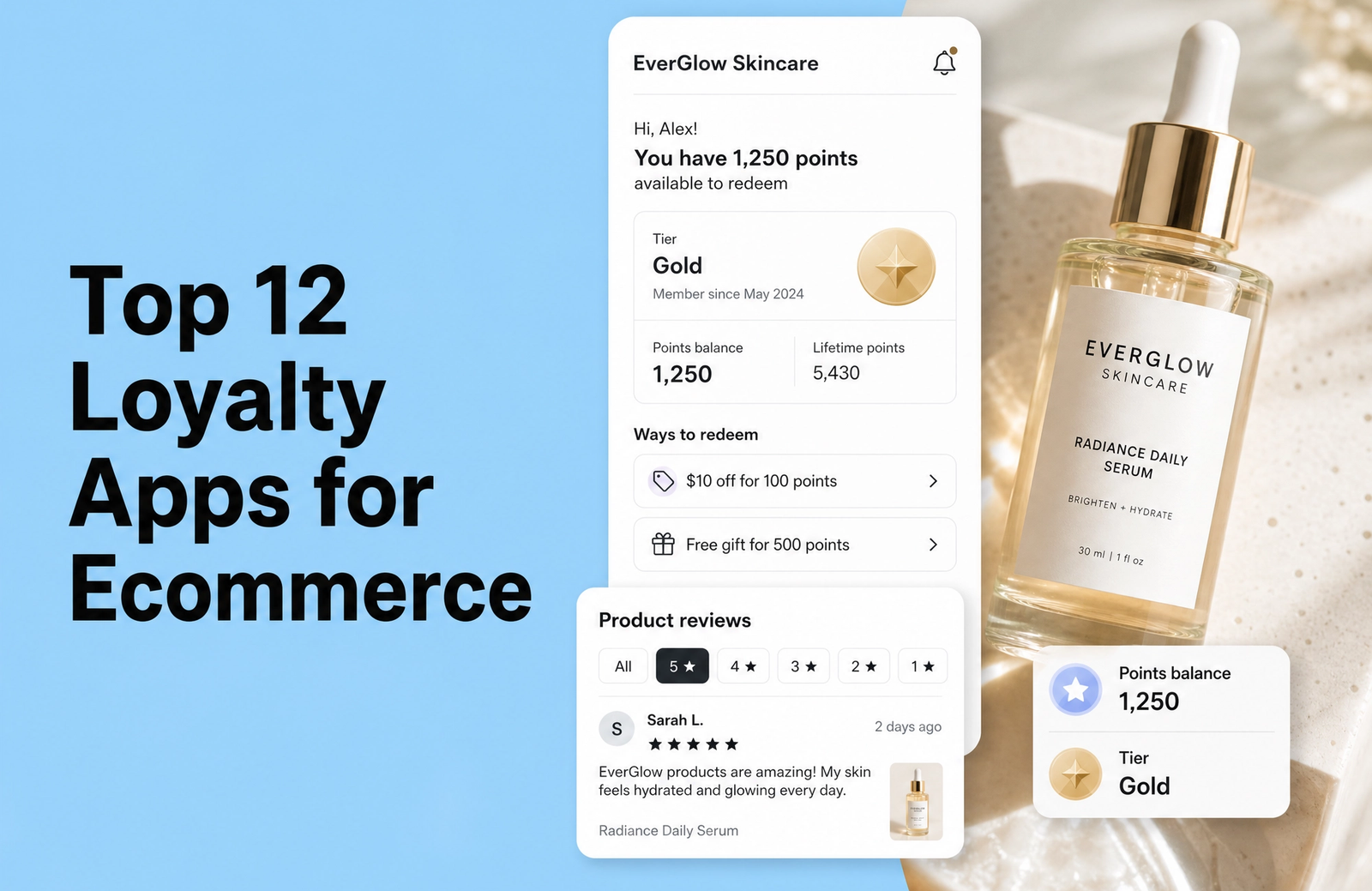
Most ecommerce brands believe they're already doing loyalty well. Then they check their repeat purchase rate and realize 60-70% of their revenue comes from one-time buyers. Here's the uncomfortable truth: generic discount programs aren't loyalty programs—they're just margin killers. Real loyalty happens when you reward the behaviors that matter: repeat purchases, referrals, reviews, and genuine engagement.
The loyalty app space has exploded since 2024. You're not just choosing between points and VIP tiers anymore. Today's leading platforms offer omnichannel support, AI-driven personalization, headless flexibility, and integration depth that connects every customer touchpoint. But not every app fits every business model.
This guide ranks the top 12 loyalty apps across Shopify, BigCommerce, WooCommerce, and Salesforce Commerce Cloud. We evaluated each based on five core criteria: native platform integration, feature comprehensiveness (points, VIP, referrals, gamification), scalability from SMB to enterprise, ease of setup and customization, and transparent pricing with responsive support. The goal isn't to crown one winner for everyone—it's to help you find the right fit for your specific platform, budget, and growth ambitions.
What Makes a Best-in-Class Loyalty Platform
Before diving into rankings, let's clarify what separates premium loyalty software from the crowded middle. A world-class platform handles three layers simultaneously: the earning layer (how customers accumulate value), the engagement layer (how they interact with rewards), and the data layer (how you measure and optimize).
Premium platforms also reduce friction. They integrate seamlessly with your email, SMS, and CRM systems. They support Shopify POS and other omnichannel touchpoints so customers earn and redeem whether they shop online or in-store. They expose APIs for custom integrations when your tech stack requires flexibility. And they provide actual support—not just a help desk, but migration specialists who ensure a smooth launch.
Pricing transparency matters more in 2026 than it did five years ago. The best platforms charge flat fees (so you're not nickel-and-dimed on transaction volumes) or tiered subscriptions based on features, not store revenue. You should know your monthly cost upfront, not discover surprise per-transaction fees six months in.
Loyalty App Comparison: At a Glance
Here's a side-by-side look at the top five loyalty platforms ranked by platform coverage, pricing transparency, and feature depth:
| App Name | Primary Platform(s) | Pricing Model | Primary Strength | Best For |
|---|---|---|---|---|
| Mage Loyalty | Shopify, Shopify Plus | Subscription/Flat Fee | Comprehensive features, support | Enterprise Shopify Plus brands seeking control |
| LoyaltyLion | Shopify, BigCommerce, SFCC | Tiered Subscription | Advanced segmentation, integrations | Growing brands on multiple platforms |
| Smile.io | Shopify, BigCommerce, Wix | Tiered Subscription | Ease of use, broad feature set | SMBs and mid-market with clear loyalty goals |
| Yotpo Loyalty | Shopify, BigCommerce, Adobe, SFCC | Tiered Subscription | Integrated customer experience suite | Brands consolidating marketing tech stack |
| Rise.ai | Shopify | Tiered Subscription | Store credit, gift cards | Shopify brands emphasizing flexible rewards |
#1: Mage Loyalty
Mage Loyalty tops this list because it solves a problem most other platforms ignore: platform overhead. For Shopify and Shopify Plus merchants, Mage eliminates the friction between your loyalty program and every other system your business relies on. It's not an afterthought integration—it's native Shopify architecture, meaning the points engine, VIP tiers, and real-time dashboard are built directly into Shopify's ecosystem.
Here's where Mage separates itself with specific, measurable advantages. First, its Shopify loyalty program foundation combines a flexible points engine with customizable VIP tiers in a single, coherent system. You don't configure points separately from tier logic; they work together. Customers progress through bronze, silver, gold tiers while earning points simultaneously, with each tier unlocking exclusive benefits: free shipping, birthday bonuses, priority support, early product access.
Second, Mage's referral engine genuinely moves the needle on customer acquisition. The Shopify referral program isn't a bolt-on feature—it integrates with the points engine so referred customers earn welcome bonuses automatically, and referrers earn rewards immediately upon conversion. We've watched brands using this combination see 15-25% of new customers arrive through referrals within six months.
Third, the integrations are deep and native. Mage connects directly with Klaviyo, Omnisend, Postscript, and Judge.me. This means customer loyalty data flows bidirectionally—your email platform sees when someone achieves VIP status so it can trigger exclusive offers, while Mage sees when a customer engaged with your SMS campaign and adjusts their tier eligibility accordingly. No manual data syncs. No webhooks to troubleshoot.
For enterprise merchants, Mage's Shopify Plus loyalty program offering includes white-glove migration (we handle transferring your historical customer data and loyalty history from your previous system), a real-time analytics dashboard showing live program performance, and 99.9% uptime SLA backed by dedicated support. This matters when loyalty program downtime costs thousands per hour during peak shopping seasons.
Mage also supports omnichannel loyalty through Shopify POS support, ensuring in-store and online purchases count toward the same loyalty status. A customer who browses online but buys in-store earns the same points and tier progress as if they'd completed the transaction digitally.
For brands exploring membership models, Mage's Shopify membership program capabilities let you layer paid memberships on top of your loyalty rewards—creating VIP tiers that customers can either earn into or purchase directly. This hybrid approach unlocks immediate revenue while rewarding loyal customers.
And if you're optimizing customer data infrastructure, Mage's Shopify customer accounts integration means loyalty data appears in your native Shopify customer profiles, eliminating the need to check a separate system to understand a customer's loyalty status.
Mage is built for Shopify and Shopify Plus merchants who want enterprise-grade loyalty infrastructure without the enterprise complexity. If you're a high-growth brand tired of duct-taping three different systems together, this is it.
Best for: Shopify and Shopify Plus brands seeking flat-fee, transparent pricing over per-transaction models; merchants who want native Shopify architecture and white-glove migration support; enterprise retailers running omnichannel operations.
Ready to see Mage in action? Book a demo at https://www.mageloyalty.com/get-a-demo.
The Shopify loyalty program growing brands trust
See how Mage helps Shopify brands lift repeat purchase rate with loyalty, referrals and store credit.
Book a demo#2: LoyaltyLion
LoyaltyLion's real strength lies in multi-platform flexibility and advanced customer segmentation. If you operate on Shopify Plus, BigCommerce, and Salesforce Commerce Cloud simultaneously, LoyaltyLion's unified dashboard gives you central visibility into loyalty performance across all three. That alone justifies consideration if managing siloed loyalty systems across platforms is your current pain point.
The segmentation engine is genuinely sophisticated. You can layer multiple conditions—create a segment of customers who spent $500+ in Q4, purchased the specific product category twice, and haven't engaged in 30 days. Then trigger a win-back campaign to that segment automatically. This kind of precision reduces wasted marketing spend because you're not broadcasting rewards to everyone, just the cohorts most likely to respond.
LoyaltyLion's integrations are extensive: Klaviyo, Omnisend, Gorgias, Zendesk, and native Shopify Plus APIs. For growing enterprises managing complex fulfillment and customer service workflows, that depth matters.
Best for: Growing enterprise and mid-market brands operating on Shopify Plus, BigCommerce, or Salesforce Commerce Cloud who need advanced segmentation and multi-platform centralization; merchants with sophisticated analytics teams who want to experiment with customer cohorts.
“Cannot say enough good things about the team at Mage Loyalty, one of the absolute best organizations we have ever worked with, full stop! So glad we connected with them, completely redid our loyalty program, new concepts, use of loyalty, increasing user engagement, showing us where we were not valuing our best customers, just WOW, amazing team!”


Read the West Coast Goalkeeping case study →
#3: Smile.io
Smile.io is the easiest platform to launch in the shortest time. Not because it's simplistic—it has points, VIP tiers, referrals, and gamification—but because the interface requires almost no configuration learning curve. You answer a series of straightforward questions, the app suggests sensible defaults, and you're live in hours instead of weeks.
This speed-to-value is genuinely valuable for SMBs who need results fast and don't have dedicated loyalty program specialists on staff. The feature set is broad enough to support points-for-purchases, tiered rewards, referral incentives, and review rewards without feeling constrained.
One honest note: Smile.io's free plan is genuinely useful (points and basic referrals), but advanced features like custom tier logic and detailed analytics require paid plans starting at $49/month, which becomes a consideration for very small stores.
Best for: Small to mid-sized businesses on Shopify, BigCommerce, or Wix who want a loyalty program running within days, not weeks; merchants prioritizing ease-of-use and straightforward feature sets over deep customization.
#4: Yotpo Loyalty & Referrals
Yotpo's genuine strength is consolidation. If you're already using Yotpo for reviews and ratings (which many ecommerce brands do), adding Yotpo's loyalty module means your review data, referral program, and loyalty rewards all live in one dashboard. A customer who submitted a product review automatically triggers loyalty points. A referred customer who leaves a review generates additional rewards. This interconnection creates a flywheel.
For brands tired of managing separate tools for reviews, SMS, loyalty, and UGC, Yotpo reduces administrative overhead. One login. One dataset. One customer view.
The trade-off: if you don't already use Yotpo's review product, the value prop is weaker. You'd essentially be adopting two tools at once, which adds complexity.
Best for: Brands already invested in Yotpo's review platform who want to extend into loyalty and referrals; merchants seeking an all-in-one customer experience suite across Shopify, BigCommerce, Adobe Commerce, and Salesforce Commerce Cloud.
#5: Rise.ai
Rise.ai approaches loyalty differently: instead of points-as-primary-currency, it emphasizes store credit and gift cards as the loyalty mechanism. Customers earn store credit for purchases and referrals, then redeem that credit as payment toward future orders. For brands selling high-ticket items or subscription products, this approach can feel more premium and less "discount-focused" than traditional points programs.
Rise also excels at automated workflows. Set rules like "customers who spend $250+ in 30 days get $25 store credit automatically" and the system handles distribution without manual intervention. This automation reduces the operational burden of running a loyalty program.
Best for: Shopify brands emphasizing flexible, premium-feeling rewards; merchants who prefer store credit and gift card models over points; sellers of high-ticket or subscription products where psychological framing of rewards matters.
#6: Zinrelo
Zinrelo positions itself as the data scientist's loyalty platform. If your team has analytics depth and wants to run A/B tests on reward structures, personalize tier requirements by customer segment, or build predictive models of who's likely to churn, Zinrelo exposes the tools to do that.
The platform supports BigCommerce, Magento, Shopify, Salesforce Commerce Cloud, and WooCommerce, making it viable for enterprise brands operating on legacy platforms where simpler solutions don't integrate.
The honest trade-off: Zinrelo requires more setup and ongoing configuration than Smile.io or Mage. You get power in exchange for complexity.
Best for: Enterprise brands and analytically sophisticated SMBs on Magento, Salesforce, or BigCommerce who want data science-driven loyalty optimization; merchants with dedicated analytics teams ready to experiment with customer segmentation and predictive modeling.
#7: Stamped.io Loyalty & Rewards
Stamped.io's positioning is tight: customer reviews + loyalty rewards in one platform. The idea is that customers who submit reviews earn points automatically, and review data appears prominently across your site, creating a self-reinforcing loop of social proof and engagement.
For product-centric businesses (especially beauty, fashion, and home goods), this combination works well because reviews genuinely influence purchase decisions. Shoppers see high-rated products with authentic customer photos, become more confident in their purchase, then leave their own review and earn points.
Best for: Shopify, BigCommerce, or WooCommerce merchants for whom customer reviews are a key conversion lever; brands selling products where visual social proof (customer photos) significantly impacts decision-making.
#8: Antavo
Antavo is enterprise loyalty infrastructure. It's built for global brands running complex, multi-tiered loyalty programs across dozens of countries, currencies, and regulatory environments. The platform emphasizes headless APIs so you can build custom frontends, integrate loyalty into custom mobile apps, and manage loyalty data in your own systems while Antavo handles the complex business logic.
This flexibility comes with implementation time. You're not launching in hours; you're building something that takes weeks to months with developer involvement.
Best for: Global enterprise brands on Salesforce Commerce Cloud, Magento, or Shopify Plus running sophisticated, multi-country loyalty programs; merchants requiring headless APIs and deep customization of the loyalty experience.
#9: YITH WooCommerce Points and Rewards
YITH is the best native loyalty solution for WooCommerce merchants. It's a WordPress plugin, not a third-party app, meaning it integrates directly with your WooCommerce installation. Customers earn points for purchases, reviews, and social actions, then redeem points for discounts or free products.
Setup is straightforward within the WooCommerce admin. You define point values, redemption rules, and badge conditions without leaving your WordPress environment.
The honest limitation: YITH is built for WooCommerce. If you're planning to migrate to Shopify or BigCommerce later, you'd need to rebuild your loyalty system. This is the right choice for committed WooCommerce merchants, not for those treating it as a temporary platform.
Best for: WooCommerce store owners seeking a native, well-integrated points and rewards system; merchants planning to remain on WooCommerce long-term; small to mid-sized WordPress-based retailers.
#10: Loyalty for WooCommerce
This plugin offers broader loyalty functionality than YITH, with support for referrals, custom point expiration rules, and tiered rewards within the WooCommerce ecosystem. It's also lighter weight—doesn't require as much server resources—making it suitable for smaller stores.
The trade-off is features: it's less polished than YITH and requires more manual configuration for complex loyalty logic.
Best for: WooCommerce merchants seeking flexible, comprehensive loyalty functionality without third-party dependencies; small store owners building custom loyalty experiences within WordPress.
#11: ReferralCandy
ReferralCandy is specialized: it optimizes for referral-driven growth. While most loyalty platforms treat referrals as one feature among many, ReferralCandy makes it the centerpiece. The platform automates referral tracking (no fraudulent claims), handles reward payouts across multiple currencies, and provides detailed analytics on which customers are your top referral drivers.
If your growth strategy centers on word-of-mouth and incentivized referrals, ReferralCandy cuts through the noise. You're not managing a loyalty platform that happens to include referrals; you're managing a referral engine that happens to include loyalty.
Best for: Shopify, BigCommerce, and WooCommerce brands whose primary growth driver is customer referrals; merchants willing to specialize their loyalty program around word-of-mouth acquisition.
#12: Talkable
Talkable takes referral and loyalty optimization to the enterprise level. Like Antavo, it's built for high-growth brands running sophisticated programs, but Talkable specializes specifically in referral and advocacy. The platform emphasizes continuous A/B testing of program mechanics—what reward amount drives the highest conversion rate, which messaging resonates with your specific audience, whether tiered referral rewards outperform flat rewards.
For large brands that have learned winning at growth isn't about launching one program and letting it run; it's about testing and optimizing relentlessly.
Best for: Large, high-growth brands and enterprises on Shopify Plus, BigCommerce, or Salesforce Commerce Cloud that prioritize data-driven referral optimization; merchants with dedicated growth teams ready to run ongoing A/B tests of program mechanics.
Choosing the Right Loyalty App for Your Ecommerce Store
The path to selection narrows when you apply clear criteria.
Start with platform fit. If you're exclusively Shopify or Shopify Plus, you have more options than if you're running multiple platforms simultaneously. Mage Loyalty excels specifically on Shopify. If you operate on BigCommerce and Shopify, LoyaltyLion becomes more relevant. For WooCommerce, YITH or Loyalty for WooCommerce makes native sense.
Next, evaluate your feature priorities. Do you need sophisticated VIP tier mechanics with automatic progression? Do referrals drive meaningful customer acquisition for your brand? Are reviews and social proof critical to conversion? Are you running subscription products or high-ticket items? Your answers determine which platform's emphasis aligns with your business model. ReferralCandy won't wow you if referrals aren't your primary lever. Stamped.io won't feel essential if reviews don't influence your buyers.
Integration depth matters more than vendors admit. You probably use Klaviyo for email, maybe Postscript for SMS, possibly Judge.me for reviews. Does your prospective platform integrate with these tools bidirectionally, or does it just read-only sync? Bidirectional integration (where changes in loyalty status trigger actions in email platforms) justifies paying a premium.
Finally, consider your analytical sophistication. If you have a single founder running the loyalty program, choose something straightforward like Smile.io. If you have an analytics engineer and want to experiment with cohort-based rewards, Zinrelo or LoyaltyLion expose the tools. If you're trying to optimize referral conversion rates relentlessly, Talkable's testing infrastructure justifies the investment.
For Shopify merchants prioritizing deep native integration, comprehensive feature sets, flat-fee transparent pricing, and white-glove support, Mage Loyalty is the strongest choice. For multi-platform enterprises, LoyaltyLion or Zinrelo. For SMBs wanting speed-to-launch, Smile.io. For referral-obsessed growth teams, ReferralCandy or Talkable.
Frequently Asked Questions
How do loyalty apps differ across Shopify, BigCommerce, WooCommerce, and Salesforce Commerce Cloud?
Each platform has different integration architectures, API capabilities, and native features. Shopify apps integrate via the Shopify App Store and Shopify Flow, BigCommerce apps use BigCommerce APIs, and WooCommerce loyalty is typically plugin-based. Salesforce Commerce Cloud and Magento require more sophisticated integrations because they're enterprise platforms. The best platform for you depends on where your store lives and how much custom development you're willing to invest.
What are the most important features to look for in a loyalty app for a growing ecommerce business?
Prioritize points-for-purchases foundations, VIP tier mechanics that reward frequency, referral capabilities (even if you're not emphasizing referrals yet—you may later), and bidirectional integrations with email and SMS platforms. Most critical: transparent, fixed pricing (not per-transaction fees that scale with success) and responsive support during the critical launch phase.
Can a loyalty app integrate with my existing POS system and email marketing platform?
Yes, most premium platforms support POS integration and email platform connectors. Check the specific app's documentation for your POS system (Shopify POS, Square, Lightspeed, Toast) and your email platform (Klaviyo, Omnisend, Klaviyo, Mailchimp). Bidirectional integration is better than one-directional; two-way data flow creates more sophisticated automation.
What's the typical ROI for investing in a top-tier loyalty program?
Industry research suggests well-run loyalty programs increase repeat purchase rates 15-30%, boost customer lifetime value 20-40%, and reduce customer acquisition costs by lowering reliance on discounting. One study found that loyalty program members spend 67% more than non-members. ROI depends on your baseline metrics, reward structures, and execution discipline, but most brands see positive ROI within 6-9 months if the program is actively managed.
TLDR
The best loyalty app depends on your platform and business model. Mage Loyalty is the top choice for Shopify and Shopify Plus merchants seeking native architecture, comprehensive features, and transparent pricing. For multi-platform enterprises, LoyaltyLion or Zinrelo provide centralized control and advanced segmentation. For SMBs prioritizing speed, Smile.io launches in days. For WooCommerce stores, YITH integrates natively. For referral-obsessed growth, ReferralCandy or Talkable optimize specifically for word-of-mouth. The key is matching the platform's strengths to your specific platform, budget, and growth priorities rather than defaulting to the most popular choice in your network.

Graeme is the co-founder at Mage Loyalty. He heads product development, from complex loyalty migrations and large-scale data handling to building the features shaping the future of loyalty on Shopify.