A free shipping loyalty reward can turn a profitable repeat order into a loss when it covers an expensive delivery rate on a low-value cart. A free shipping loyalty reward earns its place only when the added contribution or repeat behavior is worth more than the delivery subsidy.
Short answer: Free shipping works when a sensible threshold or cap keeps the subsidy below the value created by a larger basket or a retained customer. It hurts margin when customers use it on low-value, remote-zone, oversized, or expedited orders, or when they would have qualified for free shipping anyway.
What a free shipping loyalty reward actually gives the customer
Free shipping is a benefit, not a discount on the product
A free shipping loyalty reward removes the delivery charge from a qualifying order. The product price stays intact. The merchant absorbs some or all of the shipping cost instead.
That distinction matters. A percentage-off reward reduces revenue in direct proportion to the basket. A shipping reward subsidizes a variable operational cost that can change by zone, parcel weight, service level, and the number of packages required.
Within a broader Shopify loyalty program, shipping can be a useful redemption option because it gives customers a visible checkout benefit without cutting the advertised product price.
The three ways merchants structure the benefit
The same “free shipping” label can mean three different things:
- Points redemption: a customer spends loyalty points to unlock shipping on a qualifying order.
- Order-value threshold: shipping becomes free when the current cart reaches a minimum subtotal or item count.
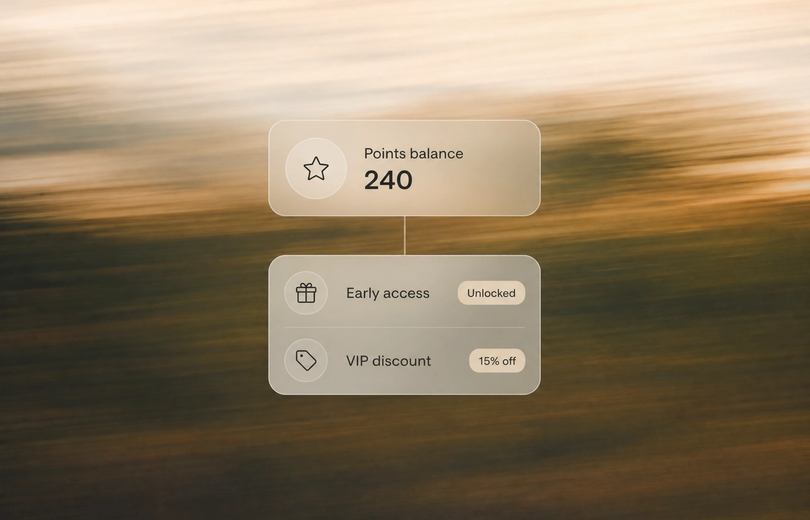
- VIP-tier entitlement: customers in a specific tier receive shipping as an ongoing status benefit.
These structures change different behavior. A threshold aims to increase the current basket. A tier benefit aims to retain customers who have already demonstrated value. A points reward gives customers a reason to return and use their balance.
Myth: free shipping is always cheaper than a percentage discount
Why the perceived value can be stronger
Shipping is a checkout charge customers notice separately from the product price. Baymard found that 64% of users think about shipping costs as early as the product page, which helps explain why removing that charge can feel more valuable than a small product discount.
A cited study found that free shipping performed better than a dollar-off discount for lower-priced goods, while finding no difference for higher-priced goods. That is a useful framing insight, not a universal rule.
Why the merchant cost can be higher
The customer sees “free.” You see the carrier charge, packaging, fulfillment labor, and any leakage from an order that would have happened without the reward.
A percentage discount scales with basket value. A shipping subsidy does not necessarily do that. A low-value order sent by express service can cost more than the percentage reward you were trying to avoid.
Read more about discounts versus points before assuming one reward format is inherently cheaper. Compare the expected cost of each reward against the contribution it produces, not against its customer-facing headline value.
The true landed cost of a free shipping reward
The cost line merchants usually miss
The relevant cost is not every expense in your business. It is the incremental cost caused by the reward.
Start with the shipping subsidy. Then add packaging variance, pick-and-pack cost, payment fees tied to incremental revenue, and expected leakage from returns or refunds. A bulky product, a remote zone, or a split shipment can make one redemption materially more expensive than another.
The cost also includes wasted redemptions. If the store already provides free shipping at the same threshold, a loyalty reward may simply replace a benefit the customer would have received anyway.
A practical break-even equation
Use this decision rule:
Incremental contribution from the rewarded order + expected retained contribution > shipping subsidy + incremental fulfillment and payment costs + expected return leakage
“Incremental” does the work here. Do not credit the reward with the entire order unless you have evidence the order would not have happened without it.
A customer moving from a smaller cart to a qualifying cart may create extra contribution. A customer who was already buying at that value may not. The same principle applies to retention. A shipping perk has value only if it changes future behavior enough to offset its cost.
That is why order-level reward math should sit beside cost per retained customer, rather than being judged on redemption volume alone.
Why AOV alone is not enough
Average order value can conceal a large group of low-value redemptions. Review both average and median order value, then segment redeemed orders by shipping zone, service level, product mix, and return rate.
A high AOV does not protect margin if the orders using the reward contain low-margin products or routinely require expensive shipping. A cap or eligibility rule gives you a practical way to control those outliers.
Threshold-based versus tier-based free shipping rewards
| Structure | Primary goal | Eligibility | Best fit | Main margin risk | Key metric |
|---|---|---|---|---|---|
| Threshold-based | Grow the current basket | Cart subtotal or item count | Customers close to a profitable order value | Low-margin filler items | Incremental contribution per order |
| Tier-based | Retain valuable customers | VIP status | High-AOV or repeat-purchase customers | Broad use across costly shipping zones | Contribution and repeat rate by tier |
| Hybrid | Grow baskets while protecting status value | Tier plus minimum requirement | Brands with variable shipping costs | Overcomplicated qualification | Used reward rate and contribution |
Use a threshold to grow the basket
A threshold-based reward is a basket-building tool. Set it where the additional items a customer adds produce enough contribution to cover the expected shipping subsidy.
The threshold should feel reachable. If customers have to add irrelevant, low-margin filler products just to qualify, you may inflate AOV while reducing contribution per order. Research suggests 58% of online shoppers have added items to qualify for free shipping, but added items are only useful when they preserve margin.
Use a tier to protect high-value customers
Tier-based shipping is a status benefit. It rewards customers for demonstrated spend, order frequency, or other loyalty behavior rather than pressuring every shopper to hit a cart target.
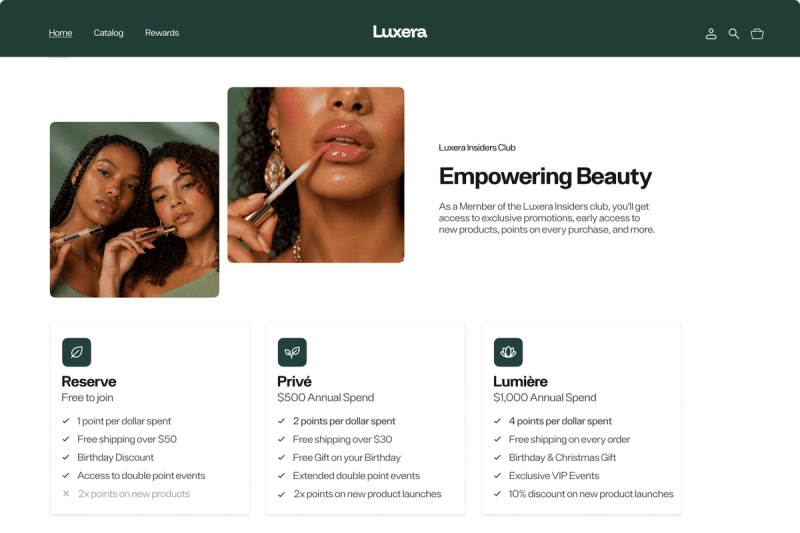
This can suit higher-AOV categories where product discounts are expensive or unnecessary. A fashion loyalty program, for example, can reserve shipping privileges for customers who qualify for higher tiers through repeat spend.
When to combine both
A hybrid model can require a minimum order value for everyone, then give higher tiers broader eligibility or a more favorable cap. This protects margin on small orders while making status feel useful.
The rule should remain easy to explain at checkout. If customers cannot tell whether they qualify, the reward becomes a source of friction instead of a reason to return.
When free shipping works as a loyalty benefit
The customer is close to a profitable threshold
Free shipping works when a customer has a realistic path to qualify by adding products they actually want. The added basket contribution must exceed the expected cost of delivery.
The reward removes a real purchase barrier
Shipping cost can be a meaningful source of checkout hesitation. Baymard’s cited research found that 55% of users abandoned an order because extra costs, mainly shipping, were too high. Treat that as user-experience research, not a promised conversion lift for every store.
The reward is strongest when shipping is visible, meaningful relative to the cart, and avoidable through a clear loyalty action.
The benefit reinforces repeat behavior
A loyalty shipping benefit can encourage a second or third order because the customer already understands the product and delivery experience. It can also preserve product pricing for VIP customers while still giving them a tangible privilege.
For subscriptions, restrict the reward to the first payment or a defined number of payments if recurring shipping subsidies would compound beyond what the subscription margin can support.
When free shipping destroys margin
Low-value orders and high shipping zones
A free shipping reward becomes risky when the subsidy consumes a large share of contribution profit. This is common on small carts, remote zones, oversized products, and multi-package orders.
Segment redemptions by actual shipping cost. A blended store average can make costly orders disappear inside a comfortable-looking overall number.
Express-shipping leakage
If a reward covers whichever shipping option the customer chooses, express delivery can consume the entire value of the order. A shipping-cost cap prevents the reward from absorbing the most expensive option.
Rewards customers would have received anyway
A loyalty shipping benefit has little value if the customer already qualifies for your standard free-shipping threshold. The customer spends points, receives no meaningful advantage, and may conclude the program is not worth using.
Set the reward requirement below the store-wide threshold, or offer a different redemption option.
Returns and partial refunds
Do not evaluate a free shipping reward only on completed redemptions. Compare redeemed orders against similar non-redeemed orders and check whether the loyalty shipping benefit changed contribution, conversion, or repeat behavior after returns are netted out.
High redemption volume alone can mean customers like the reward. It does not prove the reward is profitable.
How to configure a safer free shipping reward on Shopify
Shopify's native controls
Shopify supports free-shipping discounts with minimum purchase amount or minimum quantity requirements. The minimum purchase amount counts product prices, while taxes are excluded from the calculation, according to Shopify’s free shipping discount documentation.
When discounts can be combined, check whether Shopify calculates the minimum from the discounted product price, since that can change whether an order qualifies.
Shopify also allows merchants to exclude shipping rates above a specified amount. Use that control when express options could create disproportionate cost.
Mage reward controls
Mage lets you create a Free Shipping reward with a points cost, minimum subtotal or item-count requirement, shipping-cost cap, purchase type, expiry, and discount-combination settings. You can restrict the reward to one-time purchases, subscription orders, or both, depending on where the subsidy makes economic sense. The customer receives a unique code for checkout, and the reward can appear in the Rewards Widget, Account Sidebar, and Loyalty Page.
The configured cap matters because the code discounts the selected shipping rate only up to that limit. Free shipping rewards also cannot be combined with another shipping discount on the same order.
What to test before launch
Test standard, expedited, discounted, multi-item, subscription, below-threshold, and remote-zone carts. Check that the minimum requirement and cap behave as intended before customers can redeem points.
The Free Shipping Reward guide has the full setting detail. Your launch version should prioritize margin protection over an overly broad promise.
“I looked into so many different integrations for loyalty and referrals for our Shopify Store, but no one impressed me more than Mage on human connection, customer service, and value.”


Read the Reelie case study →
How to find the AOV point where free shipping stops making sense
| Metric | What to calculate | Why it matters | Warning sign |
|---|---|---|---|
| Median order value | Typical cart value excluding outliers | Shows where most customers actually buy | Many redemptions below a profitable basket |
| Shipping subsidy | Actual average cost by redeemed order | Reveals delivery exposure | Express or remote-zone costs rise |
| Contribution margin | Revenue left after variable costs | Funds the reward | Added basket value does not cover subsidy |
| Return rate | Refunded redeemed orders | Captures leakage after checkout | Rewarded orders return more often |
| Used versus unused rewards | Claimed codes that reach checkout | Separates interest from real cost | High claims with low use |
Start with contribution margin, not a benchmark
There is no universal AOV cutoff. A cart that is profitable for one store can lose money for another because shipping cost, product mix, contribution margin, and return behavior differ.
Calculate the minimum order value where incremental contribution covers the expected subsidy and related variable costs. Then compare that point with your median order value, not just your average.
Run a controlled test
Test a capped free shipping reward against a fixed-dollar or percentage reward with a similar expected cost. Use a holdout group or a time-based test where possible.
Measure contribution per visitor and contribution per loyalty member, not conversion rate alone. A higher AOV is not enough if the additional revenue has weak margin.
Track the metrics that reveal the trade-off
Mage analytics separates rewards claimed by type into used and unused rewards, so you can see whether customers actually redeem free shipping at checkout. Combine that with shipping cost, contribution, return rate, repeat purchase behavior, and loyalty-attributed revenue to assess loyalty program ROI.
Use a loyalty ROI calculator for the wider program view. Keep the shipping reward only when retained contribution offsets the subsidy.
FAQ
What is a free shipping loyalty reward?
A free shipping loyalty reward is a benefit that removes delivery costs from a qualifying order after a customer redeems points, meets a cart condition, or qualifies through VIP status. The merchant subsidizes shipping rather than reducing the product price, so its cost depends on the shipping rate, parcel, destination, and configured cap.
How does a free shipping reward work?
A free shipping reward works by giving an eligible customer a shipping discount code or entitlement for checkout. The merchant can control points cost, minimum subtotal or item count, reward expiry, purchase type, discount combinations, and the maximum shipping amount covered, then test how those controls behave across different carts.
Is free shipping better than a percentage discount?
Free shipping is better than a percentage discount only when its perceived value and resulting behavior justify its actual cost. It can feel compelling when delivery is a visible checkout charge, but percentage discounts may be cheaper on expensive or difficult-to-ship orders because the shipping subsidy can vary sharply by service level and zone.
How do I set a profitable free shipping threshold?
A profitable free shipping threshold is set where incremental contribution from the larger basket covers the expected shipping subsidy and related variable costs. Calculate median order value, shipping cost by redeemed order, contribution margin, product mix, and return rate, then validate the threshold with a controlled test rather than copying another store’s number.
Can free shipping be a VIP tier benefit?
Free shipping can be a VIP tier benefit when it is used to recognize customers with demonstrated spend or repeat behavior. Tier-based shipping is mainly a retention perk, while a cart threshold is mainly a basket-building tool, so use a cap or minimum order requirement when delivery costs vary widely.
Can I cap a free shipping loyalty reward?
A free shipping loyalty reward can be capped so it covers delivery only up to a specified amount. Mage supports a shipping-cost cap, minimum order requirements, expiry, purchase-type restrictions, and combination settings, helping merchants prevent an expensive express option from consuming more margin than the reward can support.
Free shipping deserves a place in your loyalty program when the numbers support it. Set a threshold or tier rule around contribution, cap volatile delivery costs, and review redeemed orders against comparable non-redeemed orders. If the reward raises AOV but lowers contribution, tighten the guardrails before scaling it.

Kris is the co-founder of Mage Loyalty. I spend most days talking to merchants, and making sure our customers get real results. If you run a Shopify store or Agency we should chat!