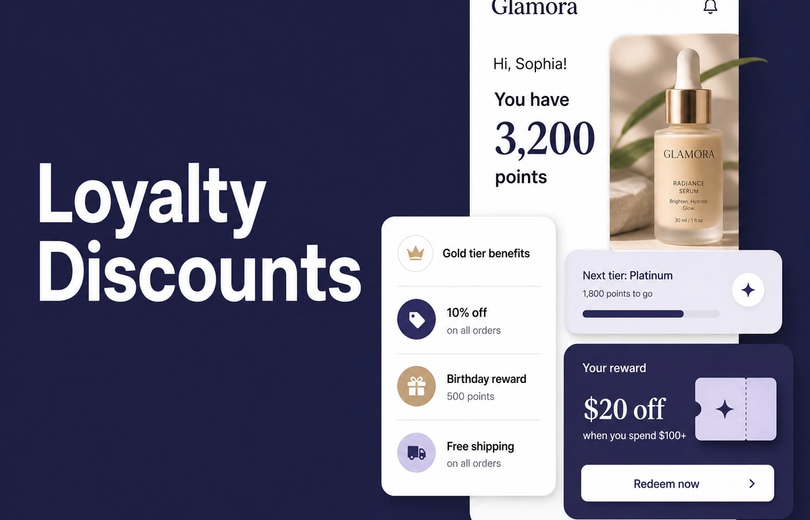
31% of surveyed consumers cite discounts as a reason to subscribe, while 14% cite accumulating points or rewards. Whether loyalty points stack subscription discounts is therefore a margin question as much as a customer-experience question.
Short answer: Loyalty points can stack with a subscription discount, but earning points and redeeming points are separate decisions. A safe default is to let paid subscription orders earn points on the discounted subtotal, while limiting point-funded discounts to one-time orders or renewal milestones until you have proven the margin and subscription-app behavior.
What “loyalty points stack subscription discounts” actually means
Earning points is not the same as redeeming points
When merchants ask whether loyalty points stack subscription discounts, they may mean two different things.
First, does a discounted renewal earn points? Second, can a customer spend an existing points balance to reduce that same renewal further?
A customer earning points on a discounted order does not reduce today’s payment. It does create a future reward liability. Redeeming points on that order creates an immediate second discount.
A Shopify loyalty program should set those rules separately. Otherwise, a sensible earn rule can accidentally become an open-ended discount policy.
Three discount layers to identify before changing a rule
Map the order before changing anything:
- The subscription plan discount, such as 10% off every delivery.
- A loyalty reward, such as a fixed amount or percentage discount.
- Any product, order, or shipping discount that may combine at checkout.
The difference between a subscription plan discount and a checkout reward
A subscription discount belongs to the subscription arrangement and may continue on the contract even after its original code is deactivated. A loyalty reward is typically created when a customer spends their balance.
Those systems can interact, but they do not automatically behave the same way at checkout or on future renewals.
Myth: subscribers must choose between points and subscription savings
Why earning and redeeming should be governed separately
A subscription discount does not automatically mean subscribers should earn no points. The better question is whether the points rate reflects the revenue you keep after the subscription discount.
Mage’s Purchase earning rule measures product spend after discounts, excluding tax and shipping. That means a subscriber can earn against the actual discounted product value rather than the list price.
The safer default for recurring products
For many replenishment programs, separate earning from redemption so subscribers can build a balance without automatically receiving a second discount on every renewal.
This is useful for health and wellness loyalty programs, where a standing subscription saving may already be doing much of the retention work.
When a no-earn rule is justified
Exclude discounted subscription items when margins are thin, the subscription offer is aggressive, or acquisition promotions already consume most available margin.
Mage can exclude discounted products from earning. State that rule clearly in program terms. A subscriber who expects points and receives none will assume the program is broken.
“I looked into so many different integrations for loyalty and referrals for our Shopify Store, but no one impressed me more than Mage on human connection, customer service, and value.”


Read the Reelie case study →
Why stacking can hurt margin even when retention improves
Calculate the effective discount rate
Use a hypothetical product priced at $100. A 15% subscription discount brings the paid product value to $85. If the loyalty program awards a future benefit equivalent to 5% of net spend, the customer earns value based on $85, not $100.
If that customer later applies a loyalty reward to a renewal, the brand has funded both the subscription incentive and the redemption. The cost may be justified, but only if it changes renewal behavior.
Use contribution margin, not revenue, as the control metric
Gross subscription revenue can look healthy while contribution margin quietly declines. Review:
Net sales − product cost − fulfillment − payment fees − shipping subsidy − loyalty cost
The loyalty cost should include points redeemed and expected future redemptions from points issued. Revenue alone does not show whether the second incentive paid for incremental retention.
A simple illustrative margin example
In this hypothetical $100 order, the customer pays $85 after the subscription saving. A later loyalty benefit worth $4.25 reduces the economic value retained from that order sequence further. The figures are illustrative, not a benchmark.
Retail subscription discounts in one cited study ranged from 17% to 20%, which is enough to make an uncontrolled second discount expensive.
Separate incremental retention from subsidized demand
The useful question is whether the reward retained a customer who would otherwise cancel. Link your analysis to whether loyalty rewards lower churn, rather than treating redemption volume as proof of success.
The main stacking policies Shopify brands use
| Policy | Customer experience | Margin risk | Operational complexity | Best fit |
|---|---|---|---|---|
| Earn on subscriptions, redeem on one-time orders | Subscribers build a balance without reducing renewals | Low | Low | Brands testing a loyalty program |
| Earn and redeem on subscriptions with a cap | Customers can use rewards on selected renewals | Medium to high | Medium | Higher-margin products |
| Exclude discounted subscription items from earning | Subscription price is the sole recurring incentive | Low | Low | Thin-margin products |
| Milestone rewards | Customers receive a reward after demonstrated retention | Controlled | Medium | Frequent replenishment products |
Policy 1: earn points on subscription orders, redeem on one-time orders
Subscribers earn on the discounted amount, then use rewards on one-time add-ons, gifts, or a later full-price purchase.
Policy 2: earn and redeem on subscriptions with a cap
Allow subscription redemption only with guardrails. A fixed-value reward limited to the next renewal is easier to model than an unrestricted percentage discount across every future payment.
Set a minimum spend, restrict eligible products, and decide whether a reward applies to one payment, a defined number of payments, or all renewals.
Policy 3: exclude discounted subscription items from earning
Use this where the subscription discount already represents the maximum sustainable offer. The program can still reward reviews, referrals, birthdays, or one-time purchases.
The tradeoff is clear: subscription customers may see less loyalty value than one-time customers.
Policy 4: replace recurring discounts with milestone rewards
A subscription milestone rewards a customer after a chosen number of successful payments. For example, reward the third or sixth completed renewal instead of issuing points on every order.
Mage’s Subscription Milestone earning rule supports this approach. It gives the brand a predictable incentive tied to demonstrated retention. See this related subscription rewards example for another way to design rewards around recurring purchasing.
How Shopify discount combinations affect subscription rewards
| Layer | What it controls | Can it stack? | What to verify |
|---|---|---|---|
| Shopify purchase type | Whether a discount applies to subscription, one-time, or both | Depends on discount setup | Eligible purchase type |
| Shopify discount combinations | Whether discount classes can combine | Only when configured | Settings on both discounts |
| Subscription platform | Rules for the subscription contract | May be stricter | Renewal-specific discount limits |
| Loyalty reward | Reward value and redemption conditions | Depends on all layers | Purchase type and expiry |
Subscription purchase types: subscription, one-time, or both
Shopify lets merchants configure discounts for subscription purchases, one-time purchases, or both. An order containing both can receive different discounts on different line items because Shopify treats them separately.
Discount order and discount classes
Shopify applies product discounts first, then order discounts against the revised subtotal, then shipping discounts. This order matters when you model the value of a loyalty reward.
Why both discounts must allow the combination
Discount combinations are not automatically enabled. Each discount must allow the relevant combination, and the cart must meet its conditions. If they cannot combine, Shopify applies the best eligible discount rather than applying every available offer.
Why the subscription app can still impose a stricter limit
Your subscription app may limit what Shopify settings can accomplish. Recharge, for example, allows only one discount on a subscription at a time.
Check the exact renewal behavior through your Recharge integration and through the subscription app’s own settings. Do not promise customers that rewards stack until you have tested the live flow.
How to configure subscription loyalty earn rules without double-discounting
| Decision | Conservative setting | When to loosen it |
|---|---|---|
| Purchase earning basis | Earn on post-discount product spend | Margin supports a higher tier rate |
| Discounted products | Exclude discounted products | Subscription margin remains healthy |
| Approval timing | Hold points through the return window | Refund risk is low |
| Reward purchase type | One-time only | Renewal behavior is tested |
| Subscription reward duration | Next payment only | Contribution margin supports more payments |
Start with the earning rule
Define the subscription offer first. Does it apply to the first payment, a fixed number of payments, or every renewal? Then set the loyalty earning rate against the amount actually paid.
In Mage, the Purchase earning rule measures product spend after discounts and does not count tax or shipping. That keeps points aligned with net product revenue.
Choose whether discounted products earn
Leave discounted products eligible if the subscription saving is modest and loyalty is part of the retention promise. Turn on Exclude discounted products if the discount already uses the available margin.
Do not make this decision product-wide without considering the subscription catalog. A high-margin add-on and a low-margin staple may need different treatment.
Set approval timing around refunds
Set an approval period when points should remain pending through the cancellation or return window. Mage can reverse purchase earnings when an order is refunded, including a proportional reversal on a partial refund.
Approval timing avoids issuing immediately usable points for revenue that may not remain earned.
Decide where redemption is allowed
Use one-time-only rewards as the starting configuration. Customers can earn through renewals, but their reward reduces a separate purchase.
For supported Mage subscription integrations, the Flexible Redemption block can let a signed-in customer apply a points-funded discount to an active subscription renewal when the reward is configured for Subscription or Both. Confirm the connected platform’s limits for minimum spend, eligible products, discount combinations, and how many renewals the reward can affect.
Recharge supports subscription reward codes, but its one-discount rule means an existing subscription discount can block a new loyalty reward. Review your Shopify subscription apps configuration before launch.
Test one-time, first-payment, and recurring-payment cases
Run these seven tests before publishing customer-facing copy:
- A new subscriber’s first payment.
- A later subscription renewal.
- A renewal with an existing subscription discount.
- A one-time order using a loyalty reward.
- A mixed cart with subscription and one-time items.
- A refunded subscription order.
- A canceled subscription before a milestone is reached.
Use Test Mode where available, and review both the customer balance and the discount applied to the order.
What top subscription brands should measure after launch
Net revenue per renewal
Track net revenue after the subscription discount, not the list price. Segment subscribers by discount-only, points-only, both incentives, and neither where volume allows.
Contribution margin after loyalty cost
Calculate contribution margin after expected reward cost. Include the value of points issued, points redeemed, payment fees, shipping subsidy, and fulfillment.
Renewal rate by offer type
Compare renewal rates for customers receiving different incentive combinations. A phased rollout or holdout group helps distinguish true renewal lift from customers who would have renewed anyway.
Points earned, redeemed, and pending
Monitor how much subscription-issued currency is later redeemed on subscriptions versus one-time purchases. A fast-growing pending balance can signal future margin exposure.
Refund and cancellation behavior
Review whether points were available before refunds or cancellations were final. If so, increase the approval window or tighten eligibility.
Incremental retention versus the control group
Program participation is not the target. You want profitable incremental retention, communicated through terms that explain whether discounted products earn and whether renewal rewards are eligible.
A practical default policy for most Shopify subscription programs
Start with earn, then restrict redemption
Choose an earning and redemption policy based on subscription margin, refund risk, and the behavior your subscription platform supports.
Use milestone rewards before permanent stacking
For low-margin consumables, reward a completed milestone instead of discounting every renewal. A third or sixth successful payment is easier to budget than a standing second discount.
Relax exclusions only after the numbers support it
If renewal lift and contribution margin support it, test a fixed-value reward on one renewal. Keep an approval period that matches cancellation and refund risk, then reassess after enough renewal cycles.
FAQ
Can customers earn loyalty points on discounted subscription orders?
Customers can earn loyalty points on discounted subscription orders when the loyalty program allows it. A brand can calculate points from the discounted subtotal, which aligns rewards with actual product revenue, or exclude discounted products entirely when the subscription saving already uses too much margin.
Can loyalty points and a subscription discount be used on the same renewal?
Loyalty points and a subscription discount can sometimes be used on the same renewal, but the result depends on the reward settings, Shopify discount combinations, and the subscription platform. Test the exact renewal path because a platform may allow only one subscription discount even when Shopify settings permit combinations.
Should subscription orders earn loyalty points after the subscription discount?
Subscription orders should usually earn loyalty points after the subscription discount when the goal is to reward net revenue. Mage’s Purchase earning rule measures product spend after discounts and excludes tax and shipping, so the points calculation reflects the product value the customer actually paid.
How do you prevent loyalty rewards from double-discounting subscription orders?
You prevent loyalty rewards from double-discounting subscription orders by separating earning from redemption. Let subscribers earn points, restrict rewards to one-time orders, exclude discounted products where necessary, or issue a milestone reward after successful payments instead of allowing an open-ended discount on every renewal.
Can Shopify combine a loyalty discount with a subscription discount?
Shopify can combine a loyalty discount with a subscription discount when both discounts allow the relevant combination and the cart meets their conditions. Shopify settings do not override subscription-platform restrictions, so merchants should test whether an existing contract discount blocks the loyalty reward on a recurring payment.
Are subscription milestone rewards better than points on every renewal?
Subscription milestone rewards can be better than points on every renewal when recurring products have thin margins or a standing subscription discount. They reward a completed retention behavior, such as a chosen number of successful payments, while keeping the incentive cost controlled and easier to forecast.
Choose the policy that produces profitable incremental retention after subscription discounts, loyalty costs, refunds, and platform restrictions are accounted for.

Graeme is the co-founder at Mage Loyalty. He heads product development, from complex loyalty migrations and large-scale data handling to building the features shaping the future of loyalty on Shopify.