lululemon Membership gives away almost nothing, and its members love it.
There are no points. There is no balance, no reward catalogue and no money off. Every benefit in the program is either a service the staff were already there to provide, or access to something the company already owned. The direct discount cost of the whole program, per member, per year, is close to zero.
That is the interesting part, and it is the part worth copying. Most loyalty programs buy loyalty with margin. This one buys it with status and access, and it is the cheapest program in retail to run.
This guide walks through setting up a loyalty program like lululemon Membership on your own Shopify store, using Mage, our Shopify loyalty program app. Every setting is included, so you can follow it start to finish. It takes about twenty minutes, and if you would rather not do it yourself, our team will set the whole thing up for you free of charge.
Examples throughout use a clothing store, because that is the category the model was built for and it transfers almost line for line. Swap the products for yours as you go.
What is lululemon Membership?
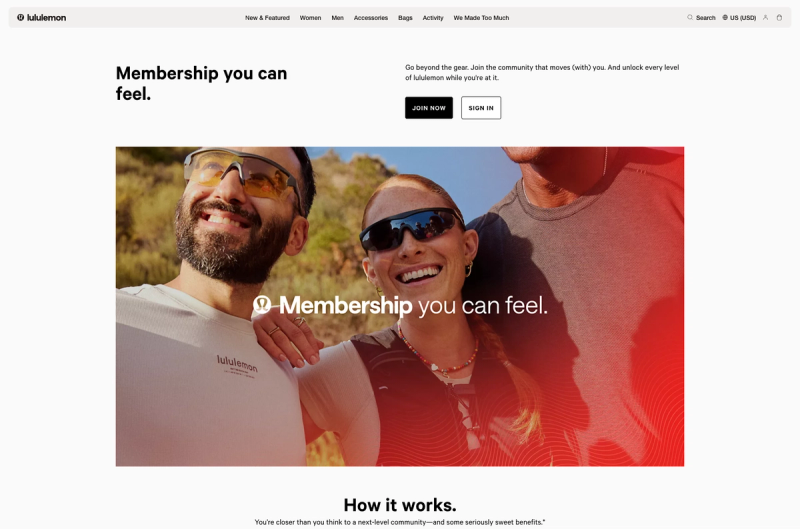
lululemon Membership is lululemon's free loyalty program. There is no points currency at all. Instead, members get a list of benefits, and how many they get depends on how much they spend in a calendar year.
If you already know the program, skip ahead to the three things that make it work.
There are three levels:
| Level | Unlocks at | What it gets you |
|---|---|---|
| Collective | Free to join | Seven benefits, from day one |
| Collective Plus | $500 a year | Everything above, plus two more |
| Collective Pinnacle | $1,000 a year | Everything above, plus two more |
Joining takes an email address. The lululemon loyalty program has no paid level, no subscription and nothing to buy before the benefits start.
“Great app! User friendly and straightforward. The customer service team has been great and so helpful.”


Read the SKYNBIO case study →
How lululemon Membership works
lululemon Membership tiers
The three lululemon Membership levels are decided by how much you spend in a calendar year, running 1 January to 31 December. Collective is free. $500 of spend in the year unlocks Collective Plus. $1,000 unlocks Collective Pinnacle.
Reaching a level upgrades you immediately, and the upgrade holds for the rest of that year and all of the following year. Qualify for Collective Plus in 2025, and you keep it until 31 December 2026. Your 2026 spending then decides where you sit from 1 January 2027.
The top level is not permanent. lululemon re evaluates every level at the end of the retention window, so Pinnacle has to be re earned like everything else.
lululemon Membership benefits
The lululemon Membership benefits stack upward, and each level adds two to the one below it.
| Benefit | Collective | Plus | Pinnacle |
|---|---|---|---|
| Free hemming and alterations | ✓ | ✓ | ✓ |
| Partner perks | ✓ | ✓ | ✓ |
| Early access to product drops | ✓ | ✓ | ✓ |
| Exchange or credit on sale items | ✓ | ✓ | ✓ |
| Receipt free returns | ✓ | ✓ | ✓ |
| Member only experiences | ✓ | ✓ | ✓ |
| Select Peloton classes | ✓ | ✓ | ✓ |
| Exclusive access to products | ✗ | ✓ | ✓ |
| Personal shopper | ✗ | ✓ | ✓ |
| First access to restocks | ✗ | ✗ | ✓ |
| Complimentary customisation | ✗ | ✗ | ✓ |
Read that list again and notice what is missing. Not one of the lululemon Membership benefits is money off. There is no discount anywhere in the program, and seven of the eleven are available to anyone with an account.
What counts towards your yearly spend
Merchandise, net of discounts and net of returns. Taxes, shipping and other fees do not count towards your level. Neither do purchases made on third party sites.
Your account has to be used at the time of purchase for the spend to count, which is lululemon's way of saying that a guest checkout does not quietly credit itself to your membership later.
How lululemon Membership status expires
This is the mechanic most people miss, and it is the one worth stealing.
Status does not expire twelve months after you earn it. It expires at the end of the calendar year after the one you earned it in. So the value of qualifying depends on when you qualify:
| Qualify in | You hold that level until | That is roughly |
|---|---|---|
| January 2025 | 31 December 2026 | 24 months |
| July 2025 | 31 December 2026 | 18 months |
| December 2025 | 31 December 2026 | 13 months |
Qualifying in January is worth nearly twice as much as qualifying in December, and lululemon knows it. Their membership page says "sign up before your next order to start levelling up right away", which is that asymmetry turned into a call to action.
That is the whole program as it stands in 2026. Three levels, one spend threshold each, a calendar year, and a benefit list with no discounts in it.
The three things that make lululemon Membership work
1. It pays in access and service, not margin
Take a customer who spends $1,000 with you in a year.
A conventional points program at 5% back owes that customer $50 of discount. You pay it on your best customers, every year, forever, and you pay it in revenue rather than cost of goods.
Now price lululemon Membership's benefit list for the same customer. Free hemming uses staff time in a shop that was already staffed and already open. Receipt free returns is a database lookup. Partner perks are funded by the partner, who is paying for access to your audience. Early access to a product drop is an email sent a day earlier than the other one. Exclusive products are inventory you already own, sold at full price.
The direct discount cost of that list is zero.
Almost all of that transfers straight to an independent clothing brand. Free alterations and hemming cost you a tailor's time, and if you already offer them on request you are giving the benefit away unbranded. A styling session uses time your team already has. Priority access to a drop costs an email send. Getting first pick of a restock costs nothing at all, because the stock was coming anyway and somebody was always going to buy it.
Run the same $1,000 customer through a benefit led program and you might spend an hour of a tailor's time and some staff attention. Against $50 of discount paid out every year, that is roughly a tenth of the cost, for a benefit list that reads longer.
This is the arguable bit, so argue with it properly. Access only works if the access is worth having. A store with one permanent range, no drops, no alterations and nothing that sells out has nothing to gate, and for that store a points program is the honest answer. But most clothing brands have new seasons, limited runs, sizes that go quickly and a fit problem worth solving. All of that is currency you are currently giving away for free.
2. The retention rule turns one threshold into eighteen months
The calendar year plus next year rule is doing more work than it looks like.
Because status is held to the end of the following calendar year, a single threshold crossing buys somewhere between thirteen and twenty four months of protected status, averaging around eighteen. The customer never falls off a cliff mid year. A quiet quarter costs them nothing.
That matters more than it sounds. A rolling twelve month window, which is what most programs use, quietly demotes people the moment they slow down, and the demotion arrives with no warning and no obvious cause. lululemon's version cannot do that. You are safe until 31 December of next year, full stop, and the date is easy to say out loud.
It also keeps a live target on the board at all times. Your spend this year is not deciding this year's status, which is already settled. It is deciding next year's. There is always a reason to keep going.
3. The free level carries most of the value
Seven of the eleven benefits are available to anyone with an account. Each level above adds only two.
Most merchants build the opposite shape, stacking value at the top so the top looks worth chasing. lululemon puts the weight at the bottom, and the reason is that joining is the conversion event that actually matters. An account gives you an email address, an identity to attribute orders to, and a customer you can segment and talk to. A free level with two thin benefits gives nobody a reason to create one.
There is a second effect. When the free level already covers the basics, the upgrades read as a finish rather than as unlocking things that should have been included. Compare "Plus unlocks free returns" with "Plus gets you a personal stylist". The first tells your free members what they are being denied. The second tells them they are being looked after and there is more if they want it. Put the cheap benefits at the bottom and the upgrades stop sounding like a hostage negotiation.
Copy the ratio, not just the rows.
What you'll set up
Here is how each part of the lululemon loyalty program maps onto what you will build, so you can see the whole job before starting it.
| lululemon Membership feature | What you'll build in Mage |
|---|---|
| Free to join, email only | Automatic on Shopify account creation |
| Three levels on yearly spend | VIP tiers, entry method set to amount spent |
| 1 January to 31 December window | Calendar year tier progress |
| Status held through all of next year | Protect tier status |
| Spend net of discounts and returns | Automatic, and it excludes tax and shipping |
| Benefits comparison grid | VIP tiers table on your loyalty page |
| Free shipping for upper levels | Shopify automatic discount on a tier tag segment |
| Welcome gift on reaching a level | Tier entry rewards |
| Partner perks | A member only perks page |
| Early access to launches | Member gated collection |
| Exclusive products for upper levels | Tier tag gated collection |
| Level upgrade notification | Tier upgrade email |
| Track your level and progress | Loyalty page, widget and account sidebar |
Step 1: Decide what your program pays in
Before any settings, make this call, because everything else follows from it.
lululemon pays in status. Nothing is earned per pound spent and nothing is redeemed. You can build exactly that, or you can build the same structure with a points currency running alongside it.
| Approach | What customers see | Best for |
|---|---|---|
| Status only | Levels, progress, and a benefit list | Stores with drops, alterations, styling or scarcity to offer |
| Status plus points | All of the above, plus a balance to spend | Stores where customers expect money off, or that discount anyway |
We would go with status only for most clothing brands, which is the opposite of what we would say in almost any other category. Clothing has the two things that make a benefit led program work: a fit problem that a service can solve, and product that sells out. If you have neither, or if your customers are already trained on seasonal discounting, add the points.
Settings → Loyalty
| Field | Value |
|---|---|
| Program Currency | Points |
| Default Prefix | `MEMBER` |
| VIP Tier Reward Prefix | `MEMBER-VIP` |
One thing to know before you worry about it: tier progress accumulates whether or not you award any points. Spend is tracked from the order itself, not from your earning rules. If you go status only and switch the purchase rule off, your levels carry on working exactly as described. Nothing breaks.
Step 2: Set your VIP tier rules before you switch tiers on
VIP Tiers → Program Settings
Do this first, and read this line before you touch anything: these settings lock the moment you enable VIP tiers. Entry method, the progress window and the protection rules all become read only, and changing them afterwards means switching tiers off, editing, switching back on, and sitting through a full recalculation that can move customers between levels.
| Field | Value |
|---|---|
| Entry Method | `Amount spent ($)` |
| Tier Progress Expiry | `Calendar Year` |
| Never downgrade the highest tier | Off |
| Protect tier status | On |
| Start date | 1 January this year |
Entry Method is set to amount spent because that is what lululemon Membership gates on. The alternatives are instructive in how wrong they go. Points earned would gate on a currency the program does not have. Number of orders would let ten $20 orders outrank one $400 order, which inverts the whole point of the program.
Tier Progress Expiry set to calendar year gives you the 1 January to 31 December window. Its own description reads "progress resets on January 1 each year", which is the source program almost word for word.
Protect tier status is the setting people miss, and it is the one that makes this program feel generous. With calendar year progress selected, its help text reads "after earning a tier, customers keep it until the end of the next calendar year, regardless of their activity". That is lululemon's retention rule exactly, with no workaround needed. Leave it off and your customers get demoted every January, which turns a program about reassurance into a program about anxiety.
Never downgrade the highest tier stays off on purpose. Turn it on and your top level becomes permanent, and the re evaluation that keeps the program honest never happens. Within two years your top tier fills with people who qualified once in 2025 and have not been back since.
Start date set to 1 January means this year's existing orders count towards this year's levels. Mage will read your order history and backfill it, so customers who have already spent enough land in the right level on day one rather than starting from zero.
Save this tab, check the summary reads back what you expect, and only then switch VIP tiers on.
Step 3: Create your three tiers
VIP Tiers → Tiers
| Name | Spend threshold | Point multiplier |
|---|---|---|
| Collective | 0 | 1x |
| Collective Plus | 500 | 1.25x |
| Collective Pinnacle | 1000 | 1.5x |
Rename these for your own brand. lululemon's names are legible enough to follow along with, but Collective means something to their customers and nothing to yours. On status only, set every multiplier to 1x.
Two rules the form enforces. Only the base level can sit at a threshold of 0, and the base level is locked to a 1x multiplier. Both are fine here, because Collective is exactly a zero threshold level that everybody lands in.
Sizing the thresholds for your catalogue
Clothing is the one category where lululemon's own numbers nearly transfer as they are, because the thresholds were built for a basket that looks like yours. lululemon's AOV sits around $130, so $500 is roughly four orders and $1,000 is about eight. Check yours against that rather than copying blindly.
| Your AOV | Second level | Top level |
|---|---|---|
| ~$70 | $300 | $600 |
| ~$100 | $400 | $800 |
| ~$130 | $500 | $1,000 |
| ~$180 | $700 | $1,400 |
The ratio is what matters, not the numbers. The top level is exactly double the second, and the second sits at roughly four orders, which for most clothing brands is a year of committed buying across two seasons. Set the second level where a good customer arrives naturally in nine to twelve months. If nobody reaches it, it is decoration. If everybody reaches it in two orders, it is not a level.
If you sell coats or tailoring, where one order can be $400, sanity check the thresholds against order count too, or you will hand your top level to somebody who bought once and never came back.
Step 4: Build the benefits table
Loyalty Pages → Landing → VIP Tiers
This is the part customers actually see, and on a status led program it is the entire product. Get it right and the rest of the build is plumbing.
Add one row per benefit, then mark each level with a tick, a cross, or free text if a level gets a different version of the same perk.
| Benefit | Collective | Plus | Pinnacle |
|---|---|---|---|
| Free hemming and alterations | ✓ | ✓ | ✓ |
| Early access to every drop | ✓ | ✓ | ✓ |
| Extended returns window | ✓ | ✓ | ✓ |
| Partner perks | ✓ | ✓ | ✓ |
| Members only pricing events | ✓ | ✓ | ✓ |
| Exclusive access to limited runs | ✗ | ✓ | ✓ |
| Personal styling session | ✗ | ✓ | ✓ |
| Free shipping and free returns | ✗ | ✓ | ✓ |
| First pick of restocks | ✗ | ✗ | ✓ |
| Complimentary monogramming | ✗ | ✗ | ✓ |
Ten rows, five of them free. That is the ratio from earlier, and it is the single most copyable decision in the program. Resist the urge to move two more of those free benefits up a level to make the upgrades look better. It makes the free level look worse, and the free level is what converts.
Free hemming is the row to take most seriously. It is lululemon's most imitated benefit for a reason: it costs a tailor's time rather than margin, it solves the actual problem clothing customers have, and it only pays out on people who already bought something. If you offer alterations on request today, you are giving away a headline benefit without getting credit for it. Put it in the table and it starts working for you.
Free shipping and returns is the one row here with a real per order cost, which is why it sits at Plus rather than at signup. In clothing, returns are the expensive half of that pair, so paying for them only above $500 of proven annual spend is the difference between a benefit and a liability. Everything above it in the table costs you either staff time or nothing. Sort your own list the same way, cheapest at the bottom, and the levels price themselves.
Then set the column headings and the copy:
| Field | Value |
|---|---|
| Collective threshold text | `Free to join` |
| Plus threshold text | `Up to $1,000` |
| Pinnacle threshold text | `$1,000+` |
| Layout | `table` |
| Tier column headers | `icon_name` |
| Show progress section | On |
| Logged Out Title | `Membership you can feel` |
| Logged In Title | `Your member benefits` |
| Progress Title | `Your level` |
Note the threshold text. lululemon labels its columns "Up to $500", "Up to $1,000" and "$1,000+", which describes where you sit rather than what you owe. It is a small piece of framing and it reads far better than a bare number.
Keep Show progress section on. Members checking how close they are to the next level is the behaviour the whole program is built to produce.
The logged out and logged in titles are separate fields for a reason. Logged out visitors are being sold the program. Logged in members are being told where they stand. Write them differently.
Step 5: Add a welcome reward to the upper levels
VIP Tiers → Collective Plus → Edit → Entry Rewards
An entry reward is granted once, automatically, the moment somebody reaches the level. It is the moment the upgrade becomes real rather than theoretical.
| Level | Reward | Settings |
|---|---|---|
| Collective Plus | Free product | A branded accessory, expires in 90 days |
| Collective Pinnacle | $25 off | Minimum spend $100, expires in 90 days |
A product rather than a discount at Plus, because giving away a cap, a pair of socks or a tote costs you wholesale rather than revenue, and it puts something branded into circulation. That is the same logic the whole program runs on, and in clothing it has a second benefit: the customer wears it.
Size the Pinnacle discount against your AOV rather than copying $25. A voucher worth less than a fifth of a typical order reads as a rounding error, and one worth more than half of it is just a sale with extra steps.
Skip this step entirely on status only. lululemon has no discounts anywhere in its program, and a store with a strong benefit list does not need one.
Set an expiry on both. A welcome gift that sits unused for two years is not doing anything for you, and a ninety day clock gives the customer a reason to come back inside the window where they are still pleased about the upgrade.
Note the distinction while you are on this screen. Entry rewards fire once on arrival. Tier rewards sit in the customer's list for as long as they hold the level and can be redeemed repeatedly. For this program you want entry rewards only.
Step 6: Set up free shipping for your upper levels
Free shipping is a standing benefit rather than a one off gift, so it cannot be a reward code. It needs to apply automatically, every time, for as long as the customer holds the level.
Mage writes each customer's level to Shopify as a customer tag, which is what makes this possible. Build a segment on the tag, then point a discount at the segment.
Shopify admin → Customers → Segments, create a segment called Plus and above:
customer_tags CONTAINS 'Mage VIP Tier: Collective Plus'
OR customer_tags CONTAINS 'Mage VIP Tier: Collective Pinnacle'
Shopify admin → Discounts → Create discount → Free shipping
| Field | Value |
|---|---|
| Method | Automatic |
| Customer eligibility | Your Plus and above segment |
| Minimum requirement | None, or your usual threshold |
Automatic rather than a code, so it applies at checkout without the customer doing anything. A standing benefit that requires typing a code is not a standing benefit, it is a coupon.
Both levels have to be listed in the segment. A segment that names only Collective Plus excludes your Pinnacle customers, who are the highest spenders you have. This catches people out because it reads like a threshold and behaves like an exact match. The same rule applies everywhere you use these tags, which is the next step.
The segment then maintains itself as customers move between levels.
Step 7: Gate your member perks with tier tags
Step 6 used the tier tag for one benefit. This step is the general pattern, because the same tag delivers every benefit that lives outside the app:
Mage VIP Tier: Collective PlusYour theme reads it, your segments read it, your email platform reads it, and your team reads it when somebody asks whether their alterations are free.
Two things to know before you write any Liquid.
Base level customers do not carry a tag. Only levels above the base one are tagged. So anything available to all members gets gated on whether the visitor has an account, not on a tag:
{% if customer %}
  <!-- every member sees this -->
{% endif %}
Check the tag for the level and every level above it. There is no "this level or higher" helper, so you list them:
{% assign tags = customer.tags | join: ',' %}
{% if tags contains 'Mage VIP Tier: Collective Plus'
   or tags contains 'Mage VIP Tier: Collective Pinnacle' %}
  <!-- Plus and Pinnacle see this -->
{% endif %}
This is the one people get wrong. A gate that checks only the Plus tag hides Plus benefits from your Pinnacle customers, who are the highest spenders you have and the most likely to email you about it. List every level upward, every time.
For the perks that are really marketing rather than storefront gating, build Shopify segments on the same tags and use them for discounts, shipping rates and email audiences:
customer_tags CONTAINS 'Mage VIP Tier: Collective Pinnacle'Tags appear once the tier recalculation and tag sync have finished, so give it a few minutes after saving before you test your Liquid.
Step 8: Give members early access to drops
Early access is the benefit that costs the least and lands the hardest, and in clothing it is the reason the program exists. Sizes sell out. Getting in before that happens is worth more to a customer than 10% off, and it costs you nothing, because the stock was always going to sell.
Create the collection for the drop and leave it out of your navigation. Wrap the section that links to it in a member gate:
{% if customer %}
  <a href="/collections/new-drop">Members get first look</a>
{% endif %}
Then send it to your member segment a day or two before it goes into public navigation. That gap is the entire benefit. You are not giving anything away, you are changing the order people find out.
For exclusive access to limited runs, which sits at Plus and above, use the same pattern with the tier tag gate from Step 7. For first pick of restocks at Pinnacle, send your back in stock notifications to the Pinnacle segment ahead of everyone else. That one matters more in clothing than in any other category, because a restock in the popular sizes is gone in hours and your best customers are the ones who missed out the first time.
Build a partner perks page
Partner perks are the cleverest line on lululemon's list because the partner pays for them. You are offering an engaged, identified audience, and adjacent brands will trade an exclusive offer for access to it.
Build a normal Shopify page listing your partners, with each offer revealed inside a {% if customer %} gate, then link it from your loyalty page. For a clothing brand the natural partners sit around the wardrobe without competing with it: a shoe or accessories label, a laundry or garment care brand, a tailor, a gym or studio if you sell activewear, a resale or repair service if your positioning is longevity.
Two or three partners is enough to make the row on your benefits table true.
Step 9: Build your loyalty page
Loyalty Pages → Landing
Add these blocks in this order:
| Order | Block | What it does |
|---|---|---|
| 1 | Hero banner | The pitch, and a join button |
| 2 | How it works | Three steps, numbered |
| 3 | VIP tiers table | The benefits grid from Step 4 |
| 4 | FAQ | The questions members actually ask |
For How it works, three steps is the right number and lululemon's are hard to improve on. Sign up for free, and all you need is an email address. Enjoy the benefits, starting from day one. Level up, because every order takes you closer to the next one.
For the FAQ, the question to answer properly is what happens when a level expires. It is the one customers actually ask, and a vague answer creates support tickets. Say the date. "Reach Collective Plus at any point this year and you keep it until 31 December next year" is one sentence and it removes the entire category of question.
If you built status only, leave off any block that talks about points balances. A page advertising a balance that never moves is worse than no page.
Step 10: Turn on the upgrade email
Email Templates → VIP Tiers → Tier upgrade
On a program where the upgrade is the reward, this email is the single most important message in the whole lifecycle. It is the payoff for everything the customer has spent.
Write it to do three things. Congratulate them by level name. List the specific new benefits they just unlocked, not the whole list. Tell them the date their status runs to, because "you keep this until 31 December 2027" is the line that makes the program feel generous rather than conditional.
Keep it short. This is a good news email and good news emails should not need scrolling.
Step 11: Put it in front of customers
Rewards Widget
Turn it on, brand it to your store, and check what it leads with. On a status led program it should show the customer's level and their progress to the next one. If you built status only, make sure it is not leading with a balance.
Loyalty Pages → Rewards Center gives members a full page account view with their level, their progress and their benefits. Account Sidebar puts the same thing inside the Shopify customer account.
Wallet Pass is worth the ten minutes here specifically. lululemon leans on its app to carry status around, and a wallet pass with the level badge is the closest thing to that without building one. It also makes the perk usable in store, which matters if your alterations happen at a counter.
You don't have to copy all of it
Very few stores need the whole thing, and it comes apart cleanly.
If you want one thing, make it Step 2's protect tier status combined with calendar year progress. It is two settings, it costs nothing, and it is the difference between a program that reassures people and one that quietly punishes a slow quarter.
If you run drops or limited runs, take Steps 4, 7 and 8 and skip the rest. A benefits table plus tag gated early access is a complete program on its own, and it costs you almost nothing per member.
If you already offer alterations, Step 4 alone is worth the twenty minutes. You are doing the work and paying for it already. Putting it in a benefits table converts a cost you absorb quietly into a reason to create an account.
If returns are eating you alive, put free returns at your second level rather than giving them to everybody. It is the same money, spent only on customers who have proven they keep more than they send back.
If your customers expect money off, keep the level structure but add a points currency and a redemption ladder. You will end up closer to Sephora or Ulta than to lululemon, which is a perfectly good place to be.
If your customers buy occasionally, add a birthday gift. It is not part of lululemon Membership, but Shopify birthday rewards give infrequent buyers a reason to return that does not depend on them spending enough to reach a level.
Take the parts that suit how your customers actually shop.
We'll set it up for you, free
If you would rather not configure any of this yourself, our team will do it for you at no cost. That includes the full build above, tuned to your catalogue and your margins, plus your branding across the widget, sidebar and loyalty pages.
We are a good fit for this particular shape of program. Choosing a loyalty program provider usually means choosing between points engines, and a lululemon style membership program does not need one. What it needs is spend based tiers, a calendar year window, protected status and a benefits table that can carry perks instead of discounts, and those are standard settings in Mage rather than workarounds.
Already running a loyalty program somewhere else? We handle migrations free of charge too, including your existing customer balances, tiers and history, so nobody loses what they have earned. We have migrated stores from Smile.io, LoyaltyLion, Yotpo, Rivo, Stamped, Joy and Bubblehouse.
Talk to our team and tell us what you want your program to look like.
Frequently asked questions
What is lululemon Membership? lululemon Membership is lululemon's free loyalty program, and it has no points. Members get a list of benefits including free hemming, early access to product drops, partner perks, receipt free returns and member only experiences. There are three levels, Collective, Collective Plus and Collective Pinnacle, decided by how much a customer spends in a calendar year.
How does lululemon Membership work? lululemon Membership works on spend alone. Joining is free and needs only an email address, and every member gets the Collective benefits from day one. Spending $500 in a calendar year unlocks Collective Plus, which adds exclusive product access and a personal shopper, and $1,000 unlocks Collective Pinnacle, which adds first access to restocks and complimentary customisation. Spend is counted 1 January to 31 December, net of discounts and returns, and it excludes tax and shipping. Reach a level and you hold it until the end of the following calendar year.
Is lululemon Membership free? Yes, lululemon Membership is completely free to join. There is no paid level and no subscription. The first level, Collective, requires nothing but an account, and seven of the program's benefits are available at that level.
How much do you have to spend for Collective Plus? $500 in a calendar year unlocks Collective Plus, and $1,000 unlocks Collective Pinnacle. Only merchandise counts, net of any discounts and net of anything you return. Tax, shipping and fees do not count towards the total.
How long does lululemon Membership status last? Longer than a year, and how much longer depends on when you qualify. Status is held for the rest of the calendar year you earned it in plus all of the following year, so qualifying in January gives you nearly 24 months while qualifying in December gives you about 13. Everyone's status runs to 31 December of the year after they qualified, and it is then re evaluated on that year's spending.
Can I build a loyalty program like lululemon Membership on Shopify? Yes, and every part of the structure in this guide can be set up in Mage: three spend based levels, the 1 January to 31 December window, status held through all of the following year, the benefits comparison table, free shipping for upper levels, welcome gifts on upgrade, tag gated early access and exclusive products, a partner perks page, and the upgrade email. This guide covers each step with the exact settings to use.
Which loyalty program provider should I use to build a lululemon style membership program? Mage is built for this shape of program, and that is not true of every provider. A lululemon Membership loyalty program needs four specific things: spend based tier entry rather than points based, a calendar year progress window, status protected through the end of the following year, and a benefits comparison table that can show perks which are not discounts. Mage has all four as standard settings, plus automatic customer tag sync so the benefits your loyalty app does not own, early access, gated collections, member pricing, can still be delivered by your theme and your Shopify segments. Most loyalty apps are built around a points balance and struggle to express a program that has none.
How long does it take to set up? About twenty minutes if you follow this guide. If you would rather it was done for you, our team sets it up free of charge, including your branding.
Should a loyalty program have points or just tiers? It depends on whether you have anything worth gating. lululemon Membership proves a program can work with no points at all, but it works because early access, exclusive products, alterations and partner offers are genuinely valuable to their customers. Clothing brands are unusually well placed to copy it, because they normally have drops, sizes that sell out, and a fit problem that a free alteration solves. If you have those, a status only program costs you a fraction of what a points program costs and often feels more generous. If you sell a single permanent range with nothing scarce and no service, your customers want money off, and you should give them points.
What happens to a customer's level when they return an order? The refund is deducted from their spend total automatically, and partial refunds are deducted proportionally. Tax and shipping never counted towards the level in the first place, so nothing needs unwinding there. If the return drops them below the threshold of a level they already reached, they keep the level anyway, because status is protected until the end of the following year.
Can I switch from my current loyalty app without losing customer data? Yes. We migrate balances, tiers and history from other loyalty platforms free of charge, so your customers keep everything they have earned and arrive in the right level on day one.
Mage is not affiliated with, endorsed by, or sponsored by lululemon. lululemon Membership is a trademark of lululemon athletica canada inc. This guide references the program for the purpose of comparison and education.

Graeme is the co-founder at Mage Loyalty. He heads product development, from complex loyalty migrations and large-scale data handling to building the features shaping the future of loyalty on Shopify.