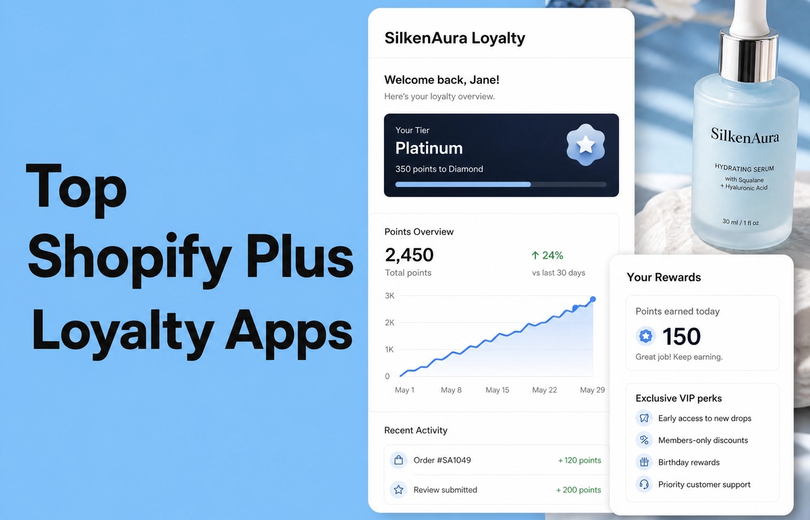
MiaDonna gives customers $1 in store credit for every $20 spent, then lets them use that balance at checkout, a journey that headless loyalty on Shopify Plus could render inside a custom storefront or account experience. The question is whether that extra control would change customer behavior enough to justify permanent frontend ownership.
Short answer: Headless loyalty on Shopify Plus is worth the development cost when loyalty is a meaningful part of a custom storefront, account system, app ecosystem, or omnichannel journey. If you mainly need points, rewards, referrals, VIP tiers, and branded account surfaces, embedded loyalty is usually faster to launch and easier to maintain.
What headless loyalty on Shopify Plus actually means
The backend owns loyalty logic, while your frontend owns the experience
Headless loyalty separates the rules and ledger from the customer-facing interface. Your loyalty platform manages earning rules, balances, rewards, tier status, referrals, and redemption eligibility. Your frontend decides where customers see that information and how they use it.
That frontend might be a full custom storefront, a mobile app, a bespoke account area, or a single loyalty component inside an otherwise standard Shopify theme.
Headless loyalty is not the same as rebuilding your whole Shopify store
A custom loyalty experience does not require a full storefront rebuild. You can keep a Shopify theme and build a custom rewards section, account module, or campaign landing page where the standard storefront tools do not fit.
Shopify’s Storefront API and headless tools support custom commerce experiences, while Hydrogen is Shopify’s toolkit for building headless storefronts. That does not mean every loyalty surface needs Hydrogen.
A Shopify loyalty program can run through embedded storefront surfaces, custom frontend components, or a mix of both.
The API-first loyalty stack
An API-first loyalty platform exposes the data and actions needed to build a custom experience.
Mage supports custom loyalty builds through a REST API, JavaScript SDK, Shopify metafields, and webhooks. That gives a team options without forcing a full rebuild from day one.
Myth: Shopify Plus brands should go headless by default
Plus gives you more options, not an obligation to rebuild
Shopify Plus gives a team more flexibility. It does not make headless the default answer for loyalty.
Shopify’s own guidance says not every business needs to replatform. The recommended starting point is a measurable problem, a baseline, and a target worth pursuing.
Plus status alone does not prove that a custom frontend will improve enrollment, reward redemption, repeat purchase rate, or checkout completion.
The real question is whether the customer experience needs custom code
Start with the constraint, not the architecture.
Perhaps your account experience is already a custom React application. Perhaps customers move between a mobile app, a subscription portal, and a storefront. Perhaps loyalty status controls access to collection drops, content, or member services that cannot be managed cleanly through theme sections.
Those are structural reasons to build custom loyalty surfaces. Wanting a more polished points display is usually an operational preference, and configurable embedded surfaces often handle it.
“Cannot say enough good things about the team at Mage Loyalty, one of the absolute best organizations we have ever worked with, full stop! So glad we connected with them, completely redid our loyalty program, new concepts, use of loyalty, increasing user engagement, showing us where we were not valuing our best customers, just WOW, amazing team!”


Read the West Coast Goalkeeping case study →
When the development investment can pay off
| Decision signal | Headless is more defensible | Embedded loyalty is more suitable |
|---|---|---|
| Customer journey | Loyalty is deeply connected to a custom account, app, or portal | Loyalty is one part of a standard storefront journey |
| Frontends | Several customer touchpoints need the same loyalty experience | The Shopify storefront is the primary customer touchpoint |
| Campaign workflow | Changes are governed through a product development process | Marketing needs to publish changes without deployments |
| Team ownership | A team can maintain frontend code after launch | Frontend capacity is limited or assigned elsewhere |
| Commercial case | A defined behavior and metric justify the build | The expected benefit is mainly visual preference |
The loyalty experience is part of your competitive product experience
Headless can pay off when loyalty is central to how customers use the brand. This is common when a custom account area is a destination in its own right, rather than a place customers visit only to check an order.
A fashion brand, for example, may want tier status, collection access, points progress, saved products, and launch messaging to work as one account journey. A fashion loyalty program may also need collection-specific campaigns and higher-tier access that deserve more control than a floating widget provides.
The commercial case must remain specific. Identify the current friction, the behavior expected to change, and the metric that will prove the change worked.
You need the same loyalty identity across multiple frontends
A custom storefront, mobile experience, account portal, and in-store journey should not present conflicting balances or tier status.
Headless loyalty can give each touchpoint access to the same source of truth while allowing different interfaces for different jobs. A mobile app may focus on wallet-style reward access. A storefront may emphasize points earned on the current cart. An account area may focus on progress, referrals, and saved products.
This is useful when the loyalty experience must travel across several owned customer surfaces. It is less useful when the only requirement is showing a balance in the storefront header.
You have a team to own the system after launch
The build is only justified if someone owns it after launch.
Define success measures before development begins. Track loyalty enrollment, repeat purchase rate, redemption, account engagement, loyalty-page conversion, checkout completion, developer hours, and campaign publishing time.
Do not assume headless will improve speed. Shopify notes that performance depends on frontend code, images, caching, hosting, and API requests, not the architecture label.
When embedded loyalty widgets are enough
Use embedded surfaces for standard loyalty jobs
Embedded loyalty is usually enough when the job is straightforward: launch points, rewards, referrals, VIP tiers, earning rules, a loyalty page, and account visibility.
A team does not need a custom application to let customers earn on purchases, view rewards, refer friends, or track tier progress. The more standard the customer journey, the more likely configurable storefront surfaces will meet the requirement with less ongoing work.
Mage works with an existing Shopify theme and customer accounts without custom development to get started. Its Rewards Widget, loyalty page, and account sidebar handle common loyalty interactions without requiring the merchant to build those surfaces from scratch.
A branded experience does not require a custom application
Brand control and custom code are separate decisions.
Mage Canvas lets teams configure loyalty, account, referral, wishlist, and saved-for-later surfaces through a no-code builder. Marketing teams can change messaging, colors, typography, layouts, and campaign presentation without every update entering a development queue.
That matters for loyalty because programs change often. A new reward, a seasonal multiplier, revised tier message, or referral offer should not automatically become a frontend sprint.
The middle path: custom sections without a full rebuild
There is a practical middle path between a generic widget and a headless storefront.
Mage automatically exposes loyalty data through Shopify metafields. Shopify Liquid can use documented data such as points balance, lifetime points, VIP tier, membership status, earning rules, rewards, and referral-program settings.
That supports custom points badges, VIP sections, reward progress modules, and tailored loyalty landing pages while keeping the rest of the storefront theme-based.
If the requirement can be met with an app block, theme section, metafield, checkout extension, or configurable account surface, start there. Build a separate frontend only when that approach creates a real limitation.
What a headless loyalty implementation actually has to do
| Workstream | What the team owns | Risk if underestimated |
|---|---|---|
| Authentication | Customer sessions, login state, token handling, logout flows | Incorrect access to customer-specific loyalty data |
| Personalized rendering | Loading balances, tiers, rewards, referrals, and guest states | Slow, confusing, or incomplete account experiences |
| Checkout connection | Reward redemption path and checkout eligibility testing | Rewards fail or behave inconsistently at checkout |
| Analytics | Loyalty interaction and order attribution | No reliable evidence that the build improved outcomes |
| Reliability | Error states, caching rules, monitoring, and fallback behavior | Broken loyalty surfaces during API or deployment issues |
| Quality assurance | Browser, device, accessibility, refund, and integration testing | Regressions reach customers after routine changes |
Customer identity and authentication
A custom frontend must identify the logged-in customer safely before displaying points, rewards, VIP status, order history, or referral details.
Shopify’s Customer Account API guidance covers authentication flows, sessions, token refresh, callback URLs, logout URLs, and server-side session storage considerations in Hydrogen implementations.
Loyalty data and personalized rendering
The frontend needs a clear loading strategy. What does a guest see? What appears while a balance loads? What happens if the loyalty API is unavailable? What should the page do when a reward becomes ineligible?
Personalized data also needs careful caching. Shopify warns that customer-specific data and personally identifiable information must not be cached in a way that exposes one customer’s information to another.
The interface should handle stale data, empty states, API errors, and changes triggered elsewhere, such as a tier upgrade after an order.
Checkout, analytics, and app integrations
The custom interface does not mean your team owns Shopify Checkout logic. It must still preserve a reliable path from a loyalty interaction to checkout redemption.
Test discount application, reward eligibility, refunds, points changes, tier changes, referral attribution, and integration events.
Mage’s REST API, JavaScript SDK, metafields, and webhooks can support this work. Its documented webhook examples include points earned, points redeemed, and tier upgrades.
Security, caching, and failure handling
A points balance is personal account data. A referral link may be customer-specific. Reward eligibility can change after an order, refund, or tier movement.
Define what happens when data fails to load. Avoid showing a reward as available if the platform cannot confirm eligibility. Monitor API failures and deployment errors, and give support teams a way to reproduce customer reports.
The maintenance burden teams underestimate
Routine changes become product work
A custom loyalty interface creates a permanent software surface. New reward displays, tier messages, account blocks, referral flows, and promotional components may all require planning, development, QA, and deployment.
The initial build is only one part of total cost. Teams also need to budget for hosting, release processes, monitoring, browser testing, accessibility work, analytics upkeep, and security reviews. Review your wider loyalty program maintenance costs alongside frontend ownership.
Every integration adds another failure surface
A loyalty experience touches several systems: customer identity, storefront data, checkout, rewards, analytics, marketing events, and sometimes subscriptions or returns.
Each update needs regression testing. Confirm that customers can still see the right balance, redeem the right reward, receive the correct tier treatment, and trigger the expected follow-up events.
Document who handles incidents. A loyalty manager may own program rules, but a technical owner must be accountable for broken authentication, API errors, failed deployments, and frontend regressions.
Performance is an ongoing operating responsibility
Headless architecture does not automatically make a store faster. Nearly 80% of Shopify stores pass all Core Web Vitals thresholds, which should challenge any assumption that a rebuild is necessary purely for speed.
Performance still matters. Shopify found that every 100 milliseconds of slower LCP correlates with about 3.5% lower conversion. A Shopify-published Deloitte summary also links a 0.1-second speed improvement to an 8.4% higher retail conversion rate.
Those are correlations and research findings, not a guarantee from a new architecture. Measure real-user performance before and after changes.
The owner after launch matters as much as the builder
Ask who will maintain the system a year from now.
If the answer is unclear, use configurable surfaces first. If the answer is a stable internal team or retained development partner with clear ownership, custom loyalty may be viable.
A custom build can also create future migration work. Read about migrating from a custom-built loyalty program before treating a bespoke implementation as a permanent decision.
A practical decision framework for Shopify Plus teams
| Question | Yes suggests | No suggests |
|---|---|---|
| Must loyalty live inside a custom app, portal, or account system? | Consider headless or selective custom components | Use embedded surfaces first |
| Do several customer frontends need the same loyalty data? | Build an API-driven shared loyalty layer | Keep the implementation closer to the storefront |
| Can marketing publish routine changes without developers? | Use configurable tools where possible | Budget developer capacity for each change |
| Is there a named post-launch technical owner? | A custom build may be sustainable | Avoid creating another owned frontend |
| Is there a measurable commercial target? | Test the build against a baseline | Do not build for prestige or visual preference |
Choose headless when the requirement is structural
Choose headless when the loyalty experience must operate inside a custom frontend, app, account system, or multi-experience architecture.
The requirement should be difficult to solve through a theme, app block, checkout extension, metafield, or configurable account surface. It should also connect to a measurable customer or commercial outcome.
Choose embedded loyalty when the requirement is operational
Choose embedded loyalty when the main needs are standard earning, redemption, referrals, VIP tiers, account visibility, branded design, and campaign agility.
This route lets a team launch, learn, and adjust without taking ownership of a separate frontend application.
Run a measured pilot before committing
Document your baseline first: enrollment, repeat purchase rate, redemption, account engagement, conversion, storefront performance, developer hours, and time to publish a campaign.
Prototype the hardest integration before expanding the build. Define rollback criteria. Use a staged rollout rather than exposing a new loyalty journey to every customer immediately.
Mage Test Mode can restrict earning, redemption, and integration events to a selected test list, which is useful when you want to soft-launch a loyalty program on Shopify before wider release.
Frequently asked questions
What is headless loyalty on Shopify Plus?
Headless loyalty on Shopify Plus is a loyalty system where the platform manages loyalty data and rules while the merchant builds the customer-facing interface separately. It can support a fully custom storefront, a Hydrogen build, a mobile app, a custom account area, or selected loyalty components within a Shopify theme.
Is headless loyalty worth the extra development cost?
Headless loyalty is worth the extra development cost when custom loyalty experiences solve a measurable business problem across important customer journeys. It is usually a poor fit when standard points, rewards, referrals, tiers, and branded account surfaces meet the need.
Does Shopify Plus require a headless storefront?
Shopify Plus does not require a headless storefront. Shopify Plus provides additional flexibility, but Shopify states that not every business needs to replatform and recommends measuring the current baseline before expanding a headless build.
What is the difference between a loyalty widget and headless loyalty?
A loyalty widget is a prebuilt storefront surface configured inside a Shopify store, while headless loyalty uses loyalty data and actions inside a merchant-built interface. A hybrid approach can combine both.
Can Shopify loyalty work with Hydrogen?
Shopify loyalty can work with Hydrogen when the loyalty platform supports the API or SDK access needed for the implementation. Hydrogen is Shopify’s toolkit for headless storefronts, but loyalty features still require deliberate integration and testing.
Is headless Shopify faster than a theme-based store?
Headless Shopify is not automatically faster than a theme-based store. Performance depends on frontend code, images, caching, hosting, API requests, and implementation quality.
Choose headless loyalty when frontend control solves a structural customer-experience problem and your team can own the result for years. Choose embedded loyalty when speed, campaign agility, and lower maintenance matter more. For many Shopify Plus teams, the sensible route is to launch embedded surfaces first, then customize only the loyalty moments that earn the investment.

Kris is the co-founder of Mage Loyalty. I spend most days talking to merchants, and making sure our customers get real results. If you run a Shopify store or Agency we should chat!