To relaunch a loyalty program, first diagnose why customers stopped using it, simplify the value exchange, and protect what existing members earned.
Short answer: Relaunch a loyalty program by diagnosing why customers stopped using it, simplifying the value exchange, and protecting existing balances and status. Audit points and tiers, communicate the change in stages, test the experience with a controlled group, then measure active engagement, redemption, and repeat purchasing after launch.
Start with a relaunch diagnosis, not a new rewards catalog
| Symptom | Likely cause | Relaunch response | Metric to monitor |
|---|---|---|---|
| Many members, few redemptions | Rewards are unclear or hard to reach | Shorten the path to a useful reward | Redemption rate |
| Points earned but rarely viewed | Program is buried | Add visibility across account and storefront surfaces | Active members |
| Frequent reward claims, low use | Reward rules create checkout friction | Review reward availability and application flow | Claimed versus used rewards |
| Strong VIP base, weak progression | Tier benefits or thresholds lack appeal | Rework benefits before adding more tiers | Tier entries and purchase frequency |
Decide whether this is a relaunch, migration, or sunset
A relaunch is a material improvement to an existing loyalty program. The customer-facing value changes, but members keep continuity where possible through preserved balances, recognized status, or a clear conversion policy.
A migration is primarily a technology move. A sunset ends the program. Do not call a platform change a relaunch if customers see the same earning rules, rewards, and experience afterward.
Start with an audit an underperforming loyalty program before redesigning anything. Find the operational problem before adding rewards.
Find the specific point where engagement breaks
Ask four questions:
- Do customers understand the benefit?
- Can they earn something meaningful quickly enough?
- Can they find their balance and available rewards?
- Can they redeem without friction?
Do not add more earning actions because the program is quiet. Fix visibility and value first.
Use Shopify customer segments to separate engaged redeemers, members with unused balances, inactive members, VIP members, and recent non-members. Shopify says segments update dynamically and can support personalized messages, discounts, and automations through Shopify customer segmentation.
Set a baseline before changing anything
Record enrollment, active members, rewards claimed, rewards used, outstanding balance, member purchase frequency, member AOV, and repeat purchase rate. Split the data by behavior rather than relying on one program-wide average.
The relaunch should improve the number of members earning or redeeming, not merely add more names to the list.
Choose one clear promise for the loyalty program relaunch
Make the benefit understandable in one sentence
Write the new promise in customer language. “Earn credit toward your next order.” “Get early access when you spend more.” “Save favorites and earn toward rewards.” Each tells the customer what they receive and why they should care.
Do not lead with a new program name, revised points ratio, or the software behind it. Lead with the benefit, when it arrives, and where customers can use it.
For a Shopify loyalty program, that usually means a visible exchange: purchase or engage, earn value, redeem it at checkout.
Reduce the number of decisions customers must make
Keep earning actions that support repeat purchase, advocacy, useful customer data, or the way people actually buy from your brand. Cut actions that exist only because they look impressive in a program menu.
A better relaunch often removes weak perks and makes the strongest one obvious. Customers should not need to study a points economy before they can see a worthwhile reward.
BCG found that the average US consumer belonged to more than 15 loyalty programs while engagement declined. That is a useful warning against copying generic rewards structures.
Use benefits beyond points when the category supports them
Points work well when customers buy often and can reach rewards quickly. Other categories may get more traction from recognition, early access, shipping benefits, useful store credit, or status.
Use Shopify VIP tiers when your best customers respond to progression and access. Tier benefits should answer a practical question: why should someone keep purchasing from you instead of waiting for a general promotion?
BCG also reported that tangible rewards alone have become less sticky as customers expect more relevant benefits and experiences. Use that finding to improve relevance, not to add complexity.
Protect legacy points, tiers, and member trust
| Member situation | Fair treatment | Customer message | Operational check |
|---|---|---|---|
| Existing points balance | Preserve value or convert at a clear rate | Your earned balance remains available | Confirm new balance matches policy |
| Customer near a reward | Offer transition access or conversion support | You still have a practical path to redeem | Check reward eligibility |
| Current VIP member | Apply a grace period or status hold | You earned this status under the previous rules | Confirm tier assignment |
| Inactive member with a balance | Keep balance visible and explain next action | Your balance is waiting when you return | Confirm sign-in and balance display |
| Pending reward or refund | Apply published policy consistently | Here is how pending activity is handled | Review order and reward logs |
Choose a balance treatment before announcing the change
Treat balances as trust deposits. Customers earned them under rules you published, and a technically correct migration can still feel unfair if the new program makes those balances harder to use.
Preserve balances at their current value, convert them at a clearly explained rate, add a temporary conversion bonus, or keep old rewards available during a transition period. If the currency changes, show the old balance, conversion rule, new balance, and effective date.
Do not silently expire balances during a relaunch. If expiry is necessary, give advance notice and a practical redemption route.
Merchants changing platforms can review how to migrate loyalty points without losing customer balances. Customers should not have to calculate whether you made their earned value worse.
Create a fair policy for VIP status
Protect active VIP members when thresholds, qualification windows, or benefits change. A grace period or temporary status hold recognizes that they qualified under the old program rules.
Explain the policy directly. “You keep your current tier until this date” is clearer than vague language about a future review.
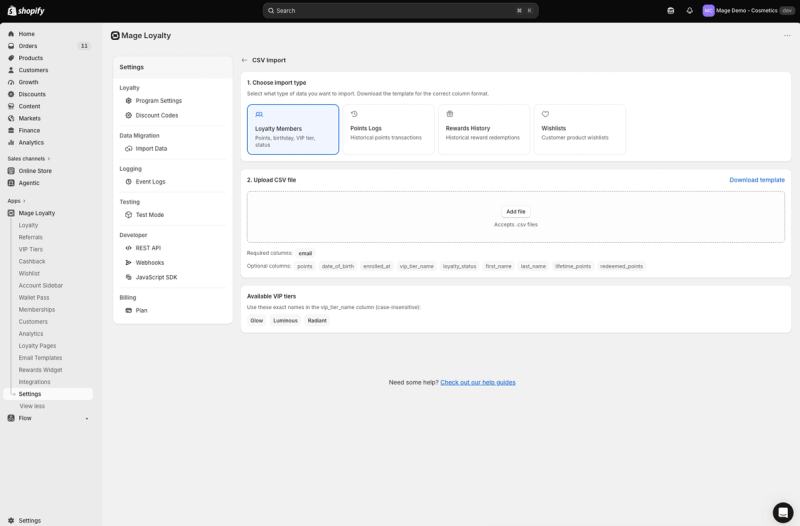
In Mage, create VIP tiers before importing members assigned to those tiers. Its Loyalty Members CSV import can import current balances, VIP tiers, birthdays, enrollment dates, member status, lifetime points, and redeemed points. Mage matches records to existing Shopify customers by email, so unmatched emails should be reviewed before launch.
Document edge cases and support responses
Create an internal matrix for pending rewards, refunded orders, expired points, customers close to a tier threshold, duplicate accounts, and login problems. Support should not decide the policy case by case after customers start asking.
If you preserve history in Mage, its Points Logs import adds positive historical earning activity without changing the current balance. The Loyalty Members import sets the balance. Imported activity tied to orders before migration is not automatically reversed if one of those old orders is refunded later, so assign an owner for manual corrections.
“I looked into so many different integrations for loyalty and referrals for our Shopify Store, but no one impressed me more than Mage on human connection, customer service, and value.”


Read the Reelie case study →
Rebuild enrollment around the moments customers already visit
Make the new program visible after purchase
Enrollment is not a one-time form. Customers should encounter the program after purchase, in post-purchase emails, in their account, on product pages, at checkout, and through storefront navigation.
Shopify customer accounts can provide order management, returns, subscriptions, loyalty points, store credit, and other self-service features through Shopify customer accounts. That makes the account area a useful place to explain the relaunch and show earned value.
Give existing members a reason to return
Segment the audience. Send different messages to active redeemers, members with balances who never redeemed, members who joined but never earned, lapsed repeat buyers, and VIP customers.
A relaunch incentive should reward a useful next action, such as completing an account, placing a second order, leaving a review, sharing a referral, or saving a product. Avoid incentives so large that the program only matters during the promotion.
Create a low-friction path for new members
New customers need a simple invitation, not a long explanation. Show what they can earn first and where they will see it.
With Mage, activate the loyalty program, Account Sidebar, and Rewards Widget before launch. Confirm the Mage app embed is enabled on the live theme. A dedicated loyalty page, floating widget, and account sidebar give customers more than one route to find their balance and rewards.
Mage Canvas can restyle loyalty, account, referral, wishlist, and saved-for-later surfaces without code. Use the same promise and visual language across each surface.
Build the go-to-market plan for a loyalty program relaunch
| Timing | Merchant action | Customer audience | Success check |
|---|---|---|---|
| Four weeks before launch | Finalize rules, balance policy, FAQs, support scripts, and baseline | Internal teams | Every edge case has an owner |
| One week before launch | Send continuity notice and prepare segments | Existing members | Messages explain balances and dates |
| Launch day | Activate storefront and send segmented announcements | Members first, then non-members | Balances and rewards display correctly |
| First 30 days | Run activation and review friction | Inactive and newly enrolled members | Engagement and redemption improve |
Four weeks before launch
Finalize the promise, earning rules, rewards, balance treatment, VIP policy, creative, FAQs, support responses, and reporting baseline.
Build your segments before the announcement. Shopify can create discounts for specific customer groups, which is useful when a relaunch offer should only reach members with unused balances or lapsed purchasers. See Shopify’s guidance on managing customer segments.
One week before launch
Tell existing members what is changing, what is staying, what happens to their balance, and the launch date. Do not make customers hunt for the balance policy in a footer.
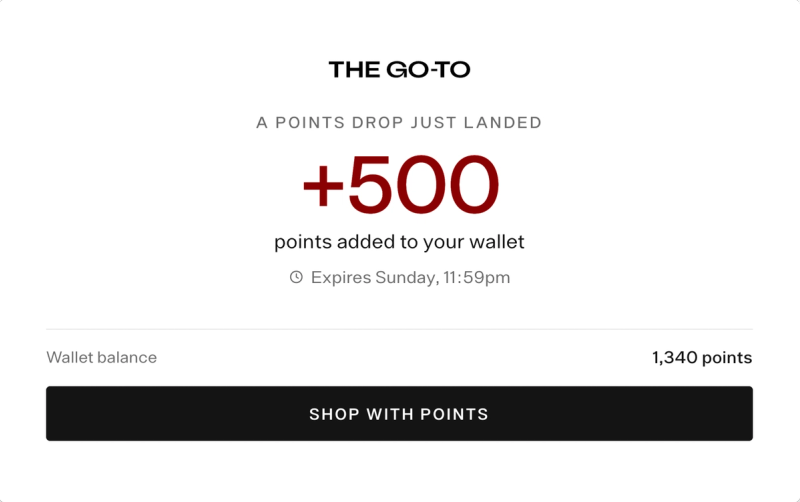
Prepare separate messages for VIPs, members with balances, inactive members, and customers who have never joined. Use loyalty email templates as a starting point, then rewrite them around your program’s actual promise.
Launch day
Send the primary announcement to existing members first. Then activate the storefront experience and communicate the program to recent purchasers and non-members.
Lead with value already available. A subject line about points, status, or a reward waiting in the account is more useful than an announcement that only promotes a new program name.
For targeted email and account links, a Klaviyo loyalty integration can sync loyalty data and events into the merchant’s existing marketing workflow. Use SMS only for customers with the appropriate marketing consent. Mage integrates with email and SMS platforms, but does not send SMS itself.
The first 30 days
Watch redemption errors, sign-in problems, reward availability, support questions, and unusual points activity during the first week. Then run a second activation for customers who saw the relaunch but did not engage.
Use the first 30 days to reinforce the clearest benefit and remind members how to use any value already available to them.
Test the relaunched program before exposing it to everyone
Test the customer journey end to end
Test account creation, sign-in, balance display, earning, reward claiming, checkout redemption, tier progress, and post-purchase communications. Test old members, new members, VIPs, customers with no balance, customers with pending rewards, and customers using different devices.
Confirm the old earning rules stop at the intended cutoff. Check cancellations, refunds, and partial refunds against the policy you published.
Use a controlled audience
Use internal accounts first, then a small customer group that knows it is testing a new experience. Do not test real communications unless the audience, consent, and message routing are controlled.
Mage Test Mode restricts earning, redemption, and integration events to customers on a selected test list. It can run on a live store, but non-test customers are silently blocked from program interactions while it is enabled. Review the Mage Test Mode guide before using it near a public launch.
Check the balance and reward logic
Verify imported balances against a sample of source records. Claim rewards, apply them at checkout, and inspect the resulting customer history.
Keep a written launch checklist and require sign-off from the person who owns loyalty, support, and storefront operations.
Measure whether the relaunch changed behavior
Track adoption and activation separately
New members are not necessarily engaged members. Measure program members added, active members, redeeming members added, rewards claimed, rewards used, and redemption rate.
Active members are especially useful because they earned points or redeemed a reward during the selected period. That tells you whether the program is being used, not merely joined.
Measure redemption and repeat purchasing
Review member repeat purchase rate, purchase frequency, AOV, and loyalty-attributed revenue. Track rewards claimed against rewards actually used, because a claimed reward that never reaches checkout may point to poor reward design or redemption friction.
Keep outstanding points balance in view as future reward liability, not revenue. A growing balance can mean healthy earning, but it can also mean members cannot find a worthwhile reason to redeem.
Review results by customer segment
Compare the relaunch with the old-program baseline using the same date windows where possible. Review the funnel in order: exposure, enrollment, first earning action, first claim, first redemption, second purchase, and repeat purchase over time.
Use segment-level reporting for VIPs, first-time buyers, lapsed members, and customers with legacy balances. Mage analytics includes Overview, Loyalty, VIP Tiers, Referrals, Wishlist, and Saved for Later reporting, depending on enabled features.
Set an operational review after the first month, then a strategic review after the next full buying cycle. The first review catches broken mechanics. The later review shows whether customer behavior changed.
FAQs
What is a loyalty program relaunch?
A loyalty program relaunch is a substantial improvement to an existing program that preserves member continuity where possible. A sunset ends the program, while a migration primarily changes the technology behind it.
When should you relaunch a loyalty program instead of replacing it?
Relaunch when existing member relationships, balances, customer data, or program recognition still have value. Replace or sunset it when the business model or core proposition has fundamentally changed.
What should you do with old loyalty points during a relaunch?
Preserve points, convert them transparently, offer a transition period, or add a conversion bonus. Publish the policy before launch and do not silently remove earned value.
How do you announce a loyalty program relaunch?
Start with existing members. Explain what changes, what stays, how balances and status are treated, and when the program begins, then tailor follow-up messages for key segments.
How do you get inactive loyalty members to rejoin?
Show inactive members their existing value and give them a useful next action. Shorten the path to a first reward and avoid relying on a generic discount or new program name alone.
How do you measure a loyalty program relaunch?
Measure active and redeeming members, redemption rate, rewards used, repeat purchase rate, purchase frequency, AOV, and loyalty-attributed revenue. Compare them with the prior baseline by customer segment.
A relaunch is worth doing when you can make the program clearer without making existing members feel reset. Preserve value, simplify the promise, test the journey, and judge the work by whether customers earn, redeem, and return more often.

Graeme is the co-founder at Mage Loyalty. He heads product development, from complex loyalty migrations and large-scale data handling to building the features shaping the future of loyalty on Shopify.