Second purchase rate is the percentage of first-time buyers who place a second order within a defined window. The job after order one is to create a relevant reason to return before reaching for a generic coupon.
Short answer: Calculate second purchase rate by first-order cohort, find the product-specific timing of second orders, then sequence education, account access, loyalty progress, replenishment, and targeted offers.
Start with second purchase rate, not blended repeat revenue
What second purchase rate measures
Second purchase rate tracks a customer’s movement from order one to order two. It is more useful than blended repeat revenue when diagnosing whether your first-order experience creates future demand.
A second order is a useful signal that the customer found enough value or relevance to return. Use cohort and customer data to investigate which factors contributed.
The formula and measurement window
Use this formula:
Customers with a second order within the window ÷ first-time customers in the cohort × 100
If 500 customers placed their first order in March and 110 placed another order within 90 days, your 90-day second purchase rate is 22%.
State the window every time. A 30-day rate and a 90-day rate answer different questions.
Second purchase rate versus repeat purchase rate and retention rate
Shopify defines repeat customer rate as repeat-purchase customers divided by unique customers, which is useful for a broad store view but mixes customers at different stages of their relationship with you. Shopify’s retention guidance uses that broader definition.
Second purchase rate isolates the first repeat conversion. Retention rate can refer to several measurements depending on the business, including whether customers remain active over a period.
Why cohort analysis matters
Build cohorts by first-order month, acquisition source, first product, discount status, geography, and customer type. Shopify recommends comparing cohorts by first-order month and reviewing the time between first and second orders. Shopify’s customer attrition guidance supports this approach.
For a fuller framework, see how to increase repeat revenue after the first purchase.
Find the repeat purchase window before you write the sequence
| First product or category | Expected repeat occasion | Median days to second order | 30-day second purchase rate | 90-day second purchase rate | Primary post-purchase message |
|---|---|---|---|---|---|
| Consumable product | Replenishment | Your data | Your data | Your data | Usage and reorder timing |
| Skincare routine item | Replenishment or routine expansion | Your data | Your data | Your data | Results, usage, then next step |
| Apparel | New drop or complementary item | Your data | Your data | Your data | Styling and relevant collection |
| Jewelry | Gifting, anniversary, or status | Your data | Your data | Your data | Care, gifting, and VIP progress |
| Durable home product | Complementary purchase | Your data | Your data | Your data | Setup, care, and related items |
Why the average window is not your window
A generic day-30 email is easy to schedule and often poorly timed. Coffee, supplements, and skincare may have a short replenishment cycle. Jewelry or a large home item may not.
Calculate the median time to second order and cumulative second-order conversion at 30, 60, and 90 days for each meaningful product group.
A July 2026 DTC analysis of 40,397 repeat buyers found that 50.3% of second orders occurred within 30 days and 76.4% occurred within 90 days. That is not a Shopify benchmark or a target for your store.
Use product consumption and first-order data together
The first product purchased should determine the path. Consumables need reorder-led messaging. Durable goods need onboarding first, then complementary products, gifting, referral, or status reasons to revisit.
A food and beverage loyalty program can pair low redemption thresholds with reorder incentives, but timing still needs to match actual consumption.
Build a 30-, 60-, and 90-day view
Review three views for every cohort:
- The share placing order two by day 30, 60, and 90.
- The median number of days between first and second orders.
- The products customers buy on their second order.
Use the earliest meaningful conversion point as your main intervention window.
Make the first order earn the second one
Confirm the product decision
The first post-purchase message should confirm the customer made a good choice. Tell them what happens next, when to expect delivery, and how to get the intended result from the product.
Customers who are confused about use, setup, care, fit, or timing are poor candidates for a cross-sell message.
Reduce uncertainty after purchase
For consumables, explain how to use the product and what signals indicate it is time to replenish. For durable products, wait until the customer has received and understood the purchase before presenting complementary items.
Use product-specific content. The item a customer chose is a better signal than a generic catalog recommendation.
Ask for the next action at the right moment
Ask for a review after the customer has had time to form an opinion. Ask for a referral after the product has delivered enough value that recommending it feels credible.
Mage can award points for purchases, signups, reviews, referrals, birthdays, wishlist actions, and other configured actions. Reward actions that help customers get more from the product or build a useful relationship with your store.
Enroll first-time buyers into loyalty without adding checkout friction
What enrollment should give the customer
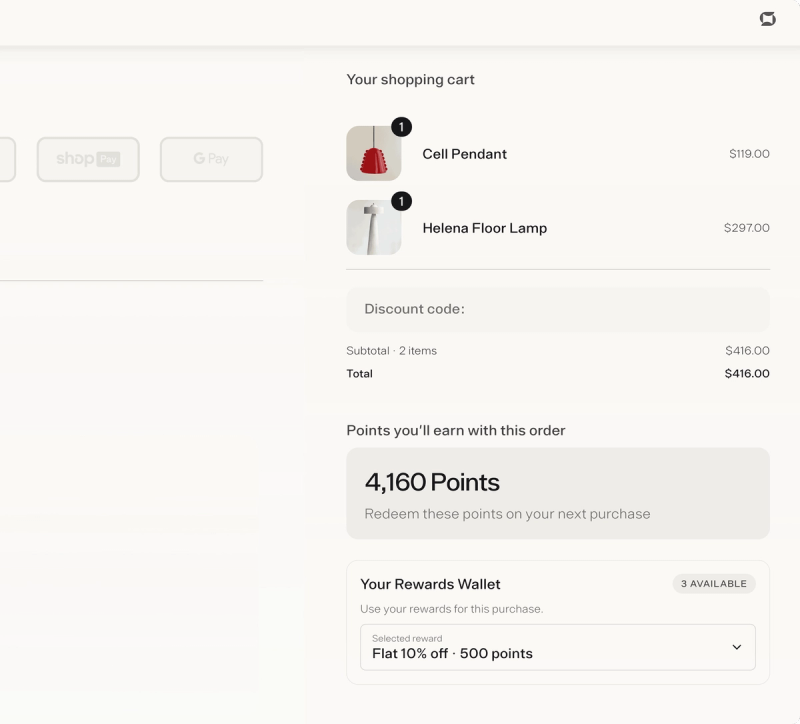
Enrollment matters when customers can see what they received and what they can do next. A useful first-order experience gives them a balance, a clear reward threshold, and a place to return.
That could be an account area, a loyalty page, or an on-site widget.
Use account creation as a retention bridge
After an order, Shopify adds customer details to the customer list. Customer accounts can give shoppers access to saved address information and order history. Shopify’s customer documentation explains those account foundations.
Use account activation as the next action after purchase. Explain the benefit: view the order, see earned points, save products, or access rewards.
Mage can reward account creation with a Signup Bonus. Its account sidebar, loyalty page, and Rewards Widget can show points and available rewards. A Shopify loyalty program can make the second order feel like progress toward something.
Show progress before asking for another purchase
Shopify’s checkout and accounts editor supports branding and apps on checkout and customer account pages. Shopify’s checkout customization guidance outlines those surfaces.
A practical enrollment flow is simple:
- Explain the account or loyalty benefit after purchase.
- Show the first reward milestone and balance once points are awarded.
- Send customers to an account or loyalty destination.
- Avoid a forced, lengthy registration flow.
“I looked into so many different integrations for loyalty and referrals for our Shopify Store, but no one impressed me more than Mage on human connection, customer service, and value.”


Read the Reelie case study →
Build the 0- to 90-day post-purchase sequence
| Timing | Customer state | Message objective | Recommended action | Offer or loyalty mechanic | Exit condition |
|---|---|---|---|---|---|
| Day 0 | Order placed | Set expectations | Confirm order and account value | Explain how purchase points will be awarded after the order is completed | Customer places order two |
| Days 3 to 7 | Awaiting or receiving order | Improve product adoption | Send usage, setup, or care guidance | None | Customer places order two |
| Days 7 to 21 | Product experienced | Gather proof and show progress | Request review or feedback | Points for eligible review action | Customer places order two |
| Days 21 to 45 | Approaching repeat occasion | Create relevance | Reorder reminder or relevant cross-sell | Points balance, VIP progress | Customer places order two |
| Days 45 to 90 | No second order | Reactivate selectively | Referral, targeted offer, or campaign | Flexible reward, points campaign, or offer | Customer purchases or exits window |
Day 0: confirmation and expectation setting
Send the order confirmation and delivery expectations. Include one clear next action, such as activating an account or explaining how purchase points will be awarded after the order is completed.
Days 3 to 7: activation and product education
Send content that makes the first purchase work: usage instructions, routines, care guidance, fit advice, or troubleshooting.
For replenishable items, introduce the expected usage cycle without sending the reorder message prematurely.
Days 7 to 21: proof, review, and loyalty progress
Request feedback once the product has had time to prove itself. Where appropriate, reward a review or photo and video contribution, then show progress toward a reward or tier milestone.
Mage’s Klaviyo loyalty integration can sync loyalty properties and events to profiles while marketing messages continue through the connected email or SMS platform.
Days 21 to 45: reorder or relevant next product
Customers who bought replenishable products should receive a reorder-led message near their observed consumption window. Customers who bought durable products may receive a complementary product, a saved-item prompt, or a status-led reason to return.
Mage’s Purchase earning rule can award points at a configured rate after completed orders, and customers can use qualifying rewards at Shopify checkout without copying a code.
Days 45 to 90: targeted offer, referral, or reactivation
Reserve monetary incentives for customers who have not purchased and have a plausible reason to return.
Shopify Messaging supports post-purchase email automations, and Shopify Flow can support custom or third-party workflows. Shopify’s automation documentation covers both options.
Shop post-purchase offers are one discount-led option. Shopify allows one active post-purchase offer at a time and reports recipients, orders, and associated sales on a rolling 30-day basis. Shopify’s post-purchase offer documentation explains the constraint.
Sequence offers without discounting immediately
Use a value ladder instead of a coupon ladder
Use this order: product education, account or loyalty enrollment, visible progress, a relevant reorder or next product, then a targeted monetary incentive.
A blanket discount immediately after order one can tell customers that waiting may be rewarded. Read more about discounts versus points before treating discounts as the default retention tool.
When points or store credit make more sense
Points work when you want customers to see an ongoing reason to take several actions over time. Mage can show progress in the account or Rewards Widget, then let logged-in customers use a Flexible Redemption block to redeem a selected amount of points for a checkout discount.
Store credit or cashback can create a clear return reason, but terms matter. Cashback can be issued as store credit or a discount code after a qualifying order, with a configurable approval period and conditions.
When to use cashback, VIP status, or referrals
Use VIP progress or early access when status and access fit the category. Use referrals after customers have experienced the product and can credibly recommend it.
A directional 2026 DTC analysis found that 77% of second purchases were reorders of the same product. Category behavior varies, but it is a reason to test replenishment relevance before elaborate cross-sell campaigns.
For more non-discount mechanisms, review these loyalty campaigns that drive revenue without discounting.
Protect contribution margin
Evaluate the second order after discount cost, shipping cost, returns, product margin, and any loyalty liability. A higher conversion rate from unprofitable orders is not an improvement.
Measure the second purchase system and improve it every cohort
| Metric | Formula or definition | Why it matters | Useful segment | Warning sign |
|---|---|---|---|---|
| Second purchase rate | Cohort customers with order two divided by all first-time cohort customers | Measures first repeat conversion | First product and acquisition source | Strong total rate, weak new cohorts |
| Time to second purchase | Days from order one to order two | Sets message timing | Product category | Offer arrives before demand |
| Second-order revenue | Revenue from customers’ second orders | Shows order value | Loyalty enrolled versus not enrolled | Conversion rises while revenue falls |
| Contribution margin | Second-order revenue less product, shipping, return, and incentive costs | Tests profitability | Offer type | Coupon redemption exceeds margin |
| Unsubscribe rate | Opt-outs after each message | Detects poor timing or relevance | Sequence step | Spike after promotion |
The dashboard to build
Track second purchase rate at 30, 60, 90, and 365 days where sample size supports it. Add time to second purchase, second-order revenue, average order value, refund rate, contribution margin, and unsubscribe rate.
Shopify Analytics can show first-time versus returning sales, cohort analysis, and repeat purchase behavior by acquisition period. Shopify’s acquisition guide describes these reporting views.
If you want to build the loyalty layer described here, explore Mage’s Shopify loyalty program or book a demo.
Separate conversion from profitability
Compare loyalty-enrolled customers with customers who were not enrolled, while controlling for acquisition source and first product. Compare reorder-led messages against cross-sell-led messages within the same product category.
The success metric is profitable second-order conversion.
Run one controlled test at a time
Test timing before increasing incentive size. Keep education and replenishment messaging constant for a control group, then give the variant account activation and loyalty progress messaging. Hold a monetary offer until the final stage.
Frequently asked questions
What is second purchase rate?
Second purchase rate is the percentage of first-time buyers who place a second order within a specified measurement window. Calculate it by cohort and label the window clearly.
How do you calculate second purchase rate?
Divide customers who placed a second order within the chosen window by all first-time customers in that cohort, then multiply by 100. Use the same first-order definition, window, and exclusions each time.
When do most second purchases happen?
Second purchases happen on a schedule set by product use, replenishment needs, and buying occasion. One directional DTC analysis found that 50.3% occurred within 30 days and 76.4% within 90 days, but your store should calculate its own cohort curve.
What is a good second purchase rate for Shopify?
A good second purchase rate depends on product frequency, category, acquisition mix, measurement window, and contribution margin. Compare current cohorts against prior cohorts with the same products and channels.
Should I offer a discount after the first purchase?
A discount after the first purchase should be targeted, not automatic. Start with product education, account access, visible loyalty progress, and a relevant reorder or next-product message.
How can I convert one-time buyers into repeat customers?
Measure first-order cohorts, identify the repeat window for each product, and send product-specific post-purchase messages. Add an account or loyalty destination, show progress toward a reward, prioritize reorders for replenishable products, and test incentives after relevance and timing are established.
Build the system around the first product and the customer’s actual repeat window. If your cohort data says customers reorder, make reordering easy. If they need more time, educate them and show meaningful progress.

Kris is the co-founder of Mage Loyalty. I spend most days talking to merchants, shipping features, and making sure our customers get real results. If you run a Shopify store or Agency we should chat!